
Potsdam
Zur Historischen Mühle 1, 14469 Potsdam, Deutschland
Park Sanssouci | Opening Hours & Free Admission
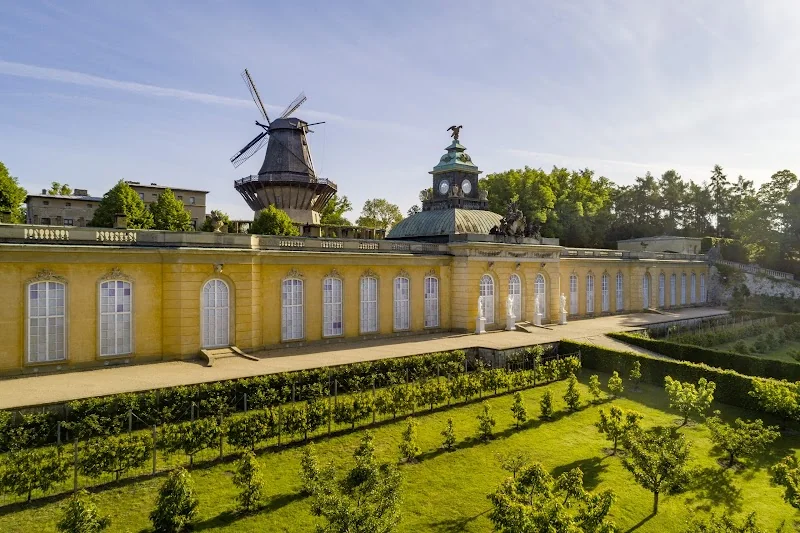
The Park Sanssouci is not just a green space surrounding a famous palace, but a self-contained total work of art made up of garden art, architecture, sightlines, water features, and sculptures. Those who stroll here move through a landscape that has been consciously designed, expanded, and maintained for over 250 years. Frederick the Great had the vineyard terraces laid out starting in 1743, creating the core of a place that combines tranquility, representation, and personal retreat. Later, Frederick William IV significantly expanded the garden between the private Sanssouci Palace and the New Palace, connecting it with a landscape park, neoclassical buildings, and romantic details. Today, Sanssouci is part of the UNESCO World Heritage and one of the most famous park ensembles in Europe. With around 300 hectares of area, an east-west extension of more than two kilometers, and an enormous density of historical buildings, the park is a destination for those seeking not only beautiful photos but also history, orientation, expansiveness, and genuine atmosphere. ([spsg.de](https://www.spsg.de/en/palaces-gardens/object/sanssouci-park))
Opening Hours, Free Admission, and What’s Important Today
For many visitors, the most important question is quite simple: Is the park open, how long can I stay, and does it cost anything? The clear answer from SPSG is: The Park Sanssouci is open daily from 8 a.m. until dusk, and admission to the park is free. This makes it one of the most attractive excursion destinations in Potsdam, as a visit can be planned spontaneously without having to buy a ticket in advance. At the same time, one should distinguish between the park itself and the buildings within the park. The park is freely accessible, but individual palaces, exhibition rooms, or attractions may have their own opening hours or may be temporarily closed due to renovation work. Currently, the Orangery Palace and the Roman Baths are marked as closed for renovation on the SPSG site. Additionally, during storm or severe weather warnings, park facilities may be closed as a precaution. So, anyone searching with the keywords “closed” or “blocked” should keep in mind: The park is generally open, but individual areas or paths may be temporarily inaccessible. The park regulations also make it clear that the visit is at one’s own risk and that the protection of the garden monument has the highest priority. This particularly concerns paths, lawns, sculptures, and the sensitive garden areas. Because Sanssouci is a historical park and not an ordinary city park, it is worth checking the official notices before visiting. This way, you can avoid disappointments and plan your day more relaxed, especially if you have specific buildings, photo spots, or paths in mind for your route. ([spsg.de](https://www.spsg.de/parkordnung-sanssouci))
The advantage of free accessibility is particularly evident in the flexibility: You can come for a quiet morning walk, take a longer round in the afternoon, or enjoy the evening light over the terraces. For search queries like “open,” “free,” or “admission,” it is important to note that the park itself is not a classic ticket product. Tickets become relevant mainly when you enter buildings, participate in guided tours, or plan combined visits. The visitor center at the Historical Mill assists with ticket sales, information, and service offerings. However, those who are only in the park usually do not need an admission ticket. For route planning, it is also helpful that the facility is divided into three elevation levels. This quickly clarifies why the park, while open, still appears large for a short visit: The paths are long, the ascents are sometimes noticeable, and the individual attractions are spread out over the grounds. For a pure walk, a short round is sufficient; however, if you want to connect Sanssouci Palace, the Great Fountain, the New Palace, and Charlottenhof in one day, you should plan several hours. ([spsg.de](https://www.spsg.de/parkordnung-sanssouci))
Park Map, Size, and the Most Important Paths in Sanssouci Park
The search queries “plan,” “map,” and “size” show very well how visitors truly experience Park Sanssouci: not as a compact individual monument, but as an expansive landscape with many levels, paths, and sections. SPSG states the area as nearly 300 hectares; additionally, an east-west axis of more than two kilometers runs through the park. This means in practice: Sanssouci is large enough for half or a whole day, but at the same time so clearly structured that one can be very targeted with a good plan. The historical facility is organized into three elevation levels. Below lie large parts of the park around the Peace Church, Chinese House, Main Avenue, New Palace, and Charlottenhof. In the middle level are, among others, the New Chambers, Sanssouci Palace, and the visitor center at the Historical Mill. At the top, you reach the areas around the Orangery Palace and the Belvedere on Klausberg. Those visiting the park for the first time benefit enormously from a map, as the topography shapes the walk. SPSG also explicitly refers to a park map with service information, a barrier-free route, and an app that helps in discovering the park. This allows the facility to be explored not only beautifully but also efficiently. Particularly helpful are the travel times noted on the official map: From Sanssouci Palace to the Great Fountain to the New Palace is about 2.0 kilometers or around 25 minutes; from the visitor center at the Historical Mill over the Great Fountain to the visitor center at the New Palace is about 2.4 kilometers and around 31 minutes. Such information helps with realistic day planning much more than any rough estimate. ([spsg.de](https://www.spsg.de/en/palaces-gardens/object/sanssouci-park))
The map is not only important for orientation but also for content selection. Sanssouci does not consist of a single “main attraction,” but of several interconnected zones. Those who want to see the famous terraces usually start at Sanssouci Palace and the Great Fountain. Those more interested in architecture and contrasts can add the New Palace, the colonnades with the triumphal arch, and the temple of antiquity. Those seeking the romantic or Italian-influenced part of the park can choose Charlottenhof, the Roman Baths, the Chinese House, or the Orangery Palace. The official service map also marks practical points such as the visitor center, toilets, restaurant, café, or museum shop. This is where the real added value of a good park plan comes from: It not only helps with walking but also with conscious decision-making. Families, older visitors, and people with little time can thus avoid walking the same paths twice. Orientation is also helpful for photographers, as some groups of motifs lie on different levels, and the light changes significantly depending on the time of day. Those who arrive early can take advantage of the greater tranquility in the upper or middle areas; those who are out in the afternoon often have particularly beautiful perspectives at the terraces and the fountain. The park map is therefore not just an additional document but practically the key to the visit. ([spsg.de](https://www.spsg.de/fileadmin/user_upload/pdf/Service-Maps/SPSG-Service-Map-Park-Sanssouci-DE.pdf))
Arrival, Train Station, and Parking at Park Sanssouci
For such a large park, the arrival is almost as important as the actual route inside. SPSG names several very useful stops for arriving by public transport: Potsdam, Sanssouci Palace; Potsdam, New Palace; Potsdam, Charlottenhof Palace; as well as Potsdam, Luisenplatz-North/Park Sanssouci. Additionally, the visitor center at the Historical Mill is mentioned as a well-located service point, and on the SPSG pages, there is also a note about the Park Sanssouci train station in close proximity. So, anyone specifically searching for “train station” will actually find several practical reference points around the park. Access via Luisenplatz is particularly convenient, as barrier-free stops and nearby parking options are also mentioned there. Important for drivers: SPSG refers to paid parking spaces for cars and buses at parking lot P1 at the Historical Mill and at P3 at the New Palace. The barrier-related notes also mention disabled parking spaces in the Luisenplatz parking garage and at the New Palace. This allows for a fairly precise decision about which access point fits the planned route before arrival. Those wanting to visit Sanssouci Palace often approach differently than someone who wants to see the New Palace or Charlottenhof first. That is exactly why the keyword complex “train station,” “parking,” and “map” is so closely linked: Sanssouci is large and has several sensible entrances, not just one main access. The official park map also names the entrances Green Gate, Charlottenhof, Cow Gate, and Monkey Path, Peace Church, and Obelisk. This is helpful for visitors with little local knowledge, as it allows them to clearly define their starting point. Those arriving by train should ideally plan in advance whether to use the Green Gate side, the area of the Historical Mill, or the station at the New Palace as their entry point. This saves time and energy and avoids unnecessary loops. ([spsg.de](https://www.spsg.de/schloesser-gaerten/objekt/park-sanssouci/))
Another practical advantage is the free shuttle service from SPSG. Between the Green Gate and the New Palace, a free shuttle service runs daily from April to October from 11 a.m. to 5:30 p.m. This is particularly interesting for visitors who do not want to walk through the entire park or want to avoid longer ascents. However, SPSG points out that the service is not always available and may be canceled in heavy rain. This is also a typical example of how Sanssouci functions: The park is very well developed but remains a historical landscape with seasonal and weather-dependent peculiarities. Those who truly want to experience the park area in peace can view the shuttle as a complement, not as a substitute for good route planning. Especially in summer heat or with children, this can be a real advantage. At the same time, the distance between central points is often greater than expected, which is why the combination of public transport, a sensible entry point, and a look at travel times is the best strategy. So, if you search for “Park Sanssouci train station” or “Park Sanssouci parking,” the short answer is: There are several suitable stops, official parking spaces, and a seasonal shuttle service, making the park very accessible even without local knowledge. ([spsg.de](https://www.spsg.de/schloesser-gaerten/objekt/park-sanssouci/))
Dogs, Bicycles, and the Park Regulations in Everyday Life
The park regulations are not a minor issue at Sanssouci but part of the visitor experience. This has a simple reason: The park is not just an attractive green space but a sensitive monument area with historical paths, sculptures, water features, and well-maintained garden sections. Therefore, it is important to know what is allowed and what is not. Dogs are generally welcome but must be kept on a short leash; dog waste must also be removed immediately. Bicycles may not be parked freely in the park or moved over all paths but only on the designated bicycle paths. Outside of these marked paths, bringing, riding, or parking bicycles is prohibited. Also prohibited are leaving the paths, climbing on structures and sculptures, barbecuing, camping, playing music, ball games, swimming in bodies of water, horseback riding, and much more. These rules may seem strict at first glance, but they are exactly what protects the historical character of the park. Those searching for “dogs” and “bicycles” are essentially looking for everyday usability: Can I walk my dog comfortably? Can I traverse the park by bike? The answer is: yes, but with clear boundaries and consideration for the monument. Additionally, the park is only open from 8 a.m. until dusk, and entry is at one’s own risk. This also answers the keyword “open” well, while “closed” and “blocked” become especially important in cases of temporary changes. SPSG informs separately in such cases, for example, when paths are restricted due to construction work or when weather conditions necessitate a precautionary closure. This occurred, for example, with temporary partial closures at the intersection of Ökonomieweg and Am Grünen Gitter, as well as precautionary closures of the park facilities during storm warnings. This means for visitors: The park is generally open, but it is worth taking a quick look at the current notices, especially in bad weather or during major renovation work. ([spsg.de](https://www.spsg.de/parkordnung-sanssouci))
Especially for families, cyclists, or dog owners, this clarity is a plus. You already know before entering which paths work and where consideration is needed. The official service plan also points out that there is a designated bicycle route and that cycling outside these paths is not allowed. The PDF from SPSG even explicitly states that cycling in Park Sanssouci is prohibited and only the paved Ökonomieweg is designated as a bike path. This is important because Sanssouci is often underestimated as a relaxed excursion destination: Especially in heavily frequented areas, the paths are not designed for free cycling. Those walking with dogs should respect the leash requirement just as naturally as the fact that plants, water areas, and sculptures are protected components of the ensemble. Commercial tours, advertising measures, and other special uses also require permission. The park is thus friendly open but not arbitrary. This balance is what gives the place its special quality. In SEO terms, people often speak of “closed,” although they actually mean that individual buildings are not accessible. Here, a differentiated view helps: The park as a whole usually remains open, while individual areas, buildings, or paths may be temporarily restricted due to renovation, danger, or weather. Those who prepare for this will experience Sanssouci much more relaxed. ([spsg.de](https://www.spsg.de/fileadmin/user_upload/pdf/Service-Maps/SPSG-Service-Map-Park-Sanssouci-DE.pdf))
Photos, Highlights, and the Most Famous Motifs in the Park
The keyword “photos” is no coincidence at Park Sanssouci. The park is one of the most photogenic landscapes in Germany because it offers more than just individual beautiful buildings. The charm arises from the interplay of terraces, perspectives, water, sculptures, plants, and historical architecture. Those who photograph here find several strong motifs: the vineyard terraces at Sanssouci Palace, the Great Fountain in the center, the view along the main axis to the New Palace, the Chinese House, the Roman Baths, the Orangery Palace, the Belvedere on Klausberg, the Historical Mill, and the vast meadows and garden areas. SPSG also points out more than 1,000 sculptures in the park, which, together with the architectural focal points, create an astonishingly dense visual world. Additionally, the parterre at the foot of Sanssouci Palace is designed with more than 230,000 plants and is rearranged twice a year according to historical models, according to SPSG. So, those searching for the most beautiful photos should not only think of a single spot location but of a sequence of motifs that change throughout the day. In the morning, the terraces and long axes often appear calmer, at noon the green shines stronger, and in the evening light, the buildings and groups of trees take on an almost cinematic effect. The official image series from SPSG shows exactly this variety, from the chestnut blossom through the Marly Garden to aerial shots overlooking the terraces at Sanssouci Palace. This makes the park interesting not only for amateur photographers but also for visitors who simply want to take beautiful impressions home. With a facility of this size, it is advisable not to focus on a single viewpoint but to take time for several perspectives. This way, a simple round becomes a real walk through different moods. ([spsg.de](https://www.spsg.de/en/palaces-gardens/object/sanssouci-park))
Historically, Sanssouci is as exciting as it is visually. The name stands for Frederick's desire for a place without worry, and this feeling can still be felt today in the differently composed areas of the park. The French pleasure garden idea of the 18th century combines here with the picturesque landscape park of the 19th century. This mixture makes the facility not only beautiful but also rich in content: One does not just see a garden but staging, power, taste, and zeitgeist. Sanssouci Palace itself is closely associated with Frederick the Great, who is said to have preferred to retreat here with his dogs. Later, expansions were added that extended the park towards the New Palace, Charlottenhof, and other ensembles. For visitors, this means: There is not just one famous palace motif, but a whole chain of highlights that complement each other. Those searching for photos for social media, travel reports, or personal memories will find motifs for every mood here: majestic at the fountain, romantic in the rose garden, classic at the picture gallery, Italian at the Roman Baths, or wide and scenic at the New Palace. This diversity is the reason why Sanssouci has been one of the most photographed park facilities in the country for decades. And that is why it is worth not choosing the route too hastily but giving the park a bit of time. Because the strongest photos are usually taken here when you do not just walk quickly by but consciously stop. ([spsg.de](https://www.spsg.de/schloesser-gaerten/objekt/schloss-sanssouci?utm_source=openai))
Cafés, Visitor Center, and Practical Tips for the Visit
Those planning a longer visit to Park Sanssouci should not only think about paths and motifs but also about breaks, services, and orientation. For this, the visitor center at the Historical Mill is the most important point of contact. SPSG describes it as a place where you can prepare for or conclude your visit to the park and Sanssouci Palace. There are tickets available, including combination tickets and annual passes, as well as event tickets. An interactive touch table and a barrier-free bronze model of the park help to better understand the facility even before entering the grounds. This is what makes the place so useful: It is not just a ticket office but also an information center. For the keyword “café,” the gastronomic surroundings are also interesting. SPSG mentions several dining options in the immediate vicinity, including Café Caroline in the visitor center at the New Palace, the theater lodge near the Green Gate, Augustiner at the Bürgerbahnhof next to the Park Sanssouci train station, Café Repin near the picture gallery and Sanssouci Palace, the Dragon House Restaurant & Café between the Paradise Garden and the Belvedere on Klausberg, Lottenhof or Bill's Kitchen near Charlottenhof Palace, and Zur Historischen Mühle near Sanssouci Palace. So, if you are looking for a coffee, a light meal, or a break after your walk, you will find several suitable addresses in and around the park. This is practical because Sanssouci is large enough to fill an entire morning or afternoon. The free shuttle service is also valuable for daily planning: It connects the Green Gate and the New Palace from April to October daily between 11 a.m. and 5:30 p.m. This makes it more comfortable to bridge the distance between the two main sides of the park if you do not want to walk the entire way. For visitors with mobility restrictions, SPSG also refers to a barrier-free route, barrier-free toilets at several locations, and the fact that the park is situated on three elevation levels. This is honest, useful information: Sanssouci is not equally accessible everywhere but offers good assistance for a meaningful tour. ([spsg.de](https://www.spsg.de/schloesser-gaerten/objekt/besuchszentrum-an-der-historischen-muehle))
A final practical tip concerns the right expectations for the visit. Park Sanssouci is large, historical, and very well maintained, but it is not a theme park with a consistently flat, uniform round path. The elevation differences are real, the distances are noticeable, and not all buildings are accessible at all times. That is why a well-chosen route is more worthwhile than a full program plan. Those with little time should focus best on Sanssouci Palace, the Great Fountain, the parterre, and the Historical Mill. Those planning half a day can add the New Palace or Charlottenhof. Those wanting to understand the entire park should take in the three levels and distribute their energy sensibly. The official app and the service map support this, as does the signage on-site. Thus, a simple search for “park sanssouci plan” or “park sanssouci café” becomes a real advantage in orientation. Because in the end, Sanssouci is most beautiful when you do not just look at the famous facade but understand the facility as a landscape: as a place for walking, seeing, resting, and discovering. This is where the strength of this park lies. It works as a short visit, as a day trip, and as a recurring destination alike. And it remains a place where history is not dismissed but can be experienced directly. Those who take the time for it will experience Potsdam's most famous park not just as a sight but as a coherent, calm, and surprisingly diverse world for themselves. ([spsg.de](https://www.spsg.de/fileadmin/user_upload/pdf/Service-Maps/SPSG-Service-Map-Park-Sanssouci-DE.pdf))
Sources:
Show moreShow less
Park Sanssouci | Opening Hours & Free Admission
The Park Sanssouci is not just a green space surrounding a famous palace, but a self-contained total work of art made up of garden art, architecture, sightlines, water features, and sculptures. Those who stroll here move through a landscape that has been consciously designed, expanded, and maintained for over 250 years. Frederick the Great had the vineyard terraces laid out starting in 1743, creating the core of a place that combines tranquility, representation, and personal retreat. Later, Frederick William IV significantly expanded the garden between the private Sanssouci Palace and the New Palace, connecting it with a landscape park, neoclassical buildings, and romantic details. Today, Sanssouci is part of the UNESCO World Heritage and one of the most famous park ensembles in Europe. With around 300 hectares of area, an east-west extension of more than two kilometers, and an enormous density of historical buildings, the park is a destination for those seeking not only beautiful photos but also history, orientation, expansiveness, and genuine atmosphere. ([spsg.de](https://www.spsg.de/en/palaces-gardens/object/sanssouci-park))
Opening Hours, Free Admission, and What’s Important Today
For many visitors, the most important question is quite simple: Is the park open, how long can I stay, and does it cost anything? The clear answer from SPSG is: The Park Sanssouci is open daily from 8 a.m. until dusk, and admission to the park is free. This makes it one of the most attractive excursion destinations in Potsdam, as a visit can be planned spontaneously without having to buy a ticket in advance. At the same time, one should distinguish between the park itself and the buildings within the park. The park is freely accessible, but individual palaces, exhibition rooms, or attractions may have their own opening hours or may be temporarily closed due to renovation work. Currently, the Orangery Palace and the Roman Baths are marked as closed for renovation on the SPSG site. Additionally, during storm or severe weather warnings, park facilities may be closed as a precaution. So, anyone searching with the keywords “closed” or “blocked” should keep in mind: The park is generally open, but individual areas or paths may be temporarily inaccessible. The park regulations also make it clear that the visit is at one’s own risk and that the protection of the garden monument has the highest priority. This particularly concerns paths, lawns, sculptures, and the sensitive garden areas. Because Sanssouci is a historical park and not an ordinary city park, it is worth checking the official notices before visiting. This way, you can avoid disappointments and plan your day more relaxed, especially if you have specific buildings, photo spots, or paths in mind for your route. ([spsg.de](https://www.spsg.de/parkordnung-sanssouci))
The advantage of free accessibility is particularly evident in the flexibility: You can come for a quiet morning walk, take a longer round in the afternoon, or enjoy the evening light over the terraces. For search queries like “open,” “free,” or “admission,” it is important to note that the park itself is not a classic ticket product. Tickets become relevant mainly when you enter buildings, participate in guided tours, or plan combined visits. The visitor center at the Historical Mill assists with ticket sales, information, and service offerings. However, those who are only in the park usually do not need an admission ticket. For route planning, it is also helpful that the facility is divided into three elevation levels. This quickly clarifies why the park, while open, still appears large for a short visit: The paths are long, the ascents are sometimes noticeable, and the individual attractions are spread out over the grounds. For a pure walk, a short round is sufficient; however, if you want to connect Sanssouci Palace, the Great Fountain, the New Palace, and Charlottenhof in one day, you should plan several hours. ([spsg.de](https://www.spsg.de/parkordnung-sanssouci))
Park Map, Size, and the Most Important Paths in Sanssouci Park
The search queries “plan,” “map,” and “size” show very well how visitors truly experience Park Sanssouci: not as a compact individual monument, but as an expansive landscape with many levels, paths, and sections. SPSG states the area as nearly 300 hectares; additionally, an east-west axis of more than two kilometers runs through the park. This means in practice: Sanssouci is large enough for half or a whole day, but at the same time so clearly structured that one can be very targeted with a good plan. The historical facility is organized into three elevation levels. Below lie large parts of the park around the Peace Church, Chinese House, Main Avenue, New Palace, and Charlottenhof. In the middle level are, among others, the New Chambers, Sanssouci Palace, and the visitor center at the Historical Mill. At the top, you reach the areas around the Orangery Palace and the Belvedere on Klausberg. Those visiting the park for the first time benefit enormously from a map, as the topography shapes the walk. SPSG also explicitly refers to a park map with service information, a barrier-free route, and an app that helps in discovering the park. This allows the facility to be explored not only beautifully but also efficiently. Particularly helpful are the travel times noted on the official map: From Sanssouci Palace to the Great Fountain to the New Palace is about 2.0 kilometers or around 25 minutes; from the visitor center at the Historical Mill over the Great Fountain to the visitor center at the New Palace is about 2.4 kilometers and around 31 minutes. Such information helps with realistic day planning much more than any rough estimate. ([spsg.de](https://www.spsg.de/en/palaces-gardens/object/sanssouci-park))
The map is not only important for orientation but also for content selection. Sanssouci does not consist of a single “main attraction,” but of several interconnected zones. Those who want to see the famous terraces usually start at Sanssouci Palace and the Great Fountain. Those more interested in architecture and contrasts can add the New Palace, the colonnades with the triumphal arch, and the temple of antiquity. Those seeking the romantic or Italian-influenced part of the park can choose Charlottenhof, the Roman Baths, the Chinese House, or the Orangery Palace. The official service map also marks practical points such as the visitor center, toilets, restaurant, café, or museum shop. This is where the real added value of a good park plan comes from: It not only helps with walking but also with conscious decision-making. Families, older visitors, and people with little time can thus avoid walking the same paths twice. Orientation is also helpful for photographers, as some groups of motifs lie on different levels, and the light changes significantly depending on the time of day. Those who arrive early can take advantage of the greater tranquility in the upper or middle areas; those who are out in the afternoon often have particularly beautiful perspectives at the terraces and the fountain. The park map is therefore not just an additional document but practically the key to the visit. ([spsg.de](https://www.spsg.de/fileadmin/user_upload/pdf/Service-Maps/SPSG-Service-Map-Park-Sanssouci-DE.pdf))
Arrival, Train Station, and Parking at Park Sanssouci
For such a large park, the arrival is almost as important as the actual route inside. SPSG names several very useful stops for arriving by public transport: Potsdam, Sanssouci Palace; Potsdam, New Palace; Potsdam, Charlottenhof Palace; as well as Potsdam, Luisenplatz-North/Park Sanssouci. Additionally, the visitor center at the Historical Mill is mentioned as a well-located service point, and on the SPSG pages, there is also a note about the Park Sanssouci train station in close proximity. So, anyone specifically searching for “train station” will actually find several practical reference points around the park. Access via Luisenplatz is particularly convenient, as barrier-free stops and nearby parking options are also mentioned there. Important for drivers: SPSG refers to paid parking spaces for cars and buses at parking lot P1 at the Historical Mill and at P3 at the New Palace. The barrier-related notes also mention disabled parking spaces in the Luisenplatz parking garage and at the New Palace. This allows for a fairly precise decision about which access point fits the planned route before arrival. Those wanting to visit Sanssouci Palace often approach differently than someone who wants to see the New Palace or Charlottenhof first. That is exactly why the keyword complex “train station,” “parking,” and “map” is so closely linked: Sanssouci is large and has several sensible entrances, not just one main access. The official park map also names the entrances Green Gate, Charlottenhof, Cow Gate, and Monkey Path, Peace Church, and Obelisk. This is helpful for visitors with little local knowledge, as it allows them to clearly define their starting point. Those arriving by train should ideally plan in advance whether to use the Green Gate side, the area of the Historical Mill, or the station at the New Palace as their entry point. This saves time and energy and avoids unnecessary loops. ([spsg.de](https://www.spsg.de/schloesser-gaerten/objekt/park-sanssouci/))
Another practical advantage is the free shuttle service from SPSG. Between the Green Gate and the New Palace, a free shuttle service runs daily from April to October from 11 a.m. to 5:30 p.m. This is particularly interesting for visitors who do not want to walk through the entire park or want to avoid longer ascents. However, SPSG points out that the service is not always available and may be canceled in heavy rain. This is also a typical example of how Sanssouci functions: The park is very well developed but remains a historical landscape with seasonal and weather-dependent peculiarities. Those who truly want to experience the park area in peace can view the shuttle as a complement, not as a substitute for good route planning. Especially in summer heat or with children, this can be a real advantage. At the same time, the distance between central points is often greater than expected, which is why the combination of public transport, a sensible entry point, and a look at travel times is the best strategy. So, if you search for “Park Sanssouci train station” or “Park Sanssouci parking,” the short answer is: There are several suitable stops, official parking spaces, and a seasonal shuttle service, making the park very accessible even without local knowledge. ([spsg.de](https://www.spsg.de/schloesser-gaerten/objekt/park-sanssouci/))
Dogs, Bicycles, and the Park Regulations in Everyday Life
The park regulations are not a minor issue at Sanssouci but part of the visitor experience. This has a simple reason: The park is not just an attractive green space but a sensitive monument area with historical paths, sculptures, water features, and well-maintained garden sections. Therefore, it is important to know what is allowed and what is not. Dogs are generally welcome but must be kept on a short leash; dog waste must also be removed immediately. Bicycles may not be parked freely in the park or moved over all paths but only on the designated bicycle paths. Outside of these marked paths, bringing, riding, or parking bicycles is prohibited. Also prohibited are leaving the paths, climbing on structures and sculptures, barbecuing, camping, playing music, ball games, swimming in bodies of water, horseback riding, and much more. These rules may seem strict at first glance, but they are exactly what protects the historical character of the park. Those searching for “dogs” and “bicycles” are essentially looking for everyday usability: Can I walk my dog comfortably? Can I traverse the park by bike? The answer is: yes, but with clear boundaries and consideration for the monument. Additionally, the park is only open from 8 a.m. until dusk, and entry is at one’s own risk. This also answers the keyword “open” well, while “closed” and “blocked” become especially important in cases of temporary changes. SPSG informs separately in such cases, for example, when paths are restricted due to construction work or when weather conditions necessitate a precautionary closure. This occurred, for example, with temporary partial closures at the intersection of Ökonomieweg and Am Grünen Gitter, as well as precautionary closures of the park facilities during storm warnings. This means for visitors: The park is generally open, but it is worth taking a quick look at the current notices, especially in bad weather or during major renovation work. ([spsg.de](https://www.spsg.de/parkordnung-sanssouci))
Especially for families, cyclists, or dog owners, this clarity is a plus. You already know before entering which paths work and where consideration is needed. The official service plan also points out that there is a designated bicycle route and that cycling outside these paths is not allowed. The PDF from SPSG even explicitly states that cycling in Park Sanssouci is prohibited and only the paved Ökonomieweg is designated as a bike path. This is important because Sanssouci is often underestimated as a relaxed excursion destination: Especially in heavily frequented areas, the paths are not designed for free cycling. Those walking with dogs should respect the leash requirement just as naturally as the fact that plants, water areas, and sculptures are protected components of the ensemble. Commercial tours, advertising measures, and other special uses also require permission. The park is thus friendly open but not arbitrary. This balance is what gives the place its special quality. In SEO terms, people often speak of “closed,” although they actually mean that individual buildings are not accessible. Here, a differentiated view helps: The park as a whole usually remains open, while individual areas, buildings, or paths may be temporarily restricted due to renovation, danger, or weather. Those who prepare for this will experience Sanssouci much more relaxed. ([spsg.de](https://www.spsg.de/fileadmin/user_upload/pdf/Service-Maps/SPSG-Service-Map-Park-Sanssouci-DE.pdf))
Photos, Highlights, and the Most Famous Motifs in the Park
The keyword “photos” is no coincidence at Park Sanssouci. The park is one of the most photogenic landscapes in Germany because it offers more than just individual beautiful buildings. The charm arises from the interplay of terraces, perspectives, water, sculptures, plants, and historical architecture. Those who photograph here find several strong motifs: the vineyard terraces at Sanssouci Palace, the Great Fountain in the center, the view along the main axis to the New Palace, the Chinese House, the Roman Baths, the Orangery Palace, the Belvedere on Klausberg, the Historical Mill, and the vast meadows and garden areas. SPSG also points out more than 1,000 sculptures in the park, which, together with the architectural focal points, create an astonishingly dense visual world. Additionally, the parterre at the foot of Sanssouci Palace is designed with more than 230,000 plants and is rearranged twice a year according to historical models, according to SPSG. So, those searching for the most beautiful photos should not only think of a single spot location but of a sequence of motifs that change throughout the day. In the morning, the terraces and long axes often appear calmer, at noon the green shines stronger, and in the evening light, the buildings and groups of trees take on an almost cinematic effect. The official image series from SPSG shows exactly this variety, from the chestnut blossom through the Marly Garden to aerial shots overlooking the terraces at Sanssouci Palace. This makes the park interesting not only for amateur photographers but also for visitors who simply want to take beautiful impressions home. With a facility of this size, it is advisable not to focus on a single viewpoint but to take time for several perspectives. This way, a simple round becomes a real walk through different moods. ([spsg.de](https://www.spsg.de/en/palaces-gardens/object/sanssouci-park))
Historically, Sanssouci is as exciting as it is visually. The name stands for Frederick's desire for a place without worry, and this feeling can still be felt today in the differently composed areas of the park. The French pleasure garden idea of the 18th century combines here with the picturesque landscape park of the 19th century. This mixture makes the facility not only beautiful but also rich in content: One does not just see a garden but staging, power, taste, and zeitgeist. Sanssouci Palace itself is closely associated with Frederick the Great, who is said to have preferred to retreat here with his dogs. Later, expansions were added that extended the park towards the New Palace, Charlottenhof, and other ensembles. For visitors, this means: There is not just one famous palace motif, but a whole chain of highlights that complement each other. Those searching for photos for social media, travel reports, or personal memories will find motifs for every mood here: majestic at the fountain, romantic in the rose garden, classic at the picture gallery, Italian at the Roman Baths, or wide and scenic at the New Palace. This diversity is the reason why Sanssouci has been one of the most photographed park facilities in the country for decades. And that is why it is worth not choosing the route too hastily but giving the park a bit of time. Because the strongest photos are usually taken here when you do not just walk quickly by but consciously stop. ([spsg.de](https://www.spsg.de/schloesser-gaerten/objekt/schloss-sanssouci?utm_source=openai))
Cafés, Visitor Center, and Practical Tips for the Visit
Those planning a longer visit to Park Sanssouci should not only think about paths and motifs but also about breaks, services, and orientation. For this, the visitor center at the Historical Mill is the most important point of contact. SPSG describes it as a place where you can prepare for or conclude your visit to the park and Sanssouci Palace. There are tickets available, including combination tickets and annual passes, as well as event tickets. An interactive touch table and a barrier-free bronze model of the park help to better understand the facility even before entering the grounds. This is what makes the place so useful: It is not just a ticket office but also an information center. For the keyword “café,” the gastronomic surroundings are also interesting. SPSG mentions several dining options in the immediate vicinity, including Café Caroline in the visitor center at the New Palace, the theater lodge near the Green Gate, Augustiner at the Bürgerbahnhof next to the Park Sanssouci train station, Café Repin near the picture gallery and Sanssouci Palace, the Dragon House Restaurant & Café between the Paradise Garden and the Belvedere on Klausberg, Lottenhof or Bill's Kitchen near Charlottenhof Palace, and Zur Historischen Mühle near Sanssouci Palace. So, if you are looking for a coffee, a light meal, or a break after your walk, you will find several suitable addresses in and around the park. This is practical because Sanssouci is large enough to fill an entire morning or afternoon. The free shuttle service is also valuable for daily planning: It connects the Green Gate and the New Palace from April to October daily between 11 a.m. and 5:30 p.m. This makes it more comfortable to bridge the distance between the two main sides of the park if you do not want to walk the entire way. For visitors with mobility restrictions, SPSG also refers to a barrier-free route, barrier-free toilets at several locations, and the fact that the park is situated on three elevation levels. This is honest, useful information: Sanssouci is not equally accessible everywhere but offers good assistance for a meaningful tour. ([spsg.de](https://www.spsg.de/schloesser-gaerten/objekt/besuchszentrum-an-der-historischen-muehle))
A final practical tip concerns the right expectations for the visit. Park Sanssouci is large, historical, and very well maintained, but it is not a theme park with a consistently flat, uniform round path. The elevation differences are real, the distances are noticeable, and not all buildings are accessible at all times. That is why a well-chosen route is more worthwhile than a full program plan. Those with little time should focus best on Sanssouci Palace, the Great Fountain, the parterre, and the Historical Mill. Those planning half a day can add the New Palace or Charlottenhof. Those wanting to understand the entire park should take in the three levels and distribute their energy sensibly. The official app and the service map support this, as does the signage on-site. Thus, a simple search for “park sanssouci plan” or “park sanssouci café” becomes a real advantage in orientation. Because in the end, Sanssouci is most beautiful when you do not just look at the famous facade but understand the facility as a landscape: as a place for walking, seeing, resting, and discovering. This is where the strength of this park lies. It works as a short visit, as a day trip, and as a recurring destination alike. And it remains a place where history is not dismissed but can be experienced directly. Those who take the time for it will experience Potsdam's most famous park not just as a sight but as a coherent, calm, and surprisingly diverse world for themselves. ([spsg.de](https://www.spsg.de/fileadmin/user_upload/pdf/Service-Maps/SPSG-Service-Map-Park-Sanssouci-DE.pdf))
Sources:
Park Sanssouci | Opening Hours & Free Admission
The Park Sanssouci is not just a green space surrounding a famous palace, but a self-contained total work of art made up of garden art, architecture, sightlines, water features, and sculptures. Those who stroll here move through a landscape that has been consciously designed, expanded, and maintained for over 250 years. Frederick the Great had the vineyard terraces laid out starting in 1743, creating the core of a place that combines tranquility, representation, and personal retreat. Later, Frederick William IV significantly expanded the garden between the private Sanssouci Palace and the New Palace, connecting it with a landscape park, neoclassical buildings, and romantic details. Today, Sanssouci is part of the UNESCO World Heritage and one of the most famous park ensembles in Europe. With around 300 hectares of area, an east-west extension of more than two kilometers, and an enormous density of historical buildings, the park is a destination for those seeking not only beautiful photos but also history, orientation, expansiveness, and genuine atmosphere. ([spsg.de](https://www.spsg.de/en/palaces-gardens/object/sanssouci-park))
Opening Hours, Free Admission, and What’s Important Today
For many visitors, the most important question is quite simple: Is the park open, how long can I stay, and does it cost anything? The clear answer from SPSG is: The Park Sanssouci is open daily from 8 a.m. until dusk, and admission to the park is free. This makes it one of the most attractive excursion destinations in Potsdam, as a visit can be planned spontaneously without having to buy a ticket in advance. At the same time, one should distinguish between the park itself and the buildings within the park. The park is freely accessible, but individual palaces, exhibition rooms, or attractions may have their own opening hours or may be temporarily closed due to renovation work. Currently, the Orangery Palace and the Roman Baths are marked as closed for renovation on the SPSG site. Additionally, during storm or severe weather warnings, park facilities may be closed as a precaution. So, anyone searching with the keywords “closed” or “blocked” should keep in mind: The park is generally open, but individual areas or paths may be temporarily inaccessible. The park regulations also make it clear that the visit is at one’s own risk and that the protection of the garden monument has the highest priority. This particularly concerns paths, lawns, sculptures, and the sensitive garden areas. Because Sanssouci is a historical park and not an ordinary city park, it is worth checking the official notices before visiting. This way, you can avoid disappointments and plan your day more relaxed, especially if you have specific buildings, photo spots, or paths in mind for your route. ([spsg.de](https://www.spsg.de/parkordnung-sanssouci))
The advantage of free accessibility is particularly evident in the flexibility: You can come for a quiet morning walk, take a longer round in the afternoon, or enjoy the evening light over the terraces. For search queries like “open,” “free,” or “admission,” it is important to note that the park itself is not a classic ticket product. Tickets become relevant mainly when you enter buildings, participate in guided tours, or plan combined visits. The visitor center at the Historical Mill assists with ticket sales, information, and service offerings. However, those who are only in the park usually do not need an admission ticket. For route planning, it is also helpful that the facility is divided into three elevation levels. This quickly clarifies why the park, while open, still appears large for a short visit: The paths are long, the ascents are sometimes noticeable, and the individual attractions are spread out over the grounds. For a pure walk, a short round is sufficient; however, if you want to connect Sanssouci Palace, the Great Fountain, the New Palace, and Charlottenhof in one day, you should plan several hours. ([spsg.de](https://www.spsg.de/parkordnung-sanssouci))
Park Map, Size, and the Most Important Paths in Sanssouci Park
The search queries “plan,” “map,” and “size” show very well how visitors truly experience Park Sanssouci: not as a compact individual monument, but as an expansive landscape with many levels, paths, and sections. SPSG states the area as nearly 300 hectares; additionally, an east-west axis of more than two kilometers runs through the park. This means in practice: Sanssouci is large enough for half or a whole day, but at the same time so clearly structured that one can be very targeted with a good plan. The historical facility is organized into three elevation levels. Below lie large parts of the park around the Peace Church, Chinese House, Main Avenue, New Palace, and Charlottenhof. In the middle level are, among others, the New Chambers, Sanssouci Palace, and the visitor center at the Historical Mill. At the top, you reach the areas around the Orangery Palace and the Belvedere on Klausberg. Those visiting the park for the first time benefit enormously from a map, as the topography shapes the walk. SPSG also explicitly refers to a park map with service information, a barrier-free route, and an app that helps in discovering the park. This allows the facility to be explored not only beautifully but also efficiently. Particularly helpful are the travel times noted on the official map: From Sanssouci Palace to the Great Fountain to the New Palace is about 2.0 kilometers or around 25 minutes; from the visitor center at the Historical Mill over the Great Fountain to the visitor center at the New Palace is about 2.4 kilometers and around 31 minutes. Such information helps with realistic day planning much more than any rough estimate. ([spsg.de](https://www.spsg.de/en/palaces-gardens/object/sanssouci-park))
The map is not only important for orientation but also for content selection. Sanssouci does not consist of a single “main attraction,” but of several interconnected zones. Those who want to see the famous terraces usually start at Sanssouci Palace and the Great Fountain. Those more interested in architecture and contrasts can add the New Palace, the colonnades with the triumphal arch, and the temple of antiquity. Those seeking the romantic or Italian-influenced part of the park can choose Charlottenhof, the Roman Baths, the Chinese House, or the Orangery Palace. The official service map also marks practical points such as the visitor center, toilets, restaurant, café, or museum shop. This is where the real added value of a good park plan comes from: It not only helps with walking but also with conscious decision-making. Families, older visitors, and people with little time can thus avoid walking the same paths twice. Orientation is also helpful for photographers, as some groups of motifs lie on different levels, and the light changes significantly depending on the time of day. Those who arrive early can take advantage of the greater tranquility in the upper or middle areas; those who are out in the afternoon often have particularly beautiful perspectives at the terraces and the fountain. The park map is therefore not just an additional document but practically the key to the visit. ([spsg.de](https://www.spsg.de/fileadmin/user_upload/pdf/Service-Maps/SPSG-Service-Map-Park-Sanssouci-DE.pdf))
Arrival, Train Station, and Parking at Park Sanssouci
For such a large park, the arrival is almost as important as the actual route inside. SPSG names several very useful stops for arriving by public transport: Potsdam, Sanssouci Palace; Potsdam, New Palace; Potsdam, Charlottenhof Palace; as well as Potsdam, Luisenplatz-North/Park Sanssouci. Additionally, the visitor center at the Historical Mill is mentioned as a well-located service point, and on the SPSG pages, there is also a note about the Park Sanssouci train station in close proximity. So, anyone specifically searching for “train station” will actually find several practical reference points around the park. Access via Luisenplatz is particularly convenient, as barrier-free stops and nearby parking options are also mentioned there. Important for drivers: SPSG refers to paid parking spaces for cars and buses at parking lot P1 at the Historical Mill and at P3 at the New Palace. The barrier-related notes also mention disabled parking spaces in the Luisenplatz parking garage and at the New Palace. This allows for a fairly precise decision about which access point fits the planned route before arrival. Those wanting to visit Sanssouci Palace often approach differently than someone who wants to see the New Palace or Charlottenhof first. That is exactly why the keyword complex “train station,” “parking,” and “map” is so closely linked: Sanssouci is large and has several sensible entrances, not just one main access. The official park map also names the entrances Green Gate, Charlottenhof, Cow Gate, and Monkey Path, Peace Church, and Obelisk. This is helpful for visitors with little local knowledge, as it allows them to clearly define their starting point. Those arriving by train should ideally plan in advance whether to use the Green Gate side, the area of the Historical Mill, or the station at the New Palace as their entry point. This saves time and energy and avoids unnecessary loops. ([spsg.de](https://www.spsg.de/schloesser-gaerten/objekt/park-sanssouci/))
Another practical advantage is the free shuttle service from SPSG. Between the Green Gate and the New Palace, a free shuttle service runs daily from April to October from 11 a.m. to 5:30 p.m. This is particularly interesting for visitors who do not want to walk through the entire park or want to avoid longer ascents. However, SPSG points out that the service is not always available and may be canceled in heavy rain. This is also a typical example of how Sanssouci functions: The park is very well developed but remains a historical landscape with seasonal and weather-dependent peculiarities. Those who truly want to experience the park area in peace can view the shuttle as a complement, not as a substitute for good route planning. Especially in summer heat or with children, this can be a real advantage. At the same time, the distance between central points is often greater than expected, which is why the combination of public transport, a sensible entry point, and a look at travel times is the best strategy. So, if you search for “Park Sanssouci train station” or “Park Sanssouci parking,” the short answer is: There are several suitable stops, official parking spaces, and a seasonal shuttle service, making the park very accessible even without local knowledge. ([spsg.de](https://www.spsg.de/schloesser-gaerten/objekt/park-sanssouci/))
Dogs, Bicycles, and the Park Regulations in Everyday Life
The park regulations are not a minor issue at Sanssouci but part of the visitor experience. This has a simple reason: The park is not just an attractive green space but a sensitive monument area with historical paths, sculptures, water features, and well-maintained garden sections. Therefore, it is important to know what is allowed and what is not. Dogs are generally welcome but must be kept on a short leash; dog waste must also be removed immediately. Bicycles may not be parked freely in the park or moved over all paths but only on the designated bicycle paths. Outside of these marked paths, bringing, riding, or parking bicycles is prohibited. Also prohibited are leaving the paths, climbing on structures and sculptures, barbecuing, camping, playing music, ball games, swimming in bodies of water, horseback riding, and much more. These rules may seem strict at first glance, but they are exactly what protects the historical character of the park. Those searching for “dogs” and “bicycles” are essentially looking for everyday usability: Can I walk my dog comfortably? Can I traverse the park by bike? The answer is: yes, but with clear boundaries and consideration for the monument. Additionally, the park is only open from 8 a.m. until dusk, and entry is at one’s own risk. This also answers the keyword “open” well, while “closed” and “blocked” become especially important in cases of temporary changes. SPSG informs separately in such cases, for example, when paths are restricted due to construction work or when weather conditions necessitate a precautionary closure. This occurred, for example, with temporary partial closures at the intersection of Ökonomieweg and Am Grünen Gitter, as well as precautionary closures of the park facilities during storm warnings. This means for visitors: The park is generally open, but it is worth taking a quick look at the current notices, especially in bad weather or during major renovation work. ([spsg.de](https://www.spsg.de/parkordnung-sanssouci))
Especially for families, cyclists, or dog owners, this clarity is a plus. You already know before entering which paths work and where consideration is needed. The official service plan also points out that there is a designated bicycle route and that cycling outside these paths is not allowed. The PDF from SPSG even explicitly states that cycling in Park Sanssouci is prohibited and only the paved Ökonomieweg is designated as a bike path. This is important because Sanssouci is often underestimated as a relaxed excursion destination: Especially in heavily frequented areas, the paths are not designed for free cycling. Those walking with dogs should respect the leash requirement just as naturally as the fact that plants, water areas, and sculptures are protected components of the ensemble. Commercial tours, advertising measures, and other special uses also require permission. The park is thus friendly open but not arbitrary. This balance is what gives the place its special quality. In SEO terms, people often speak of “closed,” although they actually mean that individual buildings are not accessible. Here, a differentiated view helps: The park as a whole usually remains open, while individual areas, buildings, or paths may be temporarily restricted due to renovation, danger, or weather. Those who prepare for this will experience Sanssouci much more relaxed. ([spsg.de](https://www.spsg.de/fileadmin/user_upload/pdf/Service-Maps/SPSG-Service-Map-Park-Sanssouci-DE.pdf))
Photos, Highlights, and the Most Famous Motifs in the Park
The keyword “photos” is no coincidence at Park Sanssouci. The park is one of the most photogenic landscapes in Germany because it offers more than just individual beautiful buildings. The charm arises from the interplay of terraces, perspectives, water, sculptures, plants, and historical architecture. Those who photograph here find several strong motifs: the vineyard terraces at Sanssouci Palace, the Great Fountain in the center, the view along the main axis to the New Palace, the Chinese House, the Roman Baths, the Orangery Palace, the Belvedere on Klausberg, the Historical Mill, and the vast meadows and garden areas. SPSG also points out more than 1,000 sculptures in the park, which, together with the architectural focal points, create an astonishingly dense visual world. Additionally, the parterre at the foot of Sanssouci Palace is designed with more than 230,000 plants and is rearranged twice a year according to historical models, according to SPSG. So, those searching for the most beautiful photos should not only think of a single spot location but of a sequence of motifs that change throughout the day. In the morning, the terraces and long axes often appear calmer, at noon the green shines stronger, and in the evening light, the buildings and groups of trees take on an almost cinematic effect. The official image series from SPSG shows exactly this variety, from the chestnut blossom through the Marly Garden to aerial shots overlooking the terraces at Sanssouci Palace. This makes the park interesting not only for amateur photographers but also for visitors who simply want to take beautiful impressions home. With a facility of this size, it is advisable not to focus on a single viewpoint but to take time for several perspectives. This way, a simple round becomes a real walk through different moods. ([spsg.de](https://www.spsg.de/en/palaces-gardens/object/sanssouci-park))
Historically, Sanssouci is as exciting as it is visually. The name stands for Frederick's desire for a place without worry, and this feeling can still be felt today in the differently composed areas of the park. The French pleasure garden idea of the 18th century combines here with the picturesque landscape park of the 19th century. This mixture makes the facility not only beautiful but also rich in content: One does not just see a garden but staging, power, taste, and zeitgeist. Sanssouci Palace itself is closely associated with Frederick the Great, who is said to have preferred to retreat here with his dogs. Later, expansions were added that extended the park towards the New Palace, Charlottenhof, and other ensembles. For visitors, this means: There is not just one famous palace motif, but a whole chain of highlights that complement each other. Those searching for photos for social media, travel reports, or personal memories will find motifs for every mood here: majestic at the fountain, romantic in the rose garden, classic at the picture gallery, Italian at the Roman Baths, or wide and scenic at the New Palace. This diversity is the reason why Sanssouci has been one of the most photographed park facilities in the country for decades. And that is why it is worth not choosing the route too hastily but giving the park a bit of time. Because the strongest photos are usually taken here when you do not just walk quickly by but consciously stop. ([spsg.de](https://www.spsg.de/schloesser-gaerten/objekt/schloss-sanssouci?utm_source=openai))
Cafés, Visitor Center, and Practical Tips for the Visit
Those planning a longer visit to Park Sanssouci should not only think about paths and motifs but also about breaks, services, and orientation. For this, the visitor center at the Historical Mill is the most important point of contact. SPSG describes it as a place where you can prepare for or conclude your visit to the park and Sanssouci Palace. There are tickets available, including combination tickets and annual passes, as well as event tickets. An interactive touch table and a barrier-free bronze model of the park help to better understand the facility even before entering the grounds. This is what makes the place so useful: It is not just a ticket office but also an information center. For the keyword “café,” the gastronomic surroundings are also interesting. SPSG mentions several dining options in the immediate vicinity, including Café Caroline in the visitor center at the New Palace, the theater lodge near the Green Gate, Augustiner at the Bürgerbahnhof next to the Park Sanssouci train station, Café Repin near the picture gallery and Sanssouci Palace, the Dragon House Restaurant & Café between the Paradise Garden and the Belvedere on Klausberg, Lottenhof or Bill's Kitchen near Charlottenhof Palace, and Zur Historischen Mühle near Sanssouci Palace. So, if you are looking for a coffee, a light meal, or a break after your walk, you will find several suitable addresses in and around the park. This is practical because Sanssouci is large enough to fill an entire morning or afternoon. The free shuttle service is also valuable for daily planning: It connects the Green Gate and the New Palace from April to October daily between 11 a.m. and 5:30 p.m. This makes it more comfortable to bridge the distance between the two main sides of the park if you do not want to walk the entire way. For visitors with mobility restrictions, SPSG also refers to a barrier-free route, barrier-free toilets at several locations, and the fact that the park is situated on three elevation levels. This is honest, useful information: Sanssouci is not equally accessible everywhere but offers good assistance for a meaningful tour. ([spsg.de](https://www.spsg.de/schloesser-gaerten/objekt/besuchszentrum-an-der-historischen-muehle))
A final practical tip concerns the right expectations for the visit. Park Sanssouci is large, historical, and very well maintained, but it is not a theme park with a consistently flat, uniform round path. The elevation differences are real, the distances are noticeable, and not all buildings are accessible at all times. That is why a well-chosen route is more worthwhile than a full program plan. Those with little time should focus best on Sanssouci Palace, the Great Fountain, the parterre, and the Historical Mill. Those planning half a day can add the New Palace or Charlottenhof. Those wanting to understand the entire park should take in the three levels and distribute their energy sensibly. The official app and the service map support this, as does the signage on-site. Thus, a simple search for “park sanssouci plan” or “park sanssouci café” becomes a real advantage in orientation. Because in the end, Sanssouci is most beautiful when you do not just look at the famous facade but understand the facility as a landscape: as a place for walking, seeing, resting, and discovering. This is where the strength of this park lies. It works as a short visit, as a day trip, and as a recurring destination alike. And it remains a place where history is not dismissed but can be experienced directly. Those who take the time for it will experience Potsdam's most famous park not just as a sight but as a coherent, calm, and surprisingly diverse world for themselves. ([spsg.de](https://www.spsg.de/fileadmin/user_upload/pdf/Service-Maps/SPSG-Service-Map-Park-Sanssouci-DE.pdf))
Sources:
Frequently Asked Questions
Reviews
Sweet Sinay's Reviews
29. November 2025
A large park with gardens, fountains, walls, earthworks, statues and a number of palaces. This is a place of interest to history enthusiasts (I am not one), landscape aficionados (I am not much of one) and photo snappers (guilty as charged). The gardens and grounds are extensive so feel free to explore. The most beautiful views often appear in the most unlikely places. Sinay says: I went in November and crowds were down but it had a somewhat dreary and somber vibe. If you like that, November may be your season but for the more floral-oriented, I suggest May and June as perhaps more aesthetically pleasing.
Vana Mavrakana
5. October 2025
A small, cause it was the summer one, but very beautiful palace. With the ticket of 22 euros you get to visit almost all places in Potsdam. Definitely more worth it to visit in the summer time or at least while everything's still green, since the gardens are a big, important part.
Yusuf Elbir
4. October 2025
Sanssouci Park is absolutely stunning! Walking through the gardens is a true delight, with so many beautiful spots to explore and photograph. The highlight for me was the Orangerieschloss! Definitely a must-see. It’s the most beautiful building in the park, with incredible architecture and charm that you won’t want to miss. Whether you’re a history lover, architecture fan, Sanssouci Park is an unforgettable experience. Truly 5 stars!
Tomasz Nguyen xuan
20. August 2025
Beautiful and vast city park with breathtaking landscapes and architecture. Great place to spend time with friends or family. It's very huge - it may take hours or days to take every route and explore each path located in the park. The entrance is free and there's a few gates you can get through. Hard to miss if you plan to visit Potsdam.
Van Essa Skye
6. January 2026
Beautifully and intricately crafted, I am still in awe of the immense love, care, and dedication poured into creating such a truly majestic palace.