
Schmied
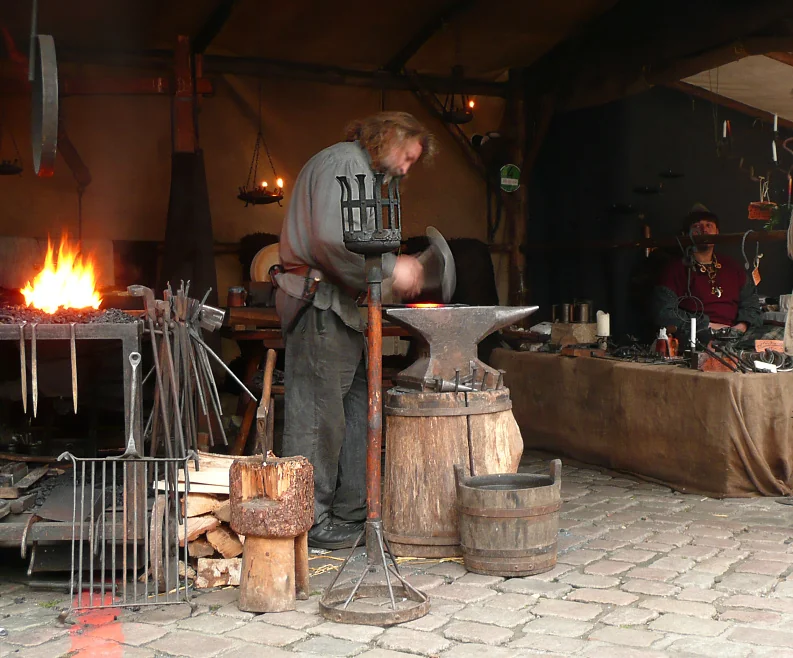
Image from Wikipedia
Image from Wikipedia
Blacksmith: A Profession Between Fire, Form, and Millennia-Old Craftsmanship
When Metal Becomes a Workpiece: The Fascination of Blacksmithing
The blacksmith is not an artist in the musical sense but a profession with enormous historical depth: Since the Bronze Age, blacksmiths have been shaping metal through forging, that is, reshaping it under heat and force. The term refers to individuals who work with metal in a craft or industrial setting; the workshop of a craftsman blacksmith is called a forge. This connects to a craft that is among the oldest manufacturing processes in humanity and continues to play a central role in shaping technology today. ([de.wikipedia.org](https://de.wikipedia.org/wiki/Schmied?utm_source=openai))
Biography of a Profession: From Ancient Craft to Modern Metalworking
When one speaks of the blacksmith, they are truly recounting the history of a profession that has carried technical, social, and cultural significance over millennia. In historical societies, the blacksmith often stood at the intersection of everyday life and innovation: tools, fittings, weapons, and everyday objects emerged where molten metal, anvil, and precise handwork came together. This tradition endures to the present day, as blacksmithing remains a symbol of material mastery, experience, and craftsmanship precision. ([de.wikipedia.org](https://de.wikipedia.org/wiki/Schmied?utm_source=openai))
The modern definition of the profession encompasses far more than the classic image of hammer work. Forging is the pressure-forming of metals or alloys between two tools with local changes in cross-sectional shape, and in the craft sector, it also includes heat treatment, splitting, punching, and forge welding. This combination of strength, temperature control, and understanding of shapes makes the blacksmith a key figure in metal processing, whether in small workshops or in industrial manufacturing processes. ([de.wikipedia.org](https://de.wikipedia.org/wiki/Schmieden?utm_source=openai))
Career Path and Professional Profile: Craftsmanship, Technology, and Responsibility
The career path of a blacksmith is characterized by expertise and practical proximity. According to vocational and training documents, the blacksmith sketches or creates scale drawings based on specifications and customer requests and shapes the metal until the desired form is achieved. This demonstrates that the profession demands not only muscle power but also spatial imagination, material knowledge, and the ability to translate technical drawings into real works. ([assets-eu-01.kc-usercontent.com](https://assets-eu-01.kc-usercontent.com/26bf2097-6663-0117-02e1-6cf39b4d6c12/8bda4ab4-bfd1-402a-a640-36da69a9a1e1/Bildungsordnung_Schmied.pdf?utm_source=openai))
In today's environment, different fields of application exist: craft blacksmithing, artistic metal design, and industrial forming technology. The vocational area ranges from decorative individual pieces to the production of high-stress forged components for mechanical engineering, commercial vehicles, or other technical applications. Official industry sources highlight the complete value chain from design through tool production to mechanical finishing. ([bew-umformtechnik.com](https://bew-umformtechnik.com/ueber-uns/?utm_source=openai))
Working Methods in the Forge: Fire, Anvil, and Sense of Form
The classic image of the forge remains powerful for good reason: material, temperature, and striking technique must interact precisely so that a robust component emerges from raw material. In free-form forging, shaping occurs without tools, where the blacksmith deliberately moves the workpiece and directs it through precise manipulation. This method is considered one of the oldest forms of craftsmanship and requires a high level of experience, quick reactions, and technical intuition. ([de.wikipedia.org](https://de.wikipedia.org/wiki/Freiformschmieden?utm_source=openai))
In an industrial context, the image changes, but the core remains the same: controlled forming under high load. Modern blacksmithing companies work with presses, heat treatment, and subsequent processing steps to produce robust, precise, and economically manufacturable parts. The centuries-old idea of forming through heat and pressure continues to thrive in advanced manufacturing technology. ([ghv-umformtechnik.de](https://www.ghv-umformtechnik.de/?utm_source=openai))
Discussion Instead of Discography: The "Works" of the Blacksmith in Cultural Context
A discography in the musical sense does not exist for the profession of blacksmith. However, the achievements of this trade can be read as a history of works: horseshoes, tools, fittings, ornate railings, components, and industrial forging parts create a functional and cultural chronicle. Especially the connection between utility and design makes the profession applicable to craft, design, and engineering. ([wien.bic.at](https://wien.bic.at/berufsinformation_pdf.php?brfid=243&utm_source=openai))
In Austria, the field is explicitly located in the area of art and handicrafts within the vocational information, highlighting the aesthetic dimension of blacksmithing. The workpiece is not only produced there, but also developed with regard to form, proportion, and usability. This dual perspective on function and design gives the blacksmith a special position between craftsmanship and cultural production. ([wien.bic.at](https://wien.bic.at/berufsinformation_pdf.php?brfid=243&utm_source=openai))
Cultural Influence: The Blacksmith as a Symbol of Strength and Design Power
For centuries, the blacksmith has been more than a profession: he is a cultural symbol of transformation. Where glowing metal takes shape under the hand, an image of mastery, discipline, and creative energy emerges, deeply rooted in literature, proverbs, and folk culture. The historical continuity of the profession explains why blacksmithing is still seen as the epitome of craftsmanship authority and material competence. ([de.wikipedia.org](https://de.wikipedia.org/wiki/Schmied?utm_source=openai))
The institutional classification also shows the significance of the profession: According to the directory of recognized training occupations, "blacksmith" is documented as a predecessor profession in the development of modern metal careers. This illustrates how strongly classical blacksmithing has inscribed itself into new occupational profiles, technical specializations, and industrial manufacturing processes. The blacksmith remains a reference point for the history of metalworking and craftsmanship professionalism. ([bibb.de](https://www.bibb.de/dienst/publikationen/de/download/20423?utm_source=openai))
Current Projects and Developments in Blacksmithing
In the 21st century, blacksmithing presents itself in an exciting dual role: on the one hand, it preserves traditional methods, while on the other, it integrates digital design, modern materials science, and industrial quality assurance. Companies in forming technology today advertise decades of blacksmithing experience, modern training workshops, and complete process chains from CAD design to ready-to-install components. Thus, the profession remains economically relevant and technically compatible. ([bew-umformtechnik.com](https://bew-umformtechnik.com/ueber-uns/?utm_source=openai))
For the future of the profession, precision, sustainability, and material efficiency stand out. Blacksmithing technology produces durable components with high structural quality and enables solutions for mechanical engineering, vehicle technology, and specialized applications. This blend of tradition and innovation makes blacksmithing a remarkable example of how ancient knowledge influences modern production environments. ([gesenkschmiede-kutsche.de](https://www.gesenkschmiede-kutsche.de/?utm_source=openai))
Conclusion: Why the Blacksmith Remains Fascinating Today
The blacksmith represents a craft that uniquely combines fire, strength, and a sense of form. Its history stretches from the Bronze Age to modern forming technology; its activity blends handwork, technical precision, and cultural symbolism. Anyone interested in metal, design, and traditional professions will encounter a vocation of extraordinary depth and lasting relevance. ([de.wikipedia.org](https://de.wikipedia.org/wiki/Schmied?utm_source=openai))
That is why it is worthwhile to experience a forge not just as a workshop, but as a living place of knowledge. The blacksmith remains exciting because he demonstrates how something lasting emerges from raw material through experience and skill. Anyone who has the opportunity to visit a historical or modern forge will experience a craft that continues to fascinate, is powerful, and remains unmistakable today. ([assets-eu-01.kc-usercontent.com](https://assets-eu-01.kc-usercontent.com/26bf2097-6663-0117-02e1-6cf39b4d6c12/8bda4ab4-bfd1-402a-a640-36da69a9a1e1/Bildungsordnung_Schmied.pdf?utm_source=openai))
Official Channels of Blacksmith:
- Instagram: No official profile found
- Facebook: No official profile found
- YouTube: No official profile found
- Spotify: No official profile found
- TikTok: No official profile found
Sources:
- Wikipedia – Blacksmith
- Wikipedia – Forging
- Wikipedia – Free-form Forging
- Training Regulations Blacksmith – Training Material
- BIBB – Directory of Recognized Training Professions
- GHV Forming Technology – Blacksmith
- Schürfeld GmbH – Forming Technology at the Highest Level
- BEW-Forming Technology – About Us
- KAISER Aluminum Forming Technology – Services
- BIC Vienna – Vocational Information Blacksmith/Blacksmithess