
Marie von Ebner-Eschenbach
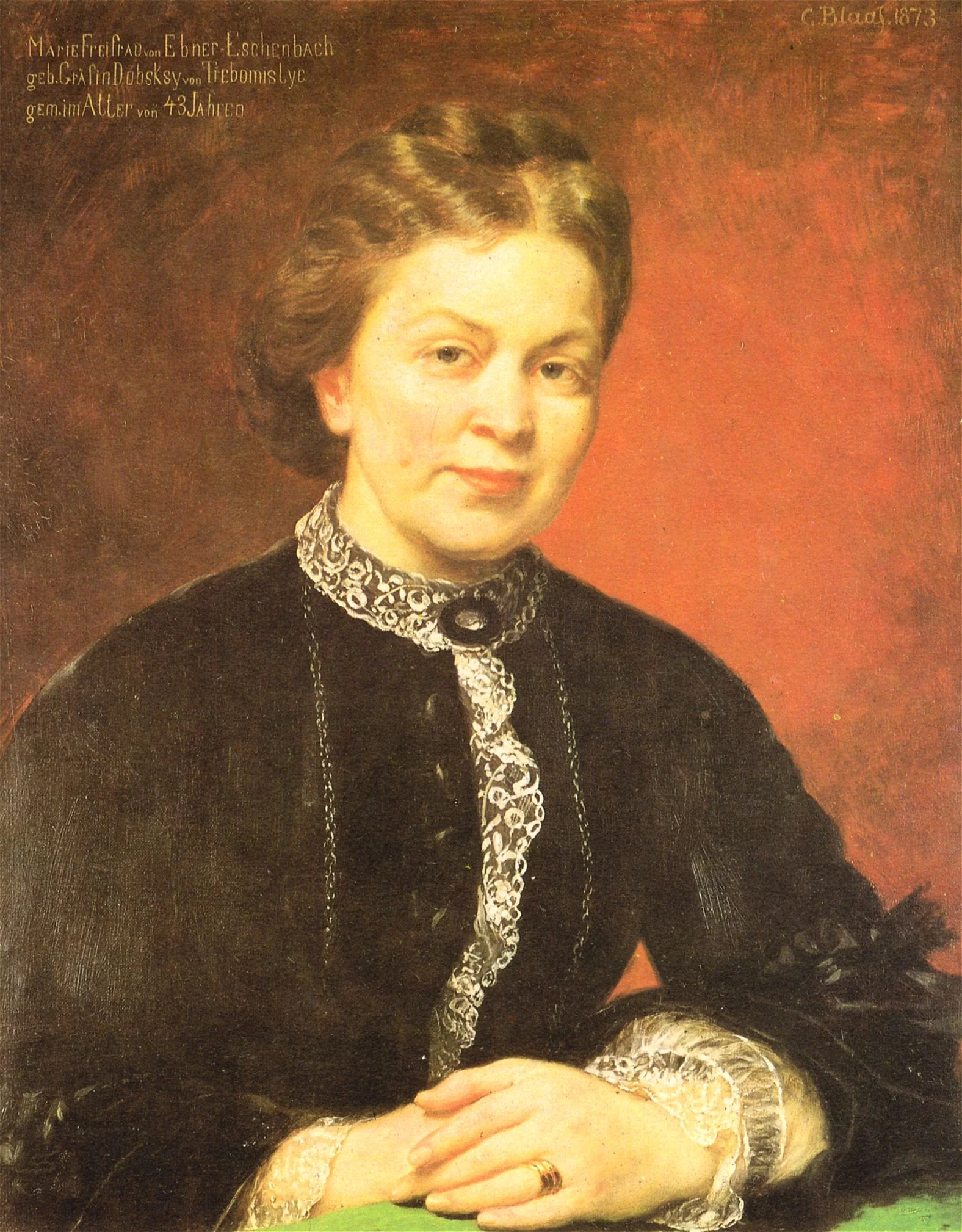
Image from Wikipedia
Image from Wikipedia
Marie von Ebner-Eschenbach: The Great Voice of Poetic Realism
An Author Who Shaped Literature of Lasting Power from Observation
Marie von Ebner-Eschenbach is counted among the most significant German-speaking writers of the 19th century. Born in 1830 at Schloss Zdislawitz in Moravia and died in 1916 in Vienna, she developed a body of work from societal experience, psychological insight, and linguistic precision that is still regarded today as a key contribution to poetic and socially critical realism. Her stories, novels, and aphorisms blend aristocratic heritage with an unrelenting gaze at social reality, inner conflicts, and human dignity. ([de.wikipedia.org](https://de.wikipedia.org/wiki/Marie_von_Ebner-Eschenbach?utm_source=openai))
Background and Early Influences in Moravia and Vienna
Marie Dubský von Třebomyslice was born as the daughter of a Moravian noble family and grew up between the estate of Zdislawitz and Vienna. This dual grounding in rural surroundings and urban culture profoundly influenced her perception of environment, class boundaries, and social movement. She was exposed to theater, classical literature, and the great dramatic authors of her time at an early age; the Burgtheater became an educational space for her. ([dhm.de](https://www.dhm.de/lemo/biografie/marie-von-ebner-eschenbach?utm_source=openai))
Her literary inclinations initially met with resistance in her family environment. Nevertheless, at the age of 18, she married her cousin Moritz von Ebner-Eschenbach, who supported her literary ambitions. The marriage provided her with stability but also brought years of inner and outer strain, which are reflected in her diaries and later in the psychological depth of her prose. From the tension between origin, sense of duty, and artistic ambition, she shaped a distinctive authorial identity. ([bmeia.gv.at](https://www.bmeia.gv.at/fileadmin/user_upload/Zentrale/Kultur/Publikationen/Kalliope_2019.pdf?utm_source=openai))
The Path to Writing: From Drama to Narrative Prose
Her first literary attempts were focused on drama. Plays like Maria Stuart in Schottland and Marie Roland show the influence of Schiller and classical theater, but it was narrative prose that offered her the formal flexibility to present characters, social environments, and moral conflicts in nuanced ways. The transition from stage to novella marked not only a change in genre but also the actual beginning of her artistic maturity. ([sites.google.com](https://sites.google.com/site/germanliterature/19th-century/ebner-eschenbach?utm_source=openai))
With the preprint of Božena in the Deutschen Rundschau, her literary breakthrough began. Julius Rodenberg recognized the quality of her storytelling early on and provided her with a central platform for bourgeois realism. From then on, Ebner-Eschenbach became an author whose name was synonymous with literary accuracy, psychological credibility, and social sensitivity. ([dhm.de](https://www.dhm.de/lemo/biografie/marie-von-ebner-eschenbach?utm_source=openai))
The Breakthrough with Stories, Novels, and Aphorisms
The early 1880s mark her peak phase. With Lotti, die Uhrmacherin, the Aphorisms, and the Dorf- und Schlossgeschichten, she achieved her definitive breakthrough. These texts connect precise milieu observation with pointed language and demonstrate her ability to transform societal tensions, educational disparities, and moral nuances into literary form. ([de.wikipedia.org](https://de.wikipedia.org/wiki/Marie_von_Ebner-Eschenbach?utm_source=openai))
Works like Unsühnbar, Das Gemeindekind, and the dog story Krambambuli solidified her reputation as a master of the short form. Her characters are seldom merely types; they act under pressure, react to their origins and environments, and thereby reveal their human complexity. In Berlin, both Ohne Liebe and Am Ende were successful on the Free Stage, emphasizing her literary influence beyond Austria. ([deutschlandfunk.de](https://www.deutschlandfunk.de/biografie-die-wiederentdeckung-der-marie-von-ebner-100.html?utm_source=openai))
Style, Themes, and Literary Handwriting
Ebner-Eschenbach's style thrives on clarity, conciseness, and psychological precision. Her prose eschews ornamental excess in favor of precisely observed dialogues, pointed turns, and a sober, often morally conflicted narrative situation. This creates a tension between empathy and analysis that keeps her texts fresh and readable to this day. ([deutschlandfunk.de](https://www.deutschlandfunk.de/biografie-die-wiederentdeckung-der-marie-von-ebner-100.html?utm_source=openai))
Thematically, her work revolves around social justice, educational issues, female self-assertion, responsibility, and the contradictions of the bourgeoisie. Particularly in her stories, her interest in people who suffer from societal expectations, inner conflicts, or unjust structures is evident. Her famous aphorisms condense this perspective into succinct formulations that are still frequently quoted and read as a mental attitude today. ([dewiki.de](https://dewiki.de/Lexikon/Marie_von_Ebner-Eschenbach?utm_source=openai))
Reception, Awards, and Cultural Significance
During her lifetime, Marie von Ebner-Eschenbach received the highest accolades. In 1898, she was awarded the Honorary Cross for Art and Literature; in 1900, she became the first woman to be awarded an honorary doctorate by the University of Vienna. These honors not only attest to her literary stature but also to her place in cultural history as an author who pushed institutional boundaries and made female authorship visible. ([de.wikipedia.org](https://de.wikipedia.org/wiki/Marie_von_Ebner-Eschenbach?utm_source=openai))
Critics particularly valued her ability to depict social reality without pathos, but with great human compassion. This makes her a key figure in German-speaking realism, standing alongside the great storytellers of her time with a focus on psychological authenticity and social observation. Later representations also emphasize that her later works and fame are based on a rare combination of literary discipline and artistic independence. ([literaturhaus-wien.at](https://www.literaturhaus-wien.at/review/beruehmt-sein-ist-nichts-marie-von-ebner-eschenbach-eine-biographie/?utm_source=openai))
Cultural Influence and Lasting Relevance
Marie von Ebner-Eschenbach belongs to those authors whose work resonates far beyond their own era. Her texts continue to influence the reading of realism, the discussion on women's writing, and the question of how literature transforms social experience into lasting form. Especially her precise observation of language, milieu, and character makes her as relevant to contemporary literary studies as to readers who appreciate literary precision. ([deutschlandfunk.de](https://www.deutschlandfunk.de/biografie-die-wiederentdeckung-der-marie-von-ebner-100.html?utm_source=openai))
Her life story also reflects perseverance: a woman who asserted herself against skepticism, role expectations, and cultural constraints, creating an independent body of work from this struggle. It is precisely this that embodies her modern strength. Those who engage with Ebner-Eschenbach discover not a museum classic, but an author whose language still resonates today with emotional subtlety and social sharpness. ([derstandard.at](https://www.derstandard.at/story/2000119908520/schriftstellerin-zum-trotz-marie-von-ebner-eschenbach?utm_source=openai))
Conclusion: Why Marie von Ebner-Eschenbach Remains Engaging
Marie von Ebner-Eschenbach fascinates because she combines literary accuracy with moral intelligence. She wrote not from a distance but from precise observation of life, and it is precisely this that creates the unique tension in her stories, novels, and aphorisms. Anyone interested in German-speaking literature, psychological prose, and poetic realism will find in her work an author of rare depth. Rediscover her, and experience a voice that resonates today in its clarity and humanity. ([de.wikipedia.org](https://de.wikipedia.org/wiki/Marie_von_Ebner-Eschenbach?utm_source=openai))
Official Channels of Marie von Ebner-Eschenbach:
- Instagram: no official profile found
- Facebook: no official profile found
- YouTube: no official profile found
- Spotify: no official profile found
- TikTok: no official profile found
Sources:
- Wikipedia - Marie von Ebner-Eschenbach
- LeMO - Biography of Marie von Ebner-Eschenbach
- Deutsche Biographie - Ebner von Eschenbach, Marie Freifrau von
- Literaturhaus Wien - Being Famous is Nothing. Marie von Ebner-Eschenbach
- Deutschlandfunk - Biography: The Rediscovery of Marie von Ebner-Eschenbach
- derStandard - Despite Being a Writer: Marie von Ebner-Eschenbach
- BMEIA PDF - Kalliope 2019
- Niederösterreichische Landesbibliothek - Marie von Ebner-Eschenbach Supplement