
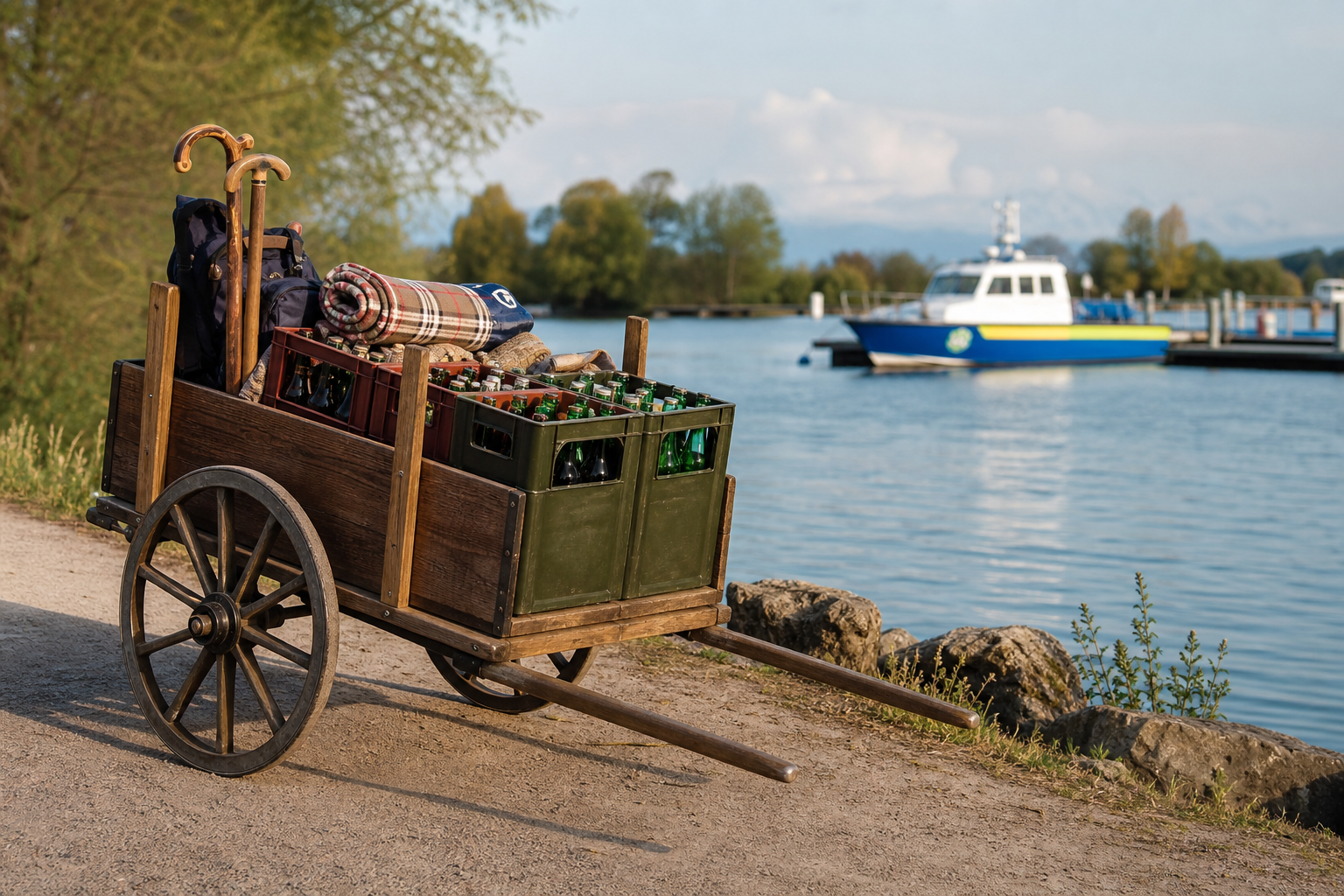
Symbolbild mithilfe von KI erstellt
Tradition, Role Models, and Order
Father's Day in Transition: Why the Handcart Tradition Remains
Family images and gender roles have visibly changed in recent decades. Nevertheless, Father's Day – in many places also known as Men's Day or Gentlemen's Day – remains surprisingly stable. Historian and political scientist Christopher Neumaier, adjunct professor at the University of Potsdam, still considers the day to be contemporary. The core of the tradition, says Neumaier, has remained: going out, being together, celebrating – often with alcohol. It is precisely this mix of leisure culture and risk behavior that makes the day not only culturally but also practically relevant for security authorities.
An Old Tradition Persists Despite New Family Images
Historically, Neumaier locates the roots of Father's Day around the year 1900, initially mainly in the Berlin area. Since then, what counts as "family" – and how parenthood is lived – has become highly pluralized. This is precisely why the continuity on Father's Day stands out: While many social rituals are losing their binding power, the group outing day remains a fixed date for many.
Neumaier describes this coexistence of change and persistence as follows: Gender roles have "to some extent" changed, but the outing day, the celebrating, and the alcohol consumption have remained. In his interpretation, Father's Day as a traditional element has even gained traction and experienced a "boom." This can also be read as an indication that the day is less an intimate family celebration than a public ritual – one that works recognizably across generations and creates a sense of belonging, precisely because it is simple: form a group, choose a route, set off.
The fact that traditional patterns in relationships persist alongside new role models fits this stability. The 2024 Social Report of the Federal Agency for Civic Education notes that unpaid housework and caregiving in Germany are predominantly done by women in relationships – according to both women and men, in more than half of couple and family households. In this context, Father's Day acts like a magnifying glass: It does not automatically stand for lived equality or "modern fatherhood," but shows how old role models and new expectations can exist simultaneously.
Between Outing Day and Security Issue
The name of the day already suggests that it is not just about fathers. Neumaier explains that on Gentlemen's Day or Men's Day, not only fathers celebrate, but also young men or boys who do not yet have children. From their perspective, says Neumaier, it is often irrelevant whether they want to become fathers one day. Thus, the day functions as a general male ritual – not a parental ritual. This also explains why certain symbols dominate: fewer gestures of thanks in private settings, more public sociability, often accompanied by alcohol.
This celebration culture has measurable consequences for public safety. For West Brandenburg, the water police have announced increased controls on rivers and lakes for the holiday. The focus is on excursion traffic and the question of whether boat operators are free of alcohol and drugs. The approach is clear: Where many people are on the move at the same time, risks increase – not only due to exuberance, but also due to simple bad decisions, which become more likely under the influence of alcohol.
A police report from Brandenburg on Ascension Day also describes a typical pattern: The number of incidents rises significantly over the course of the day, alcohol consumption increases, and there are more traffic accidents with personal injuries. Occasionally, crimes are reported, including threats and physical altercations; overall, however, the day remains comparatively peaceful.
The logic of the authorities behind this is sober: It is less about stigmatizing celebrants than about prevention during hours when several risk factors overlap – groups, movement in public spaces, alcohol, road and water traffic.
Tradition, Role Models, and Political Charge
Father's Day is therefore not a folkloric remnant, but a socially charged date. It combines leisure culture, images of masculinity, and public order – and it shows how social rituals can persist even without formal "modernization."
Neumaier also points to a historical political instrumentalization: Under the conditions of the time, the day was used in National Socialism for racial-ideological and population policy goals. This look back is more than a footnote. It reminds us that holidays and customs are not neutral, but can take on different meanings in different eras – and that "tradition" is not automatically harmless, but can be reinterpreted depending on the political context.
Commercialization: The Next Transformation Comes Quietly
For the present, Neumaier expects less of a break than a shift: a stronger commercialization. It could be examined whether there are more targeted offers for fathers that are deliberately placed. In his outline, this includes inns, beer gardens, or brewery companies that might try to attract passing handcart groups. This would not be a revolution of the tradition, but its integration into the market: The day would remain a group and outing day, but would be more strongly framed by offers that make the ritual economically usable.
Thus, Father's Day overall stands for a striking coexistence of change and persistence. Role models and family realities are changing – but the tradition of setting out and celebrating together remains anchored. The fact that police and water police accompany the day with additional controls and that the debate could simultaneously shift towards commercialization shows above all one thing: Father's Day is socially present. It does not lose its significance – it adapts without giving up its core.
Frequently Asked Questions
Sources
- https://www.radiowestfalica.de/nachrichten/news-aus-nrw-und-der-welt/potsdam-bollerwagen-und-bier-warum-der-vatertag-weiter-aktuell-ist.html, 13.05.2026
- https://polizei.brandenburg.de/pressemeldung/damit-aus-der-ausflugstour-keine-unfallf/5704073
- https://polizei.brandenburg.de/pressemeldung/polizeiliches-einsatzgeschehen-zum-himme/3936161
- https://www.bpb.de/kurz-knapp/zahlen-und-fakten/sozialbericht-2024/553162/aufteilung-der-unbezahlten-haus-und-betreuungsarbeit-in-paarbeziehungen-in-deutschland/