
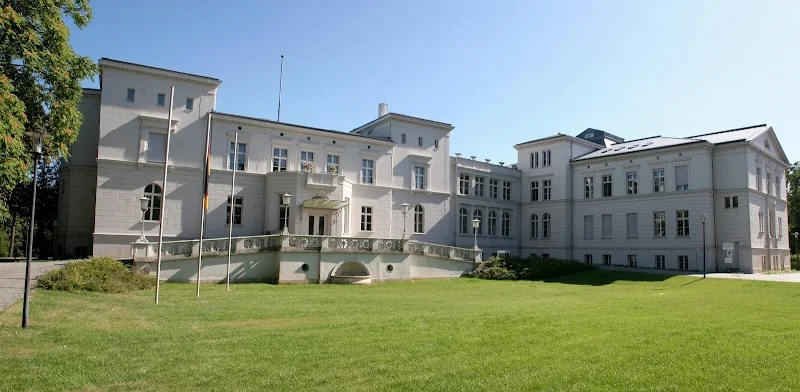
Potsdam
Zeppelinstraße 127-128, 14471 Potsdam, Deutschland
ZMSBw Potsdam | Library & Research
The Center for Military History and Social Sciences of the Bundeswehr is in Potsdam much more than just an address for historical inquiries: It is the federal research institution of the Ministry of Defense for military history, military sociology, and security policy. The official seat is located in Villa Ingenheim at Zeppelinstraße 127/128. This location shapes the perception of the institution, as those looking for photos, reviews, or practical information do not end up at a classic event arena, but at a scientific institution with public knowledge transfer, publications, lectures, and a specialized library. For many interested parties, this is the real added value: not event operations, but substance, research depth, and a clear connection to the history of the military in Germany. The center does not work in isolation, but for the Bundeswehr, science, and the public, and its content ranges from historical analyses to social science studies to current formats of knowledge transfer. ([zms.bundeswehr.de](https://zms.bundeswehr.de/de))
Library of ZMSBw: Special Collection, Opening Hours, and Use
The library of ZMSBw is one of the strongest anchors for all those looking for the location, as it gives the institution a clear profile. Officially, it is described as a unique special collection of relevant military historical literature in Germany. Its offerings are not only aimed at members of the center and the Bundeswehr but also at students of the University of Potsdam and external users in Germany and abroad who are professionally or personally interested in military history. With currently around 200,000 volumes, about 3,000 new acquisitions per year, and around 200 continuously held professional journals, the library covers the entire spectrum of modern military historical and military-related social science research. Thus, it is not a marginal offering but a central working tool of the institution and at the same time an important search term for people interested in the scientific side of ZMSBw. ([zms.bundeswehr.de](https://zms.bundeswehr.de/de/zmsbw-bibliothek))
Even in practical everyday life, the library is remarkably well structured. The opening hours are from Monday to Thursday between 09:00 and 15:00 and on Friday between 09:00 and 12:00. The inventory can be researched via the KOBV catalog, and scientific publications of ZMSBw are also available in open access on the publication server. On-site, according to the official description, there are among other things lending and information services, a free access collection, a reading room, 22 workstations, Wi-Fi, a research PC, a copier with scanning function, and access to licensed electronic resources. For visitors, this means: Those who associate ZMSBw in Potsdam with library, research, and specialist literature find here not just a name, but a functioning knowledge infrastructure with real depth of work. ([zms.bundeswehr.de](https://zms.bundeswehr.de/de/zmsbw-bibliothek))
Address, Directions, and Location in Potsdam
The location of ZMSBw in Potsdam is particularly important for orientation, as many users first search for the institution via the address or the location in Villa Ingenheim. Officially, the center is located at Zeppelinstraße 127/128, 14471 Potsdam. The homepage of the institution directly names this address, and the historical presentation of the institution also refers to Villa Ingenheim as the official seat. Thus, the location is not only unambiguously postal but also historically charged. Villa Ingenheim itself is more than just a shell for ZMSBw: it is the place where the office consolidates its scientific and public work. So, those looking for ZMSBw in Potsdam are often actually searching for a scientific campus with a clear institutional identity and not an open event center. This should be taken into account when planning a visit, research, or appointment. ([zms.bundeswehr.de](https://zms.bundeswehr.de/de))
The location in Potsdam also explains why the center is often associated with the topic of urban history and scientific location. According to official history, the predecessor institute moved to Potsdam in 1994 to Villa Ingenheim, and in 1995 the library of the Military Historical Research Office in Potsdam was made accessible to the public. ZMSBw is thus firmly anchored in the scientific space of Potsdam and is also in close relationship with the University of Potsdam, for example, through former and current study offerings in the field of military history and War and Conflict Studies. For search queries such as in Potsdam, directions, or location, it is therefore important: ZMSBw is not just any office location, but a historically grown, academically embedded place with a long-standing presence in the city. ([zms.bundeswehr.de](https://zms.bundeswehr.de/en/introduction/history-of-the-department))
Job Offers, Internships, and Career Paths
Those looking for job offers at the Center for Military History and Social Sciences of the Bundeswehr encounter a clear regulation: Open positions for researchers are not advertised on the website itself. The personnel processing office is the Federal Office for Personnel Management of the Bundeswehr in Cologne; job advertisements and the necessary information on requirements can be found on the Bundeswehr application portal or on the online administration portal. From an SEO perspective, this is important because seekers looking for job offers at the Center for Military History and Social Sciences of the Bundeswehr often expect a direct overview on the institute's page, but the official structure is deliberately organized differently. This makes the path to application somewhat indirect, but formally clear and centrally controlled. ([zms.bundeswehr.de](https://zms.bundeswehr.de/de/zmsbw-ueber-uns-ueberblick/freie-stellen-und-praktika-des-zmsbw))
At the same time, ZMSBw explicitly offers internships for students in various fields. This makes the institution interesting for academic profiles in history, social sciences, library science, political science, and related disciplines. However, for student internships, the center points out that supervision by staff of the institution unfortunately cannot be guaranteed. Therefore, those seeking practical experience should carefully examine the respective target group and prepare their application documents thoroughly. Content-wise, this fits well with the character of the institution: ZMSBw combines research, education, and knowledge transfer, creating an environment where academic and administrative careers coexist. According to official history, more than 60 civilian and military researchers work together with around 60 people in the supporting area. ([zms.bundeswehr.de](https://zms.bundeswehr.de/de/zmsbw-ueber-uns-ueberblick/freie-stellen-und-praktika-des-zmsbw))
History of ZMSBw and Villa Ingenheim
The history of ZMSBw does not begin only in 2013, but goes back much further. According to official representation, the Federal Ministry of Defense decided, in the course of the restructuring of the Bundeswehr from 2010 to 2013, to merge two previously independently operating humanities research institutions. This resulted in the establishment of the Center for Military History and Social Sciences of the Bundeswehr in Potsdam on January 1, 2013. The two predecessor institutions were the Military Historical Research Office, which existed since 1957, and the Bundeswehr Institute for Social Sciences, which was founded in 1968 and moved to Strausberg in 1994. This merger is central to the classification of the institution because it explains why ZMSBw today combines both historical and social science perspectives. The center thus stands in a tradition of research that has grown over decades and has condensed in Potsdam. ([zms.bundeswehr.de](https://zms.bundeswehr.de/en/introduction/history-of-the-department))
Villa Ingenheim itself is also part of the identity of the location. The historical presentation of the institution emphasizes that the official seat of the center is Villa Ingenheim and that the former MGFA moved to Potsdam in 1994 and settled in the buildings on Zeppelinstraße. With this move, the focus of public perception also shifted: from a purely institutional research location to a Potsdam site with strong recognition value. The library was made accessible to the public in 1995, and over time, further forms of knowledge transfer were added, such as study offerings with the University of Potsdam and the later development towards War and Conflict Studies. Therefore, understanding the history of ZMSBw also means understanding the location: it is not coincidentally in Potsdam, but has grown historically and scientifically justified. ([zms.bundeswehr.de](https://zms.bundeswehr.de/en/introduction/history-of-the-department))
Research, Education, Publications, and Events
ZMSBw is explicitly designed as a research and educational institution in its current form. The official homepage states that the center conducts basic research in the fields of military history, military sociology, and security policy. This research serves not only the scientific community but also the Federal Ministry of Defense as information, decision support, and consulting services. Organizationally, the office is divided into two scientific departments, namely research and education, supplemented by administration, support, publications, and library. Also subordinate are the Military Historical Museum of the Bundeswehr in Dresden, the permanent exhibition at Königstein Fortress, and the Military Historical Museum of the Bundeswehr in Berlin-Gatow. This makes it clear that ZMSBw plays a coordinating role in the larger field of military historical communication. ([zms.bundeswehr.de](https://zms.bundeswehr.de/de))
The public work of ZMSBw has become even more visible in recent years. The homepage showcases current formats such as podcasts, audio book journals, and map contributions, and in the area of press and media, the institution is regularly involved in public discourse. Additionally, there are lectures and specialist events in Potsdam as well as livestreams on the ZMSBw YouTube channel, significantly increasing the institution's reach. Therefore, those looking for ZMSBw photos, current impressions, or public program points find not only static information but lively scientific communication. This mix of research, education, and media presence makes the institution interesting for all who want to understand military history not just by reading but in a current context. ZMSBw thus becomes an institution that combines historical depth with contemporary communication. ([zms.bundeswehr.de](https://zms.bundeswehr.de/de))
Photos, Media, and Public Insights
For search queries with the keyword photos, ZMSBw is a grateful topic because the official website works heavily with images. The homepage regularly features motifs of Villa Ingenheim, and visual teasers are also used in the media and topic areas to make research, events, and publications accessible. This is important for the perception of the location, as the building acts not only as an address but as a visible part of the brand identity. Therefore, those viewing the center online already get an impression of the historical architecture and the factual, scientific atmosphere of the institution before a visit. This mixture makes the location attractive for many seekers looking for a special place in Potsdam but not expecting a classic event hall. ([zms.bundeswehr.de](https://zms.bundeswehr.de/de))
The public visibility of the institution is also reflected in the media area. Contributions about ZMSBw are collected there, and official announcements repeatedly contain references to lectures, workshops, and scientific results. The center is thus not only relevant internally but also present in the professional public and the broader media landscape. For people looking for reviews, this is important: As a research institution, ZMSBw primarily produces professional content, reports, and scientific classifications, not the classic evaluation environment of a gastronomy or leisure location. Nevertheless, the multitude of media contributions, image motifs, and public formats creates a clear, credible impression of the institution. Therefore, those discovering the institution online encounter an entity with profile, history, and a visibly maintained public presence. ([zms.bundeswehr.de](https://zms.bundeswehr.de/de/service-presse/zmsbw-in-den-medien?utm_source=openai))
Practical Classification for Visitors, Researchers, and Interested Parties
The Center for Military History and Social Sciences of the Bundeswehr is practically a place for research, professional discussions, scientific work, and institutional communication. The official website makes it clear that research and knowledge transfer are equally important tasks. Therefore, those planning a visit should clearly adjust their expectations regarding the use of the location: The library is excellently suited for work on-site, public events and lectures provide insights into the topics of the institution, and the website offers numerous publications and media content. This mix of scientific depth and public accessibility ensures that ZMSBw in Potsdam remains relevant for students, researchers, Bundeswehr members, and interested laypeople. ([zms.bundeswehr.de](https://zms.bundeswehr.de/de))
In summary, ZMSBw can be described as an institutional knowledge place with historical continuity. The combination of Villa Ingenheim, library, research departments, publications, and public formats makes the location unique in Potsdam. Those looking for a place with a strong professional identity find here a site that does not rely on show effects but on content. And that is precisely why ZMSBw is also so interesting for SEO: The search intent ranges from Potsdam and library to job offers and internships to photos and historical backgrounds. The center answers these search queries not with superficial promises but with a deep, well-documented scientific structure. ([zms.bundeswehr.de](https://zms.bundeswehr.de/de))
Sources:
Mehr anzeigenWeniger anzeigen
ZMSBw Potsdam | Library & Research
The Center for Military History and Social Sciences of the Bundeswehr is in Potsdam much more than just an address for historical inquiries: It is the federal research institution of the Ministry of Defense for military history, military sociology, and security policy. The official seat is located in Villa Ingenheim at Zeppelinstraße 127/128. This location shapes the perception of the institution, as those looking for photos, reviews, or practical information do not end up at a classic event arena, but at a scientific institution with public knowledge transfer, publications, lectures, and a specialized library. For many interested parties, this is the real added value: not event operations, but substance, research depth, and a clear connection to the history of the military in Germany. The center does not work in isolation, but for the Bundeswehr, science, and the public, and its content ranges from historical analyses to social science studies to current formats of knowledge transfer. ([zms.bundeswehr.de](https://zms.bundeswehr.de/de))
Library of ZMSBw: Special Collection, Opening Hours, and Use
The library of ZMSBw is one of the strongest anchors for all those looking for the location, as it gives the institution a clear profile. Officially, it is described as a unique special collection of relevant military historical literature in Germany. Its offerings are not only aimed at members of the center and the Bundeswehr but also at students of the University of Potsdam and external users in Germany and abroad who are professionally or personally interested in military history. With currently around 200,000 volumes, about 3,000 new acquisitions per year, and around 200 continuously held professional journals, the library covers the entire spectrum of modern military historical and military-related social science research. Thus, it is not a marginal offering but a central working tool of the institution and at the same time an important search term for people interested in the scientific side of ZMSBw. ([zms.bundeswehr.de](https://zms.bundeswehr.de/de/zmsbw-bibliothek))
Even in practical everyday life, the library is remarkably well structured. The opening hours are from Monday to Thursday between 09:00 and 15:00 and on Friday between 09:00 and 12:00. The inventory can be researched via the KOBV catalog, and scientific publications of ZMSBw are also available in open access on the publication server. On-site, according to the official description, there are among other things lending and information services, a free access collection, a reading room, 22 workstations, Wi-Fi, a research PC, a copier with scanning function, and access to licensed electronic resources. For visitors, this means: Those who associate ZMSBw in Potsdam with library, research, and specialist literature find here not just a name, but a functioning knowledge infrastructure with real depth of work. ([zms.bundeswehr.de](https://zms.bundeswehr.de/de/zmsbw-bibliothek))
Address, Directions, and Location in Potsdam
The location of ZMSBw in Potsdam is particularly important for orientation, as many users first search for the institution via the address or the location in Villa Ingenheim. Officially, the center is located at Zeppelinstraße 127/128, 14471 Potsdam. The homepage of the institution directly names this address, and the historical presentation of the institution also refers to Villa Ingenheim as the official seat. Thus, the location is not only unambiguously postal but also historically charged. Villa Ingenheim itself is more than just a shell for ZMSBw: it is the place where the office consolidates its scientific and public work. So, those looking for ZMSBw in Potsdam are often actually searching for a scientific campus with a clear institutional identity and not an open event center. This should be taken into account when planning a visit, research, or appointment. ([zms.bundeswehr.de](https://zms.bundeswehr.de/de))
The location in Potsdam also explains why the center is often associated with the topic of urban history and scientific location. According to official history, the predecessor institute moved to Potsdam in 1994 to Villa Ingenheim, and in 1995 the library of the Military Historical Research Office in Potsdam was made accessible to the public. ZMSBw is thus firmly anchored in the scientific space of Potsdam and is also in close relationship with the University of Potsdam, for example, through former and current study offerings in the field of military history and War and Conflict Studies. For search queries such as in Potsdam, directions, or location, it is therefore important: ZMSBw is not just any office location, but a historically grown, academically embedded place with a long-standing presence in the city. ([zms.bundeswehr.de](https://zms.bundeswehr.de/en/introduction/history-of-the-department))
Job Offers, Internships, and Career Paths
Those looking for job offers at the Center for Military History and Social Sciences of the Bundeswehr encounter a clear regulation: Open positions for researchers are not advertised on the website itself. The personnel processing office is the Federal Office for Personnel Management of the Bundeswehr in Cologne; job advertisements and the necessary information on requirements can be found on the Bundeswehr application portal or on the online administration portal. From an SEO perspective, this is important because seekers looking for job offers at the Center for Military History and Social Sciences of the Bundeswehr often expect a direct overview on the institute's page, but the official structure is deliberately organized differently. This makes the path to application somewhat indirect, but formally clear and centrally controlled. ([zms.bundeswehr.de](https://zms.bundeswehr.de/de/zmsbw-ueber-uns-ueberblick/freie-stellen-und-praktika-des-zmsbw))
At the same time, ZMSBw explicitly offers internships for students in various fields. This makes the institution interesting for academic profiles in history, social sciences, library science, political science, and related disciplines. However, for student internships, the center points out that supervision by staff of the institution unfortunately cannot be guaranteed. Therefore, those seeking practical experience should carefully examine the respective target group and prepare their application documents thoroughly. Content-wise, this fits well with the character of the institution: ZMSBw combines research, education, and knowledge transfer, creating an environment where academic and administrative careers coexist. According to official history, more than 60 civilian and military researchers work together with around 60 people in the supporting area. ([zms.bundeswehr.de](https://zms.bundeswehr.de/de/zmsbw-ueber-uns-ueberblick/freie-stellen-und-praktika-des-zmsbw))
History of ZMSBw and Villa Ingenheim
The history of ZMSBw does not begin only in 2013, but goes back much further. According to official representation, the Federal Ministry of Defense decided, in the course of the restructuring of the Bundeswehr from 2010 to 2013, to merge two previously independently operating humanities research institutions. This resulted in the establishment of the Center for Military History and Social Sciences of the Bundeswehr in Potsdam on January 1, 2013. The two predecessor institutions were the Military Historical Research Office, which existed since 1957, and the Bundeswehr Institute for Social Sciences, which was founded in 1968 and moved to Strausberg in 1994. This merger is central to the classification of the institution because it explains why ZMSBw today combines both historical and social science perspectives. The center thus stands in a tradition of research that has grown over decades and has condensed in Potsdam. ([zms.bundeswehr.de](https://zms.bundeswehr.de/en/introduction/history-of-the-department))
Villa Ingenheim itself is also part of the identity of the location. The historical presentation of the institution emphasizes that the official seat of the center is Villa Ingenheim and that the former MGFA moved to Potsdam in 1994 and settled in the buildings on Zeppelinstraße. With this move, the focus of public perception also shifted: from a purely institutional research location to a Potsdam site with strong recognition value. The library was made accessible to the public in 1995, and over time, further forms of knowledge transfer were added, such as study offerings with the University of Potsdam and the later development towards War and Conflict Studies. Therefore, understanding the history of ZMSBw also means understanding the location: it is not coincidentally in Potsdam, but has grown historically and scientifically justified. ([zms.bundeswehr.de](https://zms.bundeswehr.de/en/introduction/history-of-the-department))
Research, Education, Publications, and Events
ZMSBw is explicitly designed as a research and educational institution in its current form. The official homepage states that the center conducts basic research in the fields of military history, military sociology, and security policy. This research serves not only the scientific community but also the Federal Ministry of Defense as information, decision support, and consulting services. Organizationally, the office is divided into two scientific departments, namely research and education, supplemented by administration, support, publications, and library. Also subordinate are the Military Historical Museum of the Bundeswehr in Dresden, the permanent exhibition at Königstein Fortress, and the Military Historical Museum of the Bundeswehr in Berlin-Gatow. This makes it clear that ZMSBw plays a coordinating role in the larger field of military historical communication. ([zms.bundeswehr.de](https://zms.bundeswehr.de/de))
The public work of ZMSBw has become even more visible in recent years. The homepage showcases current formats such as podcasts, audio book journals, and map contributions, and in the area of press and media, the institution is regularly involved in public discourse. Additionally, there are lectures and specialist events in Potsdam as well as livestreams on the ZMSBw YouTube channel, significantly increasing the institution's reach. Therefore, those looking for ZMSBw photos, current impressions, or public program points find not only static information but lively scientific communication. This mix of research, education, and media presence makes the institution interesting for all who want to understand military history not just by reading but in a current context. ZMSBw thus becomes an institution that combines historical depth with contemporary communication. ([zms.bundeswehr.de](https://zms.bundeswehr.de/de))
Photos, Media, and Public Insights
For search queries with the keyword photos, ZMSBw is a grateful topic because the official website works heavily with images. The homepage regularly features motifs of Villa Ingenheim, and visual teasers are also used in the media and topic areas to make research, events, and publications accessible. This is important for the perception of the location, as the building acts not only as an address but as a visible part of the brand identity. Therefore, those viewing the center online already get an impression of the historical architecture and the factual, scientific atmosphere of the institution before a visit. This mixture makes the location attractive for many seekers looking for a special place in Potsdam but not expecting a classic event hall. ([zms.bundeswehr.de](https://zms.bundeswehr.de/de))
The public visibility of the institution is also reflected in the media area. Contributions about ZMSBw are collected there, and official announcements repeatedly contain references to lectures, workshops, and scientific results. The center is thus not only relevant internally but also present in the professional public and the broader media landscape. For people looking for reviews, this is important: As a research institution, ZMSBw primarily produces professional content, reports, and scientific classifications, not the classic evaluation environment of a gastronomy or leisure location. Nevertheless, the multitude of media contributions, image motifs, and public formats creates a clear, credible impression of the institution. Therefore, those discovering the institution online encounter an entity with profile, history, and a visibly maintained public presence. ([zms.bundeswehr.de](https://zms.bundeswehr.de/de/service-presse/zmsbw-in-den-medien?utm_source=openai))
Practical Classification for Visitors, Researchers, and Interested Parties
The Center for Military History and Social Sciences of the Bundeswehr is practically a place for research, professional discussions, scientific work, and institutional communication. The official website makes it clear that research and knowledge transfer are equally important tasks. Therefore, those planning a visit should clearly adjust their expectations regarding the use of the location: The library is excellently suited for work on-site, public events and lectures provide insights into the topics of the institution, and the website offers numerous publications and media content. This mix of scientific depth and public accessibility ensures that ZMSBw in Potsdam remains relevant for students, researchers, Bundeswehr members, and interested laypeople. ([zms.bundeswehr.de](https://zms.bundeswehr.de/de))
In summary, ZMSBw can be described as an institutional knowledge place with historical continuity. The combination of Villa Ingenheim, library, research departments, publications, and public formats makes the location unique in Potsdam. Those looking for a place with a strong professional identity find here a site that does not rely on show effects but on content. And that is precisely why ZMSBw is also so interesting for SEO: The search intent ranges from Potsdam and library to job offers and internships to photos and historical backgrounds. The center answers these search queries not with superficial promises but with a deep, well-documented scientific structure. ([zms.bundeswehr.de](https://zms.bundeswehr.de/de))
Sources:
ZMSBw Potsdam | Library & Research
The Center for Military History and Social Sciences of the Bundeswehr is in Potsdam much more than just an address for historical inquiries: It is the federal research institution of the Ministry of Defense for military history, military sociology, and security policy. The official seat is located in Villa Ingenheim at Zeppelinstraße 127/128. This location shapes the perception of the institution, as those looking for photos, reviews, or practical information do not end up at a classic event arena, but at a scientific institution with public knowledge transfer, publications, lectures, and a specialized library. For many interested parties, this is the real added value: not event operations, but substance, research depth, and a clear connection to the history of the military in Germany. The center does not work in isolation, but for the Bundeswehr, science, and the public, and its content ranges from historical analyses to social science studies to current formats of knowledge transfer. ([zms.bundeswehr.de](https://zms.bundeswehr.de/de))
Library of ZMSBw: Special Collection, Opening Hours, and Use
The library of ZMSBw is one of the strongest anchors for all those looking for the location, as it gives the institution a clear profile. Officially, it is described as a unique special collection of relevant military historical literature in Germany. Its offerings are not only aimed at members of the center and the Bundeswehr but also at students of the University of Potsdam and external users in Germany and abroad who are professionally or personally interested in military history. With currently around 200,000 volumes, about 3,000 new acquisitions per year, and around 200 continuously held professional journals, the library covers the entire spectrum of modern military historical and military-related social science research. Thus, it is not a marginal offering but a central working tool of the institution and at the same time an important search term for people interested in the scientific side of ZMSBw. ([zms.bundeswehr.de](https://zms.bundeswehr.de/de/zmsbw-bibliothek))
Even in practical everyday life, the library is remarkably well structured. The opening hours are from Monday to Thursday between 09:00 and 15:00 and on Friday between 09:00 and 12:00. The inventory can be researched via the KOBV catalog, and scientific publications of ZMSBw are also available in open access on the publication server. On-site, according to the official description, there are among other things lending and information services, a free access collection, a reading room, 22 workstations, Wi-Fi, a research PC, a copier with scanning function, and access to licensed electronic resources. For visitors, this means: Those who associate ZMSBw in Potsdam with library, research, and specialist literature find here not just a name, but a functioning knowledge infrastructure with real depth of work. ([zms.bundeswehr.de](https://zms.bundeswehr.de/de/zmsbw-bibliothek))
Address, Directions, and Location in Potsdam
The location of ZMSBw in Potsdam is particularly important for orientation, as many users first search for the institution via the address or the location in Villa Ingenheim. Officially, the center is located at Zeppelinstraße 127/128, 14471 Potsdam. The homepage of the institution directly names this address, and the historical presentation of the institution also refers to Villa Ingenheim as the official seat. Thus, the location is not only unambiguously postal but also historically charged. Villa Ingenheim itself is more than just a shell for ZMSBw: it is the place where the office consolidates its scientific and public work. So, those looking for ZMSBw in Potsdam are often actually searching for a scientific campus with a clear institutional identity and not an open event center. This should be taken into account when planning a visit, research, or appointment. ([zms.bundeswehr.de](https://zms.bundeswehr.de/de))
The location in Potsdam also explains why the center is often associated with the topic of urban history and scientific location. According to official history, the predecessor institute moved to Potsdam in 1994 to Villa Ingenheim, and in 1995 the library of the Military Historical Research Office in Potsdam was made accessible to the public. ZMSBw is thus firmly anchored in the scientific space of Potsdam and is also in close relationship with the University of Potsdam, for example, through former and current study offerings in the field of military history and War and Conflict Studies. For search queries such as in Potsdam, directions, or location, it is therefore important: ZMSBw is not just any office location, but a historically grown, academically embedded place with a long-standing presence in the city. ([zms.bundeswehr.de](https://zms.bundeswehr.de/en/introduction/history-of-the-department))
Job Offers, Internships, and Career Paths
Those looking for job offers at the Center for Military History and Social Sciences of the Bundeswehr encounter a clear regulation: Open positions for researchers are not advertised on the website itself. The personnel processing office is the Federal Office for Personnel Management of the Bundeswehr in Cologne; job advertisements and the necessary information on requirements can be found on the Bundeswehr application portal or on the online administration portal. From an SEO perspective, this is important because seekers looking for job offers at the Center for Military History and Social Sciences of the Bundeswehr often expect a direct overview on the institute's page, but the official structure is deliberately organized differently. This makes the path to application somewhat indirect, but formally clear and centrally controlled. ([zms.bundeswehr.de](https://zms.bundeswehr.de/de/zmsbw-ueber-uns-ueberblick/freie-stellen-und-praktika-des-zmsbw))
At the same time, ZMSBw explicitly offers internships for students in various fields. This makes the institution interesting for academic profiles in history, social sciences, library science, political science, and related disciplines. However, for student internships, the center points out that supervision by staff of the institution unfortunately cannot be guaranteed. Therefore, those seeking practical experience should carefully examine the respective target group and prepare their application documents thoroughly. Content-wise, this fits well with the character of the institution: ZMSBw combines research, education, and knowledge transfer, creating an environment where academic and administrative careers coexist. According to official history, more than 60 civilian and military researchers work together with around 60 people in the supporting area. ([zms.bundeswehr.de](https://zms.bundeswehr.de/de/zmsbw-ueber-uns-ueberblick/freie-stellen-und-praktika-des-zmsbw))
History of ZMSBw and Villa Ingenheim
The history of ZMSBw does not begin only in 2013, but goes back much further. According to official representation, the Federal Ministry of Defense decided, in the course of the restructuring of the Bundeswehr from 2010 to 2013, to merge two previously independently operating humanities research institutions. This resulted in the establishment of the Center for Military History and Social Sciences of the Bundeswehr in Potsdam on January 1, 2013. The two predecessor institutions were the Military Historical Research Office, which existed since 1957, and the Bundeswehr Institute for Social Sciences, which was founded in 1968 and moved to Strausberg in 1994. This merger is central to the classification of the institution because it explains why ZMSBw today combines both historical and social science perspectives. The center thus stands in a tradition of research that has grown over decades and has condensed in Potsdam. ([zms.bundeswehr.de](https://zms.bundeswehr.de/en/introduction/history-of-the-department))
Villa Ingenheim itself is also part of the identity of the location. The historical presentation of the institution emphasizes that the official seat of the center is Villa Ingenheim and that the former MGFA moved to Potsdam in 1994 and settled in the buildings on Zeppelinstraße. With this move, the focus of public perception also shifted: from a purely institutional research location to a Potsdam site with strong recognition value. The library was made accessible to the public in 1995, and over time, further forms of knowledge transfer were added, such as study offerings with the University of Potsdam and the later development towards War and Conflict Studies. Therefore, understanding the history of ZMSBw also means understanding the location: it is not coincidentally in Potsdam, but has grown historically and scientifically justified. ([zms.bundeswehr.de](https://zms.bundeswehr.de/en/introduction/history-of-the-department))
Research, Education, Publications, and Events
ZMSBw is explicitly designed as a research and educational institution in its current form. The official homepage states that the center conducts basic research in the fields of military history, military sociology, and security policy. This research serves not only the scientific community but also the Federal Ministry of Defense as information, decision support, and consulting services. Organizationally, the office is divided into two scientific departments, namely research and education, supplemented by administration, support, publications, and library. Also subordinate are the Military Historical Museum of the Bundeswehr in Dresden, the permanent exhibition at Königstein Fortress, and the Military Historical Museum of the Bundeswehr in Berlin-Gatow. This makes it clear that ZMSBw plays a coordinating role in the larger field of military historical communication. ([zms.bundeswehr.de](https://zms.bundeswehr.de/de))
The public work of ZMSBw has become even more visible in recent years. The homepage showcases current formats such as podcasts, audio book journals, and map contributions, and in the area of press and media, the institution is regularly involved in public discourse. Additionally, there are lectures and specialist events in Potsdam as well as livestreams on the ZMSBw YouTube channel, significantly increasing the institution's reach. Therefore, those looking for ZMSBw photos, current impressions, or public program points find not only static information but lively scientific communication. This mix of research, education, and media presence makes the institution interesting for all who want to understand military history not just by reading but in a current context. ZMSBw thus becomes an institution that combines historical depth with contemporary communication. ([zms.bundeswehr.de](https://zms.bundeswehr.de/de))
Photos, Media, and Public Insights
For search queries with the keyword photos, ZMSBw is a grateful topic because the official website works heavily with images. The homepage regularly features motifs of Villa Ingenheim, and visual teasers are also used in the media and topic areas to make research, events, and publications accessible. This is important for the perception of the location, as the building acts not only as an address but as a visible part of the brand identity. Therefore, those viewing the center online already get an impression of the historical architecture and the factual, scientific atmosphere of the institution before a visit. This mixture makes the location attractive for many seekers looking for a special place in Potsdam but not expecting a classic event hall. ([zms.bundeswehr.de](https://zms.bundeswehr.de/de))
The public visibility of the institution is also reflected in the media area. Contributions about ZMSBw are collected there, and official announcements repeatedly contain references to lectures, workshops, and scientific results. The center is thus not only relevant internally but also present in the professional public and the broader media landscape. For people looking for reviews, this is important: As a research institution, ZMSBw primarily produces professional content, reports, and scientific classifications, not the classic evaluation environment of a gastronomy or leisure location. Nevertheless, the multitude of media contributions, image motifs, and public formats creates a clear, credible impression of the institution. Therefore, those discovering the institution online encounter an entity with profile, history, and a visibly maintained public presence. ([zms.bundeswehr.de](https://zms.bundeswehr.de/de/service-presse/zmsbw-in-den-medien?utm_source=openai))
Practical Classification for Visitors, Researchers, and Interested Parties
The Center for Military History and Social Sciences of the Bundeswehr is practically a place for research, professional discussions, scientific work, and institutional communication. The official website makes it clear that research and knowledge transfer are equally important tasks. Therefore, those planning a visit should clearly adjust their expectations regarding the use of the location: The library is excellently suited for work on-site, public events and lectures provide insights into the topics of the institution, and the website offers numerous publications and media content. This mix of scientific depth and public accessibility ensures that ZMSBw in Potsdam remains relevant for students, researchers, Bundeswehr members, and interested laypeople. ([zms.bundeswehr.de](https://zms.bundeswehr.de/de))
In summary, ZMSBw can be described as an institutional knowledge place with historical continuity. The combination of Villa Ingenheim, library, research departments, publications, and public formats makes the location unique in Potsdam. Those looking for a place with a strong professional identity find here a site that does not rely on show effects but on content. And that is precisely why ZMSBw is also so interesting for SEO: The search intent ranges from Potsdam and library to job offers and internships to photos and historical backgrounds. The center answers these search queries not with superficial promises but with a deep, well-documented scientific structure. ([zms.bundeswehr.de](https://zms.bundeswehr.de/de))
Sources:
Upcoming Events
No events found
Frequently Asked Questions
Reviews
Mirko Grosse
13. November 2025
A super nice property with an excellent kitchen, 2 young men are totally motivated every day to bring fresh food to the table. Whether vegetarian, meat, or fish. Very balanced and healthy. The beautiful outdoor terrace invites you to linger with a view of the Havel. A lovely place to unwind.
Stefan Nitsche
5. June 2026
The center is easily accessible and has a very good library that is available to everyone after registration.
Stanenberq
19. June 2023
A very well-equipped specialized library in the field of military history. Unfortunately, the air in the rooms is very dry on warm days. The opening hours could be a bit more generous. I highly recommend the library to anyone interested in military history.
Gisela Wolff
17. October 2020
Yes, the history of our past is very important. We shouldn't forget it. Where we grew up and not everything was bad.☺
Sandro Schmidt
23. October 2019
Very friendly staff, the library is well organized and free to use.