
Potsdam
Telegrafenberg, 14473 Potsdam, Deutschland
Albert Einstein Science Park | Telegrafenberg & Access
The Albert Einstein Science Park on Telegrafenberg in Potsdam is not an ordinary place, but a historically grown research and experience space where science, architecture, and nature are closely intertwined. Amidst a wooded park lie historical observatories, neoclassical research buildings, and modern institutes that continue to perform globally recognized work to this day. The site is primarily associated with astrophysics, geosciences, climate research, polar and marine research, as well as meteorology, and unites institutions such as GFZ, PIK, AWI, AIP, and DWD. At the same time, structures like the Einstein Tower and the Great Refractor shape the image of the hill and make Telegrafenberg one of the most fascinating science locations in Germany. The current designation of Albert Einstein Science Park was coined around 1992; the historical complex is protected as a monument ensemble and continues to tell the story of the long development of the site since the 19th century. ([pik-potsdam.de](https://www.pik-potsdam.de/en/output/infodesk/telegrafenberg/about_telegrafenberg))
History of Telegrafenberg and the Albert Einstein Science Park
The history of this place begins long before its current name. Telegrafenberg received its name from an optical telegraph station built in 1832, which was part of the Prussian signal chain between Berlin and Koblenz. Thus, the wooded hill was initially not a site for research, but for communication: Military messages were transmitted using pivoting shutters and masts until electrical telegraphy replaced the system in 1852. This early use is significant because it technically enhanced the hill as early as the 19th century and laid the foundation for the establishment of scientific institutes here later. Municipal and institutional sources highlight that the current science park began to develop on the hill in the 1870s, and the first research buildings were already constructed there in the second half of the 19th century. ([pik-potsdam.de](https://www.pik-potsdam.de/en/output/infodesk/telegrafenberg/about_telegrafenberg))
Particularly noteworthy is how early the site became a center for astrophysics. After the development of the area, the first scientific buildings were constructed starting in 1874 and 1876, including the main building of the then Astrophysical Observatory, which is now known as the Michelson House. According to AIP, this institution was the first astronomical institute in the world to include the term astrophysics in its name and research program. In 1899, the Great Refractor was put into operation, and between 1919 and 1924, the Einstein Tower was built, marking the beginning of modern solar research in Potsdam. The historical core of Telegrafenberg is thus not only visually appealing but also of great scientific historical significance: Here, pioneering achievements in astronomy, geodesy, meteorology, and climate research converge. This image is complemented by the fact that the entire park, with its historical buildings, was officially referred to as Albert Einstein Science Park around 1992 and is protected as a monument ensemble. ([pik-potsdam.de](https://www.pik-potsdam.de/en/output/infodesk/telegrafenberg/about_telegrafenberg))
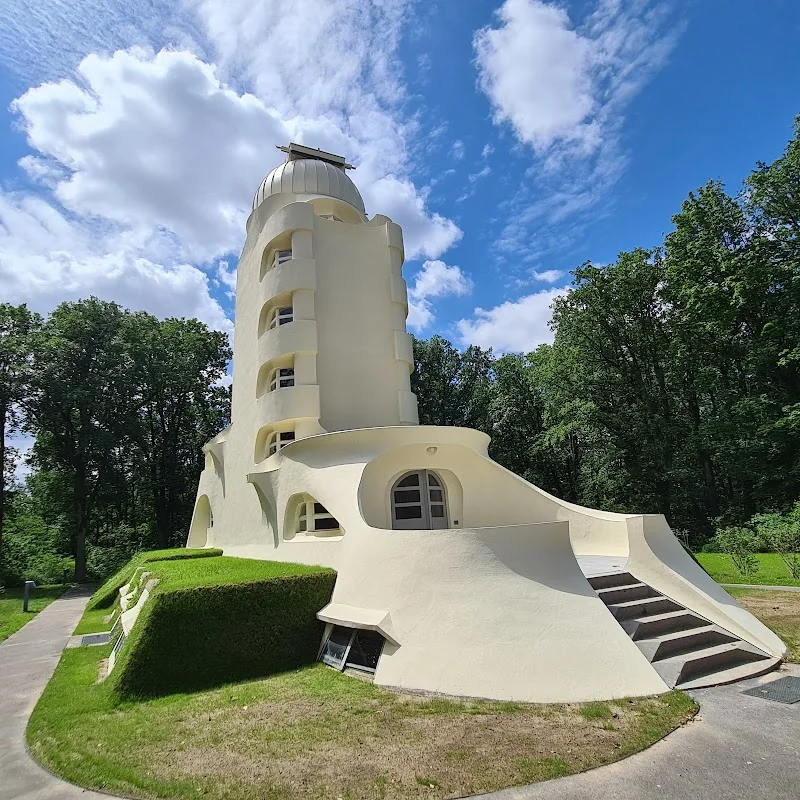
The location is also architecturally exceptional. Sources describe the complex as an English landscape park with generous, open design that served not only aesthetics but also the goal of greater air tranquility and a special working atmosphere. The historical brick buildings were constructed in the spirit of the Mark Brandenburg and influenced by Karl Friedrich Schinkel, while the Einstein Tower, as an expressionist solitary structure, speaks a completely different design language. After severe war damage, many buildings were restored over decades; between 2001 and 2007, extensive renovations and recommissions took place. Thus, Telegrafenberg today is not merely a memorial site but a vibrant research campus where history is not displayed but continued in the daily work of the institutes. This connection of past and present makes the site so compelling for visitors seeking history, photos, architecture, and scientific significance. ([pik-potsdam.de](https://www.pik-potsdam.de/en/output/infodesk/telegrafenberg/about_telegrafenberg))
Opening Hours, Visits, and Tours at Telegrafenberg
Those looking for the opening hours of the Albert Einstein Science Park should know: Telegrafenberg is not a classic recreational area with fixed daily public hours. It is an active research site, and its buildings and paths are only partially accessible as part of tours, public events, or special visiting offers. AIP points out that the Einstein Tower can be viewed from the outside during the day, but the interior is only accessible to a limited extent. The Great Refractor has regular tours and additional observation evenings during the darker season, where interested parties can look through the telescope, provided the sky is clear. This mix of scientific use and limited public accessibility shapes the place and explains why many search queries about opening hours, tickets, or tours are directly linked to the visitor experience. ([aip.de](https://www.aip.de/einsteinturm))
Particularly attractive are the public events surrounding the Great Refractor. According to AIP, the historical instrument can be viewed at various events and tours; in the winter months, observation evenings are added. Registration is required for these events due to high demand in recent years, which has led to queues at the telescope. The registration function is activated two weeks before the event. Additionally, observations are only possible in clear visibility; in rain, snow, or fog, the telescope can be viewed, but the view through the instrument is then not possible. It is also important for visitors that the dome of the building is not barrier-free and can only be accessed via stairs. Therefore, those planning to visit should check the schedule in advance, plan according to the weather, and adjust their expectations for a museum visit: Here, one experiences research and monument preservation in one. ([aip.de](https://www.aip.de/de/pr/visit-the-telescopes/visiting-the-great-refractor/observation-evenings/?utm_source=openai))
The Einstein Tower cannot be experienced like a normal exhibition space either. However, AIP offers digital access, a virtual tour, and a photo gallery for the tower's 100th anniversary. This is particularly helpful for those who want to see photos in advance or learn about architecture and history. Especially because the site is not freely accessible in every detail, these digital formats provide significant added value: They make the place comprehensible even beyond the on-site visit and assist in planning a tour. Additionally, local organizers and municipal programs regularly offer tours of Telegrafenberg, showcasing further historical spaces such as libraries or observation rooms. Therefore, those looking for a visitor experience should rely less on classic opening hours and more on a calendar of tours, pre-registrations, and special dates. This is precisely what makes the place so special and authentic. ([aip.de](https://www.aip.de/einsteinturm))
Access, Parking, and Public Transport to the Albert Einstein Science Park
Access to the Albert Einstein Science Park is well organized but deliberately understated because the site is protected as a research and monument conservation area. Those coming by car from Berlin can reach Telegrafenberg via the A115 to the Potsdam-Babelsberg exit; then follow the Nuthe Expressway signs towards the Landtag and Albert Einstein Science Park and park near the gate on the street. Entry into the science park itself by car is not possible. This is an important point for anyone using Google searches like access Telegrafenberg or parking Telegrafenberg: The actual access is on foot. For the Great Refractor, AIP mentions about a ten-minute walk or approximately 500 meters from the parking lot to the destination. ([aip.de](https://www.aip.de/en/institute/contact/historical-site-telegrafenberg/))
Traveling by public transport is also possible. AIP refers to the VBB connection with the destination Potsdam, Telegrafenberg for bus and train, specifically mentioning bus line 691, which only operates on weekdays. Local event notices have also described that bus line 691 was deployed from the main train station towards Telegrafenberg. Therefore, those planning a visit should always check the current timetable, as routes and frequencies may change. It is especially important for the visit that the site, while not located in the city center, is still reachable by public transport. This keeps Telegrafenberg attractive for guests without cars, especially for tours, public lectures, and observation evenings. ([aip.de](https://www.aip.de/en/institute/contact/historical-site-telegrafenberg/))
The walk itself is part of the experience. The science park is located in a wooded area on a hill, so the visit feels distinctly different from a typical cultural or event venue right from the ascent. The site is not designed for quick transit but for a gentle approach. This not only protects the historical substance but also ensures a very quiet atmosphere. For guests, this means: Comfortable shoes are worthwhile, especially if the route leads from the parking lot or bus stop to the Great Refractor, the Einstein Tower, or a tour of the campus. Those wanting to take photos will find numerous motifs along the paths among woods, brick, domes, and modern research. The journey is therefore not just an organizational step but almost the first part of the tour. ([pik-potsdam.de](https://www.pik-potsdam.de/en/output/infodesk/telegrafenberg/about_telegrafenberg))
Einstein Tower, Great Refractor, and Other Highlights on Telegrafenberg
The Einstein Tower is the most iconic building of the Albert Einstein Science Park. It was built as a solar observatory and is still used by researchers at AIP today. The architecture of the tower is considered extraordinary and makes it one of the most prominent examples of expressionist scientific architecture in Germany. Particularly important for the current condition of the building is the renovation between 2021 and 2023, which was supported by the Wüstenrot Foundation. AIP describes the tower as one of the highlights of Telegrafenberg again. For visitors, this is a double attraction: On one hand, one sees a building of national architectural and scientific history; on the other hand, one experiences a place where real research is still taking place. This connection is what makes the Einstein Tower a magnet for photos, history, and architecture. ([aip.de](https://www.aip.de/einsteinturm))
The Great Refractor is equally impressive. According to AIP, the telescope was inaugurated in 1899 in the presence of the emperor and is still the fourth largest refracting telescope in the world. It is a double refractor with two permanently connected telescopes on a parallactic mount. The larger tube has an 80-centimeter objective and a focal length of 12.2 meters, while the smaller one has a 50-centimeter objective with a focal length of 12.5 meters. The rotating dome weighs around 200 tons and has a diameter of 21 meters. Scientifically, the instrument was significant, among other things, because Johannes Hartmann discovered the diffuse interstellar medium here in 1904 based on observations. After war damage in 1945 and a modernization in 1953, operations were discontinued in 1968; only the support association founded in 1997 and subsequent restorations made a renewed commissioning and public use possible. ([aip.de](https://www.aip.de/en/institute/locations/great-refractor/?utm_source=openai))
Beyond these two stars, there is much to discover on the grounds. The historical complex includes various houses and institutes that together make the development of Potsdam's scientific history visible. The walk over Telegrafenberg leads past old observatories, research buildings with neoclassical and Mark Brandenburg facades, and modern infrastructure for current science. AIP also offers a tour of Telegrafenberg, where 14 stations explain buildings, history, and research. Additionally, virtual tours and digital exhibitions are available, allowing the site to be explored in high quality even without an on-site visit. Those looking for photos will find not only a beautiful backdrop but also a kind of scientific panorama of architecture, landscape, and instrument history. ([aip.de](https://www.aip.de/en/pr/visit-the-telescopes/?utm_source=openai))
Another highlight is the combination of nature and knowledge. Telegrafenberg is located in a wooded park that has been deliberately designed to be spacious and tranquil. The area is not urbanly dense but open and scenic, giving the historical buildings a special presence. This spatial structure enhances the impact of the Einstein Tower and the Great Refractor: The buildings are not isolated but embedded in a research landscape that has developed over more than a century. Together with the historical origin as a telegraph station and the later transformation into a science park, a place is created that possesses rare depth. Standing here, one sees not only a beautiful building but several layers of German scientific and architectural history in a single glance. ([pik-potsdam.de](https://www.pik-potsdam.de/en/output/infodesk/telegrafenberg/about_telegrafenberg))
Library, Research Facilities, and Current Use
The Albert Einstein Science Park is still an active research site with several clearly defined focuses. On Telegrafenberg, GFZ, PIK, the Potsdam research facility of AWI, DWD, and AIP work in close proximity. The city of Potsdam describes the campus as a place for geosciences, sustainability and climate impact research, as well as polar and marine research; PIK itself focuses on global change, climate impacts, and sustainable development. This bundling of different disciplines is an essential part of the current identity of the science park. In other words: Telegrafenberg is not just a historical heritage but a working environment where highly relevant research questions are addressed. ([potsdam.de](https://www.potsdam.de/de/content/hightech-innovation?utm_source=openai))
The scientific infrastructure is also remarkable. AIP explicitly mentions a Scientific Library and Documentation Centre on its location page and also describes the historical library landscape of the campus. The current library from 1913 is part of the historical area; during tours, historical rooms and workplaces are also regularly shown. This bibliographic and documentary dimension is important for a scientific location because it shows that research here is not only experimental but also archivally, literature-based, and historically accompanied. For those searching for the library of the Albert Einstein Science Park, it is therefore particularly relevant that the site has a genuine scientific library infrastructure and is also embedded in a historical library building within the monument landscape. ([aip.de](https://www.aip.de/en/institute/locations/))
The topics range from earth observation to astrophysics. GFZ researches the Earth system with geological, physical, chemical, and biological processes; PIK studies climate change and scenarios for sustainable development; AWI in Potsdam has been dealing with climate-relevant processes in the polar atmosphere since 1992; AIP focuses on solar, stellar, and extragalactic astrophysics, among other things. This creates a scientific density in a compact space that is rare in Germany. For visitors, this is especially exciting because each building reflects the questions being addressed here: the Earth as a system, climate as a challenge, the sun as a research object, and the universe as a space for observation. ([potsdam.de](https://www.potsdam.de/de/content/geoforschungszentrum?utm_source=openai))
Additionally, the institutional history is significant. The science park was named as such around 1992, and the historical buildings were restored and reopened between 2001 and 2007. This means that the site has grown both historically and organizationally today. It does not stand for a single event but for a long continuity of scientific work, in which each era has inscribed itself architecturally and content-wise. Therefore, those searching for Albert Einstein Science Park Potsdam, Einstein Park, or Telegrafenberg Potsdam are often looking for a place where research, memory, and the present are interconnected. This is precisely what makes it appealing: The campus is not static but a living knowledge space that is constantly being rewritten. ([pik-potsdam.de](https://www.pik-potsdam.de/en/output/infodesk/telegrafenberg/about_telegrafenberg))
Photos, Reviews, and Practical Tips for the Visit
Those looking for photos of the Albert Einstein Science Park will quickly find what they need on the official AIP pages. The institute offers a photo gallery for the Einstein Tower, a digital exhibition with in-depth background information, and virtual tours. These materials are particularly helpful because they not only show beautiful perspectives but also explain the scientific and architectural development of the site. For an on-site visit, this is ideal: One can get a picture in advance, select favorite motifs, and better plan their route between the Einstein Tower, Great Refractor, and the historical houses. Especially for photo fans, the mix of woods, domes, brick, and modern research is extremely attractive. ([aip.de](https://www.aip.de/einsteinturm))
Even though many search queries ask for reviews, one should primarily understand the site as a scientific monument and not as a classic leisure attraction. Its special quality lies in the atmosphere, historical depth, and the opportunity to experience real research up close. Therefore, those visiting the site should plan enough time, consider the weather and walking paths, and check the current dates for tours or observation evenings. Visits on clear days are particularly rewarding when the architecture is striking and the paths through the park reveal their full character. For families, architecture enthusiasts, science fans, and visitors to Potsdam, Telegrafenberg is a place where a short detour can easily develop into a very impressive highlight. ([aip.de](https://www.aip.de/de/pr/visit-the-telescopes/visiting-the-great-refractor/observation-evenings/?utm_source=openai))
It is also practical that the site is regularly opened for public events. This means: Even if there are no classic store or museum opening hours, the place is by no means closed. On the contrary: Tours, lectures, observation evenings, and digital formats ensure that the Albert Einstein Science Park is continually made accessible. Therefore, those searching for terms like opening hours, photos, access, or tours should understand Telegrafenberg as a place with changing access forms. This is precisely where its charm lies: It is not pressed into a rigid operational mode but opens up in the moments when science and the public meet. ([aip.de](https://www.aip.de/de/pr/visit-the-telescopes/?utm_source=openai))
Sources:
Mehr anzeigenWeniger anzeigen
Albert Einstein Science Park | Telegrafenberg & Access
The Albert Einstein Science Park on Telegrafenberg in Potsdam is not an ordinary place, but a historically grown research and experience space where science, architecture, and nature are closely intertwined. Amidst a wooded park lie historical observatories, neoclassical research buildings, and modern institutes that continue to perform globally recognized work to this day. The site is primarily associated with astrophysics, geosciences, climate research, polar and marine research, as well as meteorology, and unites institutions such as GFZ, PIK, AWI, AIP, and DWD. At the same time, structures like the Einstein Tower and the Great Refractor shape the image of the hill and make Telegrafenberg one of the most fascinating science locations in Germany. The current designation of Albert Einstein Science Park was coined around 1992; the historical complex is protected as a monument ensemble and continues to tell the story of the long development of the site since the 19th century. ([pik-potsdam.de](https://www.pik-potsdam.de/en/output/infodesk/telegrafenberg/about_telegrafenberg))
History of Telegrafenberg and the Albert Einstein Science Park
The history of this place begins long before its current name. Telegrafenberg received its name from an optical telegraph station built in 1832, which was part of the Prussian signal chain between Berlin and Koblenz. Thus, the wooded hill was initially not a site for research, but for communication: Military messages were transmitted using pivoting shutters and masts until electrical telegraphy replaced the system in 1852. This early use is significant because it technically enhanced the hill as early as the 19th century and laid the foundation for the establishment of scientific institutes here later. Municipal and institutional sources highlight that the current science park began to develop on the hill in the 1870s, and the first research buildings were already constructed there in the second half of the 19th century. ([pik-potsdam.de](https://www.pik-potsdam.de/en/output/infodesk/telegrafenberg/about_telegrafenberg))
Particularly noteworthy is how early the site became a center for astrophysics. After the development of the area, the first scientific buildings were constructed starting in 1874 and 1876, including the main building of the then Astrophysical Observatory, which is now known as the Michelson House. According to AIP, this institution was the first astronomical institute in the world to include the term astrophysics in its name and research program. In 1899, the Great Refractor was put into operation, and between 1919 and 1924, the Einstein Tower was built, marking the beginning of modern solar research in Potsdam. The historical core of Telegrafenberg is thus not only visually appealing but also of great scientific historical significance: Here, pioneering achievements in astronomy, geodesy, meteorology, and climate research converge. This image is complemented by the fact that the entire park, with its historical buildings, was officially referred to as Albert Einstein Science Park around 1992 and is protected as a monument ensemble. ([pik-potsdam.de](https://www.pik-potsdam.de/en/output/infodesk/telegrafenberg/about_telegrafenberg))
The location is also architecturally exceptional. Sources describe the complex as an English landscape park with generous, open design that served not only aesthetics but also the goal of greater air tranquility and a special working atmosphere. The historical brick buildings were constructed in the spirit of the Mark Brandenburg and influenced by Karl Friedrich Schinkel, while the Einstein Tower, as an expressionist solitary structure, speaks a completely different design language. After severe war damage, many buildings were restored over decades; between 2001 and 2007, extensive renovations and recommissions took place. Thus, Telegrafenberg today is not merely a memorial site but a vibrant research campus where history is not displayed but continued in the daily work of the institutes. This connection of past and present makes the site so compelling for visitors seeking history, photos, architecture, and scientific significance. ([pik-potsdam.de](https://www.pik-potsdam.de/en/output/infodesk/telegrafenberg/about_telegrafenberg))
Opening Hours, Visits, and Tours at Telegrafenberg
Those looking for the opening hours of the Albert Einstein Science Park should know: Telegrafenberg is not a classic recreational area with fixed daily public hours. It is an active research site, and its buildings and paths are only partially accessible as part of tours, public events, or special visiting offers. AIP points out that the Einstein Tower can be viewed from the outside during the day, but the interior is only accessible to a limited extent. The Great Refractor has regular tours and additional observation evenings during the darker season, where interested parties can look through the telescope, provided the sky is clear. This mix of scientific use and limited public accessibility shapes the place and explains why many search queries about opening hours, tickets, or tours are directly linked to the visitor experience. ([aip.de](https://www.aip.de/einsteinturm))
Particularly attractive are the public events surrounding the Great Refractor. According to AIP, the historical instrument can be viewed at various events and tours; in the winter months, observation evenings are added. Registration is required for these events due to high demand in recent years, which has led to queues at the telescope. The registration function is activated two weeks before the event. Additionally, observations are only possible in clear visibility; in rain, snow, or fog, the telescope can be viewed, but the view through the instrument is then not possible. It is also important for visitors that the dome of the building is not barrier-free and can only be accessed via stairs. Therefore, those planning to visit should check the schedule in advance, plan according to the weather, and adjust their expectations for a museum visit: Here, one experiences research and monument preservation in one. ([aip.de](https://www.aip.de/de/pr/visit-the-telescopes/visiting-the-great-refractor/observation-evenings/?utm_source=openai))
The Einstein Tower cannot be experienced like a normal exhibition space either. However, AIP offers digital access, a virtual tour, and a photo gallery for the tower's 100th anniversary. This is particularly helpful for those who want to see photos in advance or learn about architecture and history. Especially because the site is not freely accessible in every detail, these digital formats provide significant added value: They make the place comprehensible even beyond the on-site visit and assist in planning a tour. Additionally, local organizers and municipal programs regularly offer tours of Telegrafenberg, showcasing further historical spaces such as libraries or observation rooms. Therefore, those looking for a visitor experience should rely less on classic opening hours and more on a calendar of tours, pre-registrations, and special dates. This is precisely what makes the place so special and authentic. ([aip.de](https://www.aip.de/einsteinturm))
Access, Parking, and Public Transport to the Albert Einstein Science Park
Access to the Albert Einstein Science Park is well organized but deliberately understated because the site is protected as a research and monument conservation area. Those coming by car from Berlin can reach Telegrafenberg via the A115 to the Potsdam-Babelsberg exit; then follow the Nuthe Expressway signs towards the Landtag and Albert Einstein Science Park and park near the gate on the street. Entry into the science park itself by car is not possible. This is an important point for anyone using Google searches like access Telegrafenberg or parking Telegrafenberg: The actual access is on foot. For the Great Refractor, AIP mentions about a ten-minute walk or approximately 500 meters from the parking lot to the destination. ([aip.de](https://www.aip.de/en/institute/contact/historical-site-telegrafenberg/))
Traveling by public transport is also possible. AIP refers to the VBB connection with the destination Potsdam, Telegrafenberg for bus and train, specifically mentioning bus line 691, which only operates on weekdays. Local event notices have also described that bus line 691 was deployed from the main train station towards Telegrafenberg. Therefore, those planning a visit should always check the current timetable, as routes and frequencies may change. It is especially important for the visit that the site, while not located in the city center, is still reachable by public transport. This keeps Telegrafenberg attractive for guests without cars, especially for tours, public lectures, and observation evenings. ([aip.de](https://www.aip.de/en/institute/contact/historical-site-telegrafenberg/))
The walk itself is part of the experience. The science park is located in a wooded area on a hill, so the visit feels distinctly different from a typical cultural or event venue right from the ascent. The site is not designed for quick transit but for a gentle approach. This not only protects the historical substance but also ensures a very quiet atmosphere. For guests, this means: Comfortable shoes are worthwhile, especially if the route leads from the parking lot or bus stop to the Great Refractor, the Einstein Tower, or a tour of the campus. Those wanting to take photos will find numerous motifs along the paths among woods, brick, domes, and modern research. The journey is therefore not just an organizational step but almost the first part of the tour. ([pik-potsdam.de](https://www.pik-potsdam.de/en/output/infodesk/telegrafenberg/about_telegrafenberg))
Einstein Tower, Great Refractor, and Other Highlights on Telegrafenberg
The Einstein Tower is the most iconic building of the Albert Einstein Science Park. It was built as a solar observatory and is still used by researchers at AIP today. The architecture of the tower is considered extraordinary and makes it one of the most prominent examples of expressionist scientific architecture in Germany. Particularly important for the current condition of the building is the renovation between 2021 and 2023, which was supported by the Wüstenrot Foundation. AIP describes the tower as one of the highlights of Telegrafenberg again. For visitors, this is a double attraction: On one hand, one sees a building of national architectural and scientific history; on the other hand, one experiences a place where real research is still taking place. This connection is what makes the Einstein Tower a magnet for photos, history, and architecture. ([aip.de](https://www.aip.de/einsteinturm))
The Great Refractor is equally impressive. According to AIP, the telescope was inaugurated in 1899 in the presence of the emperor and is still the fourth largest refracting telescope in the world. It is a double refractor with two permanently connected telescopes on a parallactic mount. The larger tube has an 80-centimeter objective and a focal length of 12.2 meters, while the smaller one has a 50-centimeter objective with a focal length of 12.5 meters. The rotating dome weighs around 200 tons and has a diameter of 21 meters. Scientifically, the instrument was significant, among other things, because Johannes Hartmann discovered the diffuse interstellar medium here in 1904 based on observations. After war damage in 1945 and a modernization in 1953, operations were discontinued in 1968; only the support association founded in 1997 and subsequent restorations made a renewed commissioning and public use possible. ([aip.de](https://www.aip.de/en/institute/locations/great-refractor/?utm_source=openai))
Beyond these two stars, there is much to discover on the grounds. The historical complex includes various houses and institutes that together make the development of Potsdam's scientific history visible. The walk over Telegrafenberg leads past old observatories, research buildings with neoclassical and Mark Brandenburg facades, and modern infrastructure for current science. AIP also offers a tour of Telegrafenberg, where 14 stations explain buildings, history, and research. Additionally, virtual tours and digital exhibitions are available, allowing the site to be explored in high quality even without an on-site visit. Those looking for photos will find not only a beautiful backdrop but also a kind of scientific panorama of architecture, landscape, and instrument history. ([aip.de](https://www.aip.de/en/pr/visit-the-telescopes/?utm_source=openai))
Another highlight is the combination of nature and knowledge. Telegrafenberg is located in a wooded park that has been deliberately designed to be spacious and tranquil. The area is not urbanly dense but open and scenic, giving the historical buildings a special presence. This spatial structure enhances the impact of the Einstein Tower and the Great Refractor: The buildings are not isolated but embedded in a research landscape that has developed over more than a century. Together with the historical origin as a telegraph station and the later transformation into a science park, a place is created that possesses rare depth. Standing here, one sees not only a beautiful building but several layers of German scientific and architectural history in a single glance. ([pik-potsdam.de](https://www.pik-potsdam.de/en/output/infodesk/telegrafenberg/about_telegrafenberg))
Library, Research Facilities, and Current Use
The Albert Einstein Science Park is still an active research site with several clearly defined focuses. On Telegrafenberg, GFZ, PIK, the Potsdam research facility of AWI, DWD, and AIP work in close proximity. The city of Potsdam describes the campus as a place for geosciences, sustainability and climate impact research, as well as polar and marine research; PIK itself focuses on global change, climate impacts, and sustainable development. This bundling of different disciplines is an essential part of the current identity of the science park. In other words: Telegrafenberg is not just a historical heritage but a working environment where highly relevant research questions are addressed. ([potsdam.de](https://www.potsdam.de/de/content/hightech-innovation?utm_source=openai))
The scientific infrastructure is also remarkable. AIP explicitly mentions a Scientific Library and Documentation Centre on its location page and also describes the historical library landscape of the campus. The current library from 1913 is part of the historical area; during tours, historical rooms and workplaces are also regularly shown. This bibliographic and documentary dimension is important for a scientific location because it shows that research here is not only experimental but also archivally, literature-based, and historically accompanied. For those searching for the library of the Albert Einstein Science Park, it is therefore particularly relevant that the site has a genuine scientific library infrastructure and is also embedded in a historical library building within the monument landscape. ([aip.de](https://www.aip.de/en/institute/locations/))
The topics range from earth observation to astrophysics. GFZ researches the Earth system with geological, physical, chemical, and biological processes; PIK studies climate change and scenarios for sustainable development; AWI in Potsdam has been dealing with climate-relevant processes in the polar atmosphere since 1992; AIP focuses on solar, stellar, and extragalactic astrophysics, among other things. This creates a scientific density in a compact space that is rare in Germany. For visitors, this is especially exciting because each building reflects the questions being addressed here: the Earth as a system, climate as a challenge, the sun as a research object, and the universe as a space for observation. ([potsdam.de](https://www.potsdam.de/de/content/geoforschungszentrum?utm_source=openai))
Additionally, the institutional history is significant. The science park was named as such around 1992, and the historical buildings were restored and reopened between 2001 and 2007. This means that the site has grown both historically and organizationally today. It does not stand for a single event but for a long continuity of scientific work, in which each era has inscribed itself architecturally and content-wise. Therefore, those searching for Albert Einstein Science Park Potsdam, Einstein Park, or Telegrafenberg Potsdam are often looking for a place where research, memory, and the present are interconnected. This is precisely what makes it appealing: The campus is not static but a living knowledge space that is constantly being rewritten. ([pik-potsdam.de](https://www.pik-potsdam.de/en/output/infodesk/telegrafenberg/about_telegrafenberg))
Photos, Reviews, and Practical Tips for the Visit
Those looking for photos of the Albert Einstein Science Park will quickly find what they need on the official AIP pages. The institute offers a photo gallery for the Einstein Tower, a digital exhibition with in-depth background information, and virtual tours. These materials are particularly helpful because they not only show beautiful perspectives but also explain the scientific and architectural development of the site. For an on-site visit, this is ideal: One can get a picture in advance, select favorite motifs, and better plan their route between the Einstein Tower, Great Refractor, and the historical houses. Especially for photo fans, the mix of woods, domes, brick, and modern research is extremely attractive. ([aip.de](https://www.aip.de/einsteinturm))
Even though many search queries ask for reviews, one should primarily understand the site as a scientific monument and not as a classic leisure attraction. Its special quality lies in the atmosphere, historical depth, and the opportunity to experience real research up close. Therefore, those visiting the site should plan enough time, consider the weather and walking paths, and check the current dates for tours or observation evenings. Visits on clear days are particularly rewarding when the architecture is striking and the paths through the park reveal their full character. For families, architecture enthusiasts, science fans, and visitors to Potsdam, Telegrafenberg is a place where a short detour can easily develop into a very impressive highlight. ([aip.de](https://www.aip.de/de/pr/visit-the-telescopes/visiting-the-great-refractor/observation-evenings/?utm_source=openai))
It is also practical that the site is regularly opened for public events. This means: Even if there are no classic store or museum opening hours, the place is by no means closed. On the contrary: Tours, lectures, observation evenings, and digital formats ensure that the Albert Einstein Science Park is continually made accessible. Therefore, those searching for terms like opening hours, photos, access, or tours should understand Telegrafenberg as a place with changing access forms. This is precisely where its charm lies: It is not pressed into a rigid operational mode but opens up in the moments when science and the public meet. ([aip.de](https://www.aip.de/de/pr/visit-the-telescopes/?utm_source=openai))
Sources:
Albert Einstein Science Park | Telegrafenberg & Access
The Albert Einstein Science Park on Telegrafenberg in Potsdam is not an ordinary place, but a historically grown research and experience space where science, architecture, and nature are closely intertwined. Amidst a wooded park lie historical observatories, neoclassical research buildings, and modern institutes that continue to perform globally recognized work to this day. The site is primarily associated with astrophysics, geosciences, climate research, polar and marine research, as well as meteorology, and unites institutions such as GFZ, PIK, AWI, AIP, and DWD. At the same time, structures like the Einstein Tower and the Great Refractor shape the image of the hill and make Telegrafenberg one of the most fascinating science locations in Germany. The current designation of Albert Einstein Science Park was coined around 1992; the historical complex is protected as a monument ensemble and continues to tell the story of the long development of the site since the 19th century. ([pik-potsdam.de](https://www.pik-potsdam.de/en/output/infodesk/telegrafenberg/about_telegrafenberg))
History of Telegrafenberg and the Albert Einstein Science Park
The history of this place begins long before its current name. Telegrafenberg received its name from an optical telegraph station built in 1832, which was part of the Prussian signal chain between Berlin and Koblenz. Thus, the wooded hill was initially not a site for research, but for communication: Military messages were transmitted using pivoting shutters and masts until electrical telegraphy replaced the system in 1852. This early use is significant because it technically enhanced the hill as early as the 19th century and laid the foundation for the establishment of scientific institutes here later. Municipal and institutional sources highlight that the current science park began to develop on the hill in the 1870s, and the first research buildings were already constructed there in the second half of the 19th century. ([pik-potsdam.de](https://www.pik-potsdam.de/en/output/infodesk/telegrafenberg/about_telegrafenberg))
Particularly noteworthy is how early the site became a center for astrophysics. After the development of the area, the first scientific buildings were constructed starting in 1874 and 1876, including the main building of the then Astrophysical Observatory, which is now known as the Michelson House. According to AIP, this institution was the first astronomical institute in the world to include the term astrophysics in its name and research program. In 1899, the Great Refractor was put into operation, and between 1919 and 1924, the Einstein Tower was built, marking the beginning of modern solar research in Potsdam. The historical core of Telegrafenberg is thus not only visually appealing but also of great scientific historical significance: Here, pioneering achievements in astronomy, geodesy, meteorology, and climate research converge. This image is complemented by the fact that the entire park, with its historical buildings, was officially referred to as Albert Einstein Science Park around 1992 and is protected as a monument ensemble. ([pik-potsdam.de](https://www.pik-potsdam.de/en/output/infodesk/telegrafenberg/about_telegrafenberg))
The location is also architecturally exceptional. Sources describe the complex as an English landscape park with generous, open design that served not only aesthetics but also the goal of greater air tranquility and a special working atmosphere. The historical brick buildings were constructed in the spirit of the Mark Brandenburg and influenced by Karl Friedrich Schinkel, while the Einstein Tower, as an expressionist solitary structure, speaks a completely different design language. After severe war damage, many buildings were restored over decades; between 2001 and 2007, extensive renovations and recommissions took place. Thus, Telegrafenberg today is not merely a memorial site but a vibrant research campus where history is not displayed but continued in the daily work of the institutes. This connection of past and present makes the site so compelling for visitors seeking history, photos, architecture, and scientific significance. ([pik-potsdam.de](https://www.pik-potsdam.de/en/output/infodesk/telegrafenberg/about_telegrafenberg))
Opening Hours, Visits, and Tours at Telegrafenberg
Those looking for the opening hours of the Albert Einstein Science Park should know: Telegrafenberg is not a classic recreational area with fixed daily public hours. It is an active research site, and its buildings and paths are only partially accessible as part of tours, public events, or special visiting offers. AIP points out that the Einstein Tower can be viewed from the outside during the day, but the interior is only accessible to a limited extent. The Great Refractor has regular tours and additional observation evenings during the darker season, where interested parties can look through the telescope, provided the sky is clear. This mix of scientific use and limited public accessibility shapes the place and explains why many search queries about opening hours, tickets, or tours are directly linked to the visitor experience. ([aip.de](https://www.aip.de/einsteinturm))
Particularly attractive are the public events surrounding the Great Refractor. According to AIP, the historical instrument can be viewed at various events and tours; in the winter months, observation evenings are added. Registration is required for these events due to high demand in recent years, which has led to queues at the telescope. The registration function is activated two weeks before the event. Additionally, observations are only possible in clear visibility; in rain, snow, or fog, the telescope can be viewed, but the view through the instrument is then not possible. It is also important for visitors that the dome of the building is not barrier-free and can only be accessed via stairs. Therefore, those planning to visit should check the schedule in advance, plan according to the weather, and adjust their expectations for a museum visit: Here, one experiences research and monument preservation in one. ([aip.de](https://www.aip.de/de/pr/visit-the-telescopes/visiting-the-great-refractor/observation-evenings/?utm_source=openai))
The Einstein Tower cannot be experienced like a normal exhibition space either. However, AIP offers digital access, a virtual tour, and a photo gallery for the tower's 100th anniversary. This is particularly helpful for those who want to see photos in advance or learn about architecture and history. Especially because the site is not freely accessible in every detail, these digital formats provide significant added value: They make the place comprehensible even beyond the on-site visit and assist in planning a tour. Additionally, local organizers and municipal programs regularly offer tours of Telegrafenberg, showcasing further historical spaces such as libraries or observation rooms. Therefore, those looking for a visitor experience should rely less on classic opening hours and more on a calendar of tours, pre-registrations, and special dates. This is precisely what makes the place so special and authentic. ([aip.de](https://www.aip.de/einsteinturm))
Access, Parking, and Public Transport to the Albert Einstein Science Park
Access to the Albert Einstein Science Park is well organized but deliberately understated because the site is protected as a research and monument conservation area. Those coming by car from Berlin can reach Telegrafenberg via the A115 to the Potsdam-Babelsberg exit; then follow the Nuthe Expressway signs towards the Landtag and Albert Einstein Science Park and park near the gate on the street. Entry into the science park itself by car is not possible. This is an important point for anyone using Google searches like access Telegrafenberg or parking Telegrafenberg: The actual access is on foot. For the Great Refractor, AIP mentions about a ten-minute walk or approximately 500 meters from the parking lot to the destination. ([aip.de](https://www.aip.de/en/institute/contact/historical-site-telegrafenberg/))
Traveling by public transport is also possible. AIP refers to the VBB connection with the destination Potsdam, Telegrafenberg for bus and train, specifically mentioning bus line 691, which only operates on weekdays. Local event notices have also described that bus line 691 was deployed from the main train station towards Telegrafenberg. Therefore, those planning a visit should always check the current timetable, as routes and frequencies may change. It is especially important for the visit that the site, while not located in the city center, is still reachable by public transport. This keeps Telegrafenberg attractive for guests without cars, especially for tours, public lectures, and observation evenings. ([aip.de](https://www.aip.de/en/institute/contact/historical-site-telegrafenberg/))
The walk itself is part of the experience. The science park is located in a wooded area on a hill, so the visit feels distinctly different from a typical cultural or event venue right from the ascent. The site is not designed for quick transit but for a gentle approach. This not only protects the historical substance but also ensures a very quiet atmosphere. For guests, this means: Comfortable shoes are worthwhile, especially if the route leads from the parking lot or bus stop to the Great Refractor, the Einstein Tower, or a tour of the campus. Those wanting to take photos will find numerous motifs along the paths among woods, brick, domes, and modern research. The journey is therefore not just an organizational step but almost the first part of the tour. ([pik-potsdam.de](https://www.pik-potsdam.de/en/output/infodesk/telegrafenberg/about_telegrafenberg))
Einstein Tower, Great Refractor, and Other Highlights on Telegrafenberg
The Einstein Tower is the most iconic building of the Albert Einstein Science Park. It was built as a solar observatory and is still used by researchers at AIP today. The architecture of the tower is considered extraordinary and makes it one of the most prominent examples of expressionist scientific architecture in Germany. Particularly important for the current condition of the building is the renovation between 2021 and 2023, which was supported by the Wüstenrot Foundation. AIP describes the tower as one of the highlights of Telegrafenberg again. For visitors, this is a double attraction: On one hand, one sees a building of national architectural and scientific history; on the other hand, one experiences a place where real research is still taking place. This connection is what makes the Einstein Tower a magnet for photos, history, and architecture. ([aip.de](https://www.aip.de/einsteinturm))
The Great Refractor is equally impressive. According to AIP, the telescope was inaugurated in 1899 in the presence of the emperor and is still the fourth largest refracting telescope in the world. It is a double refractor with two permanently connected telescopes on a parallactic mount. The larger tube has an 80-centimeter objective and a focal length of 12.2 meters, while the smaller one has a 50-centimeter objective with a focal length of 12.5 meters. The rotating dome weighs around 200 tons and has a diameter of 21 meters. Scientifically, the instrument was significant, among other things, because Johannes Hartmann discovered the diffuse interstellar medium here in 1904 based on observations. After war damage in 1945 and a modernization in 1953, operations were discontinued in 1968; only the support association founded in 1997 and subsequent restorations made a renewed commissioning and public use possible. ([aip.de](https://www.aip.de/en/institute/locations/great-refractor/?utm_source=openai))
Beyond these two stars, there is much to discover on the grounds. The historical complex includes various houses and institutes that together make the development of Potsdam's scientific history visible. The walk over Telegrafenberg leads past old observatories, research buildings with neoclassical and Mark Brandenburg facades, and modern infrastructure for current science. AIP also offers a tour of Telegrafenberg, where 14 stations explain buildings, history, and research. Additionally, virtual tours and digital exhibitions are available, allowing the site to be explored in high quality even without an on-site visit. Those looking for photos will find not only a beautiful backdrop but also a kind of scientific panorama of architecture, landscape, and instrument history. ([aip.de](https://www.aip.de/en/pr/visit-the-telescopes/?utm_source=openai))
Another highlight is the combination of nature and knowledge. Telegrafenberg is located in a wooded park that has been deliberately designed to be spacious and tranquil. The area is not urbanly dense but open and scenic, giving the historical buildings a special presence. This spatial structure enhances the impact of the Einstein Tower and the Great Refractor: The buildings are not isolated but embedded in a research landscape that has developed over more than a century. Together with the historical origin as a telegraph station and the later transformation into a science park, a place is created that possesses rare depth. Standing here, one sees not only a beautiful building but several layers of German scientific and architectural history in a single glance. ([pik-potsdam.de](https://www.pik-potsdam.de/en/output/infodesk/telegrafenberg/about_telegrafenberg))
Library, Research Facilities, and Current Use
The Albert Einstein Science Park is still an active research site with several clearly defined focuses. On Telegrafenberg, GFZ, PIK, the Potsdam research facility of AWI, DWD, and AIP work in close proximity. The city of Potsdam describes the campus as a place for geosciences, sustainability and climate impact research, as well as polar and marine research; PIK itself focuses on global change, climate impacts, and sustainable development. This bundling of different disciplines is an essential part of the current identity of the science park. In other words: Telegrafenberg is not just a historical heritage but a working environment where highly relevant research questions are addressed. ([potsdam.de](https://www.potsdam.de/de/content/hightech-innovation?utm_source=openai))
The scientific infrastructure is also remarkable. AIP explicitly mentions a Scientific Library and Documentation Centre on its location page and also describes the historical library landscape of the campus. The current library from 1913 is part of the historical area; during tours, historical rooms and workplaces are also regularly shown. This bibliographic and documentary dimension is important for a scientific location because it shows that research here is not only experimental but also archivally, literature-based, and historically accompanied. For those searching for the library of the Albert Einstein Science Park, it is therefore particularly relevant that the site has a genuine scientific library infrastructure and is also embedded in a historical library building within the monument landscape. ([aip.de](https://www.aip.de/en/institute/locations/))
The topics range from earth observation to astrophysics. GFZ researches the Earth system with geological, physical, chemical, and biological processes; PIK studies climate change and scenarios for sustainable development; AWI in Potsdam has been dealing with climate-relevant processes in the polar atmosphere since 1992; AIP focuses on solar, stellar, and extragalactic astrophysics, among other things. This creates a scientific density in a compact space that is rare in Germany. For visitors, this is especially exciting because each building reflects the questions being addressed here: the Earth as a system, climate as a challenge, the sun as a research object, and the universe as a space for observation. ([potsdam.de](https://www.potsdam.de/de/content/geoforschungszentrum?utm_source=openai))
Additionally, the institutional history is significant. The science park was named as such around 1992, and the historical buildings were restored and reopened between 2001 and 2007. This means that the site has grown both historically and organizationally today. It does not stand for a single event but for a long continuity of scientific work, in which each era has inscribed itself architecturally and content-wise. Therefore, those searching for Albert Einstein Science Park Potsdam, Einstein Park, or Telegrafenberg Potsdam are often looking for a place where research, memory, and the present are interconnected. This is precisely what makes it appealing: The campus is not static but a living knowledge space that is constantly being rewritten. ([pik-potsdam.de](https://www.pik-potsdam.de/en/output/infodesk/telegrafenberg/about_telegrafenberg))
Photos, Reviews, and Practical Tips for the Visit
Those looking for photos of the Albert Einstein Science Park will quickly find what they need on the official AIP pages. The institute offers a photo gallery for the Einstein Tower, a digital exhibition with in-depth background information, and virtual tours. These materials are particularly helpful because they not only show beautiful perspectives but also explain the scientific and architectural development of the site. For an on-site visit, this is ideal: One can get a picture in advance, select favorite motifs, and better plan their route between the Einstein Tower, Great Refractor, and the historical houses. Especially for photo fans, the mix of woods, domes, brick, and modern research is extremely attractive. ([aip.de](https://www.aip.de/einsteinturm))
Even though many search queries ask for reviews, one should primarily understand the site as a scientific monument and not as a classic leisure attraction. Its special quality lies in the atmosphere, historical depth, and the opportunity to experience real research up close. Therefore, those visiting the site should plan enough time, consider the weather and walking paths, and check the current dates for tours or observation evenings. Visits on clear days are particularly rewarding when the architecture is striking and the paths through the park reveal their full character. For families, architecture enthusiasts, science fans, and visitors to Potsdam, Telegrafenberg is a place where a short detour can easily develop into a very impressive highlight. ([aip.de](https://www.aip.de/de/pr/visit-the-telescopes/visiting-the-great-refractor/observation-evenings/?utm_source=openai))
It is also practical that the site is regularly opened for public events. This means: Even if there are no classic store or museum opening hours, the place is by no means closed. On the contrary: Tours, lectures, observation evenings, and digital formats ensure that the Albert Einstein Science Park is continually made accessible. Therefore, those searching for terms like opening hours, photos, access, or tours should understand Telegrafenberg as a place with changing access forms. This is precisely where its charm lies: It is not pressed into a rigid operational mode but opens up in the moments when science and the public meet. ([aip.de](https://www.aip.de/de/pr/visit-the-telescopes/?utm_source=openai))
Sources:
Upcoming Events
No events found
Frequently Asked Questions
Reviews
Michał Kępowicz
9. June 2023
Nice park for walking, buildings with interesting architecture but all in all it is not something super special.
Michael Preibisch
26. April 2024
We had a guided tour through the Science Park. It was very impressive for me and I liked it. Thanks to the guide for all his explanations.
Fritz A Agbor
4. October 2022
Very interesting site where the great Albert Einstein did all his scientific research.
Josias Gloy
25. April 2023
A great place to work and study and also a nice science park with historic buildings to visit for people outside academia. You will not be able to enter the buildings as they are still being used, but they are rather nice and signs will tell you about the history of important buildings.
Willem Vladimir
28. January 2020
Great picturesque park with many interesting scientific and architectural aspects strewn around everywhere. Definitely a good educational or fun trip, the location is not to be underestimated since it takes at least an hour from most parts of Berlin.