
Potsdam
Karl-Liebknecht-Straße 24-25, 14476 Potsdam, Deutschland
University of Potsdam Campus Golm | Location Map & Address
The Golm campus of the University of Potsdam is not just a place on the map for many visitors, but a complete scientific location with a clear structure, its own history, and very good connections. Those looking for the address, a location map, photos, or practical information such as directions and parking will find themselves in the right place here. The campus is located west of downtown Potsdam and, with 62,000 square meters, is the largest of the three main locations of the University of Potsdam. At the same time, it is part of the Golm Science Park, which also hosts facilities of the Max Planck and Fraunhofer Societies. This connects university life, research, and campus everyday life in a compact space. ([uni-potsdam.de](https://www.uni-potsdam.de/en/zeitzeichen/locations/golm))
This mixture makes Golm particularly interesting for students, teachers, researchers, and guests. On the official university pages, there are location maps, directions, and historical images that show how the site has developed. Today, modern laboratory and teaching buildings, the IKMZ, the faculties of Human Sciences and Mathematics and Natural Sciences, and numerous departments shape the image. For visitors, it is important: The campus is large but well organized. Those who know the right building can usually find their way quickly thanks to signage, location maps, and a clear campus structure. ([uni-potsdam.de](https://www.uni-potsdam.de/en/zeitzeichen/gallery/now-and-then-the-university-of-potsdam/golm))
Location Map, Address, and Orientation on the Golm Campus
The most important address for the campus is Karl-Liebknecht-Straße 24-25, 14476 Potsdam. Official university pages list Golm as a location on the western edge of the city; other pages provide the same address for individual facilities, such as the Department of Psychology or events in Building 25. This is helpful for orientation, as on a campus of this size, the street address alone is usually not sufficient. Often, the specific building is crucial, such as Building 14 for the Department of Psychology, Building 18 for the IKMZ, Building 25 for event locations, or Building 27 for individual scientific institutes. Those who familiarize themselves with the campus map in advance save time on-site and approach seminars, meetings, or tours in a much more relaxed manner. ([uni-potsdam.de](https://www.uni-potsdam.de/en/llw/how-to-find-us/campus-golm?utm_source=openai))
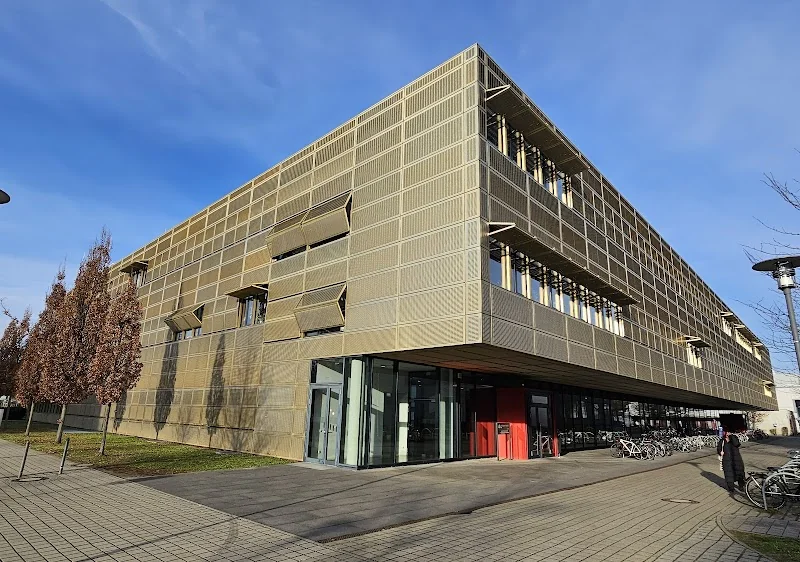
The Golm campus is not only large but also historically grown. On the official Zeitzeichen pages, it is described as the largest campus of the university; at the same time, the university points out that the site is part of the Golm Science Park, which is located on an area of 50 hectares. This explains why there are different types of buildings: historical structures from earlier usage phases, converted existing buildings, and very modern new buildings with laboratories, seminar rooms, and offices. Particularly notable are the building numbers 4, 14, 18, and 28, as they frequently appear in directions. Building 4 is the cafeteria, Building 14 is a central area for Human Sciences, Building 18 is the IKMZ, and Building 28 is the so-called Golden Cage for Physics and Astronomy. Those looking for photos or a location map will therefore be guided not only through the architecture but also through the spatial order of the campus on the official pages. ([uni-potsdam.de](https://www.uni-potsdam.de/en/zeitzeichen/gallery/now-and-then-the-university-of-potsdam/golm))
For practical orientation, it is also important that the Golm campus has a clear core area. The university describes that many facilities concentrate in the historical and newer parts of the site and that the campus, due to its location on the edge of Potsdam, appears rather open and spacious. This is one of the reasons why visitors often find the location pleasantly quiet. At the same time, one should plan enough time when moving between several buildings. For example, if one has to go from the train station to an institute in Building 27 or from the cafeteria to the IKMZ, one moves across a real campus with several paths and courtyards. Therefore, location maps and building numbers are particularly important in Golm. ([uni-potsdam.de](https://www.uni-potsdam.de/en/zeitzeichen/locations/golm))
Access by Train, Bus, and Car
For arrival, Golm train station is the most important reference point. Official university pages emphasize that the campus is only a few minutes' walk from there. Depending on the page and target area on the site, the university lists different regional train and bus connections, including RB21 and RB22, and in some directions also RB20, as well as bus lines 605, 606, X1, X5, and 612. This primarily shows one thing: Golm is closely connected to regional transport and can be easily reached from Potsdam and the surrounding Berlin area. Those arriving by train should follow the signs towards the university after getting off at Golm station and plan some time for a short walk for the last stretch. ([uni-potsdam.de](https://www.uni-potsdam.de/en/llw/how-to-find-us/campus-golm?utm_source=openai))
It is also officially easy to reach the location by car. The university describes in an event information document the access via the A10 with exit 24 Leest and via the A115 with exit Potsdam Babelsberg; from there, visitors follow the signs towards Potsdam, Golm, and the university. For people arriving with luggage, technology, or strollers, the parking situation is a significant advantage: Free parking spaces are available on the university campus Golm, and another official page mentions that there are sufficient parking spaces available. It is practical that some buildings are directly mentioned in the directions, allowing visitors to narrow down their destination in advance by building numbers and entrances. Those who orient themselves early usually arrive at the Golm campus without detours. ([uni-potsdam.de](https://www.uni-potsdam.de/en/futurelearningcamp/willkommen/tagungsort-und-anfahrt?utm_source=openai))
Faculties, Institutes, and Learning Places in Golm
In terms of content, Golm is one of the most important scientific locations of the University of Potsdam. The official Zeitzeichen pages clearly state that the Faculty of Human Sciences and the Faculty of Mathematics and Natural Sciences are primarily located here. The Institute of Physics and Astronomy even describes the campus as a modern study location with close connections to the nearby Max Planck and Fraunhofer institutes. This mixture of university teaching and extra-university research shapes the character of Golm. For students, this means short distances between seminar rooms, laboratories, libraries, and the cafeteria; for guests, it means a wide thematic range from teacher training to highly specialized research. ([uni-potsdam.de](https://www.uni-potsdam.de/en/zeitzeichen/gallery/now-and-then-the-university-of-potsdam/golm))
This is particularly evident at the Department of Psychology, which is located in Building 14 and is explicitly located on the campus page. Physics is also represented with its own building complex; the institute page describes the building as an elegant new building with teaching and seminar rooms as well as workspaces for students. Other disciplines at the site range from chemistry to biology to earth and environmental sciences. This disciplinary diversity makes Golm so attractive to interested parties because the campus does not function like a single subject building but like a small scientific quarter. Those who are there encounter very different learning and research worlds living closely together. ([uni-potsdam.de](https://www.uni-potsdam.de/en/department-psychologie/index))
A central place for study is also the IKMZ in Building 18. The university library explains that the literature for humanities and natural sciences is bundled in Golm at the IKMZ and that the university library provides a large part of its holdings there. In the official campus texts, the IKMZ is described as a building that was opened in 2011 and now houses around one million books and other media. In addition, there are reading rooms, service offerings, and proximity to other institute buildings. For visitors, this is not only practical but also architecturally exciting, as the IKMZ, as a prominent building, visibly shapes the modern part of the campus. Those learning or researching in Golm thus have a clear anchor point in the middle of the campus. ([ub.uni-potsdam.de](https://www.ub.uni-potsdam.de/en/about-us/about-the-university-library?utm_source=openai))
History of the Golm Campus and Its Notable Buildings
The history of Golm is unusual and explains much of the current atmosphere. The university describes on its Zeitzeichen page that barracks initially stood on the site in the 1930s and that it was used by the Luftwaffe for reconnaissance starting in 1943. In 1951, the training facility of the Ministry for State Security moved in, which was used under various names until 1989. Only with the founding of the University of Potsdam in July 1991 did the university take over the area, which is now part of the Golm Science Park. This eventful past is still visible in the buildings today, as historical buildings, post-war usage, and new research architecture stand side by side. ([uni-potsdam.de](https://www.uni-potsdam.de/en/zeitzeichen/locations/golm))
Among the most notable buildings are the cafeteria in Building 4, which according to the university is housed in a former Luftwaffe measuring hall from 1936, and Building 14, which was constructed as a seven-story prefabricated building in 1977 and redesigned in 2010/11. The so-called Golden Cage building, that is Building 28, was built between 2006 and 2008 and serves as a laboratory building for physicists and astronomers. The IKMZ in Building 18 was opened in 2011 and later received an award in university construction. These buildings not only tell the story of construction but also of university history: from military and administrative buildings to a modern science campus. This is why Golm is as exciting for architecture and history enthusiasts as it is for students. ([uni-potsdam.de](https://www.uni-potsdam.de/en/zeitzeichen/locations/golm/the-university-of-potsdam?utm_source=openai))
The Zeitzeichen pages also emphasize that the University of Potsdam has gradually remodeled, renovated, and supplemented the buildings in Golm since its founding. Thus, a heterogeneous area has become a campus that is now considered the largest location of the university and is closely linked to the Science Park. For visitors, this is particularly interesting because historical traces and modern research do not displace each other but visibly complement each other. Therefore, those walking across the campus see not only seminar rooms and libraries but also remnants of various architectural eras, courtyards with clear lines, and new buildings that reflect the scientific development of recent decades. Golm is thus not just any university location but a place with a strong profile and a clearly readable history. ([uni-potsdam.de](https://www.uni-potsdam.de/en/zeitzeichen/locations/golm))
Photos, Reviews, and Practical Visitor Tips
Those looking for photos of the Golm campus will indeed find many images and impressions on the official university pages. The Zeitzeichen gallery shows historical and current views of the site, while other pages provide aerial photos, building impressions, and detail photos of individual houses. This is helpful because visitors can get a sense of the size of the site and the impact of the architecture even before their arrival. At the same time, the provided location data with 4.5 stars based on 158 reviews fits well with the impression that Golm is perceived by many guests as a functional, well-organized, and characterful campus. Therefore, those looking for photos, location maps, and reviews should consider the official location pages and the existing evaluation picture together. ([uni-potsdam.de](https://www.uni-potsdam.de/en/zeitzeichen/gallery/now-and-then-the-university-of-potsdam/golm))
For the first visit, a simple plan is recommended: note the address, check the building number, determine the arrival by train or car in advance, and allow enough time for the walk from the train station or parking lot. The campus is well organized, but as the largest location of the university, it is also extensive. Those attending an event in Building 25, a meeting in Building 14, or the library in the IKMZ should know their destination in advance. Particularly practical is that the university provides location maps, maps, and directions on several pages, making orientation easier. This turns a first visit quickly into a routine path across a campus that uniquely connects science, history, and everyday life. ([uni-potsdam.de](https://www.uni-potsdam.de/en/department-psychologie/index))
Even for visitors who do not participate in a specific event, Golm is worth a visit. The location shows how a university can develop over decades: from historical buildings, from spacious new buildings, from libraries, cafeterias, laboratories, and institutes. The environment of the Science Park, the proximity to Golm train station, and the good accessibility by bus make the campus practical for everyday use. Those who want to understand the University of Potsdam cannot overlook Golm, as a large part of the disciplinary diversity and architectural identity becomes visible here. This is why inquiries about address, location map, directions, parking, photos, and reviews are so typical for this location. Golm is indeed not just a point on the map but one of the most defining places of the University of Potsdam. ([uni-potsdam.de](https://www.uni-potsdam.de/en/zeitzeichen/locations/golm))
Sources:
- University of Potsdam - Campus Golm / How to find us ([uni-potsdam.de](https://www.uni-potsdam.de/en/llw/how-to-find-us/campus-golm?utm_source=openai))
- University of Potsdam - Directions and Addresses ([uni-potsdam.de](https://www.uni-potsdam.de/de/adressen/anfahrt?utm_source=openai))
- University of Potsdam - Zeitzeichen Golm: The University of Potsdam ([uni-potsdam.de](https://www.uni-potsdam.de/en/zeitzeichen/locations/golm/the-university-of-potsdam?utm_source=openai))
- University of Potsdam - Zeitzeichen Gallery: Golm ([uni-potsdam.de](https://www.uni-potsdam.de/en/zeitzeichen/gallery/now-and-then-the-university-of-potsdam/golm))
- University of Potsdam - Institute of Physics and Astronomy ([uni-potsdam.de](https://www.uni-potsdam.de/en/physik/))
- University Library Potsdam - About the University Library ([ub.uni-potsdam.de](https://www.ub.uni-potsdam.de/en/about-us/about-the-university-library?utm_source=openai))
- University of Potsdam - Campus Golm PDF Directions ([uni-potsdam.de](https://www.uni-potsdam.de/fileadmin/projects/ling/webseite/Beschreibung_Golm.pdf))
Show moreShow less
University of Potsdam Campus Golm | Location Map & Address
The Golm campus of the University of Potsdam is not just a place on the map for many visitors, but a complete scientific location with a clear structure, its own history, and very good connections. Those looking for the address, a location map, photos, or practical information such as directions and parking will find themselves in the right place here. The campus is located west of downtown Potsdam and, with 62,000 square meters, is the largest of the three main locations of the University of Potsdam. At the same time, it is part of the Golm Science Park, which also hosts facilities of the Max Planck and Fraunhofer Societies. This connects university life, research, and campus everyday life in a compact space. ([uni-potsdam.de](https://www.uni-potsdam.de/en/zeitzeichen/locations/golm))
This mixture makes Golm particularly interesting for students, teachers, researchers, and guests. On the official university pages, there are location maps, directions, and historical images that show how the site has developed. Today, modern laboratory and teaching buildings, the IKMZ, the faculties of Human Sciences and Mathematics and Natural Sciences, and numerous departments shape the image. For visitors, it is important: The campus is large but well organized. Those who know the right building can usually find their way quickly thanks to signage, location maps, and a clear campus structure. ([uni-potsdam.de](https://www.uni-potsdam.de/en/zeitzeichen/gallery/now-and-then-the-university-of-potsdam/golm))
Location Map, Address, and Orientation on the Golm Campus
The most important address for the campus is Karl-Liebknecht-Straße 24-25, 14476 Potsdam. Official university pages list Golm as a location on the western edge of the city; other pages provide the same address for individual facilities, such as the Department of Psychology or events in Building 25. This is helpful for orientation, as on a campus of this size, the street address alone is usually not sufficient. Often, the specific building is crucial, such as Building 14 for the Department of Psychology, Building 18 for the IKMZ, Building 25 for event locations, or Building 27 for individual scientific institutes. Those who familiarize themselves with the campus map in advance save time on-site and approach seminars, meetings, or tours in a much more relaxed manner. ([uni-potsdam.de](https://www.uni-potsdam.de/en/llw/how-to-find-us/campus-golm?utm_source=openai))
The Golm campus is not only large but also historically grown. On the official Zeitzeichen pages, it is described as the largest campus of the university; at the same time, the university points out that the site is part of the Golm Science Park, which is located on an area of 50 hectares. This explains why there are different types of buildings: historical structures from earlier usage phases, converted existing buildings, and very modern new buildings with laboratories, seminar rooms, and offices. Particularly notable are the building numbers 4, 14, 18, and 28, as they frequently appear in directions. Building 4 is the cafeteria, Building 14 is a central area for Human Sciences, Building 18 is the IKMZ, and Building 28 is the so-called Golden Cage for Physics and Astronomy. Those looking for photos or a location map will therefore be guided not only through the architecture but also through the spatial order of the campus on the official pages. ([uni-potsdam.de](https://www.uni-potsdam.de/en/zeitzeichen/gallery/now-and-then-the-university-of-potsdam/golm))
For practical orientation, it is also important that the Golm campus has a clear core area. The university describes that many facilities concentrate in the historical and newer parts of the site and that the campus, due to its location on the edge of Potsdam, appears rather open and spacious. This is one of the reasons why visitors often find the location pleasantly quiet. At the same time, one should plan enough time when moving between several buildings. For example, if one has to go from the train station to an institute in Building 27 or from the cafeteria to the IKMZ, one moves across a real campus with several paths and courtyards. Therefore, location maps and building numbers are particularly important in Golm. ([uni-potsdam.de](https://www.uni-potsdam.de/en/zeitzeichen/locations/golm))
Access by Train, Bus, and Car
For arrival, Golm train station is the most important reference point. Official university pages emphasize that the campus is only a few minutes' walk from there. Depending on the page and target area on the site, the university lists different regional train and bus connections, including RB21 and RB22, and in some directions also RB20, as well as bus lines 605, 606, X1, X5, and 612. This primarily shows one thing: Golm is closely connected to regional transport and can be easily reached from Potsdam and the surrounding Berlin area. Those arriving by train should follow the signs towards the university after getting off at Golm station and plan some time for a short walk for the last stretch. ([uni-potsdam.de](https://www.uni-potsdam.de/en/llw/how-to-find-us/campus-golm?utm_source=openai))
It is also officially easy to reach the location by car. The university describes in an event information document the access via the A10 with exit 24 Leest and via the A115 with exit Potsdam Babelsberg; from there, visitors follow the signs towards Potsdam, Golm, and the university. For people arriving with luggage, technology, or strollers, the parking situation is a significant advantage: Free parking spaces are available on the university campus Golm, and another official page mentions that there are sufficient parking spaces available. It is practical that some buildings are directly mentioned in the directions, allowing visitors to narrow down their destination in advance by building numbers and entrances. Those who orient themselves early usually arrive at the Golm campus without detours. ([uni-potsdam.de](https://www.uni-potsdam.de/en/futurelearningcamp/willkommen/tagungsort-und-anfahrt?utm_source=openai))
Faculties, Institutes, and Learning Places in Golm
In terms of content, Golm is one of the most important scientific locations of the University of Potsdam. The official Zeitzeichen pages clearly state that the Faculty of Human Sciences and the Faculty of Mathematics and Natural Sciences are primarily located here. The Institute of Physics and Astronomy even describes the campus as a modern study location with close connections to the nearby Max Planck and Fraunhofer institutes. This mixture of university teaching and extra-university research shapes the character of Golm. For students, this means short distances between seminar rooms, laboratories, libraries, and the cafeteria; for guests, it means a wide thematic range from teacher training to highly specialized research. ([uni-potsdam.de](https://www.uni-potsdam.de/en/zeitzeichen/gallery/now-and-then-the-university-of-potsdam/golm))
This is particularly evident at the Department of Psychology, which is located in Building 14 and is explicitly located on the campus page. Physics is also represented with its own building complex; the institute page describes the building as an elegant new building with teaching and seminar rooms as well as workspaces for students. Other disciplines at the site range from chemistry to biology to earth and environmental sciences. This disciplinary diversity makes Golm so attractive to interested parties because the campus does not function like a single subject building but like a small scientific quarter. Those who are there encounter very different learning and research worlds living closely together. ([uni-potsdam.de](https://www.uni-potsdam.de/en/department-psychologie/index))
A central place for study is also the IKMZ in Building 18. The university library explains that the literature for humanities and natural sciences is bundled in Golm at the IKMZ and that the university library provides a large part of its holdings there. In the official campus texts, the IKMZ is described as a building that was opened in 2011 and now houses around one million books and other media. In addition, there are reading rooms, service offerings, and proximity to other institute buildings. For visitors, this is not only practical but also architecturally exciting, as the IKMZ, as a prominent building, visibly shapes the modern part of the campus. Those learning or researching in Golm thus have a clear anchor point in the middle of the campus. ([ub.uni-potsdam.de](https://www.ub.uni-potsdam.de/en/about-us/about-the-university-library?utm_source=openai))
History of the Golm Campus and Its Notable Buildings
The history of Golm is unusual and explains much of the current atmosphere. The university describes on its Zeitzeichen page that barracks initially stood on the site in the 1930s and that it was used by the Luftwaffe for reconnaissance starting in 1943. In 1951, the training facility of the Ministry for State Security moved in, which was used under various names until 1989. Only with the founding of the University of Potsdam in July 1991 did the university take over the area, which is now part of the Golm Science Park. This eventful past is still visible in the buildings today, as historical buildings, post-war usage, and new research architecture stand side by side. ([uni-potsdam.de](https://www.uni-potsdam.de/en/zeitzeichen/locations/golm))
Among the most notable buildings are the cafeteria in Building 4, which according to the university is housed in a former Luftwaffe measuring hall from 1936, and Building 14, which was constructed as a seven-story prefabricated building in 1977 and redesigned in 2010/11. The so-called Golden Cage building, that is Building 28, was built between 2006 and 2008 and serves as a laboratory building for physicists and astronomers. The IKMZ in Building 18 was opened in 2011 and later received an award in university construction. These buildings not only tell the story of construction but also of university history: from military and administrative buildings to a modern science campus. This is why Golm is as exciting for architecture and history enthusiasts as it is for students. ([uni-potsdam.de](https://www.uni-potsdam.de/en/zeitzeichen/locations/golm/the-university-of-potsdam?utm_source=openai))
The Zeitzeichen pages also emphasize that the University of Potsdam has gradually remodeled, renovated, and supplemented the buildings in Golm since its founding. Thus, a heterogeneous area has become a campus that is now considered the largest location of the university and is closely linked to the Science Park. For visitors, this is particularly interesting because historical traces and modern research do not displace each other but visibly complement each other. Therefore, those walking across the campus see not only seminar rooms and libraries but also remnants of various architectural eras, courtyards with clear lines, and new buildings that reflect the scientific development of recent decades. Golm is thus not just any university location but a place with a strong profile and a clearly readable history. ([uni-potsdam.de](https://www.uni-potsdam.de/en/zeitzeichen/locations/golm))
Photos, Reviews, and Practical Visitor Tips
Those looking for photos of the Golm campus will indeed find many images and impressions on the official university pages. The Zeitzeichen gallery shows historical and current views of the site, while other pages provide aerial photos, building impressions, and detail photos of individual houses. This is helpful because visitors can get a sense of the size of the site and the impact of the architecture even before their arrival. At the same time, the provided location data with 4.5 stars based on 158 reviews fits well with the impression that Golm is perceived by many guests as a functional, well-organized, and characterful campus. Therefore, those looking for photos, location maps, and reviews should consider the official location pages and the existing evaluation picture together. ([uni-potsdam.de](https://www.uni-potsdam.de/en/zeitzeichen/gallery/now-and-then-the-university-of-potsdam/golm))
For the first visit, a simple plan is recommended: note the address, check the building number, determine the arrival by train or car in advance, and allow enough time for the walk from the train station or parking lot. The campus is well organized, but as the largest location of the university, it is also extensive. Those attending an event in Building 25, a meeting in Building 14, or the library in the IKMZ should know their destination in advance. Particularly practical is that the university provides location maps, maps, and directions on several pages, making orientation easier. This turns a first visit quickly into a routine path across a campus that uniquely connects science, history, and everyday life. ([uni-potsdam.de](https://www.uni-potsdam.de/en/department-psychologie/index))
Even for visitors who do not participate in a specific event, Golm is worth a visit. The location shows how a university can develop over decades: from historical buildings, from spacious new buildings, from libraries, cafeterias, laboratories, and institutes. The environment of the Science Park, the proximity to Golm train station, and the good accessibility by bus make the campus practical for everyday use. Those who want to understand the University of Potsdam cannot overlook Golm, as a large part of the disciplinary diversity and architectural identity becomes visible here. This is why inquiries about address, location map, directions, parking, photos, and reviews are so typical for this location. Golm is indeed not just a point on the map but one of the most defining places of the University of Potsdam. ([uni-potsdam.de](https://www.uni-potsdam.de/en/zeitzeichen/locations/golm))
Sources:
- University of Potsdam - Campus Golm / How to find us ([uni-potsdam.de](https://www.uni-potsdam.de/en/llw/how-to-find-us/campus-golm?utm_source=openai))
- University of Potsdam - Directions and Addresses ([uni-potsdam.de](https://www.uni-potsdam.de/de/adressen/anfahrt?utm_source=openai))
- University of Potsdam - Zeitzeichen Golm: The University of Potsdam ([uni-potsdam.de](https://www.uni-potsdam.de/en/zeitzeichen/locations/golm/the-university-of-potsdam?utm_source=openai))
- University of Potsdam - Zeitzeichen Gallery: Golm ([uni-potsdam.de](https://www.uni-potsdam.de/en/zeitzeichen/gallery/now-and-then-the-university-of-potsdam/golm))
- University of Potsdam - Institute of Physics and Astronomy ([uni-potsdam.de](https://www.uni-potsdam.de/en/physik/))
- University Library Potsdam - About the University Library ([ub.uni-potsdam.de](https://www.ub.uni-potsdam.de/en/about-us/about-the-university-library?utm_source=openai))
- University of Potsdam - Campus Golm PDF Directions ([uni-potsdam.de](https://www.uni-potsdam.de/fileadmin/projects/ling/webseite/Beschreibung_Golm.pdf))
University of Potsdam Campus Golm | Location Map & Address
The Golm campus of the University of Potsdam is not just a place on the map for many visitors, but a complete scientific location with a clear structure, its own history, and very good connections. Those looking for the address, a location map, photos, or practical information such as directions and parking will find themselves in the right place here. The campus is located west of downtown Potsdam and, with 62,000 square meters, is the largest of the three main locations of the University of Potsdam. At the same time, it is part of the Golm Science Park, which also hosts facilities of the Max Planck and Fraunhofer Societies. This connects university life, research, and campus everyday life in a compact space. ([uni-potsdam.de](https://www.uni-potsdam.de/en/zeitzeichen/locations/golm))
This mixture makes Golm particularly interesting for students, teachers, researchers, and guests. On the official university pages, there are location maps, directions, and historical images that show how the site has developed. Today, modern laboratory and teaching buildings, the IKMZ, the faculties of Human Sciences and Mathematics and Natural Sciences, and numerous departments shape the image. For visitors, it is important: The campus is large but well organized. Those who know the right building can usually find their way quickly thanks to signage, location maps, and a clear campus structure. ([uni-potsdam.de](https://www.uni-potsdam.de/en/zeitzeichen/gallery/now-and-then-the-university-of-potsdam/golm))
Location Map, Address, and Orientation on the Golm Campus
The most important address for the campus is Karl-Liebknecht-Straße 24-25, 14476 Potsdam. Official university pages list Golm as a location on the western edge of the city; other pages provide the same address for individual facilities, such as the Department of Psychology or events in Building 25. This is helpful for orientation, as on a campus of this size, the street address alone is usually not sufficient. Often, the specific building is crucial, such as Building 14 for the Department of Psychology, Building 18 for the IKMZ, Building 25 for event locations, or Building 27 for individual scientific institutes. Those who familiarize themselves with the campus map in advance save time on-site and approach seminars, meetings, or tours in a much more relaxed manner. ([uni-potsdam.de](https://www.uni-potsdam.de/en/llw/how-to-find-us/campus-golm?utm_source=openai))
The Golm campus is not only large but also historically grown. On the official Zeitzeichen pages, it is described as the largest campus of the university; at the same time, the university points out that the site is part of the Golm Science Park, which is located on an area of 50 hectares. This explains why there are different types of buildings: historical structures from earlier usage phases, converted existing buildings, and very modern new buildings with laboratories, seminar rooms, and offices. Particularly notable are the building numbers 4, 14, 18, and 28, as they frequently appear in directions. Building 4 is the cafeteria, Building 14 is a central area for Human Sciences, Building 18 is the IKMZ, and Building 28 is the so-called Golden Cage for Physics and Astronomy. Those looking for photos or a location map will therefore be guided not only through the architecture but also through the spatial order of the campus on the official pages. ([uni-potsdam.de](https://www.uni-potsdam.de/en/zeitzeichen/gallery/now-and-then-the-university-of-potsdam/golm))
For practical orientation, it is also important that the Golm campus has a clear core area. The university describes that many facilities concentrate in the historical and newer parts of the site and that the campus, due to its location on the edge of Potsdam, appears rather open and spacious. This is one of the reasons why visitors often find the location pleasantly quiet. At the same time, one should plan enough time when moving between several buildings. For example, if one has to go from the train station to an institute in Building 27 or from the cafeteria to the IKMZ, one moves across a real campus with several paths and courtyards. Therefore, location maps and building numbers are particularly important in Golm. ([uni-potsdam.de](https://www.uni-potsdam.de/en/zeitzeichen/locations/golm))
Access by Train, Bus, and Car
For arrival, Golm train station is the most important reference point. Official university pages emphasize that the campus is only a few minutes' walk from there. Depending on the page and target area on the site, the university lists different regional train and bus connections, including RB21 and RB22, and in some directions also RB20, as well as bus lines 605, 606, X1, X5, and 612. This primarily shows one thing: Golm is closely connected to regional transport and can be easily reached from Potsdam and the surrounding Berlin area. Those arriving by train should follow the signs towards the university after getting off at Golm station and plan some time for a short walk for the last stretch. ([uni-potsdam.de](https://www.uni-potsdam.de/en/llw/how-to-find-us/campus-golm?utm_source=openai))
It is also officially easy to reach the location by car. The university describes in an event information document the access via the A10 with exit 24 Leest and via the A115 with exit Potsdam Babelsberg; from there, visitors follow the signs towards Potsdam, Golm, and the university. For people arriving with luggage, technology, or strollers, the parking situation is a significant advantage: Free parking spaces are available on the university campus Golm, and another official page mentions that there are sufficient parking spaces available. It is practical that some buildings are directly mentioned in the directions, allowing visitors to narrow down their destination in advance by building numbers and entrances. Those who orient themselves early usually arrive at the Golm campus without detours. ([uni-potsdam.de](https://www.uni-potsdam.de/en/futurelearningcamp/willkommen/tagungsort-und-anfahrt?utm_source=openai))
Faculties, Institutes, and Learning Places in Golm
In terms of content, Golm is one of the most important scientific locations of the University of Potsdam. The official Zeitzeichen pages clearly state that the Faculty of Human Sciences and the Faculty of Mathematics and Natural Sciences are primarily located here. The Institute of Physics and Astronomy even describes the campus as a modern study location with close connections to the nearby Max Planck and Fraunhofer institutes. This mixture of university teaching and extra-university research shapes the character of Golm. For students, this means short distances between seminar rooms, laboratories, libraries, and the cafeteria; for guests, it means a wide thematic range from teacher training to highly specialized research. ([uni-potsdam.de](https://www.uni-potsdam.de/en/zeitzeichen/gallery/now-and-then-the-university-of-potsdam/golm))
This is particularly evident at the Department of Psychology, which is located in Building 14 and is explicitly located on the campus page. Physics is also represented with its own building complex; the institute page describes the building as an elegant new building with teaching and seminar rooms as well as workspaces for students. Other disciplines at the site range from chemistry to biology to earth and environmental sciences. This disciplinary diversity makes Golm so attractive to interested parties because the campus does not function like a single subject building but like a small scientific quarter. Those who are there encounter very different learning and research worlds living closely together. ([uni-potsdam.de](https://www.uni-potsdam.de/en/department-psychologie/index))
A central place for study is also the IKMZ in Building 18. The university library explains that the literature for humanities and natural sciences is bundled in Golm at the IKMZ and that the university library provides a large part of its holdings there. In the official campus texts, the IKMZ is described as a building that was opened in 2011 and now houses around one million books and other media. In addition, there are reading rooms, service offerings, and proximity to other institute buildings. For visitors, this is not only practical but also architecturally exciting, as the IKMZ, as a prominent building, visibly shapes the modern part of the campus. Those learning or researching in Golm thus have a clear anchor point in the middle of the campus. ([ub.uni-potsdam.de](https://www.ub.uni-potsdam.de/en/about-us/about-the-university-library?utm_source=openai))
History of the Golm Campus and Its Notable Buildings
The history of Golm is unusual and explains much of the current atmosphere. The university describes on its Zeitzeichen page that barracks initially stood on the site in the 1930s and that it was used by the Luftwaffe for reconnaissance starting in 1943. In 1951, the training facility of the Ministry for State Security moved in, which was used under various names until 1989. Only with the founding of the University of Potsdam in July 1991 did the university take over the area, which is now part of the Golm Science Park. This eventful past is still visible in the buildings today, as historical buildings, post-war usage, and new research architecture stand side by side. ([uni-potsdam.de](https://www.uni-potsdam.de/en/zeitzeichen/locations/golm))
Among the most notable buildings are the cafeteria in Building 4, which according to the university is housed in a former Luftwaffe measuring hall from 1936, and Building 14, which was constructed as a seven-story prefabricated building in 1977 and redesigned in 2010/11. The so-called Golden Cage building, that is Building 28, was built between 2006 and 2008 and serves as a laboratory building for physicists and astronomers. The IKMZ in Building 18 was opened in 2011 and later received an award in university construction. These buildings not only tell the story of construction but also of university history: from military and administrative buildings to a modern science campus. This is why Golm is as exciting for architecture and history enthusiasts as it is for students. ([uni-potsdam.de](https://www.uni-potsdam.de/en/zeitzeichen/locations/golm/the-university-of-potsdam?utm_source=openai))
The Zeitzeichen pages also emphasize that the University of Potsdam has gradually remodeled, renovated, and supplemented the buildings in Golm since its founding. Thus, a heterogeneous area has become a campus that is now considered the largest location of the university and is closely linked to the Science Park. For visitors, this is particularly interesting because historical traces and modern research do not displace each other but visibly complement each other. Therefore, those walking across the campus see not only seminar rooms and libraries but also remnants of various architectural eras, courtyards with clear lines, and new buildings that reflect the scientific development of recent decades. Golm is thus not just any university location but a place with a strong profile and a clearly readable history. ([uni-potsdam.de](https://www.uni-potsdam.de/en/zeitzeichen/locations/golm))
Photos, Reviews, and Practical Visitor Tips
Those looking for photos of the Golm campus will indeed find many images and impressions on the official university pages. The Zeitzeichen gallery shows historical and current views of the site, while other pages provide aerial photos, building impressions, and detail photos of individual houses. This is helpful because visitors can get a sense of the size of the site and the impact of the architecture even before their arrival. At the same time, the provided location data with 4.5 stars based on 158 reviews fits well with the impression that Golm is perceived by many guests as a functional, well-organized, and characterful campus. Therefore, those looking for photos, location maps, and reviews should consider the official location pages and the existing evaluation picture together. ([uni-potsdam.de](https://www.uni-potsdam.de/en/zeitzeichen/gallery/now-and-then-the-university-of-potsdam/golm))
For the first visit, a simple plan is recommended: note the address, check the building number, determine the arrival by train or car in advance, and allow enough time for the walk from the train station or parking lot. The campus is well organized, but as the largest location of the university, it is also extensive. Those attending an event in Building 25, a meeting in Building 14, or the library in the IKMZ should know their destination in advance. Particularly practical is that the university provides location maps, maps, and directions on several pages, making orientation easier. This turns a first visit quickly into a routine path across a campus that uniquely connects science, history, and everyday life. ([uni-potsdam.de](https://www.uni-potsdam.de/en/department-psychologie/index))
Even for visitors who do not participate in a specific event, Golm is worth a visit. The location shows how a university can develop over decades: from historical buildings, from spacious new buildings, from libraries, cafeterias, laboratories, and institutes. The environment of the Science Park, the proximity to Golm train station, and the good accessibility by bus make the campus practical for everyday use. Those who want to understand the University of Potsdam cannot overlook Golm, as a large part of the disciplinary diversity and architectural identity becomes visible here. This is why inquiries about address, location map, directions, parking, photos, and reviews are so typical for this location. Golm is indeed not just a point on the map but one of the most defining places of the University of Potsdam. ([uni-potsdam.de](https://www.uni-potsdam.de/en/zeitzeichen/locations/golm))
Sources:
- University of Potsdam - Campus Golm / How to find us ([uni-potsdam.de](https://www.uni-potsdam.de/en/llw/how-to-find-us/campus-golm?utm_source=openai))
- University of Potsdam - Directions and Addresses ([uni-potsdam.de](https://www.uni-potsdam.de/de/adressen/anfahrt?utm_source=openai))
- University of Potsdam - Zeitzeichen Golm: The University of Potsdam ([uni-potsdam.de](https://www.uni-potsdam.de/en/zeitzeichen/locations/golm/the-university-of-potsdam?utm_source=openai))
- University of Potsdam - Zeitzeichen Gallery: Golm ([uni-potsdam.de](https://www.uni-potsdam.de/en/zeitzeichen/gallery/now-and-then-the-university-of-potsdam/golm))
- University of Potsdam - Institute of Physics and Astronomy ([uni-potsdam.de](https://www.uni-potsdam.de/en/physik/))
- University Library Potsdam - About the University Library ([ub.uni-potsdam.de](https://www.ub.uni-potsdam.de/en/about-us/about-the-university-library?utm_source=openai))
- University of Potsdam - Campus Golm PDF Directions ([uni-potsdam.de](https://www.uni-potsdam.de/fileadmin/projects/ling/webseite/Beschreibung_Golm.pdf))
Upcoming Events
No events found
Frequently Asked Questions
Reviews
Aiswarya Abhisek Mohapatra
19. February 2026
A great research university in Germany with lots of international students and postdocs.
Hakeem Usman
4. October 2020
Serene environment for learning. University of Potsdam has everything in place you need to succeed as a student either your discipline is in the STEM or Humanities. The Golm Campus is the one you should take time to tour. State of the art facilities especially for research in STEM. Great stuffs here. Come check for yourself.
Mohammed Rafsan Hussain
7. May 2024
An university that you must visit if you are visiting Berlin or nearby. University area is enclosed with beautiful nature.
Bioinf gferdofet
28. March 2023
The library is spacious but a lot of noise is easily generated. Whispering and typing sounds louder, footsteps, chair movements are amplified, you can hear the noise of machines from every angle of the reading room.
Peter G
9. September 2025
very unmodern, no ev charging and very little solar.