
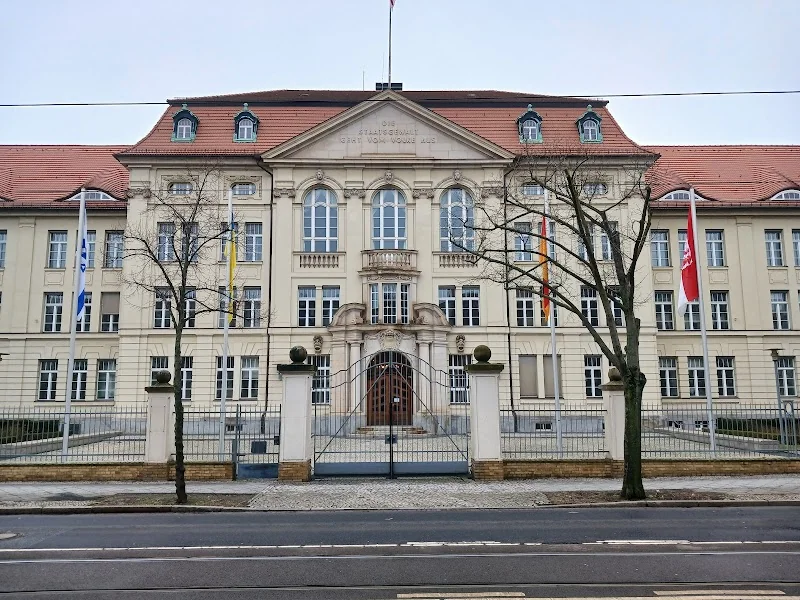
Heinrich-Mann-Allee 107, Potsdam
Heinrich-Mann-Allee 107, 14473 Potsdam, Germany
State Chancellery of Brandenburg | Address & Directions
The State Chancellery of Brandenburg is the central hub of the state government in Potsdam, located at Heinrich-Mann-Allee 107. Those searching for this address usually want to know not only the name of the building but also how to quickly understand how to reach the premises, where the visitor entrance is located, and what rules apply during an appointment. That is why terms like address, site plan, directions, and parking are so closely associated with the State Chancellery. At the same time, the location has a historically complex background: the area was not always a government seat but has evolved over centuries from forest and military use to a property of the state. Today, political governance, administration, and historical building substance come together in a compact space. This page provides a factual overview of the location, addresses the most important visitor questions, and shows why the State Chancellery in Brandenburg is much more than just an administrative building. ([service.brandenburg.de](https://service.brandenburg.de/service/de/adressen/behoerdenverzeichnis/ansicht/~021001-staatskanzlei-des-landes-brandenburg))
Address, Site Plan, and Directions to the State Chancellery Brandenburg
The official address of the State Chancellery is Heinrich-Mann-Allee 107, 14473 Potsdam. For those searching, this is more than just a mailing address, as this combination of street name, house number, and city determines whether the location can be quickly found or if one loses unnecessary time in the Potsdam traffic network. The state government explicitly refers to a directions and surrounding map and mentions the access points via Friedhofsgasse and Friedrich-Engels-Straße. Those coming from the city center or the main train station should orient themselves best along these two axes, as the regular visitor entrance is not located at an openly accessible front side but in the controlled area of the government site. This makes the address of the State Chancellery a typical destination for people who are not just looking for an authority but need a precise route description. The proximity to the main train station in Potsdam is also particularly relevant, as it is described in the official visitor information as within walking distance. Thus, the location combines centrality with clearly regulated access, making it easily reachable for appointments, even though it is not an open strolling destination. ([brandenburg.de](https://brandenburg.de/cms/detail.php/bb1.c.488487.de))
The official directions also show that the State Chancellery can be logically reached from several directions. From Potsdam South, the route leads via the B2 towards the center, the Leipzig Triangle, and Friedrich-Engels-Straße, before Friedhofsgasse branches off to the right after about 500 meters. From Potsdam North, the state government describes the route via the A10 exit Potsdam-North, the B273, the B1 or B2, and the Lange Brücke, then half left into Friedrich-Engels-Straße and again right into Friedhofsgasse. Those coming from Potsdam-Babelsberg drive via Nuthe-Schnell-Straße, Horstweg, and Heinrich-Mann-Allee before also turning into Friedhofsgasse. This clear route guidance is important for visitors because it shows that the location, although centrally located, ultimately transitions into a strictly regulated government area. That is why site plan, directions, and address are the most important search terms related to the State Chancellery Brandenburg. ([brandenburg.de](https://brandenburg.de/cms/detail.php/bb1.c.488487.de))
Parking, Entry, and Visitor Rules at Heinrich-Mann-Allee 107
Regarding parking, the State Chancellery is consciously organized strictly. There is no parking available on the premises of the state government, and guests may only access the property by car via the Friedhofsgasse entrance. Additionally, prior registration at the State Chancellery is required, as the entry service checks both individuals and license plates. For those with an appointment on-site, this regulation is crucial because it makes the journey planable from the start: first coordinate the appointment, then clarify the admission, and then determine the route. Those arriving without registration should therefore not expect spontaneous parking or free access. This is a significant difference from classic event venues, where parking, entry, and visitor guidance are often handled more openly. The State Chancellery, on the other hand, operates with a clear security and access concept that welcomes guests but organizes access in a controlled manner. Therefore, terms like parking, entry, and visitor rules are just as relevant for searchers as the actual address. ([brandenburg.de](https://brandenburg.de/cms/detail.php/bb1.c.488487.de))
The identification requirement is also clearly regulated. For entry, an official identification document with a photo is required. The state government additionally lists several alternative documents, such as monthly tickets, student or pupil ID cards, library cards, disability ID cards, or health insurance cards, provided a photo is available. For student or daycare groups, it is sufficient for the accompanying person or group leader to identify themselves; the same applies to other closed visitor groups. These details are not just bureaucratic nuances but the basis for ensuring that appointments can start smoothly. Those who arrive prepared save time at the entrance, avoid follow-up questions, and simultaneously show that the location is respected in its role as a government seat. Exactly in this interplay of accessibility and control lies the uniqueness of the State Chancellery Brandenburg: the building is accessible but not arbitrarily open. It is a place for organized visits, not for spontaneous walkthroughs. ([brandenburg.de](https://brandenburg.de/cms/detail.php/bb1.c.488487.de))
History of the Property Heinrich-Mann-Allee 107
The current State Chancellery stands on a site with an exceptionally long prehistory. Until the second half of the 17th century, the area between Heinrich-Mann-Allee and Friedrich-Engels-Straße was still part of a contiguous forest area. Under the Great Elector, it was included in the plans to expand Potsdam into a residence city; around 1665, a menagerie was created there, extending to Caputh and Saarmund. In the 18th century, the area increasingly took on military and social functions. Around 1727, part of it belonged to the military orphanage, which operated a girls' hospital here; in 1769, a boys' hospital and a civil servant's residence were added. This residential building, now referred to as House 2, is the oldest still-existing building on the property and visibly demonstrates how far back the history of the site goes. From 1747, mulberry plantations were established, indicating the economic experiments of the time and the use of the area for state political purposes. Even before the actual use by authorities, this place was a piece of Brandenburg's administrative and usage history. ([brandenburg.de](https://www.brandenburg.de/de/geschichte/bb1.c.490870.de))
In the 19th century, the area became a clear military and educational site. After the occupation of Potsdam by Napoleon's troops, the site served in 1806 as the main cavalry depot, and parts of the buildings burned down in 1807. In 1819, two cabinet orders mandated the establishment of a cadet institution, which was ceremonially inaugurated on August 3, 1822. At the beginning of the 20th century, a fundamental structural renewal followed. The neoclassical main building was redesigned in 1910 according to plans by architect Robert Klingelhöffer in a neo-baroque style and was inaugurated by Kaiser Wilhelm II. With the end of the Prussian cadet corps in 1920, a new phase began in which the site became the State Educational Institution and later the NPEA. The war caused severe damage; in particular, the air raid on April 14, 1945, destroyed numerous building materials. After 1945, the property was gradually renovated, becoming the seat of the provincial authority in 1946 and the state government in 1947, later the district council of Potsdam, and after 1990 again the State Chancellery. This sequence of military, educational, political, and administrative use makes the history of the property Heinrich-Mann-Allee 107 so remarkable. ([brandenburg.de](https://www.brandenburg.de/de/geschichte/bb1.c.490870.de))
Tasks and Organization of the State Chancellery Brandenburg
Today, the State Chancellery of Brandenburg is primarily the administrative and political control center of the state. The authority directory lists it as the location of the state government and assigns it to the Prime Minister. The organizational side also makes visible who politically and administratively shapes the building: Prime Minister Dr. Dietmar Woidke as the highest political reference point, Minister and head of the State Chancellery Kathrin Schneider as the responsible head of the house, and government spokesperson Ines Filohn as an important voice of communication. For those searching, this is relevant because the State Chancellery is not just an address but a place where responsibility converges. Those asking about contact, structure, or jurisdiction will find here the core of Brandenburg's government work. The official information also shows that the State Chancellery works with several departments, ranging from central affairs to coordination and communication, as well as regional development and representation of the state at the federal level. This makes the location an administrative center that closely connects internal governance and public communication. ([service.brandenburg.de](https://service.brandenburg.de/service/de/adressen/behoerdenverzeichnis/ansicht/~021001-staatskanzlei-des-landes-brandenburg))
Especially for SEO and real user questions, this structure is important because many search queries revolve not only around the address but also around the function of the building. Those entering State Chancellery Brandenburg often want to know who works there, how responsibilities are distributed, and what role the building plays in political everyday life. The official presentation answers these questions exactly: Here, coordination, communication, state development, and representation of the state at the federal level come together. The fact that the State Chancellery is also the location of the Prime Minister underscores its political significance. The central phone number and the authority contact also make it clear that this location is an important point of contact for citizen concerns, press inquiries, and institutional coordination. The property is thus not only historically interesting but also a hub in today's administrative structure of Brandenburg, where decision-making, representation, and networking of the state become visible. ([service.brandenburg.de](https://service.brandenburg.de/service/de/adressen/behoerdenverzeichnis/ansicht/~021001-staatskanzlei-des-landes-brandenburg))
Lausitz Commissioner of the Prime Minister and State Representation at the Federal Level
A search term that directly refers to the special role of the State Chancellery is the Lausitz Commissioner of the Prime Minister. In the Brandenburg service portal, this function is assigned to the State Chancellery, as is the representation of the state of Brandenburg at the federal level. This clearly shows that the State Chancellery is not only responsible for internal coordination in Potsdam but also takes on a bridging function between the region, state, and federal government. This is particularly important for Lausitz, as questions of structural development, political support, and regional perspectives are bundled there. Therefore, those searching for Lausitz Commissioner Brandenburg will inevitably find themselves at the State Chancellery, the place where state political coordination is organized. The location Heinrich-Mann-Allee 107 is thus not just an administrative building but also a symbol of how Brandenburg makes regional issues politically visible. The assignment of this position to the State Chancellery also explains why the term is so frequently searched in connection with the address of the building. ([service.brandenburg.de](https://service.brandenburg.de/service/de/adressen/behoerdenverzeichnis/ansicht/~021001-staatskanzlei-des-landes-brandenburg))
The other organizational details from the state portal also fit this picture. The State Chancellery is the area where strategic topics, public communication, and supra-regional interests converge. The assignment of the state representation at the federal level underscores that Brandenburg is represented at this address not only politically but also at the federal level. This makes many search queries regarding contact, contact persons, government structure, and political jurisdiction understandable. The Lausitz Commissioner is not a peripheral topic in this context but a central part of the state strategy. Those who inform themselves about the State Chancellery understand through this assignment that the location has a key function for political mediation and regional representation of interests. This combination of state government, regional responsibility, and federal political representation makes the State Chancellery Brandenburg relevant for visitors, media, and interested citizens alike. ([service.brandenburg.de](https://service.brandenburg.de/service/de/adressen/behoerdenverzeichnis/ansicht/~021001-staatskanzlei-des-landes-brandenburg))
Practical Tips for Visits to Potsdam
Anyone wishing to visit the State Chancellery Brandenburg should always consider the appointment together with the journey. Heinrich-Mann-Allee 107 is easy to find, but the crucial point is the last stretch to the premises. Guests must approach via Friedhofsgasse, and access is controlled. Therefore, it is advisable not to search for the route just before the appointment but to check the directions in advance and plan some buffer time. Especially in Potsdam, traffic can vary depending on the time of day, and since the state government does not provide parking on the premises, a well-planned visit quickly becomes the most important part of the appointment. Those arriving by public transport benefit from the proximity to the main train station; those coming by car should keep the registration, access rules, and identification document firmly in mind. This pragmatic preparation is not only convenient but also aligns with the security concept of the location. ([brandenburg.de](https://brandenburg.de/cms/detail.php/bb1.c.488487.de))
For the first visit, it is also advisable to clearly define one's role: whether it is an official appointment, a group registration, or a guided visitor tour, the necessary IDs and information should be ready before arrival. The official page makes it clear that the control is person-specific and that license plates will also be checked. This makes it understandable why spontaneous solutions on-site are hardly possible. This is an important note for those who were only looking for the address: the State Chancellery Brandenburg is not a normal public place but a secured government seat with clear rules. Those who take this into account will experience the location as a well-organized, historically significant, and politically central place in Potsdam. And this is also reflected in the search terms: address, site plan, directions, parking, and Lausitz Commissioner belong together here because they precisely describe the actual use of the building. ([brandenburg.de](https://brandenburg.de/cms/detail.php/bb1.c.488487.de))
Sources:
- State Government Brandenburg - History of the Property Heinrich-Mann-Allee 107
- State Government Brandenburg - Directions to the State Chancellery
- Service Brandenburg - State Chancellery of Brandenburg
- State Government Brandenburg - Organizational Structure of the State Chancellery
- MBJS Brandenburg - Directions to the State Chancellery
Show moreShow less
State Chancellery of Brandenburg | Address & Directions
The State Chancellery of Brandenburg is the central hub of the state government in Potsdam, located at Heinrich-Mann-Allee 107. Those searching for this address usually want to know not only the name of the building but also how to quickly understand how to reach the premises, where the visitor entrance is located, and what rules apply during an appointment. That is why terms like address, site plan, directions, and parking are so closely associated with the State Chancellery. At the same time, the location has a historically complex background: the area was not always a government seat but has evolved over centuries from forest and military use to a property of the state. Today, political governance, administration, and historical building substance come together in a compact space. This page provides a factual overview of the location, addresses the most important visitor questions, and shows why the State Chancellery in Brandenburg is much more than just an administrative building. ([service.brandenburg.de](https://service.brandenburg.de/service/de/adressen/behoerdenverzeichnis/ansicht/~021001-staatskanzlei-des-landes-brandenburg))
Address, Site Plan, and Directions to the State Chancellery Brandenburg
The official address of the State Chancellery is Heinrich-Mann-Allee 107, 14473 Potsdam. For those searching, this is more than just a mailing address, as this combination of street name, house number, and city determines whether the location can be quickly found or if one loses unnecessary time in the Potsdam traffic network. The state government explicitly refers to a directions and surrounding map and mentions the access points via Friedhofsgasse and Friedrich-Engels-Straße. Those coming from the city center or the main train station should orient themselves best along these two axes, as the regular visitor entrance is not located at an openly accessible front side but in the controlled area of the government site. This makes the address of the State Chancellery a typical destination for people who are not just looking for an authority but need a precise route description. The proximity to the main train station in Potsdam is also particularly relevant, as it is described in the official visitor information as within walking distance. Thus, the location combines centrality with clearly regulated access, making it easily reachable for appointments, even though it is not an open strolling destination. ([brandenburg.de](https://brandenburg.de/cms/detail.php/bb1.c.488487.de))
The official directions also show that the State Chancellery can be logically reached from several directions. From Potsdam South, the route leads via the B2 towards the center, the Leipzig Triangle, and Friedrich-Engels-Straße, before Friedhofsgasse branches off to the right after about 500 meters. From Potsdam North, the state government describes the route via the A10 exit Potsdam-North, the B273, the B1 or B2, and the Lange Brücke, then half left into Friedrich-Engels-Straße and again right into Friedhofsgasse. Those coming from Potsdam-Babelsberg drive via Nuthe-Schnell-Straße, Horstweg, and Heinrich-Mann-Allee before also turning into Friedhofsgasse. This clear route guidance is important for visitors because it shows that the location, although centrally located, ultimately transitions into a strictly regulated government area. That is why site plan, directions, and address are the most important search terms related to the State Chancellery Brandenburg. ([brandenburg.de](https://brandenburg.de/cms/detail.php/bb1.c.488487.de))
Parking, Entry, and Visitor Rules at Heinrich-Mann-Allee 107
Regarding parking, the State Chancellery is consciously organized strictly. There is no parking available on the premises of the state government, and guests may only access the property by car via the Friedhofsgasse entrance. Additionally, prior registration at the State Chancellery is required, as the entry service checks both individuals and license plates. For those with an appointment on-site, this regulation is crucial because it makes the journey planable from the start: first coordinate the appointment, then clarify the admission, and then determine the route. Those arriving without registration should therefore not expect spontaneous parking or free access. This is a significant difference from classic event venues, where parking, entry, and visitor guidance are often handled more openly. The State Chancellery, on the other hand, operates with a clear security and access concept that welcomes guests but organizes access in a controlled manner. Therefore, terms like parking, entry, and visitor rules are just as relevant for searchers as the actual address. ([brandenburg.de](https://brandenburg.de/cms/detail.php/bb1.c.488487.de))
The identification requirement is also clearly regulated. For entry, an official identification document with a photo is required. The state government additionally lists several alternative documents, such as monthly tickets, student or pupil ID cards, library cards, disability ID cards, or health insurance cards, provided a photo is available. For student or daycare groups, it is sufficient for the accompanying person or group leader to identify themselves; the same applies to other closed visitor groups. These details are not just bureaucratic nuances but the basis for ensuring that appointments can start smoothly. Those who arrive prepared save time at the entrance, avoid follow-up questions, and simultaneously show that the location is respected in its role as a government seat. Exactly in this interplay of accessibility and control lies the uniqueness of the State Chancellery Brandenburg: the building is accessible but not arbitrarily open. It is a place for organized visits, not for spontaneous walkthroughs. ([brandenburg.de](https://brandenburg.de/cms/detail.php/bb1.c.488487.de))
History of the Property Heinrich-Mann-Allee 107
The current State Chancellery stands on a site with an exceptionally long prehistory. Until the second half of the 17th century, the area between Heinrich-Mann-Allee and Friedrich-Engels-Straße was still part of a contiguous forest area. Under the Great Elector, it was included in the plans to expand Potsdam into a residence city; around 1665, a menagerie was created there, extending to Caputh and Saarmund. In the 18th century, the area increasingly took on military and social functions. Around 1727, part of it belonged to the military orphanage, which operated a girls' hospital here; in 1769, a boys' hospital and a civil servant's residence were added. This residential building, now referred to as House 2, is the oldest still-existing building on the property and visibly demonstrates how far back the history of the site goes. From 1747, mulberry plantations were established, indicating the economic experiments of the time and the use of the area for state political purposes. Even before the actual use by authorities, this place was a piece of Brandenburg's administrative and usage history. ([brandenburg.de](https://www.brandenburg.de/de/geschichte/bb1.c.490870.de))
In the 19th century, the area became a clear military and educational site. After the occupation of Potsdam by Napoleon's troops, the site served in 1806 as the main cavalry depot, and parts of the buildings burned down in 1807. In 1819, two cabinet orders mandated the establishment of a cadet institution, which was ceremonially inaugurated on August 3, 1822. At the beginning of the 20th century, a fundamental structural renewal followed. The neoclassical main building was redesigned in 1910 according to plans by architect Robert Klingelhöffer in a neo-baroque style and was inaugurated by Kaiser Wilhelm II. With the end of the Prussian cadet corps in 1920, a new phase began in which the site became the State Educational Institution and later the NPEA. The war caused severe damage; in particular, the air raid on April 14, 1945, destroyed numerous building materials. After 1945, the property was gradually renovated, becoming the seat of the provincial authority in 1946 and the state government in 1947, later the district council of Potsdam, and after 1990 again the State Chancellery. This sequence of military, educational, political, and administrative use makes the history of the property Heinrich-Mann-Allee 107 so remarkable. ([brandenburg.de](https://www.brandenburg.de/de/geschichte/bb1.c.490870.de))
Tasks and Organization of the State Chancellery Brandenburg
Today, the State Chancellery of Brandenburg is primarily the administrative and political control center of the state. The authority directory lists it as the location of the state government and assigns it to the Prime Minister. The organizational side also makes visible who politically and administratively shapes the building: Prime Minister Dr. Dietmar Woidke as the highest political reference point, Minister and head of the State Chancellery Kathrin Schneider as the responsible head of the house, and government spokesperson Ines Filohn as an important voice of communication. For those searching, this is relevant because the State Chancellery is not just an address but a place where responsibility converges. Those asking about contact, structure, or jurisdiction will find here the core of Brandenburg's government work. The official information also shows that the State Chancellery works with several departments, ranging from central affairs to coordination and communication, as well as regional development and representation of the state at the federal level. This makes the location an administrative center that closely connects internal governance and public communication. ([service.brandenburg.de](https://service.brandenburg.de/service/de/adressen/behoerdenverzeichnis/ansicht/~021001-staatskanzlei-des-landes-brandenburg))
Especially for SEO and real user questions, this structure is important because many search queries revolve not only around the address but also around the function of the building. Those entering State Chancellery Brandenburg often want to know who works there, how responsibilities are distributed, and what role the building plays in political everyday life. The official presentation answers these questions exactly: Here, coordination, communication, state development, and representation of the state at the federal level come together. The fact that the State Chancellery is also the location of the Prime Minister underscores its political significance. The central phone number and the authority contact also make it clear that this location is an important point of contact for citizen concerns, press inquiries, and institutional coordination. The property is thus not only historically interesting but also a hub in today's administrative structure of Brandenburg, where decision-making, representation, and networking of the state become visible. ([service.brandenburg.de](https://service.brandenburg.de/service/de/adressen/behoerdenverzeichnis/ansicht/~021001-staatskanzlei-des-landes-brandenburg))
Lausitz Commissioner of the Prime Minister and State Representation at the Federal Level
A search term that directly refers to the special role of the State Chancellery is the Lausitz Commissioner of the Prime Minister. In the Brandenburg service portal, this function is assigned to the State Chancellery, as is the representation of the state of Brandenburg at the federal level. This clearly shows that the State Chancellery is not only responsible for internal coordination in Potsdam but also takes on a bridging function between the region, state, and federal government. This is particularly important for Lausitz, as questions of structural development, political support, and regional perspectives are bundled there. Therefore, those searching for Lausitz Commissioner Brandenburg will inevitably find themselves at the State Chancellery, the place where state political coordination is organized. The location Heinrich-Mann-Allee 107 is thus not just an administrative building but also a symbol of how Brandenburg makes regional issues politically visible. The assignment of this position to the State Chancellery also explains why the term is so frequently searched in connection with the address of the building. ([service.brandenburg.de](https://service.brandenburg.de/service/de/adressen/behoerdenverzeichnis/ansicht/~021001-staatskanzlei-des-landes-brandenburg))
The other organizational details from the state portal also fit this picture. The State Chancellery is the area where strategic topics, public communication, and supra-regional interests converge. The assignment of the state representation at the federal level underscores that Brandenburg is represented at this address not only politically but also at the federal level. This makes many search queries regarding contact, contact persons, government structure, and political jurisdiction understandable. The Lausitz Commissioner is not a peripheral topic in this context but a central part of the state strategy. Those who inform themselves about the State Chancellery understand through this assignment that the location has a key function for political mediation and regional representation of interests. This combination of state government, regional responsibility, and federal political representation makes the State Chancellery Brandenburg relevant for visitors, media, and interested citizens alike. ([service.brandenburg.de](https://service.brandenburg.de/service/de/adressen/behoerdenverzeichnis/ansicht/~021001-staatskanzlei-des-landes-brandenburg))
Practical Tips for Visits to Potsdam
Anyone wishing to visit the State Chancellery Brandenburg should always consider the appointment together with the journey. Heinrich-Mann-Allee 107 is easy to find, but the crucial point is the last stretch to the premises. Guests must approach via Friedhofsgasse, and access is controlled. Therefore, it is advisable not to search for the route just before the appointment but to check the directions in advance and plan some buffer time. Especially in Potsdam, traffic can vary depending on the time of day, and since the state government does not provide parking on the premises, a well-planned visit quickly becomes the most important part of the appointment. Those arriving by public transport benefit from the proximity to the main train station; those coming by car should keep the registration, access rules, and identification document firmly in mind. This pragmatic preparation is not only convenient but also aligns with the security concept of the location. ([brandenburg.de](https://brandenburg.de/cms/detail.php/bb1.c.488487.de))
For the first visit, it is also advisable to clearly define one's role: whether it is an official appointment, a group registration, or a guided visitor tour, the necessary IDs and information should be ready before arrival. The official page makes it clear that the control is person-specific and that license plates will also be checked. This makes it understandable why spontaneous solutions on-site are hardly possible. This is an important note for those who were only looking for the address: the State Chancellery Brandenburg is not a normal public place but a secured government seat with clear rules. Those who take this into account will experience the location as a well-organized, historically significant, and politically central place in Potsdam. And this is also reflected in the search terms: address, site plan, directions, parking, and Lausitz Commissioner belong together here because they precisely describe the actual use of the building. ([brandenburg.de](https://brandenburg.de/cms/detail.php/bb1.c.488487.de))
Sources:
- State Government Brandenburg - History of the Property Heinrich-Mann-Allee 107
- State Government Brandenburg - Directions to the State Chancellery
- Service Brandenburg - State Chancellery of Brandenburg
- State Government Brandenburg - Organizational Structure of the State Chancellery
- MBJS Brandenburg - Directions to the State Chancellery
State Chancellery of Brandenburg | Address & Directions
The State Chancellery of Brandenburg is the central hub of the state government in Potsdam, located at Heinrich-Mann-Allee 107. Those searching for this address usually want to know not only the name of the building but also how to quickly understand how to reach the premises, where the visitor entrance is located, and what rules apply during an appointment. That is why terms like address, site plan, directions, and parking are so closely associated with the State Chancellery. At the same time, the location has a historically complex background: the area was not always a government seat but has evolved over centuries from forest and military use to a property of the state. Today, political governance, administration, and historical building substance come together in a compact space. This page provides a factual overview of the location, addresses the most important visitor questions, and shows why the State Chancellery in Brandenburg is much more than just an administrative building. ([service.brandenburg.de](https://service.brandenburg.de/service/de/adressen/behoerdenverzeichnis/ansicht/~021001-staatskanzlei-des-landes-brandenburg))
Address, Site Plan, and Directions to the State Chancellery Brandenburg
The official address of the State Chancellery is Heinrich-Mann-Allee 107, 14473 Potsdam. For those searching, this is more than just a mailing address, as this combination of street name, house number, and city determines whether the location can be quickly found or if one loses unnecessary time in the Potsdam traffic network. The state government explicitly refers to a directions and surrounding map and mentions the access points via Friedhofsgasse and Friedrich-Engels-Straße. Those coming from the city center or the main train station should orient themselves best along these two axes, as the regular visitor entrance is not located at an openly accessible front side but in the controlled area of the government site. This makes the address of the State Chancellery a typical destination for people who are not just looking for an authority but need a precise route description. The proximity to the main train station in Potsdam is also particularly relevant, as it is described in the official visitor information as within walking distance. Thus, the location combines centrality with clearly regulated access, making it easily reachable for appointments, even though it is not an open strolling destination. ([brandenburg.de](https://brandenburg.de/cms/detail.php/bb1.c.488487.de))
The official directions also show that the State Chancellery can be logically reached from several directions. From Potsdam South, the route leads via the B2 towards the center, the Leipzig Triangle, and Friedrich-Engels-Straße, before Friedhofsgasse branches off to the right after about 500 meters. From Potsdam North, the state government describes the route via the A10 exit Potsdam-North, the B273, the B1 or B2, and the Lange Brücke, then half left into Friedrich-Engels-Straße and again right into Friedhofsgasse. Those coming from Potsdam-Babelsberg drive via Nuthe-Schnell-Straße, Horstweg, and Heinrich-Mann-Allee before also turning into Friedhofsgasse. This clear route guidance is important for visitors because it shows that the location, although centrally located, ultimately transitions into a strictly regulated government area. That is why site plan, directions, and address are the most important search terms related to the State Chancellery Brandenburg. ([brandenburg.de](https://brandenburg.de/cms/detail.php/bb1.c.488487.de))
Parking, Entry, and Visitor Rules at Heinrich-Mann-Allee 107
Regarding parking, the State Chancellery is consciously organized strictly. There is no parking available on the premises of the state government, and guests may only access the property by car via the Friedhofsgasse entrance. Additionally, prior registration at the State Chancellery is required, as the entry service checks both individuals and license plates. For those with an appointment on-site, this regulation is crucial because it makes the journey planable from the start: first coordinate the appointment, then clarify the admission, and then determine the route. Those arriving without registration should therefore not expect spontaneous parking or free access. This is a significant difference from classic event venues, where parking, entry, and visitor guidance are often handled more openly. The State Chancellery, on the other hand, operates with a clear security and access concept that welcomes guests but organizes access in a controlled manner. Therefore, terms like parking, entry, and visitor rules are just as relevant for searchers as the actual address. ([brandenburg.de](https://brandenburg.de/cms/detail.php/bb1.c.488487.de))
The identification requirement is also clearly regulated. For entry, an official identification document with a photo is required. The state government additionally lists several alternative documents, such as monthly tickets, student or pupil ID cards, library cards, disability ID cards, or health insurance cards, provided a photo is available. For student or daycare groups, it is sufficient for the accompanying person or group leader to identify themselves; the same applies to other closed visitor groups. These details are not just bureaucratic nuances but the basis for ensuring that appointments can start smoothly. Those who arrive prepared save time at the entrance, avoid follow-up questions, and simultaneously show that the location is respected in its role as a government seat. Exactly in this interplay of accessibility and control lies the uniqueness of the State Chancellery Brandenburg: the building is accessible but not arbitrarily open. It is a place for organized visits, not for spontaneous walkthroughs. ([brandenburg.de](https://brandenburg.de/cms/detail.php/bb1.c.488487.de))
History of the Property Heinrich-Mann-Allee 107
The current State Chancellery stands on a site with an exceptionally long prehistory. Until the second half of the 17th century, the area between Heinrich-Mann-Allee and Friedrich-Engels-Straße was still part of a contiguous forest area. Under the Great Elector, it was included in the plans to expand Potsdam into a residence city; around 1665, a menagerie was created there, extending to Caputh and Saarmund. In the 18th century, the area increasingly took on military and social functions. Around 1727, part of it belonged to the military orphanage, which operated a girls' hospital here; in 1769, a boys' hospital and a civil servant's residence were added. This residential building, now referred to as House 2, is the oldest still-existing building on the property and visibly demonstrates how far back the history of the site goes. From 1747, mulberry plantations were established, indicating the economic experiments of the time and the use of the area for state political purposes. Even before the actual use by authorities, this place was a piece of Brandenburg's administrative and usage history. ([brandenburg.de](https://www.brandenburg.de/de/geschichte/bb1.c.490870.de))
In the 19th century, the area became a clear military and educational site. After the occupation of Potsdam by Napoleon's troops, the site served in 1806 as the main cavalry depot, and parts of the buildings burned down in 1807. In 1819, two cabinet orders mandated the establishment of a cadet institution, which was ceremonially inaugurated on August 3, 1822. At the beginning of the 20th century, a fundamental structural renewal followed. The neoclassical main building was redesigned in 1910 according to plans by architect Robert Klingelhöffer in a neo-baroque style and was inaugurated by Kaiser Wilhelm II. With the end of the Prussian cadet corps in 1920, a new phase began in which the site became the State Educational Institution and later the NPEA. The war caused severe damage; in particular, the air raid on April 14, 1945, destroyed numerous building materials. After 1945, the property was gradually renovated, becoming the seat of the provincial authority in 1946 and the state government in 1947, later the district council of Potsdam, and after 1990 again the State Chancellery. This sequence of military, educational, political, and administrative use makes the history of the property Heinrich-Mann-Allee 107 so remarkable. ([brandenburg.de](https://www.brandenburg.de/de/geschichte/bb1.c.490870.de))
Tasks and Organization of the State Chancellery Brandenburg
Today, the State Chancellery of Brandenburg is primarily the administrative and political control center of the state. The authority directory lists it as the location of the state government and assigns it to the Prime Minister. The organizational side also makes visible who politically and administratively shapes the building: Prime Minister Dr. Dietmar Woidke as the highest political reference point, Minister and head of the State Chancellery Kathrin Schneider as the responsible head of the house, and government spokesperson Ines Filohn as an important voice of communication. For those searching, this is relevant because the State Chancellery is not just an address but a place where responsibility converges. Those asking about contact, structure, or jurisdiction will find here the core of Brandenburg's government work. The official information also shows that the State Chancellery works with several departments, ranging from central affairs to coordination and communication, as well as regional development and representation of the state at the federal level. This makes the location an administrative center that closely connects internal governance and public communication. ([service.brandenburg.de](https://service.brandenburg.de/service/de/adressen/behoerdenverzeichnis/ansicht/~021001-staatskanzlei-des-landes-brandenburg))
Especially for SEO and real user questions, this structure is important because many search queries revolve not only around the address but also around the function of the building. Those entering State Chancellery Brandenburg often want to know who works there, how responsibilities are distributed, and what role the building plays in political everyday life. The official presentation answers these questions exactly: Here, coordination, communication, state development, and representation of the state at the federal level come together. The fact that the State Chancellery is also the location of the Prime Minister underscores its political significance. The central phone number and the authority contact also make it clear that this location is an important point of contact for citizen concerns, press inquiries, and institutional coordination. The property is thus not only historically interesting but also a hub in today's administrative structure of Brandenburg, where decision-making, representation, and networking of the state become visible. ([service.brandenburg.de](https://service.brandenburg.de/service/de/adressen/behoerdenverzeichnis/ansicht/~021001-staatskanzlei-des-landes-brandenburg))
Lausitz Commissioner of the Prime Minister and State Representation at the Federal Level
A search term that directly refers to the special role of the State Chancellery is the Lausitz Commissioner of the Prime Minister. In the Brandenburg service portal, this function is assigned to the State Chancellery, as is the representation of the state of Brandenburg at the federal level. This clearly shows that the State Chancellery is not only responsible for internal coordination in Potsdam but also takes on a bridging function between the region, state, and federal government. This is particularly important for Lausitz, as questions of structural development, political support, and regional perspectives are bundled there. Therefore, those searching for Lausitz Commissioner Brandenburg will inevitably find themselves at the State Chancellery, the place where state political coordination is organized. The location Heinrich-Mann-Allee 107 is thus not just an administrative building but also a symbol of how Brandenburg makes regional issues politically visible. The assignment of this position to the State Chancellery also explains why the term is so frequently searched in connection with the address of the building. ([service.brandenburg.de](https://service.brandenburg.de/service/de/adressen/behoerdenverzeichnis/ansicht/~021001-staatskanzlei-des-landes-brandenburg))
The other organizational details from the state portal also fit this picture. The State Chancellery is the area where strategic topics, public communication, and supra-regional interests converge. The assignment of the state representation at the federal level underscores that Brandenburg is represented at this address not only politically but also at the federal level. This makes many search queries regarding contact, contact persons, government structure, and political jurisdiction understandable. The Lausitz Commissioner is not a peripheral topic in this context but a central part of the state strategy. Those who inform themselves about the State Chancellery understand through this assignment that the location has a key function for political mediation and regional representation of interests. This combination of state government, regional responsibility, and federal political representation makes the State Chancellery Brandenburg relevant for visitors, media, and interested citizens alike. ([service.brandenburg.de](https://service.brandenburg.de/service/de/adressen/behoerdenverzeichnis/ansicht/~021001-staatskanzlei-des-landes-brandenburg))
Practical Tips for Visits to Potsdam
Anyone wishing to visit the State Chancellery Brandenburg should always consider the appointment together with the journey. Heinrich-Mann-Allee 107 is easy to find, but the crucial point is the last stretch to the premises. Guests must approach via Friedhofsgasse, and access is controlled. Therefore, it is advisable not to search for the route just before the appointment but to check the directions in advance and plan some buffer time. Especially in Potsdam, traffic can vary depending on the time of day, and since the state government does not provide parking on the premises, a well-planned visit quickly becomes the most important part of the appointment. Those arriving by public transport benefit from the proximity to the main train station; those coming by car should keep the registration, access rules, and identification document firmly in mind. This pragmatic preparation is not only convenient but also aligns with the security concept of the location. ([brandenburg.de](https://brandenburg.de/cms/detail.php/bb1.c.488487.de))
For the first visit, it is also advisable to clearly define one's role: whether it is an official appointment, a group registration, or a guided visitor tour, the necessary IDs and information should be ready before arrival. The official page makes it clear that the control is person-specific and that license plates will also be checked. This makes it understandable why spontaneous solutions on-site are hardly possible. This is an important note for those who were only looking for the address: the State Chancellery Brandenburg is not a normal public place but a secured government seat with clear rules. Those who take this into account will experience the location as a well-organized, historically significant, and politically central place in Potsdam. And this is also reflected in the search terms: address, site plan, directions, parking, and Lausitz Commissioner belong together here because they precisely describe the actual use of the building. ([brandenburg.de](https://brandenburg.de/cms/detail.php/bb1.c.488487.de))
Sources:
- State Government Brandenburg - History of the Property Heinrich-Mann-Allee 107
- State Government Brandenburg - Directions to the State Chancellery
- Service Brandenburg - State Chancellery of Brandenburg
- State Government Brandenburg - Organizational Structure of the State Chancellery
- MBJS Brandenburg - Directions to the State Chancellery
Upcoming Events
No events found
Frequently Asked Questions
Reviews
Ronald Benecke
19. February 2025
They don't know the state constitution or the Basic Law; I hope that's not due to dyslexia. Freedom of speech is not valued here.
Bernd H.
8. August 2020
A lack of citizen engagement, reminiscent of the GDR. Filing complaints and reporting legal violations is pointless. The saying "Power emanates from the German people" hasn't yet reached Potsdam. It's both sad and pathetic.
Heinz Schulte
13. May 2025
Thank you for the warm welcome and the good, valuable conversations.
Lucia
9. July 2024
Very clean, really beautiful facility 👍🏽 and nice people.
Bastian Schmidt
1. January 2018
A beautiful building, but nothing more. Upon arrival, you find yourself in front of a large iron gate.