
Potsdam
Maulbeerallee, 14469 Potsdam, Deutschland
Sanssouci Palace | Tickets & Parking
Sanssouci Palace is not a place you simply visit. It is a cultural-historical totality of architecture, garden art, sight axes, memory, and Prussian representation. Those who come here are not just in front of a famous palace, but in the midst of an ensemble closely connected to Frederick the Great, creating a distinctive atmosphere with its terraces, park, and preserved interiors to this day. That is exactly why visitors seek very concrete answers: How do I get there, where do I park, what tickets do I need, how long should I stay, what is there to see inside, and are dogs allowed? Sanssouci Palace provides practical answers to all these questions while offering an extraordinary historical context. The palace is located on Maulbeerallee in Potsdam, is part of the UNESCO World Heritage, and forms one of Germany's most famous cultural monuments together with the Sanssouci Park. ([spsg.de](https://www.spsg.de/schloesser-gaerten/objekt/schloss-sanssouci?no_cache=1))
Tickets, Admission, and Online Booking for Sanssouci Palace
If you are looking for tickets to Sanssouci Palace, the most important information is quickly clarified: The individual price for visiting the palace is 14 euros, reduced 10 euros. Those who want to see more than just Sanssouci Palace should check the combination ticket sanssouci+. It is valid for one day for the open Potsdam palaces of the SPSG, includes a fixed entry time at Sanssouci Palace and optionally additionally at the New Palace, and costs 22 euros, reduced 17 euros. For families, there is the ticket sanssouci+ family for 49 euros; it is valid for up to two adults and up to four children. Online booking is particularly practical because it allows you to avoid waiting times at the palace ticket office and better secure the limited number of tickets per day. ([spsg.de](https://www.spsg.de/schloesser-gaerten/objekt/schloss-sanssouci?no_cache=1))
For planning, it is also important that the visit to Sanssouci Palace is tied to fixed entry times. Tickets for the respective day are available from 30 minutes before the palace opens at the Visitor Center Historical Mill, and the SPSG explicitly recommends early online booking. This is not only convenient but also sensible, as day tickets are sold only subject to availability. Those arriving with an annual pass receive free admission. The combination tickets are also clearly structured: Sanssouci Palace and Hunting Lodge Stern are excluded, special exhibitions as well; for the Belvedere on the Pfingstberg, the reduced admission applies. This creates a very manageable visiting system that caters well to both spontaneous guests and visitors with a fixed daily route. ([spsg.de](https://www.spsg.de/schloesser-gaerten/objekt/schloss-sanssouci?no_cache=1))
Directions, Parking, and Opening Hours at Sanssouci Palace
The official address for directions to Sanssouci Palace is Maulbeerallee in 14469 Potsdam. The nearest stop is “Potsdam, Schloss Sanssouci.” The parking area is well accessible by public transport, and the SPSG also points out additional stops around Sanssouci Park, such as “Potsdam, Neues Palais,” “Potsdam, Schloss Charlottenhof,” and “Potsdam, Luisenplatz-Nord/Park Sanssouci.” Those arriving by car will find paid parking spaces for cars and buses at parking lot P1 at the Historical Mill; for Sanssouci Park, P3 at the New Palace and additional visitor parking are also mentioned. In the park itself, it is stated: No vehicle may be driven or parked without special permission. This makes it clear that Sanssouci is intentionally meant to be experienced as a pedestrian and garden space. ([spsg.de](https://www.spsg.de/schloesser-gaerten/objekt/schloss-sanssouci?no_cache=1))
The opening hours of the palace are also clearly regulated. From April to October, Sanssouci Palace is open Tuesday to Sunday from 10:00 AM to 5:30 PM, closed on Mondays, with the last entry occurring 30 minutes before closing time. On public holidays, the respective weekend opening hours apply unless otherwise stated. The Sanssouci Park itself is open daily from 8 AM until dusk, and admission is free. Additionally, the SPSG offers a free shuttle service between the Green Gate and the New Palace from April to October along the Ökonomieweg, daily from 11 AM to 5:30 PM. This is particularly helpful if you want to combine several stops in the park and do not want to walk everything. ([spsg.de](https://www.spsg.de/schloesser-gaerten/objekt/schloss-sanssouci?no_cache=1))
History of Sanssouci Palace and UNESCO World Heritage
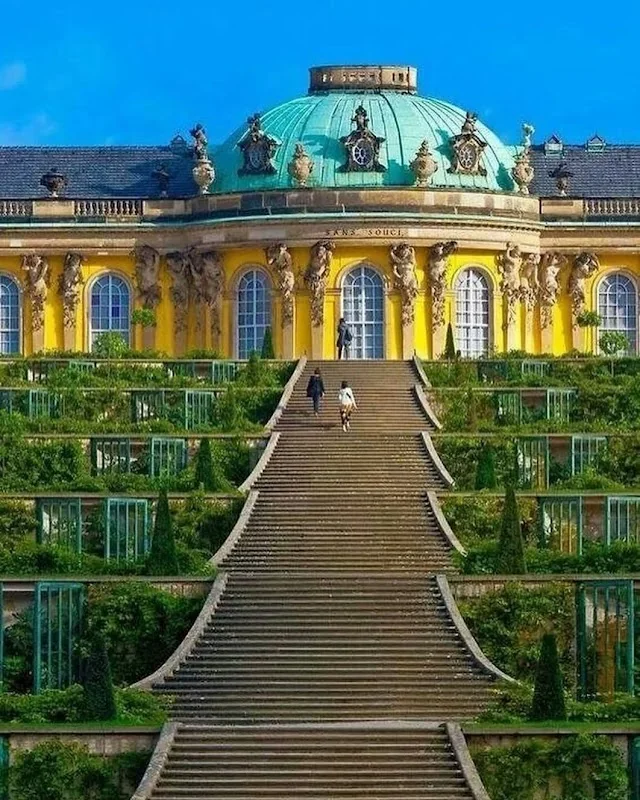
The history of Sanssouci Palace begins with a very personal wish of Frederick the Great. The king planned his palace with the terrace layout for viticulture on the vineyard above Potsdam in 1743 and also had his burial site established there. The construction itself took place from 1745 to 1747 under the direction of Georg Wenzeslaus von Knobelsdorff according to the king's specifications. The SPSG describes the building as a single-story palace in the style of a French maison de plaisance, thus rather an intimate pleasure palace and not a monumental residence. This very restraint makes Sanssouci particularly special to this day: The palace is an expression of personal retreat, taste, and a very specific idea of elegance, not of external displays of power. The name Sanssouci, meaning “without worry,” fits this guiding motif. ([spsg.de](https://www.spsg.de/schloesser-gaerten/objekt/schloss-sanssouci?no_cache=1))
The palace complex includes not only the central building but also the famous terraces, the parterre, and other buildings of the ensemble. The side wings with kitchen and ladies' wing were only expanded in their current form from 1840 to 1842 under Friedrich Wilhelm IV. based on designs by Ludwig Persius. This gave the palace additional functions without losing its character as a summer residence. Particularly noteworthy is Frederick the Great's burial idea: He wanted to be buried on the upper vineyard terrace, and this wish was only fulfilled in 1991. The grave is now located on the upper terrace and is considered by many visitors to be one of the quietest and most impressive stations of the entire tour. Thus, Sanssouci connects architectural history, personal biography, and later memory culture in an unusually dense manner. ([spsg.de](https://www.spsg.de/schloesser-gaerten/objekt/schloss-sanssouci?no_cache=1))
The UNESCO theme is also central to Sanssouci. The Palaces and Parks of Potsdam and Berlin were inscribed on the World Heritage List in 1990. UNESCO describes the site as an extraordinary artistic ensemble of architecture and landscape design that was created between 1730 and 1916 and shaped by significant architects and garden artists. The Sanssouci Park is an essential part of this World Heritage. The SPSG speaks of the palace and park as a unit of the highest garden art that has grown over 250 years. The park covers around 300 hectares, is more than two kilometers long in an east-west direction, and with over 1,000 sculptures and changing garden styles, it is an open-air museum of international standing. Therefore, those visiting Sanssouci as a UNESCO site experience not just a palace but a historically evolved cultural landscape project that rightly ranks among the most famous garden facilities in Europe. ([spsg.de](https://www.spsg.de/schloesser-gaerten/objekt/park-sanssouci/?sa=X&ved=2ahUKEwim6vnj_rWDAxUMEPkAHf8uA5kQyK4DegQIAxAl))
Interiors, Marble Hall, and Tours at Sanssouci Palace
Inside Sanssouci Palace, visitors encounter a series of rooms that shape the character of the house. On the official image and information pages, the SPSG mentions, among other things, the Marble Hall, the concert room of Frederick II, the Small Gallery, the king's library, as well as the bedroom and study. It is precisely these rooms that make the charm of the palace, as they do not appear as anonymous representative halls but show very personal living and working areas. The preserved furnishings from the 18th century convey the impression that Frederick the Great actually lived, read, played music, and worked here. The king's love for the surroundings is also palpable through the rooms: Inside and outside are not separated in Sanssouci but form a conscious whole. This is one of the reasons why Sanssouci is so often sought after for its interior life. ([spsg.de](https://www.spsg.de/schloesser-gaerten/objekt/schloss-sanssouci?no_cache=1))
For the visit, the SPSG also offers audio guide tours. The group offer is bookable year-round and lasts 60 minutes; audio guides are available in several languages, including German, English, French, Italian, Spanish, Japanese, Dutch, Ukrainian, Russian, Polish, and Korean. Additionally, the SPSG points out that visitors can also use the tour via the Sanssouci app on their own mobile device. For inquiries such as Sanssouci Palace tour or Sanssouci Palace interior, this is particularly relevant because it shows: The visit is not just a brief look into a historical building but can be experienced as a structured tour with background knowledge. Those who want to dive deeper will find a good mix of classic palace visit and modern mediation. ([spsg.de](https://www.spsg.de/schloesser-gaerten/angebot/schloss-sanssouci-mit-audioguide-fuehrung))
Sanssouci Park, Dogs, and How Much Time You Should Plan
The question of how much time one should plan for Sanssouci Palace is absolutely justified, as the park is large and the paths between the stations are longer than many first-time visitors expect. The SPSG describes Sanssouci as a facility of around 300 hectares with more than two kilometers of east-west extension and explicitly recommends planning enough time for a detailed tour. Additionally, there are the fixed entry times at the palace, possible waiting times depending on visitor traffic, and the temptation to stop along the way as new perspectives open up. Those who only want to see the palace can plan more compactly. However, those who want to connect terraces, parterre, grave, picture gallery, and other buildings should think of Sanssouci as a half-day or longer afternoon visit. This is not a hassle but part of the experience: Sanssouci has such a strong effect precisely because you can immerse yourself in the site at your own pace. ([spsg.de](https://www.spsg.de/schloesser-gaerten/objekt/park-sanssouci/?sa=X&ved=2ahUKEwim6vnj_rWDAxUMEPkAHf8uA5kQyK4DegQIAxAl))
There is a clear rule for dogs: Dogs are allowed in Sanssouci Park but must be kept on a short leash, and dog waste must be disposed of immediately. At the same time, there is a whole catalog of protection rules for the park: Vehicles may not drive or park without special permission, paths should not be left, fires and barbecues are prohibited, music may not be played, drones are prohibited, and photos or film recordings with additional equipment and/or personnel require permission. These rules may seem strict but are logical considering that Sanssouci is a unique garden artwork and a sensitive monument. The park should remain a place of culture and relaxation, not a backdrop for uncontrolled use. Those coming with dogs can therefore walk without problems but should plan for consideration and leash requirements from the start. ([spsg.de](https://www.spsg.de/parkordnung-sanssouci))
Photos, Beautiful Perspectives, and Gastronomy Around Sanssouci
Those looking for photos of Sanssouci Palace will find the best motifs not only inside but especially in the interplay of architecture and landscape. Officially, the SPSG shows, among other things, views from the foot of the terraces, from the parterre over the large fountain and with a view of the palace, from the Marble Hall, from the concert room, and from the library. It is precisely these perspectives that make Sanssouci photogenic: The palace is not isolated but embedded in the landscape through terraces, sculptures, and sight axes. For visitors, this means that good photos almost automatically arise where one takes time and varies the location a bit. The terrace levels, the sight axes to the large fountain, and the view back to the palace are particularly rewarding. If you are planning pictures or shoots, you should note the requirement for permission for professional photo, film, and television recordings with additional equipment. ([spsg.de](https://www.spsg.de/schloesser-gaerten/objekt/schloss-sanssouci?no_cache=1))
The culinary offerings in the area are also well prepared. The SPSG mentions nearby Café Repin near the Picture Gallery and Sanssouci Palace, Zur Historischen Mühle near the palace, the Drachenhaus Restaurant & Cafe in Sanssouci Park, as well as other offerings in the vicinity. This is practical for visitors who do not plan their stay as a mere transit but as a relaxed day trip. Especially at Sanssouci, a break is worthwhile because the palace, park, and paths together have more impact when one pauses in between. Thus, a simple inquiry about Sanssouci Palace restaurant or Sanssouci Palace photos quickly turns into a complete day of visit with culture, views, and a suitable break. Those who let the ensemble affect them in peace quickly understand why Sanssouci has been one of the most popular places in Potsdam for generations. ([spsg.de](https://www.spsg.de/schloesser-gaerten/objekt/schloss-sanssouci?no_cache=1))
Sources:
Show moreShow less
Sanssouci Palace | Tickets & Parking
Sanssouci Palace is not a place you simply visit. It is a cultural-historical totality of architecture, garden art, sight axes, memory, and Prussian representation. Those who come here are not just in front of a famous palace, but in the midst of an ensemble closely connected to Frederick the Great, creating a distinctive atmosphere with its terraces, park, and preserved interiors to this day. That is exactly why visitors seek very concrete answers: How do I get there, where do I park, what tickets do I need, how long should I stay, what is there to see inside, and are dogs allowed? Sanssouci Palace provides practical answers to all these questions while offering an extraordinary historical context. The palace is located on Maulbeerallee in Potsdam, is part of the UNESCO World Heritage, and forms one of Germany's most famous cultural monuments together with the Sanssouci Park. ([spsg.de](https://www.spsg.de/schloesser-gaerten/objekt/schloss-sanssouci?no_cache=1))
Tickets, Admission, and Online Booking for Sanssouci Palace
If you are looking for tickets to Sanssouci Palace, the most important information is quickly clarified: The individual price for visiting the palace is 14 euros, reduced 10 euros. Those who want to see more than just Sanssouci Palace should check the combination ticket sanssouci+. It is valid for one day for the open Potsdam palaces of the SPSG, includes a fixed entry time at Sanssouci Palace and optionally additionally at the New Palace, and costs 22 euros, reduced 17 euros. For families, there is the ticket sanssouci+ family for 49 euros; it is valid for up to two adults and up to four children. Online booking is particularly practical because it allows you to avoid waiting times at the palace ticket office and better secure the limited number of tickets per day. ([spsg.de](https://www.spsg.de/schloesser-gaerten/objekt/schloss-sanssouci?no_cache=1))
For planning, it is also important that the visit to Sanssouci Palace is tied to fixed entry times. Tickets for the respective day are available from 30 minutes before the palace opens at the Visitor Center Historical Mill, and the SPSG explicitly recommends early online booking. This is not only convenient but also sensible, as day tickets are sold only subject to availability. Those arriving with an annual pass receive free admission. The combination tickets are also clearly structured: Sanssouci Palace and Hunting Lodge Stern are excluded, special exhibitions as well; for the Belvedere on the Pfingstberg, the reduced admission applies. This creates a very manageable visiting system that caters well to both spontaneous guests and visitors with a fixed daily route. ([spsg.de](https://www.spsg.de/schloesser-gaerten/objekt/schloss-sanssouci?no_cache=1))
Directions, Parking, and Opening Hours at Sanssouci Palace
The official address for directions to Sanssouci Palace is Maulbeerallee in 14469 Potsdam. The nearest stop is “Potsdam, Schloss Sanssouci.” The parking area is well accessible by public transport, and the SPSG also points out additional stops around Sanssouci Park, such as “Potsdam, Neues Palais,” “Potsdam, Schloss Charlottenhof,” and “Potsdam, Luisenplatz-Nord/Park Sanssouci.” Those arriving by car will find paid parking spaces for cars and buses at parking lot P1 at the Historical Mill; for Sanssouci Park, P3 at the New Palace and additional visitor parking are also mentioned. In the park itself, it is stated: No vehicle may be driven or parked without special permission. This makes it clear that Sanssouci is intentionally meant to be experienced as a pedestrian and garden space. ([spsg.de](https://www.spsg.de/schloesser-gaerten/objekt/schloss-sanssouci?no_cache=1))
The opening hours of the palace are also clearly regulated. From April to October, Sanssouci Palace is open Tuesday to Sunday from 10:00 AM to 5:30 PM, closed on Mondays, with the last entry occurring 30 minutes before closing time. On public holidays, the respective weekend opening hours apply unless otherwise stated. The Sanssouci Park itself is open daily from 8 AM until dusk, and admission is free. Additionally, the SPSG offers a free shuttle service between the Green Gate and the New Palace from April to October along the Ökonomieweg, daily from 11 AM to 5:30 PM. This is particularly helpful if you want to combine several stops in the park and do not want to walk everything. ([spsg.de](https://www.spsg.de/schloesser-gaerten/objekt/schloss-sanssouci?no_cache=1))
History of Sanssouci Palace and UNESCO World Heritage
The history of Sanssouci Palace begins with a very personal wish of Frederick the Great. The king planned his palace with the terrace layout for viticulture on the vineyard above Potsdam in 1743 and also had his burial site established there. The construction itself took place from 1745 to 1747 under the direction of Georg Wenzeslaus von Knobelsdorff according to the king's specifications. The SPSG describes the building as a single-story palace in the style of a French maison de plaisance, thus rather an intimate pleasure palace and not a monumental residence. This very restraint makes Sanssouci particularly special to this day: The palace is an expression of personal retreat, taste, and a very specific idea of elegance, not of external displays of power. The name Sanssouci, meaning “without worry,” fits this guiding motif. ([spsg.de](https://www.spsg.de/schloesser-gaerten/objekt/schloss-sanssouci?no_cache=1))
The palace complex includes not only the central building but also the famous terraces, the parterre, and other buildings of the ensemble. The side wings with kitchen and ladies' wing were only expanded in their current form from 1840 to 1842 under Friedrich Wilhelm IV. based on designs by Ludwig Persius. This gave the palace additional functions without losing its character as a summer residence. Particularly noteworthy is Frederick the Great's burial idea: He wanted to be buried on the upper vineyard terrace, and this wish was only fulfilled in 1991. The grave is now located on the upper terrace and is considered by many visitors to be one of the quietest and most impressive stations of the entire tour. Thus, Sanssouci connects architectural history, personal biography, and later memory culture in an unusually dense manner. ([spsg.de](https://www.spsg.de/schloesser-gaerten/objekt/schloss-sanssouci?no_cache=1))
The UNESCO theme is also central to Sanssouci. The Palaces and Parks of Potsdam and Berlin were inscribed on the World Heritage List in 1990. UNESCO describes the site as an extraordinary artistic ensemble of architecture and landscape design that was created between 1730 and 1916 and shaped by significant architects and garden artists. The Sanssouci Park is an essential part of this World Heritage. The SPSG speaks of the palace and park as a unit of the highest garden art that has grown over 250 years. The park covers around 300 hectares, is more than two kilometers long in an east-west direction, and with over 1,000 sculptures and changing garden styles, it is an open-air museum of international standing. Therefore, those visiting Sanssouci as a UNESCO site experience not just a palace but a historically evolved cultural landscape project that rightly ranks among the most famous garden facilities in Europe. ([spsg.de](https://www.spsg.de/schloesser-gaerten/objekt/park-sanssouci/?sa=X&ved=2ahUKEwim6vnj_rWDAxUMEPkAHf8uA5kQyK4DegQIAxAl))
Interiors, Marble Hall, and Tours at Sanssouci Palace
Inside Sanssouci Palace, visitors encounter a series of rooms that shape the character of the house. On the official image and information pages, the SPSG mentions, among other things, the Marble Hall, the concert room of Frederick II, the Small Gallery, the king's library, as well as the bedroom and study. It is precisely these rooms that make the charm of the palace, as they do not appear as anonymous representative halls but show very personal living and working areas. The preserved furnishings from the 18th century convey the impression that Frederick the Great actually lived, read, played music, and worked here. The king's love for the surroundings is also palpable through the rooms: Inside and outside are not separated in Sanssouci but form a conscious whole. This is one of the reasons why Sanssouci is so often sought after for its interior life. ([spsg.de](https://www.spsg.de/schloesser-gaerten/objekt/schloss-sanssouci?no_cache=1))
For the visit, the SPSG also offers audio guide tours. The group offer is bookable year-round and lasts 60 minutes; audio guides are available in several languages, including German, English, French, Italian, Spanish, Japanese, Dutch, Ukrainian, Russian, Polish, and Korean. Additionally, the SPSG points out that visitors can also use the tour via the Sanssouci app on their own mobile device. For inquiries such as Sanssouci Palace tour or Sanssouci Palace interior, this is particularly relevant because it shows: The visit is not just a brief look into a historical building but can be experienced as a structured tour with background knowledge. Those who want to dive deeper will find a good mix of classic palace visit and modern mediation. ([spsg.de](https://www.spsg.de/schloesser-gaerten/angebot/schloss-sanssouci-mit-audioguide-fuehrung))
Sanssouci Park, Dogs, and How Much Time You Should Plan
The question of how much time one should plan for Sanssouci Palace is absolutely justified, as the park is large and the paths between the stations are longer than many first-time visitors expect. The SPSG describes Sanssouci as a facility of around 300 hectares with more than two kilometers of east-west extension and explicitly recommends planning enough time for a detailed tour. Additionally, there are the fixed entry times at the palace, possible waiting times depending on visitor traffic, and the temptation to stop along the way as new perspectives open up. Those who only want to see the palace can plan more compactly. However, those who want to connect terraces, parterre, grave, picture gallery, and other buildings should think of Sanssouci as a half-day or longer afternoon visit. This is not a hassle but part of the experience: Sanssouci has such a strong effect precisely because you can immerse yourself in the site at your own pace. ([spsg.de](https://www.spsg.de/schloesser-gaerten/objekt/park-sanssouci/?sa=X&ved=2ahUKEwim6vnj_rWDAxUMEPkAHf8uA5kQyK4DegQIAxAl))
There is a clear rule for dogs: Dogs are allowed in Sanssouci Park but must be kept on a short leash, and dog waste must be disposed of immediately. At the same time, there is a whole catalog of protection rules for the park: Vehicles may not drive or park without special permission, paths should not be left, fires and barbecues are prohibited, music may not be played, drones are prohibited, and photos or film recordings with additional equipment and/or personnel require permission. These rules may seem strict but are logical considering that Sanssouci is a unique garden artwork and a sensitive monument. The park should remain a place of culture and relaxation, not a backdrop for uncontrolled use. Those coming with dogs can therefore walk without problems but should plan for consideration and leash requirements from the start. ([spsg.de](https://www.spsg.de/parkordnung-sanssouci))
Photos, Beautiful Perspectives, and Gastronomy Around Sanssouci
Those looking for photos of Sanssouci Palace will find the best motifs not only inside but especially in the interplay of architecture and landscape. Officially, the SPSG shows, among other things, views from the foot of the terraces, from the parterre over the large fountain and with a view of the palace, from the Marble Hall, from the concert room, and from the library. It is precisely these perspectives that make Sanssouci photogenic: The palace is not isolated but embedded in the landscape through terraces, sculptures, and sight axes. For visitors, this means that good photos almost automatically arise where one takes time and varies the location a bit. The terrace levels, the sight axes to the large fountain, and the view back to the palace are particularly rewarding. If you are planning pictures or shoots, you should note the requirement for permission for professional photo, film, and television recordings with additional equipment. ([spsg.de](https://www.spsg.de/schloesser-gaerten/objekt/schloss-sanssouci?no_cache=1))
The culinary offerings in the area are also well prepared. The SPSG mentions nearby Café Repin near the Picture Gallery and Sanssouci Palace, Zur Historischen Mühle near the palace, the Drachenhaus Restaurant & Cafe in Sanssouci Park, as well as other offerings in the vicinity. This is practical for visitors who do not plan their stay as a mere transit but as a relaxed day trip. Especially at Sanssouci, a break is worthwhile because the palace, park, and paths together have more impact when one pauses in between. Thus, a simple inquiry about Sanssouci Palace restaurant or Sanssouci Palace photos quickly turns into a complete day of visit with culture, views, and a suitable break. Those who let the ensemble affect them in peace quickly understand why Sanssouci has been one of the most popular places in Potsdam for generations. ([spsg.de](https://www.spsg.de/schloesser-gaerten/objekt/schloss-sanssouci?no_cache=1))
Sources:
Sanssouci Palace | Tickets & Parking
Sanssouci Palace is not a place you simply visit. It is a cultural-historical totality of architecture, garden art, sight axes, memory, and Prussian representation. Those who come here are not just in front of a famous palace, but in the midst of an ensemble closely connected to Frederick the Great, creating a distinctive atmosphere with its terraces, park, and preserved interiors to this day. That is exactly why visitors seek very concrete answers: How do I get there, where do I park, what tickets do I need, how long should I stay, what is there to see inside, and are dogs allowed? Sanssouci Palace provides practical answers to all these questions while offering an extraordinary historical context. The palace is located on Maulbeerallee in Potsdam, is part of the UNESCO World Heritage, and forms one of Germany's most famous cultural monuments together with the Sanssouci Park. ([spsg.de](https://www.spsg.de/schloesser-gaerten/objekt/schloss-sanssouci?no_cache=1))
Tickets, Admission, and Online Booking for Sanssouci Palace
If you are looking for tickets to Sanssouci Palace, the most important information is quickly clarified: The individual price for visiting the palace is 14 euros, reduced 10 euros. Those who want to see more than just Sanssouci Palace should check the combination ticket sanssouci+. It is valid for one day for the open Potsdam palaces of the SPSG, includes a fixed entry time at Sanssouci Palace and optionally additionally at the New Palace, and costs 22 euros, reduced 17 euros. For families, there is the ticket sanssouci+ family for 49 euros; it is valid for up to two adults and up to four children. Online booking is particularly practical because it allows you to avoid waiting times at the palace ticket office and better secure the limited number of tickets per day. ([spsg.de](https://www.spsg.de/schloesser-gaerten/objekt/schloss-sanssouci?no_cache=1))
For planning, it is also important that the visit to Sanssouci Palace is tied to fixed entry times. Tickets for the respective day are available from 30 minutes before the palace opens at the Visitor Center Historical Mill, and the SPSG explicitly recommends early online booking. This is not only convenient but also sensible, as day tickets are sold only subject to availability. Those arriving with an annual pass receive free admission. The combination tickets are also clearly structured: Sanssouci Palace and Hunting Lodge Stern are excluded, special exhibitions as well; for the Belvedere on the Pfingstberg, the reduced admission applies. This creates a very manageable visiting system that caters well to both spontaneous guests and visitors with a fixed daily route. ([spsg.de](https://www.spsg.de/schloesser-gaerten/objekt/schloss-sanssouci?no_cache=1))
Directions, Parking, and Opening Hours at Sanssouci Palace
The official address for directions to Sanssouci Palace is Maulbeerallee in 14469 Potsdam. The nearest stop is “Potsdam, Schloss Sanssouci.” The parking area is well accessible by public transport, and the SPSG also points out additional stops around Sanssouci Park, such as “Potsdam, Neues Palais,” “Potsdam, Schloss Charlottenhof,” and “Potsdam, Luisenplatz-Nord/Park Sanssouci.” Those arriving by car will find paid parking spaces for cars and buses at parking lot P1 at the Historical Mill; for Sanssouci Park, P3 at the New Palace and additional visitor parking are also mentioned. In the park itself, it is stated: No vehicle may be driven or parked without special permission. This makes it clear that Sanssouci is intentionally meant to be experienced as a pedestrian and garden space. ([spsg.de](https://www.spsg.de/schloesser-gaerten/objekt/schloss-sanssouci?no_cache=1))
The opening hours of the palace are also clearly regulated. From April to October, Sanssouci Palace is open Tuesday to Sunday from 10:00 AM to 5:30 PM, closed on Mondays, with the last entry occurring 30 minutes before closing time. On public holidays, the respective weekend opening hours apply unless otherwise stated. The Sanssouci Park itself is open daily from 8 AM until dusk, and admission is free. Additionally, the SPSG offers a free shuttle service between the Green Gate and the New Palace from April to October along the Ökonomieweg, daily from 11 AM to 5:30 PM. This is particularly helpful if you want to combine several stops in the park and do not want to walk everything. ([spsg.de](https://www.spsg.de/schloesser-gaerten/objekt/schloss-sanssouci?no_cache=1))
History of Sanssouci Palace and UNESCO World Heritage
The history of Sanssouci Palace begins with a very personal wish of Frederick the Great. The king planned his palace with the terrace layout for viticulture on the vineyard above Potsdam in 1743 and also had his burial site established there. The construction itself took place from 1745 to 1747 under the direction of Georg Wenzeslaus von Knobelsdorff according to the king's specifications. The SPSG describes the building as a single-story palace in the style of a French maison de plaisance, thus rather an intimate pleasure palace and not a monumental residence. This very restraint makes Sanssouci particularly special to this day: The palace is an expression of personal retreat, taste, and a very specific idea of elegance, not of external displays of power. The name Sanssouci, meaning “without worry,” fits this guiding motif. ([spsg.de](https://www.spsg.de/schloesser-gaerten/objekt/schloss-sanssouci?no_cache=1))
The palace complex includes not only the central building but also the famous terraces, the parterre, and other buildings of the ensemble. The side wings with kitchen and ladies' wing were only expanded in their current form from 1840 to 1842 under Friedrich Wilhelm IV. based on designs by Ludwig Persius. This gave the palace additional functions without losing its character as a summer residence. Particularly noteworthy is Frederick the Great's burial idea: He wanted to be buried on the upper vineyard terrace, and this wish was only fulfilled in 1991. The grave is now located on the upper terrace and is considered by many visitors to be one of the quietest and most impressive stations of the entire tour. Thus, Sanssouci connects architectural history, personal biography, and later memory culture in an unusually dense manner. ([spsg.de](https://www.spsg.de/schloesser-gaerten/objekt/schloss-sanssouci?no_cache=1))
The UNESCO theme is also central to Sanssouci. The Palaces and Parks of Potsdam and Berlin were inscribed on the World Heritage List in 1990. UNESCO describes the site as an extraordinary artistic ensemble of architecture and landscape design that was created between 1730 and 1916 and shaped by significant architects and garden artists. The Sanssouci Park is an essential part of this World Heritage. The SPSG speaks of the palace and park as a unit of the highest garden art that has grown over 250 years. The park covers around 300 hectares, is more than two kilometers long in an east-west direction, and with over 1,000 sculptures and changing garden styles, it is an open-air museum of international standing. Therefore, those visiting Sanssouci as a UNESCO site experience not just a palace but a historically evolved cultural landscape project that rightly ranks among the most famous garden facilities in Europe. ([spsg.de](https://www.spsg.de/schloesser-gaerten/objekt/park-sanssouci/?sa=X&ved=2ahUKEwim6vnj_rWDAxUMEPkAHf8uA5kQyK4DegQIAxAl))
Interiors, Marble Hall, and Tours at Sanssouci Palace
Inside Sanssouci Palace, visitors encounter a series of rooms that shape the character of the house. On the official image and information pages, the SPSG mentions, among other things, the Marble Hall, the concert room of Frederick II, the Small Gallery, the king's library, as well as the bedroom and study. It is precisely these rooms that make the charm of the palace, as they do not appear as anonymous representative halls but show very personal living and working areas. The preserved furnishings from the 18th century convey the impression that Frederick the Great actually lived, read, played music, and worked here. The king's love for the surroundings is also palpable through the rooms: Inside and outside are not separated in Sanssouci but form a conscious whole. This is one of the reasons why Sanssouci is so often sought after for its interior life. ([spsg.de](https://www.spsg.de/schloesser-gaerten/objekt/schloss-sanssouci?no_cache=1))
For the visit, the SPSG also offers audio guide tours. The group offer is bookable year-round and lasts 60 minutes; audio guides are available in several languages, including German, English, French, Italian, Spanish, Japanese, Dutch, Ukrainian, Russian, Polish, and Korean. Additionally, the SPSG points out that visitors can also use the tour via the Sanssouci app on their own mobile device. For inquiries such as Sanssouci Palace tour or Sanssouci Palace interior, this is particularly relevant because it shows: The visit is not just a brief look into a historical building but can be experienced as a structured tour with background knowledge. Those who want to dive deeper will find a good mix of classic palace visit and modern mediation. ([spsg.de](https://www.spsg.de/schloesser-gaerten/angebot/schloss-sanssouci-mit-audioguide-fuehrung))
Sanssouci Park, Dogs, and How Much Time You Should Plan
The question of how much time one should plan for Sanssouci Palace is absolutely justified, as the park is large and the paths between the stations are longer than many first-time visitors expect. The SPSG describes Sanssouci as a facility of around 300 hectares with more than two kilometers of east-west extension and explicitly recommends planning enough time for a detailed tour. Additionally, there are the fixed entry times at the palace, possible waiting times depending on visitor traffic, and the temptation to stop along the way as new perspectives open up. Those who only want to see the palace can plan more compactly. However, those who want to connect terraces, parterre, grave, picture gallery, and other buildings should think of Sanssouci as a half-day or longer afternoon visit. This is not a hassle but part of the experience: Sanssouci has such a strong effect precisely because you can immerse yourself in the site at your own pace. ([spsg.de](https://www.spsg.de/schloesser-gaerten/objekt/park-sanssouci/?sa=X&ved=2ahUKEwim6vnj_rWDAxUMEPkAHf8uA5kQyK4DegQIAxAl))
There is a clear rule for dogs: Dogs are allowed in Sanssouci Park but must be kept on a short leash, and dog waste must be disposed of immediately. At the same time, there is a whole catalog of protection rules for the park: Vehicles may not drive or park without special permission, paths should not be left, fires and barbecues are prohibited, music may not be played, drones are prohibited, and photos or film recordings with additional equipment and/or personnel require permission. These rules may seem strict but are logical considering that Sanssouci is a unique garden artwork and a sensitive monument. The park should remain a place of culture and relaxation, not a backdrop for uncontrolled use. Those coming with dogs can therefore walk without problems but should plan for consideration and leash requirements from the start. ([spsg.de](https://www.spsg.de/parkordnung-sanssouci))
Photos, Beautiful Perspectives, and Gastronomy Around Sanssouci
Those looking for photos of Sanssouci Palace will find the best motifs not only inside but especially in the interplay of architecture and landscape. Officially, the SPSG shows, among other things, views from the foot of the terraces, from the parterre over the large fountain and with a view of the palace, from the Marble Hall, from the concert room, and from the library. It is precisely these perspectives that make Sanssouci photogenic: The palace is not isolated but embedded in the landscape through terraces, sculptures, and sight axes. For visitors, this means that good photos almost automatically arise where one takes time and varies the location a bit. The terrace levels, the sight axes to the large fountain, and the view back to the palace are particularly rewarding. If you are planning pictures or shoots, you should note the requirement for permission for professional photo, film, and television recordings with additional equipment. ([spsg.de](https://www.spsg.de/schloesser-gaerten/objekt/schloss-sanssouci?no_cache=1))
The culinary offerings in the area are also well prepared. The SPSG mentions nearby Café Repin near the Picture Gallery and Sanssouci Palace, Zur Historischen Mühle near the palace, the Drachenhaus Restaurant & Cafe in Sanssouci Park, as well as other offerings in the vicinity. This is practical for visitors who do not plan their stay as a mere transit but as a relaxed day trip. Especially at Sanssouci, a break is worthwhile because the palace, park, and paths together have more impact when one pauses in between. Thus, a simple inquiry about Sanssouci Palace restaurant or Sanssouci Palace photos quickly turns into a complete day of visit with culture, views, and a suitable break. Those who let the ensemble affect them in peace quickly understand why Sanssouci has been one of the most popular places in Potsdam for generations. ([spsg.de](https://www.spsg.de/schloesser-gaerten/objekt/schloss-sanssouci?no_cache=1))
Sources:
Frequently Asked Questions
Reviews
Sensei Mili
7. March 2026
Adult tickets cost 22€ and include the old windmill, Sanssouci Palace, and the New Palace. However, the New Palace cannot be visited independently – only through an organized guided tour due to structural issues with the floor, which could potentially collapse. Until May, these tours are available only in German. The palaces themselves are similar to many others influenced by the French court style, very ornate, with countless decorated rooms. Personally, I found the surrounding park more impressive. In spring, it is probably even more beautiful and definitely worth visiting.
Sarah Rudolph
5. June 2026
While we did not get to go over the entire palace, what we did get to see was very beautiful. Listening to the audios with the histories with each room as you go was fun too! Doesn't take that long to get through.
Andre Ola
1. December 2025
Sanssouci Palace Sanssouci Palace is undeniably beautiful, with elegant rooms and lovely details throughout. It’s smaller than I expected, but still charming and worth seeing for its architecture and history. However, the entrance ticket felt too expensive for the size of the visit. While the palace is impressive, the value for money could be better. Overall, a beautiful place to see, but be prepared for a high ticket price relative to the experience. Consider you need to pay for the parking also.
Jovan
8. February 2026
Sanssouci is a historical building in Potsdam, near Berlin. Built by Prussian King Frederick the Great as his summer palace, it is often counted among the German rivals of Versailles. While Sanssouci is in the more intimate Rococo style and is far smaller than its French Baroque counterpart, it is similarly notable for the numerous temples and follies in the surrounding park. The palace was designed and built by Georg Wenzeslaus von Knobelsdorff between 1745 and 1747 to meet Frederick's need for a private residence where he could escape the pomp and ceremony of the royal court. The palace's name is a French phrase (sans souci) meaning "without worries" or "carefree," emphasizing that the palace was meant as a place of relaxation rather than a seat of power. An absolutely enchanting place of such refined harmony at the same time exudes grandiosity and opulence in such a fine and delicate way that it is incredible and if the visit was in the winter time nothing was missing from the comprehensiveness of the impression, the thing is even more incredible knowing that you are in the place where he cultivated and nurtured his quiet and personal thoughts no less and no more than Frederick the Great, a real historical gem.
Sören K.
3. October 2025
Really stunning garden, I like the right one which is like a symmetrical maze. There they want to plant fruit trees like in the creation days. The statues around the central fountain are very impressive for me.