
Potsdam
Karl-Liebknecht-Straße 135, 14482 Potsdam-Babelsberg, Deutschland
Town Hall / Cultural Center Babelsberg | Events & Exhibitions
The Town Hall / Cultural Center Babelsberg is one of those places that cannot simply be described as an event address, because it is simultaneously a monument, a community center, a cultural hub, and a piece of local history all in one. In the former Town Hall of Babelsberg, which was planned for the municipality of Nowawes at the end of the 19th century and inaugurated in 1900, a vibrant venue for concerts, courses, workshops, readings, exhibitions, and smaller events has established itself today. The state capital Potsdam explicitly describes the offerings as particularly suitable for an intimate setting with a maximum of 70 visitors, while the AWO, as the operator of the house, provides various rooms for very different formats. This mixture of historical character and everyday culture is what makes the house appealing. Those looking for events, exhibitions, photos, directions, parking, or room bookings will find not only practical information here but also a place with a clear identity and palpable local roots. ([potsdam.de](https://www.potsdam.de/de/kulturhaus-babelsberg))
Events, Courses, and Exhibitions at the Cultural Center Babelsberg
The Cultural Center Babelsberg stands for a program that consciously remains close to the people in the neighborhood. According to the state capital Potsdam, puppet and figure theater, small art programs, small concerts, town hall festivals, and exhibitions are part of the traditional repertoire of the house. This is complemented by regularly recurring series such as the Jazz-Blues series and the Babelsberg Student Film Cinema, which have shaped the house for years and continue to attract an audience that seeks a personal atmosphere rather than a large stage. This is where an important SEO and user value lies: Those searching for events at the Cultural Center Babelsberg are often not interested in a single large event but in a house that offers cultural continuity and regional diversity. This perspective aligns very well with the many search queries related to programs, workshops, concerts, and exhibitions. ([potsdam.de](https://www.potsdam.de/de/kulturhaus-babelsberg))
The exhibition offerings are also clearly tailored to the character of the house. In the stairwell of the main building, there are opportunities for permanent exhibitions in the form of documentations, while on the first floor, in the lounge, salon, and gentlemen's room, regularly changing exhibitions are shown. The official site states that these exhibitions can generally be visited free of charge from Monday to Friday between 10 AM and 4 PM, provided the rooms are not rented out externally. This is particularly attractive for many visitors, as the house is not only a venue for evening events but also makes culture accessible during the day. For those searching for exhibitions, photos, programs, or Cultural Center Babelsberg Potsdam, this is a strong signal: Here, changing art formats connect with a clear local reference. The possibility of arranging free guided tours upon request also emphasizes the open character of the house. ([kulturhausbabelsberg.de](https://kulturhausbabelsberg.de/ausstellungen/))
Directions, Parking, and Accessibility
A central theme of many user inquiries is directions, and here too, the Cultural Center Babelsberg scores with a very good location. The official directions page states that it is only about a two-minute walk to the Babelsberg S-Bahn station. Additionally, the house is well accessible by tram and bus: The tram lines 94 and 99 as well as the bus lines 601, 616, 690, 693, and 694 stop at the Rathaus Babelsberg station. Those traveling from Potsdam or the Berlin area can reach the house conveniently without complicated detours. For a cultural center that primarily offers smaller events, courses, and exhibitions, this proximity to public transport is an important location advantage. ([kulturhausbabelsberg.de](https://kulturhausbabelsberg.de/de/anfahrt/))
When it comes to parking, the answer is deliberately pragmatic: There are bike racks at the front and in the courtyard, but only a few free car parking spaces. Visitors attending an event are therefore advised to use a parking space outside the premises. Loading and unloading is possible in the courtyard, which can be particularly helpful for rentals and setups. The house is wheelchair accessible for people with mobility impairments. The elevator is accessible via the courtyard, and there is also a disabled parking space there. Additionally, wheelchair-accessible restrooms are available on the first and second floors. This combination of public accessibility, clear parking information, and barrier-free access addresses several important search intentions such as parking, accessibility, directions, and Town Hall Babelsberg. ([kulturhausbabelsberg.de](https://kulturhausbabelsberg.de/de/anfahrt/))
Hall, Rooms, and Room Booking
Another focus of inquiries about the house concerns the rooms and room booking. This is understandable, as the Cultural Center Babelsberg is not a classic single-purpose hall but a house with a small-scale room structure that works for many formats. The rental page lists, among other things, the hall, course room I, course room II, consultation room, gentlemen's room, salon, lounge, and bar, as well as kitchen spaces. Additional rooms such as the Kerwien room and the galley expand the spectrum for events, workshops, and private celebrations. The AWO describes the offerings as adaptable from a small room for a lecture to a location for a larger event. Mentioned are, among others, conferences, seminars, workshops, children's programs, theater performances, concerts, readings, private celebrations, and festivals. This shows that the term room booking here does not only mean administration but real flexibility for very different usage scenarios. ([kulturhausbabelsberg.de](https://kulturhausbabelsberg.de/index.php/de/vermietung/))
Particularly helpful for interested parties are the specific sizes and usage possibilities. The hall measures 70 square meters, the lounge and bar 80 square meters, the salon 38 square meters, the gentlemen's room 25 square meters, and course room II 58 square meters. For the lounge and bar, the official site also specifies usage-related capacities: up to 40 people for private celebrations, events, courses, workshops, conferences, and seminars, up to 72 seats when combined with the salon, up to 80 people for standing receptions, and in combination with the salon even up to 100 people. Additionally, technical details such as a three-meter-wide screen, HDMI connection, grand piano, and sound system are provided. Those searching for hall, seating, room size, or room booking thus receive a very concrete basis for planning. ([kulturhausbabelsberg.de](https://kulturhausbabelsberg.de/de/lounge-und-bar-80-qm/))
History of the Former Town Hall Babelsberg
The history of the house is an essential part of its current appeal. The official chronicle and the municipal press page make it clear that the Cultural Center is the former Town Hall of Nowawes or later Town Hall Babelsberg. In 1898, the municipal council of Nowawes commissioned the local architect Julius Otto Kerwien to design and execute a new town hall. Shortly after the construction period, the building was inaugurated and occupied in January 1900. It was initially intended as a representative administrative building for a municipality that was then shaped by economic upturn and the self-image of a prosperous city. For today's visitors, this also explains why the house, despite its cultural use, still strongly conveys a sense of history and public significance. ([potsdam.de](https://www.potsdam.de/de/3-kulturhaus-babelsberg-als-denkmal-des-monats-januar-2023-ausgezeichnet))
With the political and urban changes of the 20th century, the function of the building changed several times. After the incorporation of Babelsberg, the town hall lost its role as an administrative seat. The chronicle states that in the 1950s, the house continued to open for registry office, health administration, and library use and developed into a cultural center since the 1960s. After the reunification, it underwent reconstruction in the 1990s as a neighborhood, cultural, and community center. Since 2005, the AWO District Association Potsdam e.V. has been responsible for the house. This development is important for SEO relevance because many search queries not only concern the current program but also the history of the Cultural Center Babelsberg, the former town hall, and the role of the building for Babelsberg as a whole. ([kulturhausbabelsberg.de](https://kulturhausbabelsberg.de/chronik/))
Architecture, Monument, and Special Atmosphere
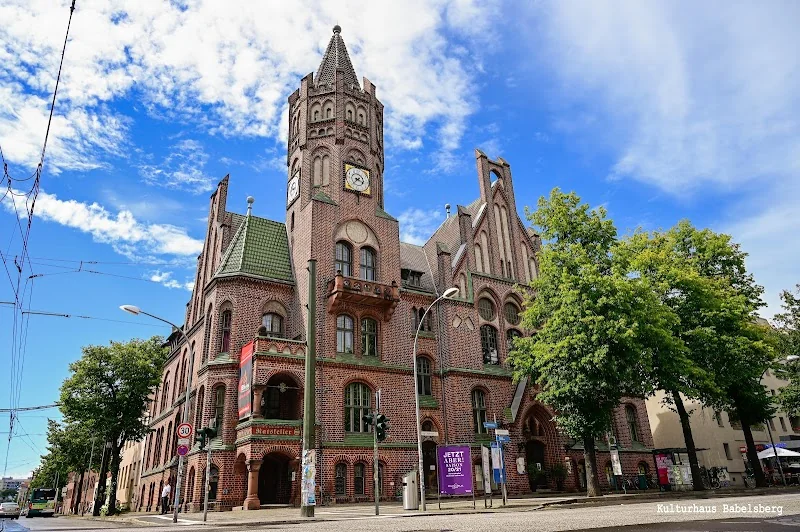
Architecturally, the house is also remarkable. The city of Potsdam describes the building as characterized by decorative gables, balconies, loggias, and the distinctive town hall tower. The construction references the Gothic brick architecture of medieval town halls in northern Germany and thus sets a consciously representative sign. The red bricks, the corner location at two main streets, and the tower make the house easily recognizable to this day. For visitors, this creates not only a historical impression but also a very specific spatial effect: The building is not hidden in the background but is present as a city landmark. This visibility contributes to the strong search queries such as photos, Town Hall Babelsberg, or Cultural Center Babelsberg Potsdam. ([potsdam.de](https://www.potsdam.de/de/3-kulturhaus-babelsberg-als-denkmal-des-monats-januar-2023-ausgezeichnet))
The subsequent renovation has combined the monument character of the house with contemporary usability. The official chronicle mentions measures such as fire protection upgrades, accessibility, the addition of an elevator, the renewal of the courtyard and parking lot, and the restoration of staircases, corridors, windows, doors, floors, and sanitary facilities. The city of Potsdam additionally emphasizes that the building, as a renovated individual monument in the town center of the district, plays a special role and was awarded the title of Monument of the Month in 2023. For many people, this combination is what makes it special: historical substance, modern accessibility, and a cultural offering that does not feel museum-like but is used vibrantly. The Cultural Center Babelsberg is therefore not a static monument but a house that makes the past visible while simultaneously enabling the present. ([kulturhausbabelsberg.de](https://kulturhausbabelsberg.de/chronik/))
Photos, Impressions, and Practical Visiting Tips for Potsdam-Babelsberg
Those searching for photos of the Town Hall / Cultural Center Babelsberg will find numerous illustrative room views and impressions from the interior of the house on the official website. The rental page shows, among other things, the hall, lounge and bar, salon, gentlemen's room, course room II, and consultation room. This is complemented by exterior photos and historical impressions in the municipal contributions. This is important for orientation because the house cannot be explained with a single large area. Those viewing the photos quickly recognize the special mix of historical building, residential room structure, and functional usability. This diversity is a good argument for search terms related to photos, rooms, hall, and atmosphere. Especially for people planning an event, images help assess whether the house feels more festive, intimate, creative, or community-oriented. ([kulturhausbabelsberg.de](https://kulturhausbabelsberg.de/index.php/de/vermietung/))
For the visit itself, simple planning is worthwhile: ideally arrive by S-Bahn or tram, plan an external parking space in advance if arriving by car, and use the barrier-free access via the courtyard if needed. Those planning to visit an exhibition, reading, or concert should also check the respective times and any potential rentals, as the rooms in the house are regularly used differently. This is precisely what makes the place interesting: a historical town hall that not only functions as an address but also serves as a genuine meeting point for the neighborhood, culture, and encounters. Thus, the Cultural Center Babelsberg answers many search intentions simultaneously: events, exhibitions, programs, directions, parking, accessibility, photos, and room booking. For Potsdam-Babelsberg, it is therefore a cultural anchor point with high recognition value and clear everyday usability. ([kulturhausbabelsberg.de](https://kulturhausbabelsberg.de/de/anfahrt/))
Sources:
Show moreShow less
Town Hall / Cultural Center Babelsberg | Events & Exhibitions
The Town Hall / Cultural Center Babelsberg is one of those places that cannot simply be described as an event address, because it is simultaneously a monument, a community center, a cultural hub, and a piece of local history all in one. In the former Town Hall of Babelsberg, which was planned for the municipality of Nowawes at the end of the 19th century and inaugurated in 1900, a vibrant venue for concerts, courses, workshops, readings, exhibitions, and smaller events has established itself today. The state capital Potsdam explicitly describes the offerings as particularly suitable for an intimate setting with a maximum of 70 visitors, while the AWO, as the operator of the house, provides various rooms for very different formats. This mixture of historical character and everyday culture is what makes the house appealing. Those looking for events, exhibitions, photos, directions, parking, or room bookings will find not only practical information here but also a place with a clear identity and palpable local roots. ([potsdam.de](https://www.potsdam.de/de/kulturhaus-babelsberg))
Events, Courses, and Exhibitions at the Cultural Center Babelsberg
The Cultural Center Babelsberg stands for a program that consciously remains close to the people in the neighborhood. According to the state capital Potsdam, puppet and figure theater, small art programs, small concerts, town hall festivals, and exhibitions are part of the traditional repertoire of the house. This is complemented by regularly recurring series such as the Jazz-Blues series and the Babelsberg Student Film Cinema, which have shaped the house for years and continue to attract an audience that seeks a personal atmosphere rather than a large stage. This is where an important SEO and user value lies: Those searching for events at the Cultural Center Babelsberg are often not interested in a single large event but in a house that offers cultural continuity and regional diversity. This perspective aligns very well with the many search queries related to programs, workshops, concerts, and exhibitions. ([potsdam.de](https://www.potsdam.de/de/kulturhaus-babelsberg))
The exhibition offerings are also clearly tailored to the character of the house. In the stairwell of the main building, there are opportunities for permanent exhibitions in the form of documentations, while on the first floor, in the lounge, salon, and gentlemen's room, regularly changing exhibitions are shown. The official site states that these exhibitions can generally be visited free of charge from Monday to Friday between 10 AM and 4 PM, provided the rooms are not rented out externally. This is particularly attractive for many visitors, as the house is not only a venue for evening events but also makes culture accessible during the day. For those searching for exhibitions, photos, programs, or Cultural Center Babelsberg Potsdam, this is a strong signal: Here, changing art formats connect with a clear local reference. The possibility of arranging free guided tours upon request also emphasizes the open character of the house. ([kulturhausbabelsberg.de](https://kulturhausbabelsberg.de/ausstellungen/))
Directions, Parking, and Accessibility
A central theme of many user inquiries is directions, and here too, the Cultural Center Babelsberg scores with a very good location. The official directions page states that it is only about a two-minute walk to the Babelsberg S-Bahn station. Additionally, the house is well accessible by tram and bus: The tram lines 94 and 99 as well as the bus lines 601, 616, 690, 693, and 694 stop at the Rathaus Babelsberg station. Those traveling from Potsdam or the Berlin area can reach the house conveniently without complicated detours. For a cultural center that primarily offers smaller events, courses, and exhibitions, this proximity to public transport is an important location advantage. ([kulturhausbabelsberg.de](https://kulturhausbabelsberg.de/de/anfahrt/))
When it comes to parking, the answer is deliberately pragmatic: There are bike racks at the front and in the courtyard, but only a few free car parking spaces. Visitors attending an event are therefore advised to use a parking space outside the premises. Loading and unloading is possible in the courtyard, which can be particularly helpful for rentals and setups. The house is wheelchair accessible for people with mobility impairments. The elevator is accessible via the courtyard, and there is also a disabled parking space there. Additionally, wheelchair-accessible restrooms are available on the first and second floors. This combination of public accessibility, clear parking information, and barrier-free access addresses several important search intentions such as parking, accessibility, directions, and Town Hall Babelsberg. ([kulturhausbabelsberg.de](https://kulturhausbabelsberg.de/de/anfahrt/))
Hall, Rooms, and Room Booking
Another focus of inquiries about the house concerns the rooms and room booking. This is understandable, as the Cultural Center Babelsberg is not a classic single-purpose hall but a house with a small-scale room structure that works for many formats. The rental page lists, among other things, the hall, course room I, course room II, consultation room, gentlemen's room, salon, lounge, and bar, as well as kitchen spaces. Additional rooms such as the Kerwien room and the galley expand the spectrum for events, workshops, and private celebrations. The AWO describes the offerings as adaptable from a small room for a lecture to a location for a larger event. Mentioned are, among others, conferences, seminars, workshops, children's programs, theater performances, concerts, readings, private celebrations, and festivals. This shows that the term room booking here does not only mean administration but real flexibility for very different usage scenarios. ([kulturhausbabelsberg.de](https://kulturhausbabelsberg.de/index.php/de/vermietung/))
Particularly helpful for interested parties are the specific sizes and usage possibilities. The hall measures 70 square meters, the lounge and bar 80 square meters, the salon 38 square meters, the gentlemen's room 25 square meters, and course room II 58 square meters. For the lounge and bar, the official site also specifies usage-related capacities: up to 40 people for private celebrations, events, courses, workshops, conferences, and seminars, up to 72 seats when combined with the salon, up to 80 people for standing receptions, and in combination with the salon even up to 100 people. Additionally, technical details such as a three-meter-wide screen, HDMI connection, grand piano, and sound system are provided. Those searching for hall, seating, room size, or room booking thus receive a very concrete basis for planning. ([kulturhausbabelsberg.de](https://kulturhausbabelsberg.de/de/lounge-und-bar-80-qm/))
History of the Former Town Hall Babelsberg
The history of the house is an essential part of its current appeal. The official chronicle and the municipal press page make it clear that the Cultural Center is the former Town Hall of Nowawes or later Town Hall Babelsberg. In 1898, the municipal council of Nowawes commissioned the local architect Julius Otto Kerwien to design and execute a new town hall. Shortly after the construction period, the building was inaugurated and occupied in January 1900. It was initially intended as a representative administrative building for a municipality that was then shaped by economic upturn and the self-image of a prosperous city. For today's visitors, this also explains why the house, despite its cultural use, still strongly conveys a sense of history and public significance. ([potsdam.de](https://www.potsdam.de/de/3-kulturhaus-babelsberg-als-denkmal-des-monats-januar-2023-ausgezeichnet))
With the political and urban changes of the 20th century, the function of the building changed several times. After the incorporation of Babelsberg, the town hall lost its role as an administrative seat. The chronicle states that in the 1950s, the house continued to open for registry office, health administration, and library use and developed into a cultural center since the 1960s. After the reunification, it underwent reconstruction in the 1990s as a neighborhood, cultural, and community center. Since 2005, the AWO District Association Potsdam e.V. has been responsible for the house. This development is important for SEO relevance because many search queries not only concern the current program but also the history of the Cultural Center Babelsberg, the former town hall, and the role of the building for Babelsberg as a whole. ([kulturhausbabelsberg.de](https://kulturhausbabelsberg.de/chronik/))
Architecture, Monument, and Special Atmosphere
Architecturally, the house is also remarkable. The city of Potsdam describes the building as characterized by decorative gables, balconies, loggias, and the distinctive town hall tower. The construction references the Gothic brick architecture of medieval town halls in northern Germany and thus sets a consciously representative sign. The red bricks, the corner location at two main streets, and the tower make the house easily recognizable to this day. For visitors, this creates not only a historical impression but also a very specific spatial effect: The building is not hidden in the background but is present as a city landmark. This visibility contributes to the strong search queries such as photos, Town Hall Babelsberg, or Cultural Center Babelsberg Potsdam. ([potsdam.de](https://www.potsdam.de/de/3-kulturhaus-babelsberg-als-denkmal-des-monats-januar-2023-ausgezeichnet))
The subsequent renovation has combined the monument character of the house with contemporary usability. The official chronicle mentions measures such as fire protection upgrades, accessibility, the addition of an elevator, the renewal of the courtyard and parking lot, and the restoration of staircases, corridors, windows, doors, floors, and sanitary facilities. The city of Potsdam additionally emphasizes that the building, as a renovated individual monument in the town center of the district, plays a special role and was awarded the title of Monument of the Month in 2023. For many people, this combination is what makes it special: historical substance, modern accessibility, and a cultural offering that does not feel museum-like but is used vibrantly. The Cultural Center Babelsberg is therefore not a static monument but a house that makes the past visible while simultaneously enabling the present. ([kulturhausbabelsberg.de](https://kulturhausbabelsberg.de/chronik/))
Photos, Impressions, and Practical Visiting Tips for Potsdam-Babelsberg
Those searching for photos of the Town Hall / Cultural Center Babelsberg will find numerous illustrative room views and impressions from the interior of the house on the official website. The rental page shows, among other things, the hall, lounge and bar, salon, gentlemen's room, course room II, and consultation room. This is complemented by exterior photos and historical impressions in the municipal contributions. This is important for orientation because the house cannot be explained with a single large area. Those viewing the photos quickly recognize the special mix of historical building, residential room structure, and functional usability. This diversity is a good argument for search terms related to photos, rooms, hall, and atmosphere. Especially for people planning an event, images help assess whether the house feels more festive, intimate, creative, or community-oriented. ([kulturhausbabelsberg.de](https://kulturhausbabelsberg.de/index.php/de/vermietung/))
For the visit itself, simple planning is worthwhile: ideally arrive by S-Bahn or tram, plan an external parking space in advance if arriving by car, and use the barrier-free access via the courtyard if needed. Those planning to visit an exhibition, reading, or concert should also check the respective times and any potential rentals, as the rooms in the house are regularly used differently. This is precisely what makes the place interesting: a historical town hall that not only functions as an address but also serves as a genuine meeting point for the neighborhood, culture, and encounters. Thus, the Cultural Center Babelsberg answers many search intentions simultaneously: events, exhibitions, programs, directions, parking, accessibility, photos, and room booking. For Potsdam-Babelsberg, it is therefore a cultural anchor point with high recognition value and clear everyday usability. ([kulturhausbabelsberg.de](https://kulturhausbabelsberg.de/de/anfahrt/))
Sources:
Town Hall / Cultural Center Babelsberg | Events & Exhibitions
The Town Hall / Cultural Center Babelsberg is one of those places that cannot simply be described as an event address, because it is simultaneously a monument, a community center, a cultural hub, and a piece of local history all in one. In the former Town Hall of Babelsberg, which was planned for the municipality of Nowawes at the end of the 19th century and inaugurated in 1900, a vibrant venue for concerts, courses, workshops, readings, exhibitions, and smaller events has established itself today. The state capital Potsdam explicitly describes the offerings as particularly suitable for an intimate setting with a maximum of 70 visitors, while the AWO, as the operator of the house, provides various rooms for very different formats. This mixture of historical character and everyday culture is what makes the house appealing. Those looking for events, exhibitions, photos, directions, parking, or room bookings will find not only practical information here but also a place with a clear identity and palpable local roots. ([potsdam.de](https://www.potsdam.de/de/kulturhaus-babelsberg))
Events, Courses, and Exhibitions at the Cultural Center Babelsberg
The Cultural Center Babelsberg stands for a program that consciously remains close to the people in the neighborhood. According to the state capital Potsdam, puppet and figure theater, small art programs, small concerts, town hall festivals, and exhibitions are part of the traditional repertoire of the house. This is complemented by regularly recurring series such as the Jazz-Blues series and the Babelsberg Student Film Cinema, which have shaped the house for years and continue to attract an audience that seeks a personal atmosphere rather than a large stage. This is where an important SEO and user value lies: Those searching for events at the Cultural Center Babelsberg are often not interested in a single large event but in a house that offers cultural continuity and regional diversity. This perspective aligns very well with the many search queries related to programs, workshops, concerts, and exhibitions. ([potsdam.de](https://www.potsdam.de/de/kulturhaus-babelsberg))
The exhibition offerings are also clearly tailored to the character of the house. In the stairwell of the main building, there are opportunities for permanent exhibitions in the form of documentations, while on the first floor, in the lounge, salon, and gentlemen's room, regularly changing exhibitions are shown. The official site states that these exhibitions can generally be visited free of charge from Monday to Friday between 10 AM and 4 PM, provided the rooms are not rented out externally. This is particularly attractive for many visitors, as the house is not only a venue for evening events but also makes culture accessible during the day. For those searching for exhibitions, photos, programs, or Cultural Center Babelsberg Potsdam, this is a strong signal: Here, changing art formats connect with a clear local reference. The possibility of arranging free guided tours upon request also emphasizes the open character of the house. ([kulturhausbabelsberg.de](https://kulturhausbabelsberg.de/ausstellungen/))
Directions, Parking, and Accessibility
A central theme of many user inquiries is directions, and here too, the Cultural Center Babelsberg scores with a very good location. The official directions page states that it is only about a two-minute walk to the Babelsberg S-Bahn station. Additionally, the house is well accessible by tram and bus: The tram lines 94 and 99 as well as the bus lines 601, 616, 690, 693, and 694 stop at the Rathaus Babelsberg station. Those traveling from Potsdam or the Berlin area can reach the house conveniently without complicated detours. For a cultural center that primarily offers smaller events, courses, and exhibitions, this proximity to public transport is an important location advantage. ([kulturhausbabelsberg.de](https://kulturhausbabelsberg.de/de/anfahrt/))
When it comes to parking, the answer is deliberately pragmatic: There are bike racks at the front and in the courtyard, but only a few free car parking spaces. Visitors attending an event are therefore advised to use a parking space outside the premises. Loading and unloading is possible in the courtyard, which can be particularly helpful for rentals and setups. The house is wheelchair accessible for people with mobility impairments. The elevator is accessible via the courtyard, and there is also a disabled parking space there. Additionally, wheelchair-accessible restrooms are available on the first and second floors. This combination of public accessibility, clear parking information, and barrier-free access addresses several important search intentions such as parking, accessibility, directions, and Town Hall Babelsberg. ([kulturhausbabelsberg.de](https://kulturhausbabelsberg.de/de/anfahrt/))
Hall, Rooms, and Room Booking
Another focus of inquiries about the house concerns the rooms and room booking. This is understandable, as the Cultural Center Babelsberg is not a classic single-purpose hall but a house with a small-scale room structure that works for many formats. The rental page lists, among other things, the hall, course room I, course room II, consultation room, gentlemen's room, salon, lounge, and bar, as well as kitchen spaces. Additional rooms such as the Kerwien room and the galley expand the spectrum for events, workshops, and private celebrations. The AWO describes the offerings as adaptable from a small room for a lecture to a location for a larger event. Mentioned are, among others, conferences, seminars, workshops, children's programs, theater performances, concerts, readings, private celebrations, and festivals. This shows that the term room booking here does not only mean administration but real flexibility for very different usage scenarios. ([kulturhausbabelsberg.de](https://kulturhausbabelsberg.de/index.php/de/vermietung/))
Particularly helpful for interested parties are the specific sizes and usage possibilities. The hall measures 70 square meters, the lounge and bar 80 square meters, the salon 38 square meters, the gentlemen's room 25 square meters, and course room II 58 square meters. For the lounge and bar, the official site also specifies usage-related capacities: up to 40 people for private celebrations, events, courses, workshops, conferences, and seminars, up to 72 seats when combined with the salon, up to 80 people for standing receptions, and in combination with the salon even up to 100 people. Additionally, technical details such as a three-meter-wide screen, HDMI connection, grand piano, and sound system are provided. Those searching for hall, seating, room size, or room booking thus receive a very concrete basis for planning. ([kulturhausbabelsberg.de](https://kulturhausbabelsberg.de/de/lounge-und-bar-80-qm/))
History of the Former Town Hall Babelsberg
The history of the house is an essential part of its current appeal. The official chronicle and the municipal press page make it clear that the Cultural Center is the former Town Hall of Nowawes or later Town Hall Babelsberg. In 1898, the municipal council of Nowawes commissioned the local architect Julius Otto Kerwien to design and execute a new town hall. Shortly after the construction period, the building was inaugurated and occupied in January 1900. It was initially intended as a representative administrative building for a municipality that was then shaped by economic upturn and the self-image of a prosperous city. For today's visitors, this also explains why the house, despite its cultural use, still strongly conveys a sense of history and public significance. ([potsdam.de](https://www.potsdam.de/de/3-kulturhaus-babelsberg-als-denkmal-des-monats-januar-2023-ausgezeichnet))
With the political and urban changes of the 20th century, the function of the building changed several times. After the incorporation of Babelsberg, the town hall lost its role as an administrative seat. The chronicle states that in the 1950s, the house continued to open for registry office, health administration, and library use and developed into a cultural center since the 1960s. After the reunification, it underwent reconstruction in the 1990s as a neighborhood, cultural, and community center. Since 2005, the AWO District Association Potsdam e.V. has been responsible for the house. This development is important for SEO relevance because many search queries not only concern the current program but also the history of the Cultural Center Babelsberg, the former town hall, and the role of the building for Babelsberg as a whole. ([kulturhausbabelsberg.de](https://kulturhausbabelsberg.de/chronik/))
Architecture, Monument, and Special Atmosphere
Architecturally, the house is also remarkable. The city of Potsdam describes the building as characterized by decorative gables, balconies, loggias, and the distinctive town hall tower. The construction references the Gothic brick architecture of medieval town halls in northern Germany and thus sets a consciously representative sign. The red bricks, the corner location at two main streets, and the tower make the house easily recognizable to this day. For visitors, this creates not only a historical impression but also a very specific spatial effect: The building is not hidden in the background but is present as a city landmark. This visibility contributes to the strong search queries such as photos, Town Hall Babelsberg, or Cultural Center Babelsberg Potsdam. ([potsdam.de](https://www.potsdam.de/de/3-kulturhaus-babelsberg-als-denkmal-des-monats-januar-2023-ausgezeichnet))
The subsequent renovation has combined the monument character of the house with contemporary usability. The official chronicle mentions measures such as fire protection upgrades, accessibility, the addition of an elevator, the renewal of the courtyard and parking lot, and the restoration of staircases, corridors, windows, doors, floors, and sanitary facilities. The city of Potsdam additionally emphasizes that the building, as a renovated individual monument in the town center of the district, plays a special role and was awarded the title of Monument of the Month in 2023. For many people, this combination is what makes it special: historical substance, modern accessibility, and a cultural offering that does not feel museum-like but is used vibrantly. The Cultural Center Babelsberg is therefore not a static monument but a house that makes the past visible while simultaneously enabling the present. ([kulturhausbabelsberg.de](https://kulturhausbabelsberg.de/chronik/))
Photos, Impressions, and Practical Visiting Tips for Potsdam-Babelsberg
Those searching for photos of the Town Hall / Cultural Center Babelsberg will find numerous illustrative room views and impressions from the interior of the house on the official website. The rental page shows, among other things, the hall, lounge and bar, salon, gentlemen's room, course room II, and consultation room. This is complemented by exterior photos and historical impressions in the municipal contributions. This is important for orientation because the house cannot be explained with a single large area. Those viewing the photos quickly recognize the special mix of historical building, residential room structure, and functional usability. This diversity is a good argument for search terms related to photos, rooms, hall, and atmosphere. Especially for people planning an event, images help assess whether the house feels more festive, intimate, creative, or community-oriented. ([kulturhausbabelsberg.de](https://kulturhausbabelsberg.de/index.php/de/vermietung/))
For the visit itself, simple planning is worthwhile: ideally arrive by S-Bahn or tram, plan an external parking space in advance if arriving by car, and use the barrier-free access via the courtyard if needed. Those planning to visit an exhibition, reading, or concert should also check the respective times and any potential rentals, as the rooms in the house are regularly used differently. This is precisely what makes the place interesting: a historical town hall that not only functions as an address but also serves as a genuine meeting point for the neighborhood, culture, and encounters. Thus, the Cultural Center Babelsberg answers many search intentions simultaneously: events, exhibitions, programs, directions, parking, accessibility, photos, and room booking. For Potsdam-Babelsberg, it is therefore a cultural anchor point with high recognition value and clear everyday usability. ([kulturhausbabelsberg.de](https://kulturhausbabelsberg.de/de/anfahrt/))
Sources:
Upcoming Events

"Cursed and Sewn!" Our Halloween Impro Show in Potsdam
Halloween improv with goosebumps and laughter in Potsdam: spontaneous stories, spooky twists, and a lot of stage magic. On 31.10.2026 for 12 €. #Improtheater

Murder on the Move - Our Improvised Crime in Potsdam
A crime full of pace, wit, and surprises in Potsdam-Babelsberg: Murder on the Move is created live before your eyes. 14.11.2026, 12 €. #Theater

Logistics Center Engel & Co – Our Impro Christmas Show...
An Advent evening full of spontaneous comedy in Potsdam: impro, Christmas chaos, and strong stage moments at the AWO Cultural House Babelsberg. #Comedy #Potsdam
Frequently Asked Questions
Reviews
Marcel Zille
28. January 2017
okay
Thomas Schmiedgen
28. July 2025
The old town hall of the Babelsberg district, now the Kulturhaus, is located in the former town hall building of Babelsberg. Before April 1, 1938, it was known as the town hall of Nowawes. The Kulturhaus Babelsberg is situated in the Potsdam district of Babelsberg at Karl-Liebknecht-Straße 135, at the intersection with Rudolf-Breitscheid-Straße. It's a three-story historic brick building that was constructed between 1898 and 1899 by architect Julius Otto Kerwien, inspired by medieval brick architecture. The richly decorated facades, featuring glazed bricks and sculpted sandstone elements, are dominated by a corner tower that transitions into an octagon, overlooking the intersection with Rudolf-Breitscheid-Straße. The Nowawes community council decided to purchase the property at Priesterstraße/corner of Lindenstraße (Gasthaus Göhlsdorf) for the construction of a new community center. In August/September 1898, Potsdam architect Julius Otto Kerwien received the building contract, and the earthworks began. The ceremonial groundbreaking took place in December 1898, during which a document detailing the history of the weaver colony Nowawes was buried. On January 19, 1900, the office and community house was inaugurated by community leader Ernst Winkelmann in the presence of district administrator Ernst von Stubenrauch. On April 7, 1907, the communities of Nowawes and Neuendorf were merged under the name Nowawes. In January 1910, the last offices from the old Neuendorf town hall moved into the new Nowawes town hall. From 1919 to 1923, a children's and infant's station was located in the basement, along with the city printing office. On April 1, 1938, Neu-Babelsberg was also incorporated, and the town was renamed Babelsberg. At that time, the population was about 35,000. Exactly one year later, Babelsberg was annexed to Potsdam, and the town hall lost its function as an administrative center. During World War I, parts of the building were used as a reserve hospital. Additionally, there was a branch of the city library in the building, and the first floor housed a branch of the savings bank. In the 1950s, the building also accommodated the registry office, a branch of the health and hygiene office, and continued to host the library branch. In 1956, the town hall was transformed into a club house by a decision of the city council and developed into a cultural site for the district in the following years. In May 1974, the building was named "Herbert Ritter." Efforts to name it after Bertolt Brecht were unsuccessful, as the Brecht heirs refused their consent. After the fall of the Berlin Wall, the building fell into disrepair, along with the previous cultural structures. In the 1990s, it was established as a neighborhood, cultural, and community center. Renovation measures were carried out in the interior and exterior of the building until the mid-1990s.
Matthias Gartschock
16. March 2023
A big thank you to Ms. Pachl for the wonderful organization and support of our event on gut health (Nowawes Pharmacy) on March 15, 2023. 👍🏼😊 Very nice location at fair prices. This will definitely not be our last lecture at the Kulturhaus Babelsberg. Highly recommended ⭐️⭐️⭐️⭐️⭐️
steveaktiv
2. May 2024
The town hall of Babelsberg is visible from the platform of the Babelsberg S-Bahn station at dusk.
Mari A
15. September 2023
Unfortunately, young people can't rent the venue for a birthday party. After a long email exchange (where my age was never asked) and a site visit, the AWO turned us down because a birthday celebration for a 25th birthday with friends, without parents or grandparents, was deemed too youthful and had to be avoided. They were too worried about potential damage to the venue. When I asked how old you need to be to rent the space, we didn't get a clear answer. I really find it very disappointing that you get put in a box and discriminated against because of your age.