
Potsdam
Im Neuen Garten 6, 14469 Potsdam, Deutschland
Palm Hall Potsdam | Events & History
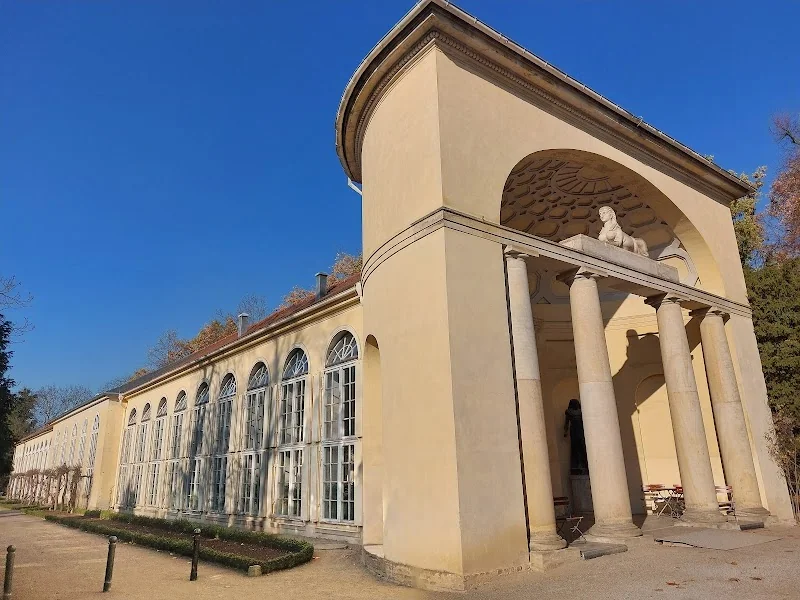
The Palm Hall in the Orangery in the New Garden is one of the places in Potsdam where architecture, music history, and park landscape come together directly. Those looking for an extraordinary location will find here not just any hall, but a historic space in the northern part of the New Garden, one of the most significant garden ensembles in the city. The Palm Hall is now primarily known as a listed event space and is also part of an ensemble closely associated with Friedrich Wilhelm II, Prussian garden art, and the representative building culture of the late 18th century. Practically speaking: The plant halls and the Palm Hall are currently not available for rentals due to renovation measures; the reopening is planned for summer 2027. So, those looking for the Palm Hall are not just searching for a hall, but a place with history, atmosphere, and a distinct cultural profile. ([spsg.de](https://www.spsg.de/en/rental-locations/eventlocation/orangery-in-the-new-garden-palm-hall))
What Makes the Palm Hall in the New Garden Special
The Palm Hall owes its special effect primarily to the combination of courtly representation and understated elegance. The SPSG describes the Orangery as a building from 1791, commissioned by Friedrich Wilhelm II from Carl Gotthard Langhans. Not only exotic plants were to winter here; in the center of the complex, a central concert hall was created, where the king himself played cello and held intimate concerts with a chamber orchestra. This very mix of music, garden art, and spatial effect makes the Palm Hall so interesting to this day. It is not a loud banquet hall, but a space for concentrated, cultivated formats that thrive on the historical ambiance. Those who value atmosphere, history, and a clear architectural framework quickly understand why this place has a firm place in the cultural-historical memory of Potsdam. ([spsg.de](https://www.spsg.de/en/rental-locations/eventlocation/orangery-in-the-new-garden-palm-hall))
The design of the interior also contributes significantly to the character of the hall. The Palm Hall is clad with woods from yew, plum, and elm, giving the space a warm, almost handcrafted feel. Large windows on the south side open the view into the park, so that the interior and garden almost merge. Access is from the east through the Egyptian portal and the plant hall, which consciously stages the arrival in the building and makes the path to the hall feel like a small transition from the park into a representative, almost private space. This is precisely one of its strengths: The Palm Hall does not thrive on size, but on proportion, materiality, and perspective. It is thus ideal for visitors who want to perceive historical spaces not just as sights, but as a holistic experience of architecture, light, and surroundings. ([spsg.de](https://www.spsg.de/en/rental-locations/eventlocation/orangery-in-the-new-garden-palm-hall))
Events, Usage, and Current Availability
The Palm Hall is officially designated for concerts, readings, and lectures. This fits very well with its room size and its historical origin as a place for musical and cultural gatherings. For organizers, it is particularly relevant that catering is not allowed in the Palm Hall itself, but only in the plant halls. This keeps the hall as a historic core space protected and its atmosphere is not overshadowed by event-typical ancillary functions. Additionally, the SPSG mentions the use of the indoor areas between May and September, while rentals are currently suspended due to renovation work. Those planning long-term should keep an eye on the reopening in summer 2027 and continue to follow the official location development. For editorial, cultural, or SEO-oriented content, this status is important because it accurately reflects the real usage situation while simultaneously emphasizing the historical value of the place. ([spsg.de](https://www.spsg.de/en/rental-locations/eventlocation/orangery-in-the-new-garden-palm-hall))
Especially for small, exclusive formats, the combination of historical architecture and limited capacity is an advantage. The Palm Hall is not a space for arbitrary mass events, but rather intended for finely curated cultural programs, chamber music, lectures, or upscale representative occasions. This also explains why the location is perceived as strongly associated with quality rather than quantity. The view into the park landscape, the simple size, and the historical materiality create a framework in which content has more impact than mere stage effects. For those seeking events in Potsdam, a historic concert hall, or a special location in the green, the Palm Hall is therefore a highly relevant hit. Those who understand the place not just as a building but as a cultural event quickly recognize its true added value: a historical environment that does not overshadow artistic formats but visibly supports them. ([spsg.de](https://www.spsg.de/en/rental-locations/eventlocation/orangery-in-the-new-garden-palm-hall))
Directions and Parking at the Palm Hall in Potsdam
The official address is Neuer Garten, Am Neuen Garten, 14469 Potsdam. For arrival, it is important that the SPSG mentions several stops in the vicinity, including Potsdam, Schloss Cecilienhof, as well as Potsdam, Gothic Library, Potsdam, Birkenstr./Alleestr., and Potsdam, Glumestr. Therefore, those coming by public transport should not look for a single stop but consider access via the New Garden and the surroundings of Cecilienhof. Especially with a historic ensemble, the last stretch is part of the experience: Arrival does not occur in an anonymous functional building, but in a park landscape that gradually prepares for the destination. The SPSG's traffic and mobility section also refers to further information on local transport. For visitors, this means: plan early, check the exact route, and allow enough time for the walk through the park. ([spsg.de](https://www.spsg.de/en/rental-locations/eventlocation/orangery-in-the-new-garden-palm-hall))
Those arriving by car will find paid parking spaces near Schloss Cecilienhof, according to the SPSG. At the same time, the foundation points out that due to construction work, only parking spaces for cars are currently available. This is an important note because it has direct consequences for travel planning, especially for groups, delivery traffic, or event dates with multiple guests. The Palm Hall is thus located in an environment where the quiet, historical character of the place takes precedence over a classic large parking situation. For practical orientation, it is also helpful that the New Garden itself is a spacious, landscape-shaped park, whose visit should not be left to the last moment. Those visiting the Palm Hall should understand the connection between parking, park path, and building access as a coherent route and not just as a short address entry in the navigation system. ([spsg.de](https://www.spsg.de/en/rental-locations/eventlocation/orangery-in-the-new-garden-palm-hall))
Capacity, Equipment, and Accessibility
With 130 square meters and a maximum occupancy of up to 100 participants, the Palm Hall is clearly aimed at small to medium formats. This number is crucial for the positioning of the location because it clearly distinguishes the space from large multipurpose halls. Those considering the hall for cultural events, lectures, or chamber music formats immediately recognize that here it is not the maximum number of visitors that matters, but the proximity to the historical space and the quality of the atmosphere that take center stage. The scale is intentionally intimate. This is important for SEO content because queries about capacity, seating, and room size should provide exactly this orientation. The Palm Hall is therefore particularly interesting for users who are not looking for an anonymous event space but rather a hall with a clearly defined size and strong historical profile. ([spsg.de](https://www.spsg.de/en/rental-locations/eventlocation/orangery-in-the-new-garden-palm-hall))
The equipment includes that toilets with limited wheelchair access are located about 50 meters away in the restoration courtyard and that the location has wheelchair access. Additionally, deliveries to the entrance are possible. These details are at least as important for real planning as the historical backdrop because they show how a listed place functions in everyday life. At the same time, it becomes clear that while the Palm Hall is accessible, it was not designed like a modern new building. This is part of its character: historical substance with limited but clearly described usage options. For organizers, this means adjusting to a special but also sensitive space. For visitors, it means experiencing the historical facility with an eye for practical details. This mixture of beauty and concrete information makes the Palm Hall a credible and planable location. ([spsg.de](https://www.spsg.de/en/rental-locations/eventlocation/orangery-in-the-new-garden-palm-hall))
History of the Orangery and the Palm Hall
The Palm Hall is inseparably linked to the New Garden, which in turn is one of the most influential landscape facilities in Potsdam. The New Garden covers 102.5 hectares, is located in the north of the city, and stretches along the Holy Lake and the Jungfernsee. It was laid out starting in 1787 on the orders of Friedrich Wilhelm II, who consciously had a garden created in the English style as a counter-design to the baroque ornamental and kitchen garden of Sanssouci. The implementation of the modern garden concept was initially carried out by Johann August Eyserbeck, later Peter Joseph Lenné took over the design from 1816. The park is thus not only a place of beautiful paths and views but also a central chapter of Prussian garden art. In this larger context, the Orangery with the Palm Hall also stands: as part of a landscape where architecture is not isolated but conceived as part of a total work of art. ([potsdam-sanssouci.com](https://www.potsdam-sanssouci.com/potsdam-sehenswuerdigkeiten/neuer-garten/))
The surroundings make the historical significance even more tangible. The New Garden includes and included significant facilities such as the Marble Palace, the Palace Kitchen, the Gothic Library, the Pyramid, the Shell Grotto, the Dairy, the Dutch Establishment, and the Hermitage. Additionally, there is Schloss Cecilienhof, which was built between 1914 and 1917 and later gained world-historical significance through the Potsdam Conference. This dense neighborhood of historical buildings explains why the Palm Hall should not be viewed as a standalone object. It is part of a cultural-historical system that connects courtly representation, symbolism, and landscape staging. Even the unusual forms in the park, such as the Palace Kitchen as a temple ruin or the ice cellar in pyramid form, tell of the intellectual world of Friedrich Wilhelm II. With its location in the midst of this ensemble, the Palm Hall is not only a beautiful space but also a testament to how Prussia brought music, nature, and architecture together into a narrative. ([potsdam-sanssouci.com](https://www.potsdam-sanssouci.com/potsdam-sehenswuerdigkeiten/neuer-garten/))
Café in the New Garden, Surroundings, and Practical Tips
A special advantage of the Orangery is that in the summer months, the Café in the New Garden is located in the eastern plant hall. This makes the place attractive not only for event planners but also for walkers, culture enthusiasts, and day visitors. The plant hall complements the Palm Hall in a meaningful way: while the hall itself is a clearly structured historical space, the café offers a more open, low-threshold connection to the ensemble. At the same time, it remains important that catering is not allowed in the Palm Hall itself, but only in the plant halls. Practically speaking, this means a clear separation between historical spatial impact and supplementary catering. Those planning to use the Palm Hall as a location should therefore distinguish from the outset between hall use and gastronomic accompaniment. Especially in historical buildings, this clarity is helpful because it preserves the character of the place while also considering modern requirements. ([spsg.de](https://www.spsg.de/en/rental-locations/eventlocation/orangery-in-the-new-garden-palm-hall))
The park itself is also a strong argument for a visit. The New Garden is open daily from 8 a.m. until dusk, and entry is free. This makes the area excellent for a walk before or after a visit to the surroundings. Those researching the Palm Hall should therefore not only focus on the space but also on the overall experience: the path by the water, the historical sightlines, the neighboring buildings, and the tranquil atmosphere of the park. For visitors, this is particularly appealing because the Palm Hall fits into a larger cultural framework that ranges from the Marble Palace to Cecilienhof. For those interested in events, this location is an advantage because it immediately gives the occasion a special context. The Palm Hall is therefore not just a location in Potsdam, but a place where history, garden art, and usability stand in remarkable balance. ([potsdam-sanssouci.com](https://www.potsdam-sanssouci.com/potsdam-sehenswuerdigkeiten/neuer-garten/))
Sources:
Show moreShow less
Palm Hall Potsdam | Events & History
The Palm Hall in the Orangery in the New Garden is one of the places in Potsdam where architecture, music history, and park landscape come together directly. Those looking for an extraordinary location will find here not just any hall, but a historic space in the northern part of the New Garden, one of the most significant garden ensembles in the city. The Palm Hall is now primarily known as a listed event space and is also part of an ensemble closely associated with Friedrich Wilhelm II, Prussian garden art, and the representative building culture of the late 18th century. Practically speaking: The plant halls and the Palm Hall are currently not available for rentals due to renovation measures; the reopening is planned for summer 2027. So, those looking for the Palm Hall are not just searching for a hall, but a place with history, atmosphere, and a distinct cultural profile. ([spsg.de](https://www.spsg.de/en/rental-locations/eventlocation/orangery-in-the-new-garden-palm-hall))
What Makes the Palm Hall in the New Garden Special
The Palm Hall owes its special effect primarily to the combination of courtly representation and understated elegance. The SPSG describes the Orangery as a building from 1791, commissioned by Friedrich Wilhelm II from Carl Gotthard Langhans. Not only exotic plants were to winter here; in the center of the complex, a central concert hall was created, where the king himself played cello and held intimate concerts with a chamber orchestra. This very mix of music, garden art, and spatial effect makes the Palm Hall so interesting to this day. It is not a loud banquet hall, but a space for concentrated, cultivated formats that thrive on the historical ambiance. Those who value atmosphere, history, and a clear architectural framework quickly understand why this place has a firm place in the cultural-historical memory of Potsdam. ([spsg.de](https://www.spsg.de/en/rental-locations/eventlocation/orangery-in-the-new-garden-palm-hall))
The design of the interior also contributes significantly to the character of the hall. The Palm Hall is clad with woods from yew, plum, and elm, giving the space a warm, almost handcrafted feel. Large windows on the south side open the view into the park, so that the interior and garden almost merge. Access is from the east through the Egyptian portal and the plant hall, which consciously stages the arrival in the building and makes the path to the hall feel like a small transition from the park into a representative, almost private space. This is precisely one of its strengths: The Palm Hall does not thrive on size, but on proportion, materiality, and perspective. It is thus ideal for visitors who want to perceive historical spaces not just as sights, but as a holistic experience of architecture, light, and surroundings. ([spsg.de](https://www.spsg.de/en/rental-locations/eventlocation/orangery-in-the-new-garden-palm-hall))
Events, Usage, and Current Availability
The Palm Hall is officially designated for concerts, readings, and lectures. This fits very well with its room size and its historical origin as a place for musical and cultural gatherings. For organizers, it is particularly relevant that catering is not allowed in the Palm Hall itself, but only in the plant halls. This keeps the hall as a historic core space protected and its atmosphere is not overshadowed by event-typical ancillary functions. Additionally, the SPSG mentions the use of the indoor areas between May and September, while rentals are currently suspended due to renovation work. Those planning long-term should keep an eye on the reopening in summer 2027 and continue to follow the official location development. For editorial, cultural, or SEO-oriented content, this status is important because it accurately reflects the real usage situation while simultaneously emphasizing the historical value of the place. ([spsg.de](https://www.spsg.de/en/rental-locations/eventlocation/orangery-in-the-new-garden-palm-hall))
Especially for small, exclusive formats, the combination of historical architecture and limited capacity is an advantage. The Palm Hall is not a space for arbitrary mass events, but rather intended for finely curated cultural programs, chamber music, lectures, or upscale representative occasions. This also explains why the location is perceived as strongly associated with quality rather than quantity. The view into the park landscape, the simple size, and the historical materiality create a framework in which content has more impact than mere stage effects. For those seeking events in Potsdam, a historic concert hall, or a special location in the green, the Palm Hall is therefore a highly relevant hit. Those who understand the place not just as a building but as a cultural event quickly recognize its true added value: a historical environment that does not overshadow artistic formats but visibly supports them. ([spsg.de](https://www.spsg.de/en/rental-locations/eventlocation/orangery-in-the-new-garden-palm-hall))
Directions and Parking at the Palm Hall in Potsdam
The official address is Neuer Garten, Am Neuen Garten, 14469 Potsdam. For arrival, it is important that the SPSG mentions several stops in the vicinity, including Potsdam, Schloss Cecilienhof, as well as Potsdam, Gothic Library, Potsdam, Birkenstr./Alleestr., and Potsdam, Glumestr. Therefore, those coming by public transport should not look for a single stop but consider access via the New Garden and the surroundings of Cecilienhof. Especially with a historic ensemble, the last stretch is part of the experience: Arrival does not occur in an anonymous functional building, but in a park landscape that gradually prepares for the destination. The SPSG's traffic and mobility section also refers to further information on local transport. For visitors, this means: plan early, check the exact route, and allow enough time for the walk through the park. ([spsg.de](https://www.spsg.de/en/rental-locations/eventlocation/orangery-in-the-new-garden-palm-hall))
Those arriving by car will find paid parking spaces near Schloss Cecilienhof, according to the SPSG. At the same time, the foundation points out that due to construction work, only parking spaces for cars are currently available. This is an important note because it has direct consequences for travel planning, especially for groups, delivery traffic, or event dates with multiple guests. The Palm Hall is thus located in an environment where the quiet, historical character of the place takes precedence over a classic large parking situation. For practical orientation, it is also helpful that the New Garden itself is a spacious, landscape-shaped park, whose visit should not be left to the last moment. Those visiting the Palm Hall should understand the connection between parking, park path, and building access as a coherent route and not just as a short address entry in the navigation system. ([spsg.de](https://www.spsg.de/en/rental-locations/eventlocation/orangery-in-the-new-garden-palm-hall))
Capacity, Equipment, and Accessibility
With 130 square meters and a maximum occupancy of up to 100 participants, the Palm Hall is clearly aimed at small to medium formats. This number is crucial for the positioning of the location because it clearly distinguishes the space from large multipurpose halls. Those considering the hall for cultural events, lectures, or chamber music formats immediately recognize that here it is not the maximum number of visitors that matters, but the proximity to the historical space and the quality of the atmosphere that take center stage. The scale is intentionally intimate. This is important for SEO content because queries about capacity, seating, and room size should provide exactly this orientation. The Palm Hall is therefore particularly interesting for users who are not looking for an anonymous event space but rather a hall with a clearly defined size and strong historical profile. ([spsg.de](https://www.spsg.de/en/rental-locations/eventlocation/orangery-in-the-new-garden-palm-hall))
The equipment includes that toilets with limited wheelchair access are located about 50 meters away in the restoration courtyard and that the location has wheelchair access. Additionally, deliveries to the entrance are possible. These details are at least as important for real planning as the historical backdrop because they show how a listed place functions in everyday life. At the same time, it becomes clear that while the Palm Hall is accessible, it was not designed like a modern new building. This is part of its character: historical substance with limited but clearly described usage options. For organizers, this means adjusting to a special but also sensitive space. For visitors, it means experiencing the historical facility with an eye for practical details. This mixture of beauty and concrete information makes the Palm Hall a credible and planable location. ([spsg.de](https://www.spsg.de/en/rental-locations/eventlocation/orangery-in-the-new-garden-palm-hall))
History of the Orangery and the Palm Hall
The Palm Hall is inseparably linked to the New Garden, which in turn is one of the most influential landscape facilities in Potsdam. The New Garden covers 102.5 hectares, is located in the north of the city, and stretches along the Holy Lake and the Jungfernsee. It was laid out starting in 1787 on the orders of Friedrich Wilhelm II, who consciously had a garden created in the English style as a counter-design to the baroque ornamental and kitchen garden of Sanssouci. The implementation of the modern garden concept was initially carried out by Johann August Eyserbeck, later Peter Joseph Lenné took over the design from 1816. The park is thus not only a place of beautiful paths and views but also a central chapter of Prussian garden art. In this larger context, the Orangery with the Palm Hall also stands: as part of a landscape where architecture is not isolated but conceived as part of a total work of art. ([potsdam-sanssouci.com](https://www.potsdam-sanssouci.com/potsdam-sehenswuerdigkeiten/neuer-garten/))
The surroundings make the historical significance even more tangible. The New Garden includes and included significant facilities such as the Marble Palace, the Palace Kitchen, the Gothic Library, the Pyramid, the Shell Grotto, the Dairy, the Dutch Establishment, and the Hermitage. Additionally, there is Schloss Cecilienhof, which was built between 1914 and 1917 and later gained world-historical significance through the Potsdam Conference. This dense neighborhood of historical buildings explains why the Palm Hall should not be viewed as a standalone object. It is part of a cultural-historical system that connects courtly representation, symbolism, and landscape staging. Even the unusual forms in the park, such as the Palace Kitchen as a temple ruin or the ice cellar in pyramid form, tell of the intellectual world of Friedrich Wilhelm II. With its location in the midst of this ensemble, the Palm Hall is not only a beautiful space but also a testament to how Prussia brought music, nature, and architecture together into a narrative. ([potsdam-sanssouci.com](https://www.potsdam-sanssouci.com/potsdam-sehenswuerdigkeiten/neuer-garten/))
Café in the New Garden, Surroundings, and Practical Tips
A special advantage of the Orangery is that in the summer months, the Café in the New Garden is located in the eastern plant hall. This makes the place attractive not only for event planners but also for walkers, culture enthusiasts, and day visitors. The plant hall complements the Palm Hall in a meaningful way: while the hall itself is a clearly structured historical space, the café offers a more open, low-threshold connection to the ensemble. At the same time, it remains important that catering is not allowed in the Palm Hall itself, but only in the plant halls. Practically speaking, this means a clear separation between historical spatial impact and supplementary catering. Those planning to use the Palm Hall as a location should therefore distinguish from the outset between hall use and gastronomic accompaniment. Especially in historical buildings, this clarity is helpful because it preserves the character of the place while also considering modern requirements. ([spsg.de](https://www.spsg.de/en/rental-locations/eventlocation/orangery-in-the-new-garden-palm-hall))
The park itself is also a strong argument for a visit. The New Garden is open daily from 8 a.m. until dusk, and entry is free. This makes the area excellent for a walk before or after a visit to the surroundings. Those researching the Palm Hall should therefore not only focus on the space but also on the overall experience: the path by the water, the historical sightlines, the neighboring buildings, and the tranquil atmosphere of the park. For visitors, this is particularly appealing because the Palm Hall fits into a larger cultural framework that ranges from the Marble Palace to Cecilienhof. For those interested in events, this location is an advantage because it immediately gives the occasion a special context. The Palm Hall is therefore not just a location in Potsdam, but a place where history, garden art, and usability stand in remarkable balance. ([potsdam-sanssouci.com](https://www.potsdam-sanssouci.com/potsdam-sehenswuerdigkeiten/neuer-garten/))
Sources:
Palm Hall Potsdam | Events & History
The Palm Hall in the Orangery in the New Garden is one of the places in Potsdam where architecture, music history, and park landscape come together directly. Those looking for an extraordinary location will find here not just any hall, but a historic space in the northern part of the New Garden, one of the most significant garden ensembles in the city. The Palm Hall is now primarily known as a listed event space and is also part of an ensemble closely associated with Friedrich Wilhelm II, Prussian garden art, and the representative building culture of the late 18th century. Practically speaking: The plant halls and the Palm Hall are currently not available for rentals due to renovation measures; the reopening is planned for summer 2027. So, those looking for the Palm Hall are not just searching for a hall, but a place with history, atmosphere, and a distinct cultural profile. ([spsg.de](https://www.spsg.de/en/rental-locations/eventlocation/orangery-in-the-new-garden-palm-hall))
What Makes the Palm Hall in the New Garden Special
The Palm Hall owes its special effect primarily to the combination of courtly representation and understated elegance. The SPSG describes the Orangery as a building from 1791, commissioned by Friedrich Wilhelm II from Carl Gotthard Langhans. Not only exotic plants were to winter here; in the center of the complex, a central concert hall was created, where the king himself played cello and held intimate concerts with a chamber orchestra. This very mix of music, garden art, and spatial effect makes the Palm Hall so interesting to this day. It is not a loud banquet hall, but a space for concentrated, cultivated formats that thrive on the historical ambiance. Those who value atmosphere, history, and a clear architectural framework quickly understand why this place has a firm place in the cultural-historical memory of Potsdam. ([spsg.de](https://www.spsg.de/en/rental-locations/eventlocation/orangery-in-the-new-garden-palm-hall))
The design of the interior also contributes significantly to the character of the hall. The Palm Hall is clad with woods from yew, plum, and elm, giving the space a warm, almost handcrafted feel. Large windows on the south side open the view into the park, so that the interior and garden almost merge. Access is from the east through the Egyptian portal and the plant hall, which consciously stages the arrival in the building and makes the path to the hall feel like a small transition from the park into a representative, almost private space. This is precisely one of its strengths: The Palm Hall does not thrive on size, but on proportion, materiality, and perspective. It is thus ideal for visitors who want to perceive historical spaces not just as sights, but as a holistic experience of architecture, light, and surroundings. ([spsg.de](https://www.spsg.de/en/rental-locations/eventlocation/orangery-in-the-new-garden-palm-hall))
Events, Usage, and Current Availability
The Palm Hall is officially designated for concerts, readings, and lectures. This fits very well with its room size and its historical origin as a place for musical and cultural gatherings. For organizers, it is particularly relevant that catering is not allowed in the Palm Hall itself, but only in the plant halls. This keeps the hall as a historic core space protected and its atmosphere is not overshadowed by event-typical ancillary functions. Additionally, the SPSG mentions the use of the indoor areas between May and September, while rentals are currently suspended due to renovation work. Those planning long-term should keep an eye on the reopening in summer 2027 and continue to follow the official location development. For editorial, cultural, or SEO-oriented content, this status is important because it accurately reflects the real usage situation while simultaneously emphasizing the historical value of the place. ([spsg.de](https://www.spsg.de/en/rental-locations/eventlocation/orangery-in-the-new-garden-palm-hall))
Especially for small, exclusive formats, the combination of historical architecture and limited capacity is an advantage. The Palm Hall is not a space for arbitrary mass events, but rather intended for finely curated cultural programs, chamber music, lectures, or upscale representative occasions. This also explains why the location is perceived as strongly associated with quality rather than quantity. The view into the park landscape, the simple size, and the historical materiality create a framework in which content has more impact than mere stage effects. For those seeking events in Potsdam, a historic concert hall, or a special location in the green, the Palm Hall is therefore a highly relevant hit. Those who understand the place not just as a building but as a cultural event quickly recognize its true added value: a historical environment that does not overshadow artistic formats but visibly supports them. ([spsg.de](https://www.spsg.de/en/rental-locations/eventlocation/orangery-in-the-new-garden-palm-hall))
Directions and Parking at the Palm Hall in Potsdam
The official address is Neuer Garten, Am Neuen Garten, 14469 Potsdam. For arrival, it is important that the SPSG mentions several stops in the vicinity, including Potsdam, Schloss Cecilienhof, as well as Potsdam, Gothic Library, Potsdam, Birkenstr./Alleestr., and Potsdam, Glumestr. Therefore, those coming by public transport should not look for a single stop but consider access via the New Garden and the surroundings of Cecilienhof. Especially with a historic ensemble, the last stretch is part of the experience: Arrival does not occur in an anonymous functional building, but in a park landscape that gradually prepares for the destination. The SPSG's traffic and mobility section also refers to further information on local transport. For visitors, this means: plan early, check the exact route, and allow enough time for the walk through the park. ([spsg.de](https://www.spsg.de/en/rental-locations/eventlocation/orangery-in-the-new-garden-palm-hall))
Those arriving by car will find paid parking spaces near Schloss Cecilienhof, according to the SPSG. At the same time, the foundation points out that due to construction work, only parking spaces for cars are currently available. This is an important note because it has direct consequences for travel planning, especially for groups, delivery traffic, or event dates with multiple guests. The Palm Hall is thus located in an environment where the quiet, historical character of the place takes precedence over a classic large parking situation. For practical orientation, it is also helpful that the New Garden itself is a spacious, landscape-shaped park, whose visit should not be left to the last moment. Those visiting the Palm Hall should understand the connection between parking, park path, and building access as a coherent route and not just as a short address entry in the navigation system. ([spsg.de](https://www.spsg.de/en/rental-locations/eventlocation/orangery-in-the-new-garden-palm-hall))
Capacity, Equipment, and Accessibility
With 130 square meters and a maximum occupancy of up to 100 participants, the Palm Hall is clearly aimed at small to medium formats. This number is crucial for the positioning of the location because it clearly distinguishes the space from large multipurpose halls. Those considering the hall for cultural events, lectures, or chamber music formats immediately recognize that here it is not the maximum number of visitors that matters, but the proximity to the historical space and the quality of the atmosphere that take center stage. The scale is intentionally intimate. This is important for SEO content because queries about capacity, seating, and room size should provide exactly this orientation. The Palm Hall is therefore particularly interesting for users who are not looking for an anonymous event space but rather a hall with a clearly defined size and strong historical profile. ([spsg.de](https://www.spsg.de/en/rental-locations/eventlocation/orangery-in-the-new-garden-palm-hall))
The equipment includes that toilets with limited wheelchair access are located about 50 meters away in the restoration courtyard and that the location has wheelchair access. Additionally, deliveries to the entrance are possible. These details are at least as important for real planning as the historical backdrop because they show how a listed place functions in everyday life. At the same time, it becomes clear that while the Palm Hall is accessible, it was not designed like a modern new building. This is part of its character: historical substance with limited but clearly described usage options. For organizers, this means adjusting to a special but also sensitive space. For visitors, it means experiencing the historical facility with an eye for practical details. This mixture of beauty and concrete information makes the Palm Hall a credible and planable location. ([spsg.de](https://www.spsg.de/en/rental-locations/eventlocation/orangery-in-the-new-garden-palm-hall))
History of the Orangery and the Palm Hall
The Palm Hall is inseparably linked to the New Garden, which in turn is one of the most influential landscape facilities in Potsdam. The New Garden covers 102.5 hectares, is located in the north of the city, and stretches along the Holy Lake and the Jungfernsee. It was laid out starting in 1787 on the orders of Friedrich Wilhelm II, who consciously had a garden created in the English style as a counter-design to the baroque ornamental and kitchen garden of Sanssouci. The implementation of the modern garden concept was initially carried out by Johann August Eyserbeck, later Peter Joseph Lenné took over the design from 1816. The park is thus not only a place of beautiful paths and views but also a central chapter of Prussian garden art. In this larger context, the Orangery with the Palm Hall also stands: as part of a landscape where architecture is not isolated but conceived as part of a total work of art. ([potsdam-sanssouci.com](https://www.potsdam-sanssouci.com/potsdam-sehenswuerdigkeiten/neuer-garten/))
The surroundings make the historical significance even more tangible. The New Garden includes and included significant facilities such as the Marble Palace, the Palace Kitchen, the Gothic Library, the Pyramid, the Shell Grotto, the Dairy, the Dutch Establishment, and the Hermitage. Additionally, there is Schloss Cecilienhof, which was built between 1914 and 1917 and later gained world-historical significance through the Potsdam Conference. This dense neighborhood of historical buildings explains why the Palm Hall should not be viewed as a standalone object. It is part of a cultural-historical system that connects courtly representation, symbolism, and landscape staging. Even the unusual forms in the park, such as the Palace Kitchen as a temple ruin or the ice cellar in pyramid form, tell of the intellectual world of Friedrich Wilhelm II. With its location in the midst of this ensemble, the Palm Hall is not only a beautiful space but also a testament to how Prussia brought music, nature, and architecture together into a narrative. ([potsdam-sanssouci.com](https://www.potsdam-sanssouci.com/potsdam-sehenswuerdigkeiten/neuer-garten/))
Café in the New Garden, Surroundings, and Practical Tips
A special advantage of the Orangery is that in the summer months, the Café in the New Garden is located in the eastern plant hall. This makes the place attractive not only for event planners but also for walkers, culture enthusiasts, and day visitors. The plant hall complements the Palm Hall in a meaningful way: while the hall itself is a clearly structured historical space, the café offers a more open, low-threshold connection to the ensemble. At the same time, it remains important that catering is not allowed in the Palm Hall itself, but only in the plant halls. Practically speaking, this means a clear separation between historical spatial impact and supplementary catering. Those planning to use the Palm Hall as a location should therefore distinguish from the outset between hall use and gastronomic accompaniment. Especially in historical buildings, this clarity is helpful because it preserves the character of the place while also considering modern requirements. ([spsg.de](https://www.spsg.de/en/rental-locations/eventlocation/orangery-in-the-new-garden-palm-hall))
The park itself is also a strong argument for a visit. The New Garden is open daily from 8 a.m. until dusk, and entry is free. This makes the area excellent for a walk before or after a visit to the surroundings. Those researching the Palm Hall should therefore not only focus on the space but also on the overall experience: the path by the water, the historical sightlines, the neighboring buildings, and the tranquil atmosphere of the park. For visitors, this is particularly appealing because the Palm Hall fits into a larger cultural framework that ranges from the Marble Palace to Cecilienhof. For those interested in events, this location is an advantage because it immediately gives the occasion a special context. The Palm Hall is therefore not just a location in Potsdam, but a place where history, garden art, and usability stand in remarkable balance. ([potsdam-sanssouci.com](https://www.potsdam-sanssouci.com/potsdam-sehenswuerdigkeiten/neuer-garten/))
Sources:
Upcoming Events
No events found
Frequently Asked Questions
Reviews
No reviews found