
Potsdam
Ruinenberg, 14469 Potsdam, Deutschland
Norman Tower on the Ruinenberg | Photos & Opening Hours
The Norman Tower on the Ruinenberg is one of the most impressive historical viewpoints in Potsdam. It does not represent a classic event program, but rather landscape, architecture, and a wide view. Those searching for photos, images, or reviews usually want to first understand what makes this place so special: the location on the Ruinenberg, the connection to the park landscape of Sanssouci, and the view over one of the most famous cultural landscapes in Brandenburg. The tower is just under 23 meters high, was built in 1846 under King Friedrich Wilhelm IV, and is currently only open during special events. This rarity makes it particularly attractive to many visitors. The aim of this text is therefore not only to make the place visually tangible but also to clearly answer the most important questions regarding access, parking, opening hours, accessibility, and history. The facts come from the official information of the Prussian Palaces and Gardens Foundation as well as from the Potsdam tourism offer. ([spsg.de](https://www.spsg.de/schloesser-gaerten/objekt/normannischer-turm-auf-dem-ruinenberg/?utm_source=openai))
History and Development of the Ruinenberg
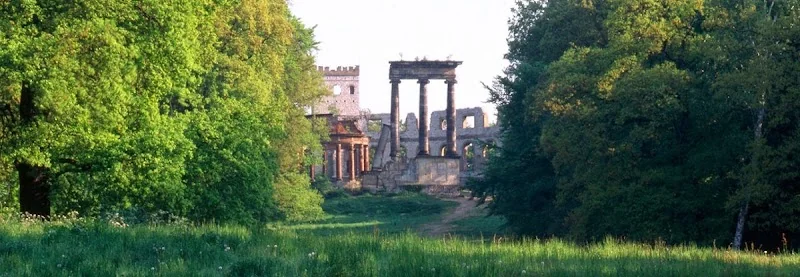
The Ruinenberg is much more than just the site of a lookout tower. Its history begins in the 18th century when Frederick the Great had a water basin created here to supply the fountains in the Sanssouci Park with water. Around this technical basin, a deliberately staged landscape setting was created with colossal columns, a Doric round temple, a pyramid, a ruin wall inspired by ancient theaters, and a natural backdrop of trees. This composition is one of the earliest landscape images influenced by England on the European continent and shows how strongly garden art, architecture, and representation were interconnected in Potsdam. The current Norman Tower was later added under Friedrich Wilhelm IV and built in 1846 as a medieval-looking watchtower. The planning is attributed to the architect Ludwig Persius in the official sources, while the execution was overseen by Ferdinand von Arnim. Thus, the tower aligned itself with a romantic idea of the Middle Ages, which was particularly popular in Prussia in the 19th century. At the same time, Peter Joseph Lenné artistically expanded the Potsdam park landscape towards Ruinenberg and Bornstedter Feld. The site is therefore not an isolated monument but part of a long-term developed cultural landscape based on sight axes, topographical contrasts, and carefully composed visual relationships. Standing here, one does not only look from a tower into the distance but experiences a deliberately planned dramaturgy of height, water, garden, and architecture. The official history also explains why the Ruinenberg is still perceived today as a historical viewpoint with a special aura. ([spsg.de](https://www.spsg.de/schloesser-gaerten/objekt/normannischer-turm-auf-dem-ruinenberg/?utm_source=openai))
Photos, Panorama, and the Most Beautiful View Axes
The most common search queries about this place revolve around photos and images, which is easily understandable: The Norman Tower is primarily a place of perspective. The panoramic view extends from the Peacock Island over the Sanssouci Park to the Wilhelmshöhe near Werder. This panoramic axis is highlighted multiple times in the official descriptions of the SPSG and makes the tower one of the most impressive viewpoints in Potsdam. Unlike many lookout towers in cities, it does not only show roofs and streets but a landscaped cultural landscape with meadows, hills, groups of trees, water surfaces, and palace architecture. This is particularly exciting for photography because changing image motifs arise here: the tower itself as a romantic building, the Ruinenberg backdrop with the theater wall, and the vastness of the Potsdam park landscape. Those looking for the best motifs should not view the tower as an isolated object but as part of an ensemble. From a distance, it appears as a medieval silhouette; up close, it reveals its historical construction and careful restoration. Especially in clear visibility, the lines of the landscape become particularly readable, and the official imagery of the SPSG emphasizes this character with shots along the basin and over the Ruinenberg. For search queries like photos, images, or reviews, it is important to know: The actual attraction is the overall picture of viewpoint, history, and staging. Those looking for a place where they can not only observe Potsdam but experience it in a historical perspective will find a very characteristic viewpoint here. ([spsg.de](https://www.spsg.de/schloesser-gaerten/objekt/normannischer-turm-auf-dem-ruinenberg/?utm_source=openai))
Opening Hours, Special Openings, and Tickets
The opening hours of the Norman Tower are a crucial question for many visitors, and there is a peculiarity here: The tower is not regularly accessible daily but is only opened during special events. The official SPSG website publishes corresponding dates separately. For the year 2026, for example, the foundation mentions special openings for the Day of Open Monuments and October 3rd, each from 10:00 AM to 5:00 PM. The event “Fantastic Views!” also shows that the tower is listed as a special highlight in the event calendar. Those planning a visit should therefore not expect classic opening hours like in a museum but check the current event page of the SPSG. Tickets are offered on-site during special openings; in an official event notice, regular admission prices for such dates are also mentioned. This is important because different rules may apply for this special form than for other castles and gardens of the SPSG. The site is therefore not suitable for a spontaneous standard visit but for a targeted plan around a specific date. This gives it its exclusive character. When visitors search for opening hours, special openings, or tickets, it is about a deliberately reduced accessibility that protects the monument character and makes the visit a special event. Those who plan early have the best chances of attending one of the limited dates and experiencing the tower in a calm, decelerated setting. ([spsg.de](https://www.spsg.de/schloesser-gaerten/objekt/normannischer-turm-auf-dem-ruinenberg?utm_source=openai))
Access, Parking, and Path to the Tower
Even when it comes to access, a close look at the official information is worthwhile. For special openings, the SPSG names the address Ruinenberg in 14469 Potsdam. For public transport, the stop Potsdam, Schloss Sanssouci is indicated. This makes it clear that the visit is embedded in the larger park context, and one should understand the path to the tower as part of a walk through the cultural landscape. Those arriving by car will find paid parking spaces for cars and buses at parking lot P1 near the Historical Mill during special openings. Additionally, the SPSG points out the nearest parking spaces in the Luisenplatz underground garage in the context of the accessibility of the Sanssouci Park. For visitors who want to orient themselves in the park first, this information is helpful because the Ruinenberg is well connected but does not function like a classic city center theme with direct access. The goal is rather a quiet, scenic approach than an urban arrival. The path through the surroundings of Sanssouci, Historical Mill, and Ruinenberg is part of the experience. Those searching for access and parking should therefore always distinguish between regular park visits and special openings. For the specific date at the tower, P1 at the Historical Mill is the obvious solution; for further park visits, the Luisenplatz area can be a good starting point. It is clear: The Norman Tower is indeed easily accessible, but the visit begins even before the entrance with the choice of the right starting point. ([spsg.de](https://www.spsg.de/aktuelles/veranstaltung/phantastische-aussichten-4/event/tid/13867?utm_source=openai))
Accessibility, Rules, and Practical Tips
An important practical point concerns accessibility. The SPSG explicitly states that the Norman Tower is not wheelchair accessible. Additionally, the use of strollers in the exhibition rooms is not possible for conservation reasons. Therefore, those who wish to visit the tower should consider this in their planning, especially if strollers, walkers, or other mobility aids play a role. At the same time, the official information shows that the tower is to be understood more as a historical monument than as a modern equipped visitor attraction. The protection of the building substance and the interiors takes priority. Special notes apply for assistance dogs, and luggage may not be left in the entrance area for security reasons. These are not trivial matters but part of a monument-compliant visit. Practically, this means: Light equipment, comfortable shoes, and careful preparation facilitate the visit. Those visiting the tower during a special opening should also bring some time, as the charm of the place unfolds not only in the interior but also in the surroundings. The path over the Ruinenberg, the view of the landscape, and the embedding in Sanssouci Park are part of the overall experience. The official accessibility page of the park also lists accessible stops and park-close paths, which is particularly useful for overall planning. The Norman Tower thus remains a place primarily intended for historically and scenically interested visitors seeking an authentic monument experience while respecting the special protection requirements. ([spsg.de](https://www.spsg.de/schloesser-gaerten/objekt/normannischer-turm-auf-dem-ruinenberg?utm_source=openai))
The Ruinenberg in the Context of Sanssouci and Potsdam
The Norman Tower can be best understood when viewed not in isolation but in the context of Sanssouci and the entire Potsdam cultural landscape. The SPSG describes the Ruinenberg as a historically significant viewpoint that is integrated into the landscape planning around Sanssouci Park. The early idea of creating a water basin for the fountains on the hill underscores the close connection between technology, art, and representation of power. Later, the area was integrated into the park landscape by Lenné, so that today the tower not only points to a beautiful view but also to a historical overall concept. This is a fundamental reason why the site is so important for Potsdam: It tells the story of a city that was deliberately designed as a landscape and architectural space in the 18th and 19th centuries. The Norman Tower stands for the romantic addition to this facility in the 19th century. Official texts also highlight that the tower was restored after its destruction in World War II and reopened in October 2001. Thus, the site has received a second, modern layer: it is not only a monument of the 19th century but also a result of careful monument preservation in the 21st century. Today, those searching for Potsdam attractions, Sanssouci Park, or Ruinenberg will find a place where historical design, restoration, and public accessibility meet. This very mix makes the Norman Tower a strong search term for visitors who want to combine photos, background knowledge, and a real excursion point. ([spsg.de](https://www.spsg.de/schloesser-gaerten/objekt/normannischer-turm-auf-dem-ruinenberg/?utm_source=openai))
Sources:
Mehr anzeigenWeniger anzeigen
Norman Tower on the Ruinenberg | Photos & Opening Hours
The Norman Tower on the Ruinenberg is one of the most impressive historical viewpoints in Potsdam. It does not represent a classic event program, but rather landscape, architecture, and a wide view. Those searching for photos, images, or reviews usually want to first understand what makes this place so special: the location on the Ruinenberg, the connection to the park landscape of Sanssouci, and the view over one of the most famous cultural landscapes in Brandenburg. The tower is just under 23 meters high, was built in 1846 under King Friedrich Wilhelm IV, and is currently only open during special events. This rarity makes it particularly attractive to many visitors. The aim of this text is therefore not only to make the place visually tangible but also to clearly answer the most important questions regarding access, parking, opening hours, accessibility, and history. The facts come from the official information of the Prussian Palaces and Gardens Foundation as well as from the Potsdam tourism offer. ([spsg.de](https://www.spsg.de/schloesser-gaerten/objekt/normannischer-turm-auf-dem-ruinenberg/?utm_source=openai))
History and Development of the Ruinenberg
The Ruinenberg is much more than just the site of a lookout tower. Its history begins in the 18th century when Frederick the Great had a water basin created here to supply the fountains in the Sanssouci Park with water. Around this technical basin, a deliberately staged landscape setting was created with colossal columns, a Doric round temple, a pyramid, a ruin wall inspired by ancient theaters, and a natural backdrop of trees. This composition is one of the earliest landscape images influenced by England on the European continent and shows how strongly garden art, architecture, and representation were interconnected in Potsdam. The current Norman Tower was later added under Friedrich Wilhelm IV and built in 1846 as a medieval-looking watchtower. The planning is attributed to the architect Ludwig Persius in the official sources, while the execution was overseen by Ferdinand von Arnim. Thus, the tower aligned itself with a romantic idea of the Middle Ages, which was particularly popular in Prussia in the 19th century. At the same time, Peter Joseph Lenné artistically expanded the Potsdam park landscape towards Ruinenberg and Bornstedter Feld. The site is therefore not an isolated monument but part of a long-term developed cultural landscape based on sight axes, topographical contrasts, and carefully composed visual relationships. Standing here, one does not only look from a tower into the distance but experiences a deliberately planned dramaturgy of height, water, garden, and architecture. The official history also explains why the Ruinenberg is still perceived today as a historical viewpoint with a special aura. ([spsg.de](https://www.spsg.de/schloesser-gaerten/objekt/normannischer-turm-auf-dem-ruinenberg/?utm_source=openai))
Photos, Panorama, and the Most Beautiful View Axes
The most common search queries about this place revolve around photos and images, which is easily understandable: The Norman Tower is primarily a place of perspective. The panoramic view extends from the Peacock Island over the Sanssouci Park to the Wilhelmshöhe near Werder. This panoramic axis is highlighted multiple times in the official descriptions of the SPSG and makes the tower one of the most impressive viewpoints in Potsdam. Unlike many lookout towers in cities, it does not only show roofs and streets but a landscaped cultural landscape with meadows, hills, groups of trees, water surfaces, and palace architecture. This is particularly exciting for photography because changing image motifs arise here: the tower itself as a romantic building, the Ruinenberg backdrop with the theater wall, and the vastness of the Potsdam park landscape. Those looking for the best motifs should not view the tower as an isolated object but as part of an ensemble. From a distance, it appears as a medieval silhouette; up close, it reveals its historical construction and careful restoration. Especially in clear visibility, the lines of the landscape become particularly readable, and the official imagery of the SPSG emphasizes this character with shots along the basin and over the Ruinenberg. For search queries like photos, images, or reviews, it is important to know: The actual attraction is the overall picture of viewpoint, history, and staging. Those looking for a place where they can not only observe Potsdam but experience it in a historical perspective will find a very characteristic viewpoint here. ([spsg.de](https://www.spsg.de/schloesser-gaerten/objekt/normannischer-turm-auf-dem-ruinenberg/?utm_source=openai))
Opening Hours, Special Openings, and Tickets
The opening hours of the Norman Tower are a crucial question for many visitors, and there is a peculiarity here: The tower is not regularly accessible daily but is only opened during special events. The official SPSG website publishes corresponding dates separately. For the year 2026, for example, the foundation mentions special openings for the Day of Open Monuments and October 3rd, each from 10:00 AM to 5:00 PM. The event “Fantastic Views!” also shows that the tower is listed as a special highlight in the event calendar. Those planning a visit should therefore not expect classic opening hours like in a museum but check the current event page of the SPSG. Tickets are offered on-site during special openings; in an official event notice, regular admission prices for such dates are also mentioned. This is important because different rules may apply for this special form than for other castles and gardens of the SPSG. The site is therefore not suitable for a spontaneous standard visit but for a targeted plan around a specific date. This gives it its exclusive character. When visitors search for opening hours, special openings, or tickets, it is about a deliberately reduced accessibility that protects the monument character and makes the visit a special event. Those who plan early have the best chances of attending one of the limited dates and experiencing the tower in a calm, decelerated setting. ([spsg.de](https://www.spsg.de/schloesser-gaerten/objekt/normannischer-turm-auf-dem-ruinenberg?utm_source=openai))
Access, Parking, and Path to the Tower
Even when it comes to access, a close look at the official information is worthwhile. For special openings, the SPSG names the address Ruinenberg in 14469 Potsdam. For public transport, the stop Potsdam, Schloss Sanssouci is indicated. This makes it clear that the visit is embedded in the larger park context, and one should understand the path to the tower as part of a walk through the cultural landscape. Those arriving by car will find paid parking spaces for cars and buses at parking lot P1 near the Historical Mill during special openings. Additionally, the SPSG points out the nearest parking spaces in the Luisenplatz underground garage in the context of the accessibility of the Sanssouci Park. For visitors who want to orient themselves in the park first, this information is helpful because the Ruinenberg is well connected but does not function like a classic city center theme with direct access. The goal is rather a quiet, scenic approach than an urban arrival. The path through the surroundings of Sanssouci, Historical Mill, and Ruinenberg is part of the experience. Those searching for access and parking should therefore always distinguish between regular park visits and special openings. For the specific date at the tower, P1 at the Historical Mill is the obvious solution; for further park visits, the Luisenplatz area can be a good starting point. It is clear: The Norman Tower is indeed easily accessible, but the visit begins even before the entrance with the choice of the right starting point. ([spsg.de](https://www.spsg.de/aktuelles/veranstaltung/phantastische-aussichten-4/event/tid/13867?utm_source=openai))
Accessibility, Rules, and Practical Tips
An important practical point concerns accessibility. The SPSG explicitly states that the Norman Tower is not wheelchair accessible. Additionally, the use of strollers in the exhibition rooms is not possible for conservation reasons. Therefore, those who wish to visit the tower should consider this in their planning, especially if strollers, walkers, or other mobility aids play a role. At the same time, the official information shows that the tower is to be understood more as a historical monument than as a modern equipped visitor attraction. The protection of the building substance and the interiors takes priority. Special notes apply for assistance dogs, and luggage may not be left in the entrance area for security reasons. These are not trivial matters but part of a monument-compliant visit. Practically, this means: Light equipment, comfortable shoes, and careful preparation facilitate the visit. Those visiting the tower during a special opening should also bring some time, as the charm of the place unfolds not only in the interior but also in the surroundings. The path over the Ruinenberg, the view of the landscape, and the embedding in Sanssouci Park are part of the overall experience. The official accessibility page of the park also lists accessible stops and park-close paths, which is particularly useful for overall planning. The Norman Tower thus remains a place primarily intended for historically and scenically interested visitors seeking an authentic monument experience while respecting the special protection requirements. ([spsg.de](https://www.spsg.de/schloesser-gaerten/objekt/normannischer-turm-auf-dem-ruinenberg?utm_source=openai))
The Ruinenberg in the Context of Sanssouci and Potsdam
The Norman Tower can be best understood when viewed not in isolation but in the context of Sanssouci and the entire Potsdam cultural landscape. The SPSG describes the Ruinenberg as a historically significant viewpoint that is integrated into the landscape planning around Sanssouci Park. The early idea of creating a water basin for the fountains on the hill underscores the close connection between technology, art, and representation of power. Later, the area was integrated into the park landscape by Lenné, so that today the tower not only points to a beautiful view but also to a historical overall concept. This is a fundamental reason why the site is so important for Potsdam: It tells the story of a city that was deliberately designed as a landscape and architectural space in the 18th and 19th centuries. The Norman Tower stands for the romantic addition to this facility in the 19th century. Official texts also highlight that the tower was restored after its destruction in World War II and reopened in October 2001. Thus, the site has received a second, modern layer: it is not only a monument of the 19th century but also a result of careful monument preservation in the 21st century. Today, those searching for Potsdam attractions, Sanssouci Park, or Ruinenberg will find a place where historical design, restoration, and public accessibility meet. This very mix makes the Norman Tower a strong search term for visitors who want to combine photos, background knowledge, and a real excursion point. ([spsg.de](https://www.spsg.de/schloesser-gaerten/objekt/normannischer-turm-auf-dem-ruinenberg/?utm_source=openai))
Sources:
Upcoming Events
No events found
Frequently Asked Questions
Reviews
Sheika Fateema
27. June 2026
I walked all the way from Sanssouci Palace to the Normannischer Turm auf dem Ruinenberg, and it was well worth the effort. The walk itself was peaceful and scenic, especially if you enjoy exploring on foot. Once I reached the tower, I was rewarded with beautiful views of Potsdam and the surrounding landscape. The area is quiet, making it a great place to take a break, enjoy nature, and appreciate a different side of Potsdam away from the crowds. If you don’t mind a bit of walking, I definitely recommend adding this spot to your itinerary.
Alexandr Orlov
9. September 2019
The living embodiment of the desire to travel. This place appeared here thanks to the ruler's love for other places and his desire to visit them, but the inability to leave his home. He built this place as an opportunity to somehow visit the desired places. Low rating due to the fact that a long journey here did not meet expectations for impressions. This historic place looks interesting, but small.
UK Photo Journey
13. January 2024
The Ruinenberg is a hill in the Bornstedt borough of Potsdam, located north of Sanssouci Park. The Prussian king Frederick the Great had a water tank with a capacity of around 7,600 cubic metres, built on top to supply the Sanssouci water features in 1748 and had it decorated with artificial ruins which created amazing atmosphere. From 1841 a surrounding landscape garden was laid out at the behest of King Frederick William IV of Prussia, according to plans designed by Peter Joseph Lenné. It is a beautiful place and worth to visit.
Shuwaib Malik
16. April 2026
I spotted these from Sanscoussi palace so walked over. Very random but also very cool to see. You won't see so many other people there.
DDF GhostHunting
2. August 2022
Was a very cool place and not many tourists cuz its so far off the beaten path.