
Potsdam
Am Försteracker 1, 14478 Potsdam Süd, Deutschland
Martin Luther Chapel of the Resurrection Community Potsdam | Photos
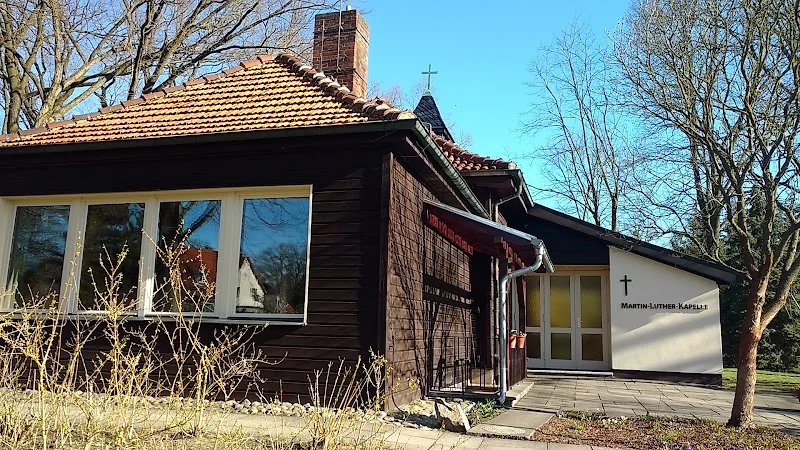
The Martin Luther Chapel of the Protestant Resurrection Community in Potsdam is not a monumental large building, but a deliberately understated yet very characterful wooden structure that immediately conveys a special atmosphere. Those looking for photos, historical impressions, or a place with lived community culture will find here a chapel that convinces with its simple form, its history, and its current use. The city of Potsdam describes the building as a small rectangular hall with a hipped roof and a small bell tower; it is located on the edge of the garden city settlement "Am Brunnen" and is still used as a community site today. This mix of modesty, history, and vibrant everyday life makes the Martin Luther Chapel interesting for visitors. The building is also documented on tourism websites and in historical image collections, allowing for a good impression from the outside and of its architectural impact. ([potsdam.de](https://www.potsdam.de/de/martin-luther-kapelle))
Photos, Architecture, and Location of the Martin Luther Chapel
Those interested in photos of the Martin Luther Chapel will discover primarily a building that appears through simplicity. The outer shape is clearly readable: a wooden, rectangular hall, a hipped roof, a small bell tower, and overall a restrained, almost residential appearance. The city side highlights these features and places the chapel at the edge of the settlement, making the building not appear as an isolated monument, but as a grown part of the neighborhood. This is important for photographic perspective, as the chapel thrives not on monumental distance but on proximity to its surroundings, on lines, roof shape, and materiality. When viewed photographically, one finds a structure that appears particularly distinctive in profile and with its wooden facade. The tourism page also refers to the chapel and places it in the context of Potsdam with image material, while historical photo entries on Wikimedia Commons show that the place is also visually documented. This creates an image of a chapel that does not need to be loud to photographically convince. ([potsdam.de](https://www.potsdam.de/de/martin-luther-kapelle))
The location in the southern part of Potsdam complements this impression. The address Am Försteracker 1 clearly situates the chapel in a residential and community context, not in a tourist stage with much traffic. This is an advantage for visitors seeking quiet, authentic motifs: here stands not a spectacular brick cathedral, but a small sacred wooden building with a personal aura. Particularly in the interplay of architecture and surroundings, a very unique character emerges. The chapel appears as a place that was not built for effect, but for permanence, devotion, and neighborly community. This also aids the visual language: the building visually tells of a house of worship that consciously integrates into its environment. The urban description also makes it clear that the building has been adapted multiple times to new needs. This is evident not only in its history but also in today’s impression, which connects tradition and practical use. ([potsdam.de](https://www.potsdam.de/de/martin-luther-kapelle))
History of the Martin Luther Chapel: From Mining Chapel to Potsdam Community Site
The history of the Martin Luther Chapel is unusual and precisely for that reason so exciting. According to the city of Potsdam, the small house of worship was originally used as a mining chapel for the Brefeld shaft in Tarthun near Staßfurt in the Harz mountains. In 1934, the building was relocated to Potsdam and newly integrated into the community context there. The church consecration took place on November 11, 1934. This origin explains the special character of the chapel: it did not simply arise at its current location but has a visible biography behind it. Such relocated sacred buildings are rare and make the Martin Luther Chapel a structural testimony to the reuse of architecture, the mobility of church sites, and the development of community centers in the 20th century. The fact that the architect is unknown adds a certain historical openness to the building; the signature of a famous person is not at the forefront, but rather the life path of a house that received a new purpose and a new location. ([potsdam.de](https://www.potsdam.de/de/martin-luther-kapelle))
The history also includes later changes that reflect practical community life. In 1962, the liturgical furnishings were made of wood according to designs by Winfried Wendland. This points to a conscious design of the interior that adapted to the material wood and the character of the chapel. Later, the building was remodeled in 1977/80 to create usable spaces. This changed the chapel not just aesthetically but functionally: from a compact church space, it became a place with further usage possibilities for the community. This development is typical for vibrant community houses that retain their religious core while also responding to new demands. Thus, when viewing the chapel today, one sees not only a historical wooden building but a place that has been gently developed over decades. The history is therefore not concluded but written into the present. ([potsdam.de](https://www.potsdam.de/de/martin-luther-kapelle))
Services, Film Evenings, and Community Life in the Chapel
The Martin Luther Chapel is still an active community site today, and this is clearly shown by the community newsletters of the Protestant Resurrection Community. There are regular entries for Point-11 services, baptism services, evening services, and special festive forms around the church year. In the community newsletter for 2025, for example, a Point-11 service is announced as a baptism service, another as a confirmation presentation. In addition, there are evening services with the youth community as well as an open-air service on the meadow by the chapel for Ascension Day. This is important because it shows that the chapel does not only function as a static place of devotion but as a location with different liturgical forms and a noticeable integration of various age groups. For SEO and content logic, this means: those searching for services, events, or community life will find real, recurring use here and not just a historical shell. ([evangelisch-in-potsdam.de](https://www.evangelisch-in-potsdam.de/fileadmin/sites/kirchenkreis-potsdam.de/uploads/Lichtblick_98.pdf?utm_source=openai))
The chapel also appears particularly lively through the offerings for adults and for communal togetherness. The community newsletters mention the women’s circle, the men’s circle, discussions about God and the world, film evenings in the chapel, senior café dates, as well as the choir and the instrumental group. Such formats make it visible that the Martin Luther Chapel is much more than a place for Sunday services. It is a meeting point, a place for conversation, a cultural space, and a room where community life becomes concrete. Particularly the film evenings in the chapel are a nice indication of how flexibly the place is used. The combination of fixed spiritual forms and open discussion or cultural offerings fits well with the character of the house: small, approachable, and communal. Thus, those searching for events in Potsdam that allow not only for events but also for encounters will find here a chapel with genuine internal activity. ([evangelisch-in-potsdam.de](https://www.evangelisch-in-potsdam.de/fileadmin/sites/kirchenkreis-potsdam.de/Lichtblick_93.pdf?utm_source=openai))
Address, Office Hours, and Practical Orientation to the Resurrection Community
For practical orientation, the address is clear: The Martin Luther Chapel belongs to the Protestant Resurrection Church Community and is located at Försteracker 1 in 14478 Potsdam. The city page also provides the contact details of the community with email and phone number as well as office hours on Tuesday from 1:00 PM to 6:00 PM and Thursday from 9:00 AM to 1:00 PM. This is particularly helpful for anyone with questions about services, community events, or visiting the chapel. It is also important to distinguish between the chapel location and the community office: in the community newsletters, the office is listed at Am Plantagenhaus 11. So, anyone looking for organizational information should keep an eye on not just the chapel itself but also this second location. This is a practical tip that saves time and avoids misunderstandings when planning a visit. ([potsdam.de](https://www.potsdam.de/de/martin-luther-kapelle))
The location in the southern part of Potsdam makes the chapel relevant for people from the neighborhood as well as for visitors who specifically seek church sites with history. The building does not stand as an isolated solitary structure on a large area but is embedded in a grown settlement structure. This also creates an impression of closeness and neighborhood. The city description emphasizes the edge of the garden city settlement "Am Brunnen," and this context explains why the chapel functions so well as a community site today: it lies in the midst of everyday life, but at the same time with enough independence to be perceived as a special place. For SEO-relevant search queries such as address, opening hours, or community Potsdam South, the location thus provides clear, practical information. At the same time, the chapel shows with its history that functional orientation and cultural identity do not exclude each other but can complement each other very well. ([potsdam.de](https://www.potsdam.de/de/martin-luther-kapelle))
Special Features, Use, and Why the Chapel Stands Out for Visitors and Photos
What makes the Martin Luther Chapel special is the connection of historical origin, architectural restraint, and versatile use. The city of Potsdam explicitly states that the expansion from 1977/80 to create usable spaces has expanded the diverse usage possibilities for the community. This is more than a technical footnote: it explains why such different formats appear in the community newsletters, from services to film evenings to circles and choir trips. The place is thus a good example of how a small sacred building can remain vibrant in a neighborhood when it adapts to the needs of its community. For visitors, this creates an authentic impression of church life that is far removed from museum-like distance. So, anyone looking for a quiet, genuine, and not overly staged place will find here a chapel with character but without pathos. This is also what makes it interesting for photos: the motif is not the size but the attitude of the building. ([potsdam.de](https://www.potsdam.de/de/martin-luther-kapelle))
For visual perception, it is also important that the building appears repeatedly as its own type in official and tourist representations: a small wooden building with a hipped roof and bell tower, originating from an earlier mining chapel and newly located in Potsdam. This history is visible in the building, even if it is not loudly told at first glance. For this reason, engaging with photos and perspectives is worthwhile: exterior shots show the calm roofline, the materiality of the wood, and the embedding in the surroundings, while historical image sources additionally document the place. In a single house, multiple levels are thus bundled: local history, community identity, sacred architecture, and everyday use. The result is a destination for all those interested in Potsdam churches, smaller chapels, church events, or simply good photographic motifs. The Martin Luther Chapel is not a large tourist magnet, but therein lies its charm: it is genuine, manageable, and surprisingly rich in stories. ([potsdam.de](https://www.potsdam.de/de/martin-luther-kapelle))
Sources:
- Martin Luther Chapel - State Capital Potsdam ([potsdam.de](https://www.potsdam.de/de/martin-luther-kapelle))
- Lichtblick 101 - Protestant Resurrection Community Potsdam ([evangelisch-in-potsdam.de](https://www.evangelisch-in-potsdam.de/fileadmin/sites/kirchenkreis-potsdam.de/Gemeinden/Auferstehung/Lichtblick_101.pdf?utm_source=openai))
- Lichtblick 99 - Protestant Resurrection Community Potsdam ([evangelisch-in-potsdam.de](https://www.evangelisch-in-potsdam.de/fileadmin/sites/kirchenkreis-potsdam.de/uploads/Lichtblick_99.pdf?utm_source=openai))
- Martin Luther Chapel - Potsdam Tourism ([potsdamtourismus.de](https://www.potsdamtourismus.de/poi/martin-luther-kapelle?utm_source=openai))
- File:Martin-Luther-Kapelle 3.jpg - Wikimedia Commons ([commons.wikimedia.org](https://commons.wikimedia.org/wiki/File%3AMartin-Luther-Kapelle_3.jpg?utm_source=openai))
Mehr anzeigenWeniger anzeigen
Martin Luther Chapel of the Resurrection Community Potsdam | Photos
The Martin Luther Chapel of the Protestant Resurrection Community in Potsdam is not a monumental large building, but a deliberately understated yet very characterful wooden structure that immediately conveys a special atmosphere. Those looking for photos, historical impressions, or a place with lived community culture will find here a chapel that convinces with its simple form, its history, and its current use. The city of Potsdam describes the building as a small rectangular hall with a hipped roof and a small bell tower; it is located on the edge of the garden city settlement "Am Brunnen" and is still used as a community site today. This mix of modesty, history, and vibrant everyday life makes the Martin Luther Chapel interesting for visitors. The building is also documented on tourism websites and in historical image collections, allowing for a good impression from the outside and of its architectural impact. ([potsdam.de](https://www.potsdam.de/de/martin-luther-kapelle))
Photos, Architecture, and Location of the Martin Luther Chapel
Those interested in photos of the Martin Luther Chapel will discover primarily a building that appears through simplicity. The outer shape is clearly readable: a wooden, rectangular hall, a hipped roof, a small bell tower, and overall a restrained, almost residential appearance. The city side highlights these features and places the chapel at the edge of the settlement, making the building not appear as an isolated monument, but as a grown part of the neighborhood. This is important for photographic perspective, as the chapel thrives not on monumental distance but on proximity to its surroundings, on lines, roof shape, and materiality. When viewed photographically, one finds a structure that appears particularly distinctive in profile and with its wooden facade. The tourism page also refers to the chapel and places it in the context of Potsdam with image material, while historical photo entries on Wikimedia Commons show that the place is also visually documented. This creates an image of a chapel that does not need to be loud to photographically convince. ([potsdam.de](https://www.potsdam.de/de/martin-luther-kapelle))
The location in the southern part of Potsdam complements this impression. The address Am Försteracker 1 clearly situates the chapel in a residential and community context, not in a tourist stage with much traffic. This is an advantage for visitors seeking quiet, authentic motifs: here stands not a spectacular brick cathedral, but a small sacred wooden building with a personal aura. Particularly in the interplay of architecture and surroundings, a very unique character emerges. The chapel appears as a place that was not built for effect, but for permanence, devotion, and neighborly community. This also aids the visual language: the building visually tells of a house of worship that consciously integrates into its environment. The urban description also makes it clear that the building has been adapted multiple times to new needs. This is evident not only in its history but also in today’s impression, which connects tradition and practical use. ([potsdam.de](https://www.potsdam.de/de/martin-luther-kapelle))
History of the Martin Luther Chapel: From Mining Chapel to Potsdam Community Site
The history of the Martin Luther Chapel is unusual and precisely for that reason so exciting. According to the city of Potsdam, the small house of worship was originally used as a mining chapel for the Brefeld shaft in Tarthun near Staßfurt in the Harz mountains. In 1934, the building was relocated to Potsdam and newly integrated into the community context there. The church consecration took place on November 11, 1934. This origin explains the special character of the chapel: it did not simply arise at its current location but has a visible biography behind it. Such relocated sacred buildings are rare and make the Martin Luther Chapel a structural testimony to the reuse of architecture, the mobility of church sites, and the development of community centers in the 20th century. The fact that the architect is unknown adds a certain historical openness to the building; the signature of a famous person is not at the forefront, but rather the life path of a house that received a new purpose and a new location. ([potsdam.de](https://www.potsdam.de/de/martin-luther-kapelle))
The history also includes later changes that reflect practical community life. In 1962, the liturgical furnishings were made of wood according to designs by Winfried Wendland. This points to a conscious design of the interior that adapted to the material wood and the character of the chapel. Later, the building was remodeled in 1977/80 to create usable spaces. This changed the chapel not just aesthetically but functionally: from a compact church space, it became a place with further usage possibilities for the community. This development is typical for vibrant community houses that retain their religious core while also responding to new demands. Thus, when viewing the chapel today, one sees not only a historical wooden building but a place that has been gently developed over decades. The history is therefore not concluded but written into the present. ([potsdam.de](https://www.potsdam.de/de/martin-luther-kapelle))
Services, Film Evenings, and Community Life in the Chapel
The Martin Luther Chapel is still an active community site today, and this is clearly shown by the community newsletters of the Protestant Resurrection Community. There are regular entries for Point-11 services, baptism services, evening services, and special festive forms around the church year. In the community newsletter for 2025, for example, a Point-11 service is announced as a baptism service, another as a confirmation presentation. In addition, there are evening services with the youth community as well as an open-air service on the meadow by the chapel for Ascension Day. This is important because it shows that the chapel does not only function as a static place of devotion but as a location with different liturgical forms and a noticeable integration of various age groups. For SEO and content logic, this means: those searching for services, events, or community life will find real, recurring use here and not just a historical shell. ([evangelisch-in-potsdam.de](https://www.evangelisch-in-potsdam.de/fileadmin/sites/kirchenkreis-potsdam.de/uploads/Lichtblick_98.pdf?utm_source=openai))
The chapel also appears particularly lively through the offerings for adults and for communal togetherness. The community newsletters mention the women’s circle, the men’s circle, discussions about God and the world, film evenings in the chapel, senior café dates, as well as the choir and the instrumental group. Such formats make it visible that the Martin Luther Chapel is much more than a place for Sunday services. It is a meeting point, a place for conversation, a cultural space, and a room where community life becomes concrete. Particularly the film evenings in the chapel are a nice indication of how flexibly the place is used. The combination of fixed spiritual forms and open discussion or cultural offerings fits well with the character of the house: small, approachable, and communal. Thus, those searching for events in Potsdam that allow not only for events but also for encounters will find here a chapel with genuine internal activity. ([evangelisch-in-potsdam.de](https://www.evangelisch-in-potsdam.de/fileadmin/sites/kirchenkreis-potsdam.de/Lichtblick_93.pdf?utm_source=openai))
Address, Office Hours, and Practical Orientation to the Resurrection Community
For practical orientation, the address is clear: The Martin Luther Chapel belongs to the Protestant Resurrection Church Community and is located at Försteracker 1 in 14478 Potsdam. The city page also provides the contact details of the community with email and phone number as well as office hours on Tuesday from 1:00 PM to 6:00 PM and Thursday from 9:00 AM to 1:00 PM. This is particularly helpful for anyone with questions about services, community events, or visiting the chapel. It is also important to distinguish between the chapel location and the community office: in the community newsletters, the office is listed at Am Plantagenhaus 11. So, anyone looking for organizational information should keep an eye on not just the chapel itself but also this second location. This is a practical tip that saves time and avoids misunderstandings when planning a visit. ([potsdam.de](https://www.potsdam.de/de/martin-luther-kapelle))
The location in the southern part of Potsdam makes the chapel relevant for people from the neighborhood as well as for visitors who specifically seek church sites with history. The building does not stand as an isolated solitary structure on a large area but is embedded in a grown settlement structure. This also creates an impression of closeness and neighborhood. The city description emphasizes the edge of the garden city settlement "Am Brunnen," and this context explains why the chapel functions so well as a community site today: it lies in the midst of everyday life, but at the same time with enough independence to be perceived as a special place. For SEO-relevant search queries such as address, opening hours, or community Potsdam South, the location thus provides clear, practical information. At the same time, the chapel shows with its history that functional orientation and cultural identity do not exclude each other but can complement each other very well. ([potsdam.de](https://www.potsdam.de/de/martin-luther-kapelle))
Special Features, Use, and Why the Chapel Stands Out for Visitors and Photos
What makes the Martin Luther Chapel special is the connection of historical origin, architectural restraint, and versatile use. The city of Potsdam explicitly states that the expansion from 1977/80 to create usable spaces has expanded the diverse usage possibilities for the community. This is more than a technical footnote: it explains why such different formats appear in the community newsletters, from services to film evenings to circles and choir trips. The place is thus a good example of how a small sacred building can remain vibrant in a neighborhood when it adapts to the needs of its community. For visitors, this creates an authentic impression of church life that is far removed from museum-like distance. So, anyone looking for a quiet, genuine, and not overly staged place will find here a chapel with character but without pathos. This is also what makes it interesting for photos: the motif is not the size but the attitude of the building. ([potsdam.de](https://www.potsdam.de/de/martin-luther-kapelle))
For visual perception, it is also important that the building appears repeatedly as its own type in official and tourist representations: a small wooden building with a hipped roof and bell tower, originating from an earlier mining chapel and newly located in Potsdam. This history is visible in the building, even if it is not loudly told at first glance. For this reason, engaging with photos and perspectives is worthwhile: exterior shots show the calm roofline, the materiality of the wood, and the embedding in the surroundings, while historical image sources additionally document the place. In a single house, multiple levels are thus bundled: local history, community identity, sacred architecture, and everyday use. The result is a destination for all those interested in Potsdam churches, smaller chapels, church events, or simply good photographic motifs. The Martin Luther Chapel is not a large tourist magnet, but therein lies its charm: it is genuine, manageable, and surprisingly rich in stories. ([potsdam.de](https://www.potsdam.de/de/martin-luther-kapelle))
Sources:
- Martin Luther Chapel - State Capital Potsdam ([potsdam.de](https://www.potsdam.de/de/martin-luther-kapelle))
- Lichtblick 101 - Protestant Resurrection Community Potsdam ([evangelisch-in-potsdam.de](https://www.evangelisch-in-potsdam.de/fileadmin/sites/kirchenkreis-potsdam.de/Gemeinden/Auferstehung/Lichtblick_101.pdf?utm_source=openai))
- Lichtblick 99 - Protestant Resurrection Community Potsdam ([evangelisch-in-potsdam.de](https://www.evangelisch-in-potsdam.de/fileadmin/sites/kirchenkreis-potsdam.de/uploads/Lichtblick_99.pdf?utm_source=openai))
- Martin Luther Chapel - Potsdam Tourism ([potsdamtourismus.de](https://www.potsdamtourismus.de/poi/martin-luther-kapelle?utm_source=openai))
- File:Martin-Luther-Kapelle 3.jpg - Wikimedia Commons ([commons.wikimedia.org](https://commons.wikimedia.org/wiki/File%3AMartin-Luther-Kapelle_3.jpg?utm_source=openai))
Martin Luther Chapel of the Resurrection Community Potsdam | Photos
The Martin Luther Chapel of the Protestant Resurrection Community in Potsdam is not a monumental large building, but a deliberately understated yet very characterful wooden structure that immediately conveys a special atmosphere. Those looking for photos, historical impressions, or a place with lived community culture will find here a chapel that convinces with its simple form, its history, and its current use. The city of Potsdam describes the building as a small rectangular hall with a hipped roof and a small bell tower; it is located on the edge of the garden city settlement "Am Brunnen" and is still used as a community site today. This mix of modesty, history, and vibrant everyday life makes the Martin Luther Chapel interesting for visitors. The building is also documented on tourism websites and in historical image collections, allowing for a good impression from the outside and of its architectural impact. ([potsdam.de](https://www.potsdam.de/de/martin-luther-kapelle))
Photos, Architecture, and Location of the Martin Luther Chapel
Those interested in photos of the Martin Luther Chapel will discover primarily a building that appears through simplicity. The outer shape is clearly readable: a wooden, rectangular hall, a hipped roof, a small bell tower, and overall a restrained, almost residential appearance. The city side highlights these features and places the chapel at the edge of the settlement, making the building not appear as an isolated monument, but as a grown part of the neighborhood. This is important for photographic perspective, as the chapel thrives not on monumental distance but on proximity to its surroundings, on lines, roof shape, and materiality. When viewed photographically, one finds a structure that appears particularly distinctive in profile and with its wooden facade. The tourism page also refers to the chapel and places it in the context of Potsdam with image material, while historical photo entries on Wikimedia Commons show that the place is also visually documented. This creates an image of a chapel that does not need to be loud to photographically convince. ([potsdam.de](https://www.potsdam.de/de/martin-luther-kapelle))
The location in the southern part of Potsdam complements this impression. The address Am Försteracker 1 clearly situates the chapel in a residential and community context, not in a tourist stage with much traffic. This is an advantage for visitors seeking quiet, authentic motifs: here stands not a spectacular brick cathedral, but a small sacred wooden building with a personal aura. Particularly in the interplay of architecture and surroundings, a very unique character emerges. The chapel appears as a place that was not built for effect, but for permanence, devotion, and neighborly community. This also aids the visual language: the building visually tells of a house of worship that consciously integrates into its environment. The urban description also makes it clear that the building has been adapted multiple times to new needs. This is evident not only in its history but also in today’s impression, which connects tradition and practical use. ([potsdam.de](https://www.potsdam.de/de/martin-luther-kapelle))
History of the Martin Luther Chapel: From Mining Chapel to Potsdam Community Site
The history of the Martin Luther Chapel is unusual and precisely for that reason so exciting. According to the city of Potsdam, the small house of worship was originally used as a mining chapel for the Brefeld shaft in Tarthun near Staßfurt in the Harz mountains. In 1934, the building was relocated to Potsdam and newly integrated into the community context there. The church consecration took place on November 11, 1934. This origin explains the special character of the chapel: it did not simply arise at its current location but has a visible biography behind it. Such relocated sacred buildings are rare and make the Martin Luther Chapel a structural testimony to the reuse of architecture, the mobility of church sites, and the development of community centers in the 20th century. The fact that the architect is unknown adds a certain historical openness to the building; the signature of a famous person is not at the forefront, but rather the life path of a house that received a new purpose and a new location. ([potsdam.de](https://www.potsdam.de/de/martin-luther-kapelle))
The history also includes later changes that reflect practical community life. In 1962, the liturgical furnishings were made of wood according to designs by Winfried Wendland. This points to a conscious design of the interior that adapted to the material wood and the character of the chapel. Later, the building was remodeled in 1977/80 to create usable spaces. This changed the chapel not just aesthetically but functionally: from a compact church space, it became a place with further usage possibilities for the community. This development is typical for vibrant community houses that retain their religious core while also responding to new demands. Thus, when viewing the chapel today, one sees not only a historical wooden building but a place that has been gently developed over decades. The history is therefore not concluded but written into the present. ([potsdam.de](https://www.potsdam.de/de/martin-luther-kapelle))
Services, Film Evenings, and Community Life in the Chapel
The Martin Luther Chapel is still an active community site today, and this is clearly shown by the community newsletters of the Protestant Resurrection Community. There are regular entries for Point-11 services, baptism services, evening services, and special festive forms around the church year. In the community newsletter for 2025, for example, a Point-11 service is announced as a baptism service, another as a confirmation presentation. In addition, there are evening services with the youth community as well as an open-air service on the meadow by the chapel for Ascension Day. This is important because it shows that the chapel does not only function as a static place of devotion but as a location with different liturgical forms and a noticeable integration of various age groups. For SEO and content logic, this means: those searching for services, events, or community life will find real, recurring use here and not just a historical shell. ([evangelisch-in-potsdam.de](https://www.evangelisch-in-potsdam.de/fileadmin/sites/kirchenkreis-potsdam.de/uploads/Lichtblick_98.pdf?utm_source=openai))
The chapel also appears particularly lively through the offerings for adults and for communal togetherness. The community newsletters mention the women’s circle, the men’s circle, discussions about God and the world, film evenings in the chapel, senior café dates, as well as the choir and the instrumental group. Such formats make it visible that the Martin Luther Chapel is much more than a place for Sunday services. It is a meeting point, a place for conversation, a cultural space, and a room where community life becomes concrete. Particularly the film evenings in the chapel are a nice indication of how flexibly the place is used. The combination of fixed spiritual forms and open discussion or cultural offerings fits well with the character of the house: small, approachable, and communal. Thus, those searching for events in Potsdam that allow not only for events but also for encounters will find here a chapel with genuine internal activity. ([evangelisch-in-potsdam.de](https://www.evangelisch-in-potsdam.de/fileadmin/sites/kirchenkreis-potsdam.de/Lichtblick_93.pdf?utm_source=openai))
Address, Office Hours, and Practical Orientation to the Resurrection Community
For practical orientation, the address is clear: The Martin Luther Chapel belongs to the Protestant Resurrection Church Community and is located at Försteracker 1 in 14478 Potsdam. The city page also provides the contact details of the community with email and phone number as well as office hours on Tuesday from 1:00 PM to 6:00 PM and Thursday from 9:00 AM to 1:00 PM. This is particularly helpful for anyone with questions about services, community events, or visiting the chapel. It is also important to distinguish between the chapel location and the community office: in the community newsletters, the office is listed at Am Plantagenhaus 11. So, anyone looking for organizational information should keep an eye on not just the chapel itself but also this second location. This is a practical tip that saves time and avoids misunderstandings when planning a visit. ([potsdam.de](https://www.potsdam.de/de/martin-luther-kapelle))
The location in the southern part of Potsdam makes the chapel relevant for people from the neighborhood as well as for visitors who specifically seek church sites with history. The building does not stand as an isolated solitary structure on a large area but is embedded in a grown settlement structure. This also creates an impression of closeness and neighborhood. The city description emphasizes the edge of the garden city settlement "Am Brunnen," and this context explains why the chapel functions so well as a community site today: it lies in the midst of everyday life, but at the same time with enough independence to be perceived as a special place. For SEO-relevant search queries such as address, opening hours, or community Potsdam South, the location thus provides clear, practical information. At the same time, the chapel shows with its history that functional orientation and cultural identity do not exclude each other but can complement each other very well. ([potsdam.de](https://www.potsdam.de/de/martin-luther-kapelle))
Special Features, Use, and Why the Chapel Stands Out for Visitors and Photos
What makes the Martin Luther Chapel special is the connection of historical origin, architectural restraint, and versatile use. The city of Potsdam explicitly states that the expansion from 1977/80 to create usable spaces has expanded the diverse usage possibilities for the community. This is more than a technical footnote: it explains why such different formats appear in the community newsletters, from services to film evenings to circles and choir trips. The place is thus a good example of how a small sacred building can remain vibrant in a neighborhood when it adapts to the needs of its community. For visitors, this creates an authentic impression of church life that is far removed from museum-like distance. So, anyone looking for a quiet, genuine, and not overly staged place will find here a chapel with character but without pathos. This is also what makes it interesting for photos: the motif is not the size but the attitude of the building. ([potsdam.de](https://www.potsdam.de/de/martin-luther-kapelle))
For visual perception, it is also important that the building appears repeatedly as its own type in official and tourist representations: a small wooden building with a hipped roof and bell tower, originating from an earlier mining chapel and newly located in Potsdam. This history is visible in the building, even if it is not loudly told at first glance. For this reason, engaging with photos and perspectives is worthwhile: exterior shots show the calm roofline, the materiality of the wood, and the embedding in the surroundings, while historical image sources additionally document the place. In a single house, multiple levels are thus bundled: local history, community identity, sacred architecture, and everyday use. The result is a destination for all those interested in Potsdam churches, smaller chapels, church events, or simply good photographic motifs. The Martin Luther Chapel is not a large tourist magnet, but therein lies its charm: it is genuine, manageable, and surprisingly rich in stories. ([potsdam.de](https://www.potsdam.de/de/martin-luther-kapelle))
Sources:
- Martin Luther Chapel - State Capital Potsdam ([potsdam.de](https://www.potsdam.de/de/martin-luther-kapelle))
- Lichtblick 101 - Protestant Resurrection Community Potsdam ([evangelisch-in-potsdam.de](https://www.evangelisch-in-potsdam.de/fileadmin/sites/kirchenkreis-potsdam.de/Gemeinden/Auferstehung/Lichtblick_101.pdf?utm_source=openai))
- Lichtblick 99 - Protestant Resurrection Community Potsdam ([evangelisch-in-potsdam.de](https://www.evangelisch-in-potsdam.de/fileadmin/sites/kirchenkreis-potsdam.de/uploads/Lichtblick_99.pdf?utm_source=openai))
- Martin Luther Chapel - Potsdam Tourism ([potsdamtourismus.de](https://www.potsdamtourismus.de/poi/martin-luther-kapelle?utm_source=openai))
- File:Martin-Luther-Kapelle 3.jpg - Wikimedia Commons ([commons.wikimedia.org](https://commons.wikimedia.org/wiki/File%3AMartin-Luther-Kapelle_3.jpg?utm_source=openai))

Frequently Asked Questions
Reviews
No reviews found