
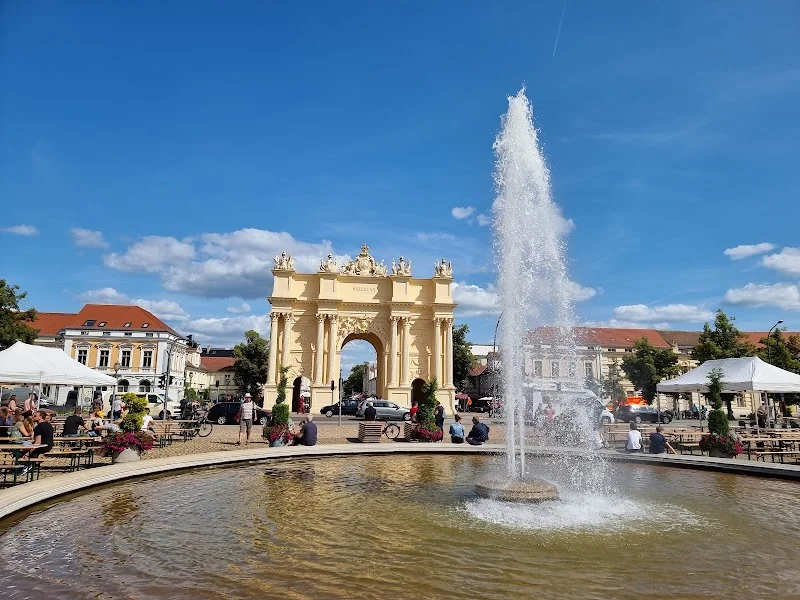
Luisenpl., Potsdam
Luisenpl., 14471 Potsdam, Germany
Luisenplatz Potsdam | Parking & Events
The Luisenplatz in Potsdam is much more than just a representative city square. It connects history, urban movement, and a diverse range of events at one of the most visible addresses in the city center. The square is located in the historic center between the Brandenburg Gate and the avenue leading to Sanssouci, thus at a transition that makes Potsdam's baroque city history as tangible as the path towards the palace park. In close proximity is also the pedestrian zone Brandenburger Straße, making Luisenplatz function as a place of arrival, passage, and stay at the same time. The city describes it as a space for concerts, specialty markets, city festivals, public viewing, and historical celebrations; at the same time, the design with fountains, underground parking, and clear pathways shows that the square is intentionally designed for public use. This mix of attraction, event venue, and urban infrastructure explains why so many search queries related to Luisenplatz Potsdam, parking, parking garage, routes, and events converge. ([potsdam.de](https://www.potsdam.de/de/luisenplatz-als-veranstaltungsort))
Parking and Access to Luisenplatz Potsdam
Those looking to park at Luisenplatz Potsdam usually mean the underground garage directly beneath the square. The city designates this underground garage as a parking option and lists it as part of the public parking space in the center. On the mobility portal, it is described as a monitored underground garage that is integrated into the parking guidance system and offers direct connections to trams and buses. Additionally, it is located directly on Brandenburger Straße and just a few minutes' walk from the entrance Grünes Gitter to Sanssouci Park. For visitors seeking a central, weather-independent, and pedestrian-friendly solution, this is one of the most convenient options in the city center. It is particularly practical that, according to the city administration, Luisenplatz is only about two minutes away from tram and bus stops. Thus, the square is not only a destination for drivers but also a well-connected hub for public transport. ([potsdam.de](https://www.potsdam.de/de/luisenplatz-als-veranstaltungsort))
For the search intent Luisenplatz Potsdam route, the location within the city network is also important. According to the city's description, the square can be reached from Potsdam Central Station by tram or bus on the route towards Sanssouci. This connection is relevant not only for tourists but also for anyone heading to the square on event days or during the pre-Christmas season. The advantage lies in the clear orientation: Those who know the Brandenburg Gate as a landmark can orient themselves at the western end of Brandenburger Straße and along the historic axis towards Sanssouci Park. This makes Luisenplatz a very readable destination on the city map that can be approached without complicated detours. The proximity to urban footpaths also allows for short distances between shopping, culture, and gastronomy, which is a decisive advantage, especially during larger visitor flows. ([potsdam.de](https://www.potsdam.de/de/content/between-brandenburg-and-nauen-gates))
Taxi and short stop traffic are also considered in the vicinity. The city's mobility portal lists a taxi stand at Luisenplatz with eight spaces. For visitors who do not wish to park themselves or come by taxi from other parts of the city, this is an additional convenient option. In practice, this shows that Luisenplatz is not only intended as a historical site but as a genuine mobility hub that seamlessly integrates various modes of arrival. Especially in a city center with a high density of attractions, gastronomy, and events, this type of organization is important because it clearly structures arrival, onward travel, and departure. Therefore, anyone searching for parking garage, underground garage, or route to Luisenplatz Potsdam will find not an isolated parking area but an integrated urban component concept of parking, public transport, and footpaths. ([mobil-potsdam.de](https://www.mobil-potsdam.de/de/tram-bus-bahn-und-taxi/taxiplaetze/?utm_source=openai))
However, temporary restrictions should be expected during major events. For instance, the city announced in connection with a public viewing at Luisenplatz that streets around the square were closed, although the exit from the underground garage remained possible. At the same time, it was explicitly recommended to arrive on foot, by bicycle, or by tram. This is an important note for anyone visiting the square during events: The best access depends not only on the ticket but also on the event calendar. Therefore, those visiting Luisenplatz on heavily frequented days should check in advance whether access for cars or the route through the city center is affected. This is a typical advantage of Luisenplatz as an event venue: it is robust enough for large crowds but central enough to remain easily accessible without a car. ([potsdam.de](https://www.potsdam.de/de/286-public-viewing-auf-dem-luisenplatz-strassensperrungen-am-freitag-ab-17-uhr))
Events at Luisenplatz: Markets, Concerts, and Public Viewing
The official event description from the city is very clear: Luisenplatz is suitable for concerts, specialty markets, city festivals, soccer tournaments, public viewing, advertising trucks, and historical celebrations. This enumeration shows that the square is intentionally used as a multifunctional space. The open, central, and yet clearly defined square geometry makes it attractive for formats that require public visibility but do not necessarily need a closed building. Markets, culinary events, or fan events particularly benefit from such an environment because they rely on visibility, easy accessibility, and a strong local connection. Luisenplatz meets these requirements and simultaneously appears significantly more representative due to the Brandenburg Gate and its proximity to Sanssouci than a purely functional parking lot or traffic junction. ([potsdam.de](https://www.potsdam.de/de/luisenplatz-als-veranstaltungsort))
Current and recurring formats confirm this function very concretely. For 2026, the city announces the Spring Wine Market at Luisenplatz, where from April 30 to May 17, vintners and wineries from Germany and neighboring countries will present their wines, sparkling wines, and sparkling wine creations. The city also mentions a Street Food Festival at Luisenplatz in March 2026, which will transform the square into a culinary paradise. Furthermore, during the Potsdam Christmas Magic, Luisenplatz is part of the event backdrop: together with Brandenburger Straße and Bassinplatz, it forms the route for a festive stroll with music, art, and culinary delights. Therefore, those searching for Luisenplatz Wine Market, Luisenplatz Christmas Magic, or Luisenplatz Street Food Festival are not looking for random single events but for regularly recurring formats with a clear urban address. ([potsdam.de](https://www.potsdam.de/de/veranstaltung/fruehlings-weinmarkt-auf-dem-luisenplatz-16))
Particularly significant is also the public viewing that the city organized at Luisenplatz in the summer of 2024. The administration communicated street closures, a limitation on the number of spectators, entry controls, and a ban on glass bottles, firecrackers, and pyrotechnics on the event grounds. This shows that Luisenplatz is not only used for small market stalls but also for events with large audiences and increased security needs. This is important for the external perception because it underscores the quality of the square: a place where such formats can be organized typically has sufficient spatial structure, good accessibility, and effective coordination with the city's infrastructure. This mix makes Luisenplatz in Potsdam so relevant for event search queries. ([potsdam.de](https://www.potsdam.de/de/286-public-viewing-auf-dem-luisenplatz-strassensperrungen-am-freitag-ab-17-uhr))
The atmosphere of such events can also be derived from the location. The square is situated at a historic entrance to the city center, in view of the Brandenburg Gate and just a few steps from the access to Sanssouci. This creates not the effect of an anonymous event area but of a place with history and urban identity. Markets and festivals automatically have a different feel here because the surroundings shape the character. A glass of wine at the Spring Wine Market, a warm snack at the Street Food Festival, or a stroll through the Christmas Magic gain a special backdrop in this square. Therefore, the city does not only use the place functionally but stages it as a stage between everyday city life and historical center. ([potsdam.de](https://www.potsdam.de/de/luisenplatz-als-veranstaltungsort))
History of Luisenplatz between Brandenburg Gate and Sanssouci
The historical depth of Luisenplatz is one of the main reasons why this place is so frequently searched and described. According to the city, the square was established in front of the Brandenburg Gate in 1744 under Frederick II. The Brandenburg Gate itself was built during the second baroque city expansion, and its current appearance was designed in 1770/1771 by Carl von Gontard and his student Georg Christian Unger in the style of a Roman triumphal arch. The square is therefore not just an open space next to a building but part of a deliberately designed urban axis that was meant to make power, order, and representation visible. The gate then closed off the direction towards the city of Brandenburg and simultaneously funneled the paths to the royal palaces and gardens of Potsdam. This function as a forecourt, transition, and staging area continues to shape Luisenplatz to this day. ([potsdam.de](https://www.potsdam.de/de/brandenburger-tor-und-luisenplatz))
The later development of the square is also well documented. The city states that Luisenplatz was planted by Peter Joseph Lenné in 1854. In 1939, it was paved; many trees disappeared to make room for a parking lot. Only the redesign from 1999 to 2000 brought a new urban idea: an underground garage beneath the square, rows of linden trees, and a fountain in the center. This is crucial for the perception of the square because it shows that Luisenplatz Potsdam is not just a relic of history but a repeatedly transformed space that has continually responded to new demands. The current form connects the historical heritage of the 18th century with the infrastructure logic of the 20th and 21st centuries. This tension makes the square so interesting for visitors who want to experience history and the present in one place. ([potsdam.de](https://www.potsdam.de/en/content/brandenburg-gate-and-luisenplatz))
A second official city text describes the development further from an urban historical perspective. It states that Luisenplatz was equipped again with tree rows, an underground garage, and a central fountain in connection with the later redesign; additionally, the proximity to the Grünes Gitter is highlighted, from where one can reach the entrance to Sanssouci Park in just a few minutes. The square thus stands at a historical threshold: on one side the Brandenburg Gate and the urban spaces, on the other side the vast park landscape of the Prussian heritage. Therefore, anyone standing there today is moving in a space that does not appear beautiful by chance but is the result of long-term, deliberately designed urban development. This is a strong content core for SEO topics such as history, special features, and attractions. ([potsdam.de](https://www.potsdam.de/de/content/between-brandenburg-and-nauen-gates))
The Brandenburg Gate itself further enhances this perception. The city's description emphasizes that the forecourt of the gate not only controlled passage but also formed a spacious forecourt for the staging of architecture. It is precisely in this logic that Luisenplatz was planned: as a place where paths converge, architecture has an impact, and the city displays its representative character. Today, visitors may read this connection more intuitively than back then, but the spatial idea remains the same. The sight axis, the generosity of the square, and the proximity to the gate make Luisenplatz one of the clearest examples of the connection between baroque urban planning and modern urban use in Potsdam. ([potsdam.de](https://www.potsdam.de/de/brandenburger-tor-und-luisenplatz))
Luisenplatz in the Potsdam Urban Landscape: Brandenburger Straße, City Center, and Surroundings
To truly understand Luisenplatz, one must see it in connection with Brandenburger Straße and the Potsdam city center. The city describes the square as part of the historic city center in close proximity to the pedestrian zone Brandenburger Straße. This street itself is described in an urban portrait as a 750-meter-long axis extending from St. Peter and Paul Church to the Brandenburg Gate. It was an important shopping street in the 19th and 20th centuries and was later converted into a pedestrian zone. Together with Luisenplatz, it forms one of the most important promenading and movement axes of the city center. For visitors, this means: Luisenplatz is not an isolated square but part of a dense urban context of shopping, strolling, culture, and gastronomy. ([potsdam.de](https://www.potsdam.de/de/luisenplatz-als-veranstaltungsort))
The proximity to Sanssouci Park is also central. The city points out that one can reach the Grünes Gitter, one of the main entrances to the park, from Luisenplatz via the avenue to Sanssouci in just a few minutes. This connection is particularly important for the search intent Luisenplatz Sanssouci, as it shows how closely the city center and the World Heritage Site are spatially linked. The square is therefore not just a stop on the way to the park but part of the visitor experience itself. Walking from there towards Sanssouci represents a classic Potsdam movement: from the urban gate area into the landscape and architecturally shaped palace and garden world. This makes Luisenplatz so valuable for day trips and city walks, as it connects several points of interest in very short distances. ([potsdam.de](https://www.potsdam.de/de/content/between-brandenburg-and-nauen-gates))
In the larger urban framework, Luisenplatz also plays an important role. The city's description classifies the city center as a space with high usage density and mixed functions, where living, working, retail, and leisure come together. Luisenplatz is located precisely in this area, characterized by the historic urban space, baroque expansions, and modern mobility infrastructure. For visitors, this is convenient because a short walk quickly leads to many other destinations: Brandenburg Gate, Brandenburger Straße, Sanssouci Park, city center gastronomy, and other historic streets. Therefore, anyone searching for a route or a day plan for Potsdam will find Luisenplatz an excellent starting or ending point where several urban worlds converge. ([potsdam.de](https://www.potsdam.de/de/content/between-brandenburg-and-nauen-gates))
The surroundings also explain why Luisenplatz appears in so many contexts. It is a destination for visitors who want to visit a market, experience a concert, stroll through the city center, or continue to Sanssouci Park. At the same time, it is a transport hub, historical space, and symbolic address. This multifunctionality leads to search queries often being very diverse, even though they refer to the same place: Luisenplatz Potsdam, Luisenplatz parking garage, Luisenplatz route, Luisenplatz Christmas Magic, or Brandenburg Gate Luisenplatz. Thematically, this fits very well together because the square lies precisely at the intersection where these search intentions arise. ([potsdam.de](https://www.potsdam.de/de/luisenplatz-als-veranstaltungsort))
Democracy Monument and Special Features of the Square
Another defining element of Luisenplatz is the monument of the Potsdam democracy movement. The city describes that right in the middle of Potsdam, directly at Luisenplatz and in close proximity to Sanssouci Park, this monument was created thirty years after the reunification. The site is historically significant because on November 4, 1989, the largest demonstration of the Potsdam upheaval before the fall of the Berlin Wall took place at the then Platz der Nationen. Thus, Luisenplatz connects not only Prussia, urban planning, and the present but also the city's democratic memory culture. Therefore, anyone visiting the square stands at a place that is not only beautiful but also politically significant. ([potsdam.de](https://www.potsdam.de/de/denkmal-der-potsdamer-demokratiebewegung-im-herbst-1989))
The monument itself consists of artistically designed steel plates in the form of the inscription 4.11.1989. More than one hundred original footprints of participants from the demonstration, as well as slogans and quotes, are embedded in these plates. The city emphasizes that the monument was created as a memorial to commemorate the events of 1989 and to translate the peaceful revolution into the urban space. For visitors, this is remarkable because the square thus gains an additional layer: it is not only a representation area and event location but also a place for engagement with freedom, protest, and democratic history. This function clearly distinguishes it from many other urban squares. ([potsdam.de](https://www.potsdam.de/de/denkmal-fuer-demokratie-auf-dem-luisenplatz-offiziell-enthuellt))
Visible features also include the fountain in the center of the square, which the city explicitly names as a central feature on the event page. Additionally, there are the accesses to the underground garage, which connect the square in its use as an urban space with traffic infrastructure. This combination is important for perception: above is an open square with a historical backdrop, below is a modern parking solution, and in between is a fountain that serves as a spatial centerpiece. The city's description also mentions a partially paved area and a water-bound surface, highlighting the complexity of the surface. The result is a square that is not only photogenically attractive but also functionally very well thought out. ([potsdam.de](https://www.potsdam.de/de/luisenplatz-als-veranstaltungsort))
From the combination of all these features, a clear conclusion can be drawn: Luisenplatz is one of the places in Potsdam where multiple identities overlap. It is the entrance to the historic city center, the forecourt of the Brandenburg Gate, the path to the park landscape of Sanssouci, an event space, and a place of remembrance at the same time. This makes it particularly interesting for visitors and relevant for search engines. Anyone looking for an atmosphere of history, movement, urban life, and symbolism will find here one of the densest places in Potsdam. This complexity is not coincidental but the result of a long, documented development from the baroque square through the parking lot to today's urban meeting point. ([potsdam.de](https://www.potsdam.de/en/content/brandenburg-gate-and-luisenplatz))
Sources:
Show moreShow less
Luisenplatz Potsdam | Parking & Events
The Luisenplatz in Potsdam is much more than just a representative city square. It connects history, urban movement, and a diverse range of events at one of the most visible addresses in the city center. The square is located in the historic center between the Brandenburg Gate and the avenue leading to Sanssouci, thus at a transition that makes Potsdam's baroque city history as tangible as the path towards the palace park. In close proximity is also the pedestrian zone Brandenburger Straße, making Luisenplatz function as a place of arrival, passage, and stay at the same time. The city describes it as a space for concerts, specialty markets, city festivals, public viewing, and historical celebrations; at the same time, the design with fountains, underground parking, and clear pathways shows that the square is intentionally designed for public use. This mix of attraction, event venue, and urban infrastructure explains why so many search queries related to Luisenplatz Potsdam, parking, parking garage, routes, and events converge. ([potsdam.de](https://www.potsdam.de/de/luisenplatz-als-veranstaltungsort))
Parking and Access to Luisenplatz Potsdam
Those looking to park at Luisenplatz Potsdam usually mean the underground garage directly beneath the square. The city designates this underground garage as a parking option and lists it as part of the public parking space in the center. On the mobility portal, it is described as a monitored underground garage that is integrated into the parking guidance system and offers direct connections to trams and buses. Additionally, it is located directly on Brandenburger Straße and just a few minutes' walk from the entrance Grünes Gitter to Sanssouci Park. For visitors seeking a central, weather-independent, and pedestrian-friendly solution, this is one of the most convenient options in the city center. It is particularly practical that, according to the city administration, Luisenplatz is only about two minutes away from tram and bus stops. Thus, the square is not only a destination for drivers but also a well-connected hub for public transport. ([potsdam.de](https://www.potsdam.de/de/luisenplatz-als-veranstaltungsort))
For the search intent Luisenplatz Potsdam route, the location within the city network is also important. According to the city's description, the square can be reached from Potsdam Central Station by tram or bus on the route towards Sanssouci. This connection is relevant not only for tourists but also for anyone heading to the square on event days or during the pre-Christmas season. The advantage lies in the clear orientation: Those who know the Brandenburg Gate as a landmark can orient themselves at the western end of Brandenburger Straße and along the historic axis towards Sanssouci Park. This makes Luisenplatz a very readable destination on the city map that can be approached without complicated detours. The proximity to urban footpaths also allows for short distances between shopping, culture, and gastronomy, which is a decisive advantage, especially during larger visitor flows. ([potsdam.de](https://www.potsdam.de/de/content/between-brandenburg-and-nauen-gates))
Taxi and short stop traffic are also considered in the vicinity. The city's mobility portal lists a taxi stand at Luisenplatz with eight spaces. For visitors who do not wish to park themselves or come by taxi from other parts of the city, this is an additional convenient option. In practice, this shows that Luisenplatz is not only intended as a historical site but as a genuine mobility hub that seamlessly integrates various modes of arrival. Especially in a city center with a high density of attractions, gastronomy, and events, this type of organization is important because it clearly structures arrival, onward travel, and departure. Therefore, anyone searching for parking garage, underground garage, or route to Luisenplatz Potsdam will find not an isolated parking area but an integrated urban component concept of parking, public transport, and footpaths. ([mobil-potsdam.de](https://www.mobil-potsdam.de/de/tram-bus-bahn-und-taxi/taxiplaetze/?utm_source=openai))
However, temporary restrictions should be expected during major events. For instance, the city announced in connection with a public viewing at Luisenplatz that streets around the square were closed, although the exit from the underground garage remained possible. At the same time, it was explicitly recommended to arrive on foot, by bicycle, or by tram. This is an important note for anyone visiting the square during events: The best access depends not only on the ticket but also on the event calendar. Therefore, those visiting Luisenplatz on heavily frequented days should check in advance whether access for cars or the route through the city center is affected. This is a typical advantage of Luisenplatz as an event venue: it is robust enough for large crowds but central enough to remain easily accessible without a car. ([potsdam.de](https://www.potsdam.de/de/286-public-viewing-auf-dem-luisenplatz-strassensperrungen-am-freitag-ab-17-uhr))
Events at Luisenplatz: Markets, Concerts, and Public Viewing
The official event description from the city is very clear: Luisenplatz is suitable for concerts, specialty markets, city festivals, soccer tournaments, public viewing, advertising trucks, and historical celebrations. This enumeration shows that the square is intentionally used as a multifunctional space. The open, central, and yet clearly defined square geometry makes it attractive for formats that require public visibility but do not necessarily need a closed building. Markets, culinary events, or fan events particularly benefit from such an environment because they rely on visibility, easy accessibility, and a strong local connection. Luisenplatz meets these requirements and simultaneously appears significantly more representative due to the Brandenburg Gate and its proximity to Sanssouci than a purely functional parking lot or traffic junction. ([potsdam.de](https://www.potsdam.de/de/luisenplatz-als-veranstaltungsort))
Current and recurring formats confirm this function very concretely. For 2026, the city announces the Spring Wine Market at Luisenplatz, where from April 30 to May 17, vintners and wineries from Germany and neighboring countries will present their wines, sparkling wines, and sparkling wine creations. The city also mentions a Street Food Festival at Luisenplatz in March 2026, which will transform the square into a culinary paradise. Furthermore, during the Potsdam Christmas Magic, Luisenplatz is part of the event backdrop: together with Brandenburger Straße and Bassinplatz, it forms the route for a festive stroll with music, art, and culinary delights. Therefore, those searching for Luisenplatz Wine Market, Luisenplatz Christmas Magic, or Luisenplatz Street Food Festival are not looking for random single events but for regularly recurring formats with a clear urban address. ([potsdam.de](https://www.potsdam.de/de/veranstaltung/fruehlings-weinmarkt-auf-dem-luisenplatz-16))
Particularly significant is also the public viewing that the city organized at Luisenplatz in the summer of 2024. The administration communicated street closures, a limitation on the number of spectators, entry controls, and a ban on glass bottles, firecrackers, and pyrotechnics on the event grounds. This shows that Luisenplatz is not only used for small market stalls but also for events with large audiences and increased security needs. This is important for the external perception because it underscores the quality of the square: a place where such formats can be organized typically has sufficient spatial structure, good accessibility, and effective coordination with the city's infrastructure. This mix makes Luisenplatz in Potsdam so relevant for event search queries. ([potsdam.de](https://www.potsdam.de/de/286-public-viewing-auf-dem-luisenplatz-strassensperrungen-am-freitag-ab-17-uhr))
The atmosphere of such events can also be derived from the location. The square is situated at a historic entrance to the city center, in view of the Brandenburg Gate and just a few steps from the access to Sanssouci. This creates not the effect of an anonymous event area but of a place with history and urban identity. Markets and festivals automatically have a different feel here because the surroundings shape the character. A glass of wine at the Spring Wine Market, a warm snack at the Street Food Festival, or a stroll through the Christmas Magic gain a special backdrop in this square. Therefore, the city does not only use the place functionally but stages it as a stage between everyday city life and historical center. ([potsdam.de](https://www.potsdam.de/de/luisenplatz-als-veranstaltungsort))
History of Luisenplatz between Brandenburg Gate and Sanssouci
The historical depth of Luisenplatz is one of the main reasons why this place is so frequently searched and described. According to the city, the square was established in front of the Brandenburg Gate in 1744 under Frederick II. The Brandenburg Gate itself was built during the second baroque city expansion, and its current appearance was designed in 1770/1771 by Carl von Gontard and his student Georg Christian Unger in the style of a Roman triumphal arch. The square is therefore not just an open space next to a building but part of a deliberately designed urban axis that was meant to make power, order, and representation visible. The gate then closed off the direction towards the city of Brandenburg and simultaneously funneled the paths to the royal palaces and gardens of Potsdam. This function as a forecourt, transition, and staging area continues to shape Luisenplatz to this day. ([potsdam.de](https://www.potsdam.de/de/brandenburger-tor-und-luisenplatz))
The later development of the square is also well documented. The city states that Luisenplatz was planted by Peter Joseph Lenné in 1854. In 1939, it was paved; many trees disappeared to make room for a parking lot. Only the redesign from 1999 to 2000 brought a new urban idea: an underground garage beneath the square, rows of linden trees, and a fountain in the center. This is crucial for the perception of the square because it shows that Luisenplatz Potsdam is not just a relic of history but a repeatedly transformed space that has continually responded to new demands. The current form connects the historical heritage of the 18th century with the infrastructure logic of the 20th and 21st centuries. This tension makes the square so interesting for visitors who want to experience history and the present in one place. ([potsdam.de](https://www.potsdam.de/en/content/brandenburg-gate-and-luisenplatz))
A second official city text describes the development further from an urban historical perspective. It states that Luisenplatz was equipped again with tree rows, an underground garage, and a central fountain in connection with the later redesign; additionally, the proximity to the Grünes Gitter is highlighted, from where one can reach the entrance to Sanssouci Park in just a few minutes. The square thus stands at a historical threshold: on one side the Brandenburg Gate and the urban spaces, on the other side the vast park landscape of the Prussian heritage. Therefore, anyone standing there today is moving in a space that does not appear beautiful by chance but is the result of long-term, deliberately designed urban development. This is a strong content core for SEO topics such as history, special features, and attractions. ([potsdam.de](https://www.potsdam.de/de/content/between-brandenburg-and-nauen-gates))
The Brandenburg Gate itself further enhances this perception. The city's description emphasizes that the forecourt of the gate not only controlled passage but also formed a spacious forecourt for the staging of architecture. It is precisely in this logic that Luisenplatz was planned: as a place where paths converge, architecture has an impact, and the city displays its representative character. Today, visitors may read this connection more intuitively than back then, but the spatial idea remains the same. The sight axis, the generosity of the square, and the proximity to the gate make Luisenplatz one of the clearest examples of the connection between baroque urban planning and modern urban use in Potsdam. ([potsdam.de](https://www.potsdam.de/de/brandenburger-tor-und-luisenplatz))
Luisenplatz in the Potsdam Urban Landscape: Brandenburger Straße, City Center, and Surroundings
To truly understand Luisenplatz, one must see it in connection with Brandenburger Straße and the Potsdam city center. The city describes the square as part of the historic city center in close proximity to the pedestrian zone Brandenburger Straße. This street itself is described in an urban portrait as a 750-meter-long axis extending from St. Peter and Paul Church to the Brandenburg Gate. It was an important shopping street in the 19th and 20th centuries and was later converted into a pedestrian zone. Together with Luisenplatz, it forms one of the most important promenading and movement axes of the city center. For visitors, this means: Luisenplatz is not an isolated square but part of a dense urban context of shopping, strolling, culture, and gastronomy. ([potsdam.de](https://www.potsdam.de/de/luisenplatz-als-veranstaltungsort))
The proximity to Sanssouci Park is also central. The city points out that one can reach the Grünes Gitter, one of the main entrances to the park, from Luisenplatz via the avenue to Sanssouci in just a few minutes. This connection is particularly important for the search intent Luisenplatz Sanssouci, as it shows how closely the city center and the World Heritage Site are spatially linked. The square is therefore not just a stop on the way to the park but part of the visitor experience itself. Walking from there towards Sanssouci represents a classic Potsdam movement: from the urban gate area into the landscape and architecturally shaped palace and garden world. This makes Luisenplatz so valuable for day trips and city walks, as it connects several points of interest in very short distances. ([potsdam.de](https://www.potsdam.de/de/content/between-brandenburg-and-nauen-gates))
In the larger urban framework, Luisenplatz also plays an important role. The city's description classifies the city center as a space with high usage density and mixed functions, where living, working, retail, and leisure come together. Luisenplatz is located precisely in this area, characterized by the historic urban space, baroque expansions, and modern mobility infrastructure. For visitors, this is convenient because a short walk quickly leads to many other destinations: Brandenburg Gate, Brandenburger Straße, Sanssouci Park, city center gastronomy, and other historic streets. Therefore, anyone searching for a route or a day plan for Potsdam will find Luisenplatz an excellent starting or ending point where several urban worlds converge. ([potsdam.de](https://www.potsdam.de/de/content/between-brandenburg-and-nauen-gates))
The surroundings also explain why Luisenplatz appears in so many contexts. It is a destination for visitors who want to visit a market, experience a concert, stroll through the city center, or continue to Sanssouci Park. At the same time, it is a transport hub, historical space, and symbolic address. This multifunctionality leads to search queries often being very diverse, even though they refer to the same place: Luisenplatz Potsdam, Luisenplatz parking garage, Luisenplatz route, Luisenplatz Christmas Magic, or Brandenburg Gate Luisenplatz. Thematically, this fits very well together because the square lies precisely at the intersection where these search intentions arise. ([potsdam.de](https://www.potsdam.de/de/luisenplatz-als-veranstaltungsort))
Democracy Monument and Special Features of the Square
Another defining element of Luisenplatz is the monument of the Potsdam democracy movement. The city describes that right in the middle of Potsdam, directly at Luisenplatz and in close proximity to Sanssouci Park, this monument was created thirty years after the reunification. The site is historically significant because on November 4, 1989, the largest demonstration of the Potsdam upheaval before the fall of the Berlin Wall took place at the then Platz der Nationen. Thus, Luisenplatz connects not only Prussia, urban planning, and the present but also the city's democratic memory culture. Therefore, anyone visiting the square stands at a place that is not only beautiful but also politically significant. ([potsdam.de](https://www.potsdam.de/de/denkmal-der-potsdamer-demokratiebewegung-im-herbst-1989))
The monument itself consists of artistically designed steel plates in the form of the inscription 4.11.1989. More than one hundred original footprints of participants from the demonstration, as well as slogans and quotes, are embedded in these plates. The city emphasizes that the monument was created as a memorial to commemorate the events of 1989 and to translate the peaceful revolution into the urban space. For visitors, this is remarkable because the square thus gains an additional layer: it is not only a representation area and event location but also a place for engagement with freedom, protest, and democratic history. This function clearly distinguishes it from many other urban squares. ([potsdam.de](https://www.potsdam.de/de/denkmal-fuer-demokratie-auf-dem-luisenplatz-offiziell-enthuellt))
Visible features also include the fountain in the center of the square, which the city explicitly names as a central feature on the event page. Additionally, there are the accesses to the underground garage, which connect the square in its use as an urban space with traffic infrastructure. This combination is important for perception: above is an open square with a historical backdrop, below is a modern parking solution, and in between is a fountain that serves as a spatial centerpiece. The city's description also mentions a partially paved area and a water-bound surface, highlighting the complexity of the surface. The result is a square that is not only photogenically attractive but also functionally very well thought out. ([potsdam.de](https://www.potsdam.de/de/luisenplatz-als-veranstaltungsort))
From the combination of all these features, a clear conclusion can be drawn: Luisenplatz is one of the places in Potsdam where multiple identities overlap. It is the entrance to the historic city center, the forecourt of the Brandenburg Gate, the path to the park landscape of Sanssouci, an event space, and a place of remembrance at the same time. This makes it particularly interesting for visitors and relevant for search engines. Anyone looking for an atmosphere of history, movement, urban life, and symbolism will find here one of the densest places in Potsdam. This complexity is not coincidental but the result of a long, documented development from the baroque square through the parking lot to today's urban meeting point. ([potsdam.de](https://www.potsdam.de/en/content/brandenburg-gate-and-luisenplatz))
Sources:
Luisenplatz Potsdam | Parking & Events
The Luisenplatz in Potsdam is much more than just a representative city square. It connects history, urban movement, and a diverse range of events at one of the most visible addresses in the city center. The square is located in the historic center between the Brandenburg Gate and the avenue leading to Sanssouci, thus at a transition that makes Potsdam's baroque city history as tangible as the path towards the palace park. In close proximity is also the pedestrian zone Brandenburger Straße, making Luisenplatz function as a place of arrival, passage, and stay at the same time. The city describes it as a space for concerts, specialty markets, city festivals, public viewing, and historical celebrations; at the same time, the design with fountains, underground parking, and clear pathways shows that the square is intentionally designed for public use. This mix of attraction, event venue, and urban infrastructure explains why so many search queries related to Luisenplatz Potsdam, parking, parking garage, routes, and events converge. ([potsdam.de](https://www.potsdam.de/de/luisenplatz-als-veranstaltungsort))
Parking and Access to Luisenplatz Potsdam
Those looking to park at Luisenplatz Potsdam usually mean the underground garage directly beneath the square. The city designates this underground garage as a parking option and lists it as part of the public parking space in the center. On the mobility portal, it is described as a monitored underground garage that is integrated into the parking guidance system and offers direct connections to trams and buses. Additionally, it is located directly on Brandenburger Straße and just a few minutes' walk from the entrance Grünes Gitter to Sanssouci Park. For visitors seeking a central, weather-independent, and pedestrian-friendly solution, this is one of the most convenient options in the city center. It is particularly practical that, according to the city administration, Luisenplatz is only about two minutes away from tram and bus stops. Thus, the square is not only a destination for drivers but also a well-connected hub for public transport. ([potsdam.de](https://www.potsdam.de/de/luisenplatz-als-veranstaltungsort))
For the search intent Luisenplatz Potsdam route, the location within the city network is also important. According to the city's description, the square can be reached from Potsdam Central Station by tram or bus on the route towards Sanssouci. This connection is relevant not only for tourists but also for anyone heading to the square on event days or during the pre-Christmas season. The advantage lies in the clear orientation: Those who know the Brandenburg Gate as a landmark can orient themselves at the western end of Brandenburger Straße and along the historic axis towards Sanssouci Park. This makes Luisenplatz a very readable destination on the city map that can be approached without complicated detours. The proximity to urban footpaths also allows for short distances between shopping, culture, and gastronomy, which is a decisive advantage, especially during larger visitor flows. ([potsdam.de](https://www.potsdam.de/de/content/between-brandenburg-and-nauen-gates))
Taxi and short stop traffic are also considered in the vicinity. The city's mobility portal lists a taxi stand at Luisenplatz with eight spaces. For visitors who do not wish to park themselves or come by taxi from other parts of the city, this is an additional convenient option. In practice, this shows that Luisenplatz is not only intended as a historical site but as a genuine mobility hub that seamlessly integrates various modes of arrival. Especially in a city center with a high density of attractions, gastronomy, and events, this type of organization is important because it clearly structures arrival, onward travel, and departure. Therefore, anyone searching for parking garage, underground garage, or route to Luisenplatz Potsdam will find not an isolated parking area but an integrated urban component concept of parking, public transport, and footpaths. ([mobil-potsdam.de](https://www.mobil-potsdam.de/de/tram-bus-bahn-und-taxi/taxiplaetze/?utm_source=openai))
However, temporary restrictions should be expected during major events. For instance, the city announced in connection with a public viewing at Luisenplatz that streets around the square were closed, although the exit from the underground garage remained possible. At the same time, it was explicitly recommended to arrive on foot, by bicycle, or by tram. This is an important note for anyone visiting the square during events: The best access depends not only on the ticket but also on the event calendar. Therefore, those visiting Luisenplatz on heavily frequented days should check in advance whether access for cars or the route through the city center is affected. This is a typical advantage of Luisenplatz as an event venue: it is robust enough for large crowds but central enough to remain easily accessible without a car. ([potsdam.de](https://www.potsdam.de/de/286-public-viewing-auf-dem-luisenplatz-strassensperrungen-am-freitag-ab-17-uhr))
Events at Luisenplatz: Markets, Concerts, and Public Viewing
The official event description from the city is very clear: Luisenplatz is suitable for concerts, specialty markets, city festivals, soccer tournaments, public viewing, advertising trucks, and historical celebrations. This enumeration shows that the square is intentionally used as a multifunctional space. The open, central, and yet clearly defined square geometry makes it attractive for formats that require public visibility but do not necessarily need a closed building. Markets, culinary events, or fan events particularly benefit from such an environment because they rely on visibility, easy accessibility, and a strong local connection. Luisenplatz meets these requirements and simultaneously appears significantly more representative due to the Brandenburg Gate and its proximity to Sanssouci than a purely functional parking lot or traffic junction. ([potsdam.de](https://www.potsdam.de/de/luisenplatz-als-veranstaltungsort))
Current and recurring formats confirm this function very concretely. For 2026, the city announces the Spring Wine Market at Luisenplatz, where from April 30 to May 17, vintners and wineries from Germany and neighboring countries will present their wines, sparkling wines, and sparkling wine creations. The city also mentions a Street Food Festival at Luisenplatz in March 2026, which will transform the square into a culinary paradise. Furthermore, during the Potsdam Christmas Magic, Luisenplatz is part of the event backdrop: together with Brandenburger Straße and Bassinplatz, it forms the route for a festive stroll with music, art, and culinary delights. Therefore, those searching for Luisenplatz Wine Market, Luisenplatz Christmas Magic, or Luisenplatz Street Food Festival are not looking for random single events but for regularly recurring formats with a clear urban address. ([potsdam.de](https://www.potsdam.de/de/veranstaltung/fruehlings-weinmarkt-auf-dem-luisenplatz-16))
Particularly significant is also the public viewing that the city organized at Luisenplatz in the summer of 2024. The administration communicated street closures, a limitation on the number of spectators, entry controls, and a ban on glass bottles, firecrackers, and pyrotechnics on the event grounds. This shows that Luisenplatz is not only used for small market stalls but also for events with large audiences and increased security needs. This is important for the external perception because it underscores the quality of the square: a place where such formats can be organized typically has sufficient spatial structure, good accessibility, and effective coordination with the city's infrastructure. This mix makes Luisenplatz in Potsdam so relevant for event search queries. ([potsdam.de](https://www.potsdam.de/de/286-public-viewing-auf-dem-luisenplatz-strassensperrungen-am-freitag-ab-17-uhr))
The atmosphere of such events can also be derived from the location. The square is situated at a historic entrance to the city center, in view of the Brandenburg Gate and just a few steps from the access to Sanssouci. This creates not the effect of an anonymous event area but of a place with history and urban identity. Markets and festivals automatically have a different feel here because the surroundings shape the character. A glass of wine at the Spring Wine Market, a warm snack at the Street Food Festival, or a stroll through the Christmas Magic gain a special backdrop in this square. Therefore, the city does not only use the place functionally but stages it as a stage between everyday city life and historical center. ([potsdam.de](https://www.potsdam.de/de/luisenplatz-als-veranstaltungsort))
History of Luisenplatz between Brandenburg Gate and Sanssouci
The historical depth of Luisenplatz is one of the main reasons why this place is so frequently searched and described. According to the city, the square was established in front of the Brandenburg Gate in 1744 under Frederick II. The Brandenburg Gate itself was built during the second baroque city expansion, and its current appearance was designed in 1770/1771 by Carl von Gontard and his student Georg Christian Unger in the style of a Roman triumphal arch. The square is therefore not just an open space next to a building but part of a deliberately designed urban axis that was meant to make power, order, and representation visible. The gate then closed off the direction towards the city of Brandenburg and simultaneously funneled the paths to the royal palaces and gardens of Potsdam. This function as a forecourt, transition, and staging area continues to shape Luisenplatz to this day. ([potsdam.de](https://www.potsdam.de/de/brandenburger-tor-und-luisenplatz))
The later development of the square is also well documented. The city states that Luisenplatz was planted by Peter Joseph Lenné in 1854. In 1939, it was paved; many trees disappeared to make room for a parking lot. Only the redesign from 1999 to 2000 brought a new urban idea: an underground garage beneath the square, rows of linden trees, and a fountain in the center. This is crucial for the perception of the square because it shows that Luisenplatz Potsdam is not just a relic of history but a repeatedly transformed space that has continually responded to new demands. The current form connects the historical heritage of the 18th century with the infrastructure logic of the 20th and 21st centuries. This tension makes the square so interesting for visitors who want to experience history and the present in one place. ([potsdam.de](https://www.potsdam.de/en/content/brandenburg-gate-and-luisenplatz))
A second official city text describes the development further from an urban historical perspective. It states that Luisenplatz was equipped again with tree rows, an underground garage, and a central fountain in connection with the later redesign; additionally, the proximity to the Grünes Gitter is highlighted, from where one can reach the entrance to Sanssouci Park in just a few minutes. The square thus stands at a historical threshold: on one side the Brandenburg Gate and the urban spaces, on the other side the vast park landscape of the Prussian heritage. Therefore, anyone standing there today is moving in a space that does not appear beautiful by chance but is the result of long-term, deliberately designed urban development. This is a strong content core for SEO topics such as history, special features, and attractions. ([potsdam.de](https://www.potsdam.de/de/content/between-brandenburg-and-nauen-gates))
The Brandenburg Gate itself further enhances this perception. The city's description emphasizes that the forecourt of the gate not only controlled passage but also formed a spacious forecourt for the staging of architecture. It is precisely in this logic that Luisenplatz was planned: as a place where paths converge, architecture has an impact, and the city displays its representative character. Today, visitors may read this connection more intuitively than back then, but the spatial idea remains the same. The sight axis, the generosity of the square, and the proximity to the gate make Luisenplatz one of the clearest examples of the connection between baroque urban planning and modern urban use in Potsdam. ([potsdam.de](https://www.potsdam.de/de/brandenburger-tor-und-luisenplatz))
Luisenplatz in the Potsdam Urban Landscape: Brandenburger Straße, City Center, and Surroundings
To truly understand Luisenplatz, one must see it in connection with Brandenburger Straße and the Potsdam city center. The city describes the square as part of the historic city center in close proximity to the pedestrian zone Brandenburger Straße. This street itself is described in an urban portrait as a 750-meter-long axis extending from St. Peter and Paul Church to the Brandenburg Gate. It was an important shopping street in the 19th and 20th centuries and was later converted into a pedestrian zone. Together with Luisenplatz, it forms one of the most important promenading and movement axes of the city center. For visitors, this means: Luisenplatz is not an isolated square but part of a dense urban context of shopping, strolling, culture, and gastronomy. ([potsdam.de](https://www.potsdam.de/de/luisenplatz-als-veranstaltungsort))
The proximity to Sanssouci Park is also central. The city points out that one can reach the Grünes Gitter, one of the main entrances to the park, from Luisenplatz via the avenue to Sanssouci in just a few minutes. This connection is particularly important for the search intent Luisenplatz Sanssouci, as it shows how closely the city center and the World Heritage Site are spatially linked. The square is therefore not just a stop on the way to the park but part of the visitor experience itself. Walking from there towards Sanssouci represents a classic Potsdam movement: from the urban gate area into the landscape and architecturally shaped palace and garden world. This makes Luisenplatz so valuable for day trips and city walks, as it connects several points of interest in very short distances. ([potsdam.de](https://www.potsdam.de/de/content/between-brandenburg-and-nauen-gates))
In the larger urban framework, Luisenplatz also plays an important role. The city's description classifies the city center as a space with high usage density and mixed functions, where living, working, retail, and leisure come together. Luisenplatz is located precisely in this area, characterized by the historic urban space, baroque expansions, and modern mobility infrastructure. For visitors, this is convenient because a short walk quickly leads to many other destinations: Brandenburg Gate, Brandenburger Straße, Sanssouci Park, city center gastronomy, and other historic streets. Therefore, anyone searching for a route or a day plan for Potsdam will find Luisenplatz an excellent starting or ending point where several urban worlds converge. ([potsdam.de](https://www.potsdam.de/de/content/between-brandenburg-and-nauen-gates))
The surroundings also explain why Luisenplatz appears in so many contexts. It is a destination for visitors who want to visit a market, experience a concert, stroll through the city center, or continue to Sanssouci Park. At the same time, it is a transport hub, historical space, and symbolic address. This multifunctionality leads to search queries often being very diverse, even though they refer to the same place: Luisenplatz Potsdam, Luisenplatz parking garage, Luisenplatz route, Luisenplatz Christmas Magic, or Brandenburg Gate Luisenplatz. Thematically, this fits very well together because the square lies precisely at the intersection where these search intentions arise. ([potsdam.de](https://www.potsdam.de/de/luisenplatz-als-veranstaltungsort))
Democracy Monument and Special Features of the Square
Another defining element of Luisenplatz is the monument of the Potsdam democracy movement. The city describes that right in the middle of Potsdam, directly at Luisenplatz and in close proximity to Sanssouci Park, this monument was created thirty years after the reunification. The site is historically significant because on November 4, 1989, the largest demonstration of the Potsdam upheaval before the fall of the Berlin Wall took place at the then Platz der Nationen. Thus, Luisenplatz connects not only Prussia, urban planning, and the present but also the city's democratic memory culture. Therefore, anyone visiting the square stands at a place that is not only beautiful but also politically significant. ([potsdam.de](https://www.potsdam.de/de/denkmal-der-potsdamer-demokratiebewegung-im-herbst-1989))
The monument itself consists of artistically designed steel plates in the form of the inscription 4.11.1989. More than one hundred original footprints of participants from the demonstration, as well as slogans and quotes, are embedded in these plates. The city emphasizes that the monument was created as a memorial to commemorate the events of 1989 and to translate the peaceful revolution into the urban space. For visitors, this is remarkable because the square thus gains an additional layer: it is not only a representation area and event location but also a place for engagement with freedom, protest, and democratic history. This function clearly distinguishes it from many other urban squares. ([potsdam.de](https://www.potsdam.de/de/denkmal-fuer-demokratie-auf-dem-luisenplatz-offiziell-enthuellt))
Visible features also include the fountain in the center of the square, which the city explicitly names as a central feature on the event page. Additionally, there are the accesses to the underground garage, which connect the square in its use as an urban space with traffic infrastructure. This combination is important for perception: above is an open square with a historical backdrop, below is a modern parking solution, and in between is a fountain that serves as a spatial centerpiece. The city's description also mentions a partially paved area and a water-bound surface, highlighting the complexity of the surface. The result is a square that is not only photogenically attractive but also functionally very well thought out. ([potsdam.de](https://www.potsdam.de/de/luisenplatz-als-veranstaltungsort))
From the combination of all these features, a clear conclusion can be drawn: Luisenplatz is one of the places in Potsdam where multiple identities overlap. It is the entrance to the historic city center, the forecourt of the Brandenburg Gate, the path to the park landscape of Sanssouci, an event space, and a place of remembrance at the same time. This makes it particularly interesting for visitors and relevant for search engines. Anyone looking for an atmosphere of history, movement, urban life, and symbolism will find here one of the densest places in Potsdam. This complexity is not coincidental but the result of a long, documented development from the baroque square through the parking lot to today's urban meeting point. ([potsdam.de](https://www.potsdam.de/en/content/brandenburg-gate-and-luisenplatz))
Sources:
Upcoming Events
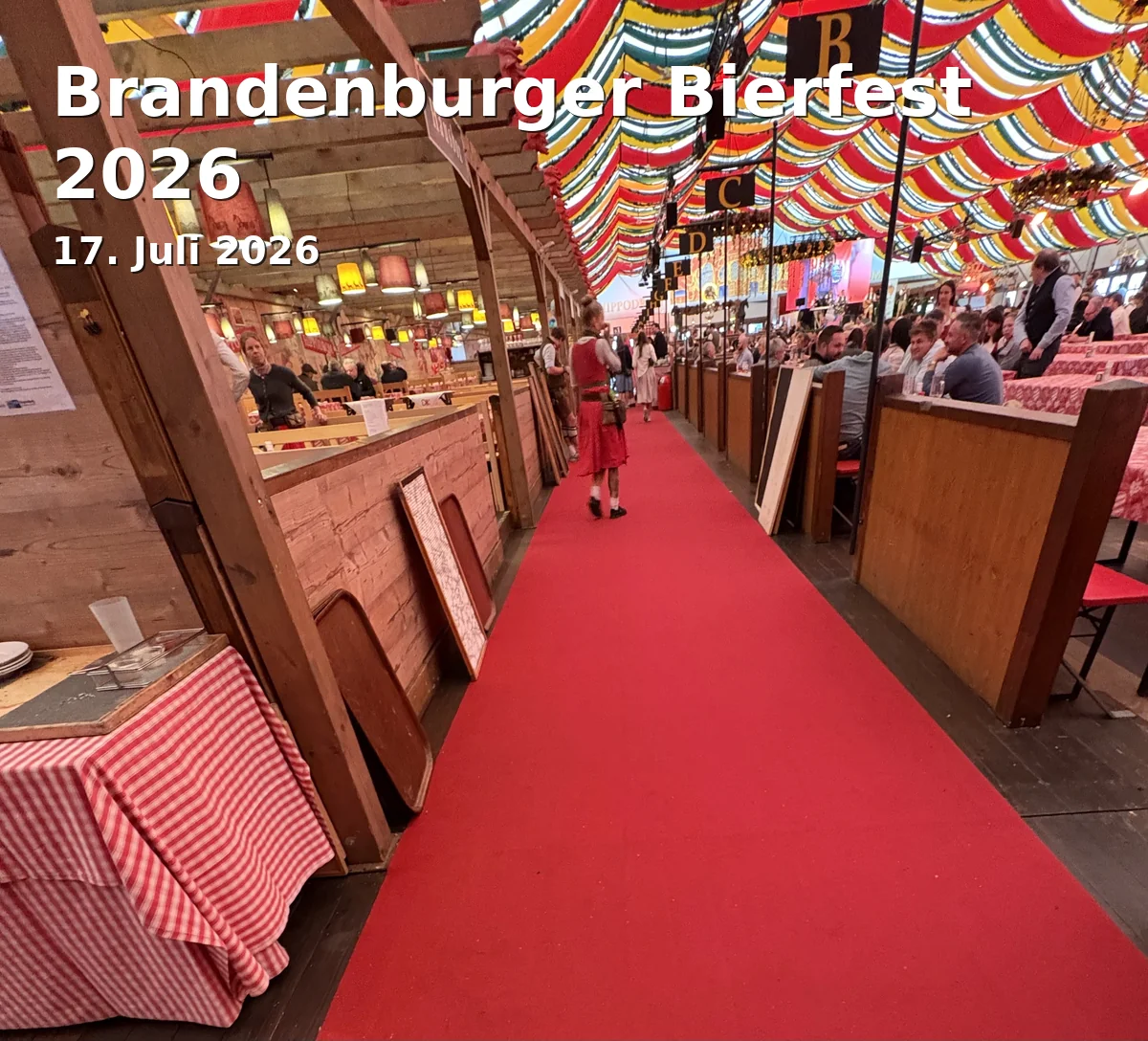
Brandenburg Beer Festival 2026
Enjoy the variety of regional beers and culinary specialties on the Luisenplatz in Potsdam.

Potsdam Christmas Magic
Winter glow in Potsdam: The Christmas Magic entices with 250 stalls, ice rink, music, and family moments. Free entry on 23.11.2026. #ChristmasMagic
Frequently Asked Questions
Reviews
Maestro AC
16. December 2025
This winter there was a nice Christmas Market with fine foods and assortments.
Rob Hickey
19. June 2024
Public viewing of Euro Cup 2024! Especially fun watching the home team play and win!
Marco Tabo Silalahi
28. June 2025
Super chill city
Nuno Tavares Lopes
22. October 2023
If you come to Berlin you need to pass by here!
Marius Bucys
3. July 2024
I'm very upset about the parking below. Leave a car late in the evening, took in the morning, pay 30eur.