
Luftschiffhafen Potsdam
(656 Reviews)

Potsdam

Olympischer Weg 2, 14471 Potsdam-Westliche Vorstadt, Deutschland

Airship Port Potsdam | Events & Parking

Airship Port Potsdam is much more than a single hall or a stadium. The location by Templiner See has developed from a historical airship port into one of the most important sports and performance centers of the state capital. Today, the stadium, swimming pool, athletics hall, canoe center, MBS Arena, sports school, boarding school, cafeteria, and club rooms are all gathered on a spacious area between Zeppelinstraße and Havel. The city describes the airship port as a publicly accessible area with a long-standing sports tradition; at the same time, Airship Port Potsdam GmbH operates the facility on behalf of the city and ProPotsdam, ensuring operation, development, and facility management. For visitors, the place is therefore doubly exciting: on one hand, as a venue for major sporting events and events, and on the other hand, as a historically charged site with a very clear sports infrastructure, short distances, and a special location by the water. Those looking for event dates, parking information, routes, Google Maps, photos, or practical tips will find a compact overview with the most important facts here. ([sportpark-luftschiffhafen.de](https://www.sportpark-luftschiffhafen.de/))

Where are events taking place today at Airship Port Potsdam?

The central event address in the sports park is the MBS Arena. With up to 2900 spectator seats, it has been the heart of the airship port since 2012 and is explicitly designed for sports events, concerts, shows, and fairs. In addition, there are integrated special areas such as judo and fencing halls, two three-field halls, one single-field hall, two weight rooms, a sauna, a recovery pool, and physiotherapy. Therefore, those inquiring about today's program or events are not looking for a classic concert hall, but rather a multifunctional arena in a sports park where competitions, club operations, and event usage converge. The arena also has its own area with room plans for different types of use, which is particularly important for ticket interested parties, as sports, boxing, banquets, conferences, and concerts are organized differently. ([sportpark-luftschiffhafen.de](https://www.sportpark-luftschiffhafen.de/index.php/de-DE/sportstaetten))

The security and event framework is also clearly regulated. The MBS Arena has a permanent operating permit, and before each event, the necessary security measures are established in conjunction with authorities and organizers. At the same time, the official events page shows that the arena is regularly used with changing dates and tickets. This makes Airship Port Potsdam particularly interesting for current events, as there is not only a single large evening but a continuous mix of sports, youth, club activities, and special events. The location directly at the sports park creates short distances between entry, foyer, parking garage, and the other sports facilities. Therefore, anyone planning an event should always consider the respective event level: MBS Arena for large events, stadium for athletics and outdoor sports, and other halls and sports areas for training and special use. This mix explains why the location often appears in search queries with terms like today, program, tickets, seating plan, and events. ([mbs-arena.de](https://www.mbs-arena.de/?utm_source=openai))

How does access and parking work at the Sports Park Airship Port?

When it comes to access, the airship port is unusually well organized. The sports park area is not freely accessible by vehicle, and access is only permitted via the central entrance on Zeppelinstraße according to the parking regulations. In principle, only vehicles with appropriate authorization or those that have rented a parking space on the sports park area are granted access. Parking is only allowed in designated areas; green spaces and the central avenue are expressly excluded. Similarly, the use of motorized two-wheelers on the premises is not permitted. These rules are important because the location does not function like an open parking area, but rather like a sensitively controlled sports and event environment with emergency routes, parking permits, and clearly marked areas. ([sportpark-luftschiffhafen.de](https://sportpark-luftschiffhafen.de/index.php/de-DE/8-home/12-der-sportpark-8))

For visitors to the MBS Arena, additional practical information is relevant: The arena is part of the Airship Port Sports Park, parking in the immediate vicinity is limited, and the official travel recommendation refers to the free P+R parking lot at Pirschheide train station as well as bus and tram services. The bus lines 580, 631, and N14 as well as the tram lines 91 and 98, which run frequently nearby, are mentioned. Those arriving by car can refer to the arena data: The MBS Arena is located at Olympischer Weg 6, and the parking garage is situated between Zeppelinstraße 113 and 114. For the general location, Olympischer Weg 2 is the most important address. This combination of controlled access, designated parking areas, and good public transport makes the journey manageable but requires some preparation, especially on event days. Arriving early not only saves stress but also avoids unnecessary detours over blocked or prohibited access routes. ([mbs-arena.de](https://www.mbs-arena.de/index.php/anreise?utm_source=openai))

Additionally, the parking organization has evolved in recent years. The official parking regulations of the sports park have been adjusted as an extension of an older concept because the area has become busier due to construction activities, delivery traffic, and events. Since 2025, there has been a change of operators for the parking garage and a camera-monitored free-flow system without barriers. For everyday life in the sports park, this means: Not only the event itself but also the access is part of the visitor experience. The area is clearly structured but not spontaneously accessible to everyone. This is precisely why terms like route, maps, parking, and address frequently appear in search queries. Those wishing to visit the airship port should enter the official address directly into their navigation device, pay attention to the signposted central entrance, and check early for events whether the parking garage, P+R, or public transport is the best choice. ([sportpark-luftschiffhafen.de](https://sportpark-luftschiffhafen.de/index.php/de-DE/8-home/12-der-sportpark-8))

How did the Airship Port Potsdam come into existence historically?

The history of the airship port does not begin with sports but with aviation. As early as 1910, Count Zeppelin received an area of about 25 hectares at Templiner See from the city of Potsdam to establish an airship port. In 1911, the first airship, LZ 10 Schwaben, landed on the site, and in 1912, the largest airship hall in Germany at that time was built here. This shows that the site was a technical and urban prestige project from the very beginning. In 1913, the entrance to the facility was given a design with a semicircle of 22 linden trees that still shapes the historical character of the area today. The early phase of the airship port is therefore not only a chapter in the city's history but also a visible origin of today's design. Anyone entering the site today is moving in a place whose form and symbolism are deeply rooted in the airship era. ([potsdam.de](https://www.potsdam.de/de/luftschiffhafen-potsdam?utm_source=openai))

After the end of airship production, the area gradually transformed. In 1924, the city repurchased the area, in 1925 the General Water Sports Exhibition took place there, and from 1927 the land and water sports area Airship Port was used. Subsequently, the site developed into a center for sports in Potsdam. The city side describes that the area was transformed into a land and water sports area in the 1920s and continued to focus on competitive sports during the GDR era. This is complemented by the music pavilion from 1932, one of the most important original testimonies of the historical site. After 1990, the area became publicly accessible, and in 1996 the waterfront path was expanded. Thus, today's sports park is the result of a long transformation: from an aviation site to a water sports area, from a competitive sports center of the GDR to a modern, open, and multifunctional sports park of the present. ([potsdam.de](https://www.potsdam.de/de/content/luftschiffhafen-1))

In the 2000s and 2010s, the site was consistently further developed. The state capital and ProPotsdam emphasize that the company operates the sports park on behalf of the city and that the construction of the MBS Arena was a central step in development. In parallel, additional functions were added, such as school, residential, and club structures. This development makes Airship Port Potsdam today a place where history is not museum-like but integrated into current use. This is precisely why the location is so interesting for visitors: it connects the memory of Zeppelin, hangars, and early aviation with a modern sports landscape that remains visibly alive in everyday life. This makes the airship port a rare example of how a historical site can reinvent itself over more than a century while its origin remains clearly recognizable. ([propotsdam.de](https://www.propotsdam.de/ueber-uns/unternehmensverbund/luftschiffhafen-potsdam-gmbh/))

What sports facilities characterize the location?

The face of the sports park is primarily determined by its sports facilities. The MBS Arena is the centerpiece, but the site encompasses much more. According to the official overview, this includes a stadium, swimming pool, canoe center, gymnastics hall, sports school, cafeteria, dormitory, and canoe barn. This density is a key reason why the airship port is considered the center of sports in Potsdam. The facility combines short distances, specialized training locations, and an infrastructure that supports both youth and elite sports. This bundling is characteristic of the location: not a single building, but the interplay of many clearly functioning facilities creates the character of the area. ([potsdam.de](https://www.potsdam.de/de/content/der-sportpark-luftschiffhafen))

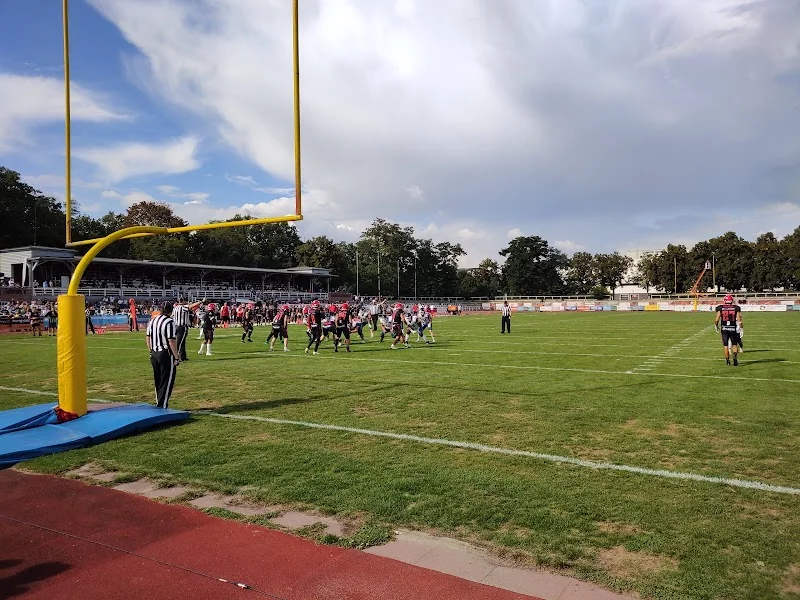
The athletics stadium is one of the most traditional elements. It was built in 1927 and then accommodated up to 11,000 spectators. Later, national athletics competitions were held there. Today, the stadium features stands, covered seating, sanitary facilities, an electronic scoreboard, as well as sound and floodlight systems. Additionally, there are eight running tracks in tartan and facilities for shot put, discus, javelin, and hammer throw, as well as two high jump, long jump, and pole vault facilities each. At the back of the athletics hall, there is a secondary stadium as a training area with a grass surface. In practice, this means: The airship port is not only a venue for events but a fully planned training and competition site that provides both visibility and functionality. ([sportpark-luftschiffhafen.de](https://www.sportpark-luftschiffhafen.de/index.php/de-DE/sportstaetten))

Another core area is the athletics hall. It was reconstructed in 2004 and has a main usable area of around 8750 square meters. The hall is designed for running and jumping disciplines as well as for throwing and shot training. It features a 200-meter running track with four lanes, six sprint straights with light barriers and timing systems, a throwing hall, a two-field ball game hall, and five strength training rooms. Thus, the hall is an example of the technical depth of the sports park: it is not only about movement but also about diagnostics, repetition, performance control, and systematic training. For search queries regarding gym, stadium, or maps, it is therefore important to understand that the airship port is not a single building but a complex sports ensemble whose individual areas each have their own functions and work closely together. ([sportpark-luftschiffhafen.de](https://www.sportpark-luftschiffhafen.de/index.php/de-DE/sportstaetten))

The swimming pool is particularly interesting for competitive sports. The official equipment includes long and short courses of 10 by 50 meters and 20 by 25 meters, as well as strength training rooms, a gymnastics room, a training room, a swimming counter-current system with an underwater window and video recordings, and the possibility for hypoxia-supported training. Additionally, there are 20 starting blocks and an electronic timing system. In 2023, the hall was also equipped with modern LED lighting. This combination of pools, diagnostics, and training environment shows why the swimming pool at the airship port is of regional relevance. It is not just a pure leisure pool structure but a real training facility with a laboratory character, focused on precise performance. ([sportpark-luftschiffhafen.de](https://www.sportpark-luftschiffhafen.de/index.php/de-DE/sportstaetten))

The canoe center complements this focus on water and endurance sports. It features strength and gymnastics rooms, a canoe counter-current system, a boat hall, two 200-meter competition courses with starting facilities and electronic timing, as well as illuminated 500-meter training tracks. The training area directly on the Havel and Templiner See is described in the official description as one of the most beautiful in Germany. Additionally, the gymnastics hall connects to a long tradition of gymnastics in Potsdam. The young gymnastics talent school Airship Port is now located in the new gymnastics hall of the University of Potsdam. Together, these sports facilities demonstrate how diverse the location is: swimming, running, throwing, rowing, canoeing, gymnastics, and team sports are organized here not side by side but in a dense spatial connection. ([sportpark-luftschiffhafen.de](https://www.sportpark-luftschiffhafen.de/index.php/de-DE/sportstaetten))

How are school, boarding school, cafeteria, and club life organized?

Airship Port Potsdam functions not only as a sports facility but also as a place of life. This is clearly shown by the statement on the official homepage that training, learning, and leisure connect in a small space here. The sports school, boarding school, cafeteria, and sports facilities are within walking distance of each other, allowing for short distances in everyday life. This is crucial for competitive sports as it simplifies processes and reduces strain. According to the official description, a team of more than a hundred teachers works at the sports school, combining academic education, competitive sports training, and educational support. The location is thus an example of a holistic sports model in which education and training are systematically coordinated. ([sportpark-luftschiffhafen.de](https://www.sportpark-luftschiffhafen.de/))

This is particularly visible in the House of Athletes and the House of Clubs. The House of Clubs has been the seat of the Canoe Club Potsdam in OSC, the 1. FFC Turbine, the Potsdam Running Club, and the DLRG state associations and local groups since 2013. In addition to office and administrative spaces, there are training and multipurpose rooms, a sauna and relaxation area, as well as a communal area. The House of Athletes has consisted of an existing building with 14 floors and a newly constructed replacement building with 5 floors since August 2014; both buildings form an ensemble directly on the banks of the Havel. The school, sports facilities, cafeteria, and MBS Arena are within walking distance. This shows how strongly the location is designed for short distances and functional proximity. What appears from the outside as a large sports park is in everyday life a closely linked infrastructure with clear social and sports logic. ([sportpark-luftschiffhafen.de](https://www.sportpark-luftschiffhafen.de/index.php/de-DE/sportstaetten-2))

The cafeteria also plays a larger role than it may seem at first glance. It was inaugurated at the beginning of 2011, expanded from nearly 900 to almost 1800 square meters, and supplemented by a cafeteria and a side room, among other things. This may sound technical, but it is central to the operation of the site, as in high-performance sports, nutrition, regeneration, and time management are closely interconnected. Together with the club rooms, the dormitory, and the school buildings, the cafeteria forms a daily center that keeps the entire sports park running. Therefore, anyone viewing the airship port solely as an event venue sees only the tip of the iceberg. In reality, the location is a permanent working and living environment for many people who train, learn, teach, organize, or engage in club life there. This everyday aspect makes the sports park so credible and so independent. ([sportpark-luftschiffhafen.de](https://www.sportpark-luftschiffhafen.de/index.php/de-DE/sportstaetten-2))

Hotel, surroundings, and visitor tips at Templiner See

Those looking for accommodation for a visit to Airship Port Potsdam will find the Congress Hotel Potsdam at Airship Port 1 in the immediate vicinity. The hotel itself refers to the history of the site and its location by Templiner See. Thus, it is a convenient point of contact for guests planning events in the sports park, training camps, conferences, or longer stays. The location is practical for visitors because the hotel, sports park, and lakeside area share the same historical space and allow for short distances. This is particularly interesting for people who want to experience the site as part of a stay in Potsdam, rather than just attending a single event. ([kongresshotel-potsdam.com](https://www.kongresshotel-potsdam.com/about-us/history/))

The surrounding area itself also has a special charm. The city emphasizes that the airship port has been publicly accessible since 1990 and that the waterfront path was expanded in 1996. As a result, the area today is not only a sports location but also a place with publicly accessible water features. Those searching for photos of Airship Port Potsdam will find striking motifs: the historic entrance with the linden alley, the music pavilion from 1932, the waterfront zone, and the modern sports architecture surrounding the stadium and arena. This mix of history, nature, and sports makes the location visually strong. Therefore, for a successful visit, it is worthwhile to plan some time for the surroundings and not just focus on the actual event. The airship port is a place where Potsdam's city history, sporting everyday life, and modern event culture come together closely. Those who consciously perceive these layers understand why the location has been so formative for Potsdam for decades. ([potsdam.de](https://www.potsdam.de/de/content/luftschiffhafen-1))

Sources:

Mehr anzeigen

Airship Port Potsdam | Events & Parking

Airship Port Potsdam is much more than a single hall or a stadium. The location by Templiner See has developed from a historical airship port into one of the most important sports and performance centers of the state capital. Today, the stadium, swimming pool, athletics hall, canoe center, MBS Arena, sports school, boarding school, cafeteria, and club rooms are all gathered on a spacious area between Zeppelinstraße and Havel. The city describes the airship port as a publicly accessible area with a long-standing sports tradition; at the same time, Airship Port Potsdam GmbH operates the facility on behalf of the city and ProPotsdam, ensuring operation, development, and facility management. For visitors, the place is therefore doubly exciting: on one hand, as a venue for major sporting events and events, and on the other hand, as a historically charged site with a very clear sports infrastructure, short distances, and a special location by the water. Those looking for event dates, parking information, routes, Google Maps, photos, or practical tips will find a compact overview with the most important facts here. ([sportpark-luftschiffhafen.de](https://www.sportpark-luftschiffhafen.de/))

Where are events taking place today at Airship Port Potsdam?

The central event address in the sports park is the MBS Arena. With up to 2900 spectator seats, it has been the heart of the airship port since 2012 and is explicitly designed for sports events, concerts, shows, and fairs. In addition, there are integrated special areas such as judo and fencing halls, two three-field halls, one single-field hall, two weight rooms, a sauna, a recovery pool, and physiotherapy. Therefore, those inquiring about today's program or events are not looking for a classic concert hall, but rather a multifunctional arena in a sports park where competitions, club operations, and event usage converge. The arena also has its own area with room plans for different types of use, which is particularly important for ticket interested parties, as sports, boxing, banquets, conferences, and concerts are organized differently. ([sportpark-luftschiffhafen.de](https://www.sportpark-luftschiffhafen.de/index.php/de-DE/sportstaetten))

The security and event framework is also clearly regulated. The MBS Arena has a permanent operating permit, and before each event, the necessary security measures are established in conjunction with authorities and organizers. At the same time, the official events page shows that the arena is regularly used with changing dates and tickets. This makes Airship Port Potsdam particularly interesting for current events, as there is not only a single large evening but a continuous mix of sports, youth, club activities, and special events. The location directly at the sports park creates short distances between entry, foyer, parking garage, and the other sports facilities. Therefore, anyone planning an event should always consider the respective event level: MBS Arena for large events, stadium for athletics and outdoor sports, and other halls and sports areas for training and special use. This mix explains why the location often appears in search queries with terms like today, program, tickets, seating plan, and events. ([mbs-arena.de](https://www.mbs-arena.de/?utm_source=openai))

How does access and parking work at the Sports Park Airship Port?

When it comes to access, the airship port is unusually well organized. The sports park area is not freely accessible by vehicle, and access is only permitted via the central entrance on Zeppelinstraße according to the parking regulations. In principle, only vehicles with appropriate authorization or those that have rented a parking space on the sports park area are granted access. Parking is only allowed in designated areas; green spaces and the central avenue are expressly excluded. Similarly, the use of motorized two-wheelers on the premises is not permitted. These rules are important because the location does not function like an open parking area, but rather like a sensitively controlled sports and event environment with emergency routes, parking permits, and clearly marked areas. ([sportpark-luftschiffhafen.de](https://sportpark-luftschiffhafen.de/index.php/de-DE/8-home/12-der-sportpark-8))

For visitors to the MBS Arena, additional practical information is relevant: The arena is part of the Airship Port Sports Park, parking in the immediate vicinity is limited, and the official travel recommendation refers to the free P+R parking lot at Pirschheide train station as well as bus and tram services. The bus lines 580, 631, and N14 as well as the tram lines 91 and 98, which run frequently nearby, are mentioned. Those arriving by car can refer to the arena data: The MBS Arena is located at Olympischer Weg 6, and the parking garage is situated between Zeppelinstraße 113 and 114. For the general location, Olympischer Weg 2 is the most important address. This combination of controlled access, designated parking areas, and good public transport makes the journey manageable but requires some preparation, especially on event days. Arriving early not only saves stress but also avoids unnecessary detours over blocked or prohibited access routes. ([mbs-arena.de](https://www.mbs-arena.de/index.php/anreise?utm_source=openai))

Additionally, the parking organization has evolved in recent years. The official parking regulations of the sports park have been adjusted as an extension of an older concept because the area has become busier due to construction activities, delivery traffic, and events. Since 2025, there has been a change of operators for the parking garage and a camera-monitored free-flow system without barriers. For everyday life in the sports park, this means: Not only the event itself but also the access is part of the visitor experience. The area is clearly structured but not spontaneously accessible to everyone. This is precisely why terms like route, maps, parking, and address frequently appear in search queries. Those wishing to visit the airship port should enter the official address directly into their navigation device, pay attention to the signposted central entrance, and check early for events whether the parking garage, P+R, or public transport is the best choice. ([sportpark-luftschiffhafen.de](https://sportpark-luftschiffhafen.de/index.php/de-DE/8-home/12-der-sportpark-8))

How did the Airship Port Potsdam come into existence historically?

The history of the airship port does not begin with sports but with aviation. As early as 1910, Count Zeppelin received an area of about 25 hectares at Templiner See from the city of Potsdam to establish an airship port. In 1911, the first airship, LZ 10 Schwaben, landed on the site, and in 1912, the largest airship hall in Germany at that time was built here. This shows that the site was a technical and urban prestige project from the very beginning. In 1913, the entrance to the facility was given a design with a semicircle of 22 linden trees that still shapes the historical character of the area today. The early phase of the airship port is therefore not only a chapter in the city's history but also a visible origin of today's design. Anyone entering the site today is moving in a place whose form and symbolism are deeply rooted in the airship era. ([potsdam.de](https://www.potsdam.de/de/luftschiffhafen-potsdam?utm_source=openai))

After the end of airship production, the area gradually transformed. In 1924, the city repurchased the area, in 1925 the General Water Sports Exhibition took place there, and from 1927 the land and water sports area Airship Port was used. Subsequently, the site developed into a center for sports in Potsdam. The city side describes that the area was transformed into a land and water sports area in the 1920s and continued to focus on competitive sports during the GDR era. This is complemented by the music pavilion from 1932, one of the most important original testimonies of the historical site. After 1990, the area became publicly accessible, and in 1996 the waterfront path was expanded. Thus, today's sports park is the result of a long transformation: from an aviation site to a water sports area, from a competitive sports center of the GDR to a modern, open, and multifunctional sports park of the present. ([potsdam.de](https://www.potsdam.de/de/content/luftschiffhafen-1))

In the 2000s and 2010s, the site was consistently further developed. The state capital and ProPotsdam emphasize that the company operates the sports park on behalf of the city and that the construction of the MBS Arena was a central step in development. In parallel, additional functions were added, such as school, residential, and club structures. This development makes Airship Port Potsdam today a place where history is not museum-like but integrated into current use. This is precisely why the location is so interesting for visitors: it connects the memory of Zeppelin, hangars, and early aviation with a modern sports landscape that remains visibly alive in everyday life. This makes the airship port a rare example of how a historical site can reinvent itself over more than a century while its origin remains clearly recognizable. ([propotsdam.de](https://www.propotsdam.de/ueber-uns/unternehmensverbund/luftschiffhafen-potsdam-gmbh/))

What sports facilities characterize the location?

The face of the sports park is primarily determined by its sports facilities. The MBS Arena is the centerpiece, but the site encompasses much more. According to the official overview, this includes a stadium, swimming pool, canoe center, gymnastics hall, sports school, cafeteria, dormitory, and canoe barn. This density is a key reason why the airship port is considered the center of sports in Potsdam. The facility combines short distances, specialized training locations, and an infrastructure that supports both youth and elite sports. This bundling is characteristic of the location: not a single building, but the interplay of many clearly functioning facilities creates the character of the area. ([potsdam.de](https://www.potsdam.de/de/content/der-sportpark-luftschiffhafen))

The athletics stadium is one of the most traditional elements. It was built in 1927 and then accommodated up to 11,000 spectators. Later, national athletics competitions were held there. Today, the stadium features stands, covered seating, sanitary facilities, an electronic scoreboard, as well as sound and floodlight systems. Additionally, there are eight running tracks in tartan and facilities for shot put, discus, javelin, and hammer throw, as well as two high jump, long jump, and pole vault facilities each. At the back of the athletics hall, there is a secondary stadium as a training area with a grass surface. In practice, this means: The airship port is not only a venue for events but a fully planned training and competition site that provides both visibility and functionality. ([sportpark-luftschiffhafen.de](https://www.sportpark-luftschiffhafen.de/index.php/de-DE/sportstaetten))

Another core area is the athletics hall. It was reconstructed in 2004 and has a main usable area of around 8750 square meters. The hall is designed for running and jumping disciplines as well as for throwing and shot training. It features a 200-meter running track with four lanes, six sprint straights with light barriers and timing systems, a throwing hall, a two-field ball game hall, and five strength training rooms. Thus, the hall is an example of the technical depth of the sports park: it is not only about movement but also about diagnostics, repetition, performance control, and systematic training. For search queries regarding gym, stadium, or maps, it is therefore important to understand that the airship port is not a single building but a complex sports ensemble whose individual areas each have their own functions and work closely together. ([sportpark-luftschiffhafen.de](https://www.sportpark-luftschiffhafen.de/index.php/de-DE/sportstaetten))

The swimming pool is particularly interesting for competitive sports. The official equipment includes long and short courses of 10 by 50 meters and 20 by 25 meters, as well as strength training rooms, a gymnastics room, a training room, a swimming counter-current system with an underwater window and video recordings, and the possibility for hypoxia-supported training. Additionally, there are 20 starting blocks and an electronic timing system. In 2023, the hall was also equipped with modern LED lighting. This combination of pools, diagnostics, and training environment shows why the swimming pool at the airship port is of regional relevance. It is not just a pure leisure pool structure but a real training facility with a laboratory character, focused on precise performance. ([sportpark-luftschiffhafen.de](https://www.sportpark-luftschiffhafen.de/index.php/de-DE/sportstaetten))

The canoe center complements this focus on water and endurance sports. It features strength and gymnastics rooms, a canoe counter-current system, a boat hall, two 200-meter competition courses with starting facilities and electronic timing, as well as illuminated 500-meter training tracks. The training area directly on the Havel and Templiner See is described in the official description as one of the most beautiful in Germany. Additionally, the gymnastics hall connects to a long tradition of gymnastics in Potsdam. The young gymnastics talent school Airship Port is now located in the new gymnastics hall of the University of Potsdam. Together, these sports facilities demonstrate how diverse the location is: swimming, running, throwing, rowing, canoeing, gymnastics, and team sports are organized here not side by side but in a dense spatial connection. ([sportpark-luftschiffhafen.de](https://www.sportpark-luftschiffhafen.de/index.php/de-DE/sportstaetten))

How are school, boarding school, cafeteria, and club life organized?

Airship Port Potsdam functions not only as a sports facility but also as a place of life. This is clearly shown by the statement on the official homepage that training, learning, and leisure connect in a small space here. The sports school, boarding school, cafeteria, and sports facilities are within walking distance of each other, allowing for short distances in everyday life. This is crucial for competitive sports as it simplifies processes and reduces strain. According to the official description, a team of more than a hundred teachers works at the sports school, combining academic education, competitive sports training, and educational support. The location is thus an example of a holistic sports model in which education and training are systematically coordinated. ([sportpark-luftschiffhafen.de](https://www.sportpark-luftschiffhafen.de/))

This is particularly visible in the House of Athletes and the House of Clubs. The House of Clubs has been the seat of the Canoe Club Potsdam in OSC, the 1. FFC Turbine, the Potsdam Running Club, and the DLRG state associations and local groups since 2013. In addition to office and administrative spaces, there are training and multipurpose rooms, a sauna and relaxation area, as well as a communal area. The House of Athletes has consisted of an existing building with 14 floors and a newly constructed replacement building with 5 floors since August 2014; both buildings form an ensemble directly on the banks of the Havel. The school, sports facilities, cafeteria, and MBS Arena are within walking distance. This shows how strongly the location is designed for short distances and functional proximity. What appears from the outside as a large sports park is in everyday life a closely linked infrastructure with clear social and sports logic. ([sportpark-luftschiffhafen.de](https://www.sportpark-luftschiffhafen.de/index.php/de-DE/sportstaetten-2))

The cafeteria also plays a larger role than it may seem at first glance. It was inaugurated at the beginning of 2011, expanded from nearly 900 to almost 1800 square meters, and supplemented by a cafeteria and a side room, among other things. This may sound technical, but it is central to the operation of the site, as in high-performance sports, nutrition, regeneration, and time management are closely interconnected. Together with the club rooms, the dormitory, and the school buildings, the cafeteria forms a daily center that keeps the entire sports park running. Therefore, anyone viewing the airship port solely as an event venue sees only the tip of the iceberg. In reality, the location is a permanent working and living environment for many people who train, learn, teach, organize, or engage in club life there. This everyday aspect makes the sports park so credible and so independent. ([sportpark-luftschiffhafen.de](https://www.sportpark-luftschiffhafen.de/index.php/de-DE/sportstaetten-2))

Hotel, surroundings, and visitor tips at Templiner See

Those looking for accommodation for a visit to Airship Port Potsdam will find the Congress Hotel Potsdam at Airship Port 1 in the immediate vicinity. The hotel itself refers to the history of the site and its location by Templiner See. Thus, it is a convenient point of contact for guests planning events in the sports park, training camps, conferences, or longer stays. The location is practical for visitors because the hotel, sports park, and lakeside area share the same historical space and allow for short distances. This is particularly interesting for people who want to experience the site as part of a stay in Potsdam, rather than just attending a single event. ([kongresshotel-potsdam.com](https://www.kongresshotel-potsdam.com/about-us/history/))

The surrounding area itself also has a special charm. The city emphasizes that the airship port has been publicly accessible since 1990 and that the waterfront path was expanded in 1996. As a result, the area today is not only a sports location but also a place with publicly accessible water features. Those searching for photos of Airship Port Potsdam will find striking motifs: the historic entrance with the linden alley, the music pavilion from 1932, the waterfront zone, and the modern sports architecture surrounding the stadium and arena. This mix of history, nature, and sports makes the location visually strong. Therefore, for a successful visit, it is worthwhile to plan some time for the surroundings and not just focus on the actual event. The airship port is a place where Potsdam's city history, sporting everyday life, and modern event culture come together closely. Those who consciously perceive these layers understand why the location has been so formative for Potsdam for decades. ([potsdam.de](https://www.potsdam.de/de/content/luftschiffhafen-1))

Sources:

Frequently Asked Questions

Reviews

ED

Experience Designer

6. February 2026

I was here for a swimming lesson with Unisport Potsdam. It is definitely a facility designed for athletes rather than casual swimming, the pool is Olympic-level with modern equipment, and the coaches are professional. You need to bring your own padlock for the lockers, and a swimming cap is mandatory. Also, the doors were locked when I arrived, so I had to wait outside for the coach to let me in. It's a great spot for serious training.

PO

Philipp Olshausen

14. July 2024

Parking on game day for the Royals is difficult. Stadium is cute. Wood bench seating but with a back.

MD

mitali damle

16. May 2018

All in one sports complex. Easily accessible.

WG

Walid Githaka

29. September 2024

Wonderful place for sports.

CV

Charlotte Vacogne

8. June 2019

Good Olympic-sized pool.