
Potsdam
Lange Brücke, 14 Potsdam, Germany
Long Bridge | Access & Parking in Potsdam
The Long Bridge is much more than just a functional structure in Potsdam. It is a transition, a landmark, a focal point, and an important part of urban daily life. Anyone arriving in the city center from the main train station, strolling to Friendship Island, exploring the waterfront areas along the Old Channel, or simply searching for a route between water, the old town, and new neighborhoods will almost always pass this location. This is precisely why the Long Bridge is interesting for those seeking information about access, parking, history, surroundings, and significance in the urban landscape. It represents the interplay of mobility and urban space, traffic and quality of stay, technology and landscape. The official city information describes it as the most famous bridge structure in Potsdam, and this role is still clearly felt on site today. ([potsdam.de](https://www.potsdam.de/de/lange-bruecke?utm_source=openai))
What Makes the Long Bridge in Potsdam So Special
The Long Bridge is an urban joint point with exceptionally high visibility. It spans the Old and New Channels of the Havel and is located precisely where Potsdam's historic center, the waterfront areas of the city center, and the paths to the main train station intersect. This is one of the reasons why the bridge appears not only on maps and navigation systems but also plays a fixed role in the daily lives of many people. It is part of one of the most important inner-city traffic axes and at the same time a place where the unique Potsdam cityscape can be experienced very intensively. On one side lies the city center with the Old Market, the State Parliament, and waterfront areas, while on the other side, paths lead to the train station, residential neighborhoods, and the bridges over the Havel arms. So, standing here, one sees not only asphalt, lanes, and traffic lights but a transition between different urban spaces. This blend of function and atmosphere makes the Long Bridge so relevant. The city also emphasizes that the area around the Long Bridge has repeatedly been the subject of measures to improve cycling traffic in recent years. In 2025, the intersection area of Long Bridge / Babelsberger Straße was reopened after reconstruction; the cycling path was widened to over six meters to improve comfort and reduce conflicts. This clearly shows how important this location is in today's Potsdam: not as an isolated bridge but as part of a vibrant mobility space where pedestrian traffic, cycling, public transport, and motorized traffic must be organized side by side. For visitors, this is useful because one can rely on a very central location. For those interested in the city, it is exciting because the bridge is an example of how Potsdam brings together historical waterfront areas and modern traffic needs. ([potsdam.de](https://www.potsdam.de/de/lange-bruecke?utm_source=openai))
History of the Long Bridge: From 1317 to the Prestressed Concrete Structure of 1959/60
The history of the Long Bridge dates back very far in Potsdam. According to official city information, the prestressed concrete structure built in 1959/60 was already the sixth bridge construction at this location since 1317. This is a remarkably long continuity, as it shows that the crossing over the Havel arms has long been one of the strategically important points in the city. The current bridge was planned starting in 1957 by the design office for road construction in Babelsberg and was built at a time when Potsdam needed new solutions for urban infrastructure after the war destruction. The new structure replaced a temporary bridge that had been provisionally erected in 1945 on the abutments of the bridge destroyed by war action. The technical background is also interesting: According to city information, a design without river piers was pursued because the earlier bridges no longer met the requirements of shipping. As early as the 19th century, the then-stone bridges had not withstood the growing demands, which further explains the long development at this site. Particularly revealing is that the city offered tours through the interior of the bridge in 2022. Visitors could explore the structure beneath the roadway and learn more about technology, history, and the planned replacement construction. Such tours make it clear that the Long Bridge should not only be viewed from the outside. It is an engineering structure with an unusual history, a monument to the city's transformation, and at the same time a current topic in traffic planning. The official city website also points out that starting in 1995, a restoration of the entire bridge complex was initiated. This means that the bridge is not only historically significant but also a permanently managed infrastructure work that has had to be repeatedly adapted to the needs of its time. For the contextual classification, it is particularly important that Potsdam understands the bridge as a visible part of its city history. Here, several layers of time intersect: medieval traffic relationships, the development of the residence city, the destruction of World War II, post-war modernity, and today's discussion about a new construction. This is precisely why the Long Bridge is also so relevant for inquiries about history, new construction, and significance. ([potsdam.de](https://www.potsdam.de/de/lange-bruecke?utm_source=openai))
Access to the Long Bridge by Train, Tram, and Bus
Anyone wanting to reach the Long Bridge in Potsdam benefits from a very central location. The surroundings are clearly oriented towards the main train station and the city center, and this is precisely the advantage for visitors, commuters, and excursion guests. The Berlin tourism site for the landing stage Potsdam (Long Bridge) lists the proximity to the Potsdam main train station, the connection to the old town, and accessibility by tram, bus, and S-Bahn as important orientation points. The stop Potsdam, Long Bridge is also listed there with a number of tram and bus lines, including connections such as tram 91, 92, 93, 96, and 99, as well as various bus lines in the immediate vicinity. Additionally, S-Bahn and regional train connections at Potsdam main train station are just a few minutes' walk away. This makes the Long Bridge attractive for everyone who wants to arrive without a car. Particularly practical is that one can quickly reach the city center, the waterfront areas, and Friendship Island from the train station. The location therefore does not feel like a peripheral address but like a central gateway to the Potsdam city core. Those arriving by public transport can even experience the surroundings as a short city walk: first the train station, then the bridge complex, then the waterfront areas, and finally the old town. This is more pleasant for many visitors than a direct arrival by car because orientation on site can easily be established through large reference points. The city and tourism information also show that the Long Bridge lies within a network of stops that connects the Old Market and the area around the main train station. This is particularly useful when planning excursions to Friendship Island, to boat landing stages, or to events in the harbor area. Therefore, those arriving by train do not have to walk far and are quickly in the middle of one of the most exciting areas of Potsdam. For inquiries about access, public transport, and location, the Long Bridge is particularly relevant because it offers an easily understandable access to the city center and is not an isolated single address. ([berlin.de](https://www.berlin.de/tourismus/dampferfahrten/anlegestellen/4707911-2486252-anlegestelle-potsdam-langebruecke.html))
Parking at the Long Bridge and the Main Train Station
When it comes to parking, some planning around the Long Bridge is sensible, as the official visitor information explicitly points out that parking options in the immediate vicinity are limited. This is not unusual for such a central location, as the city center, waterfront, train station area, and tourist use converge here. The best orientation is therefore provided by the main train station: According to Berlin landing stage information, there is a parking garage at Babelsberger Straße 16, which is about 250 meters from the landing stage Potsdam (Long Bridge). For drivers, this is the most practical point of contact if they want to park as close as possible to the bridge, Friendship Island, or the boat landings. Those arriving with a navigation system are also advised by the Berlin site to use Babelsberger Straße 7 as the destination for the landing stage, as the location itself does not have a classic postal address. This further emphasizes that the area around the Long Bridge is not a closed parking location but an inner-city functional space with several partial addresses and short distances. For visitors, this primarily means: arrive early, do not hope for immediate free parking, and rather use the train station as a reference point. Additionally, the location is particularly in demand due to its central position in the Potsdam street network. Therefore, those arriving during the day, on weekends, or in good weather should rely more on the parking garage at the main train station or other central parking spaces in the city center. This is also sensible because the actual attractiveness of the location unfolds better on foot. Those who park their car near the train station can then comfortably explore the bridge complex, the waterfront promenade, and Friendship Island on foot. For SEO search inquiries, this combination is important: parking, short distances, central location, and good accessibility without complicated side streets. Thus, the Long Bridge is not a place with generous parking space directly at the structure, but a place where urban proximity and convenient accessibility are at the forefront. ([berlin.de](https://www.berlin.de/tourismus/dampferfahrten/anlegestellen/4707911-2486252-anlegestelle-potsdam-langebruecke.html))
Friendship Island, Old Channel, and the Surroundings by the Water
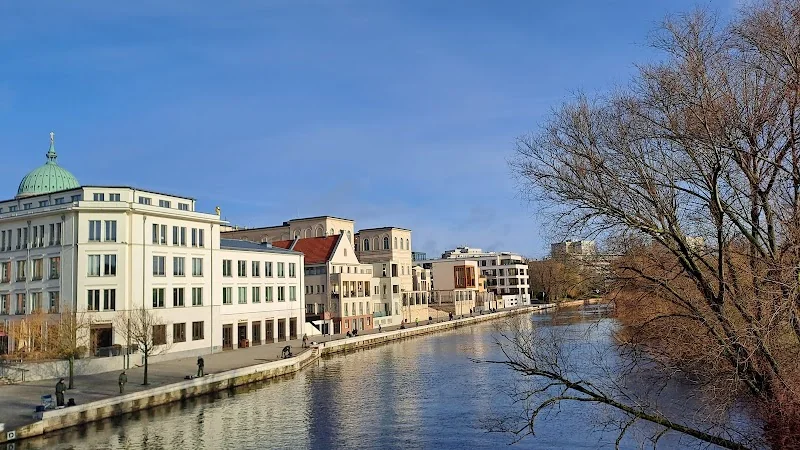
The greatest advantage of the Long Bridge is its surroundings. Directly connected are Friendship Island and the waterfront areas along the Old Channel, and it is precisely here that the Potsdam cityscape unfolds particularly impressively. The official city information describes Friendship Island as a six-hectare island between the Old and New Channels, equipped with a playground, open-air stage, exhibition pavilion, and café. It goes back to the design by Karl Foerster; between 1938 and 1940, the first show and trial garden for hardy flowering perennials, ferns, and grasses in Germany was established there and further developed in the 1950s and 1970s. This means for visitors: The Long Bridge is not only a traffic crossing but also the direct access to one of the most beautiful green and recreational areas in the center of Potsdam. Those standing on the bridge or crossing it on foot can reach a very quiet, garden-shaped island world in just a few minutes. The city also emphasizes that Friendship Island is a worthwhile destination year-round and can be entered free of charge. Additionally, the city describes the Old Channel as a waterfront promenade opposite Friendship Island, extending between the Long Bridge and the Holy Spirit Hospital. On the renovated quay wall, one can stroll from the Old Market over the new bridge to the island or further to the Große Fischerstraße. This is precisely where the special charm of this place arises: Water, garden, historical city silhouette, and modern traffic management lie in close proximity. For walkers, photography fans, and day visitors, this is ideal because one can transition from the urban crossing to a quiet area with just a few steps. Therefore, those searching for Long Bridge Potsdam often mean not only the bridge itself but a whole ensemble of waterfront paths, island access, sightlines, and city references. This spatial interconnection makes the address so popular and so searchable. One can arrive at the Long Bridge, walk over the island, stroll along the Old Channel, and then continue directly into the city center. This is exactly the kind of urban experience that shapes Potsdam. ([potsdam.de](https://www.potsdam.de/de/content/freundschaftsinsel-2))
The Long Bridge Today: Traffic, Cycling, and Future in Urban Space
Today, the Long Bridge is a place where Potsdam's past and present visibly intertwine. The city describes it not only as a historical structure but also as a central axis where traffic management, cycling, pedestrian paths, and urban renewal come together. This is particularly evident in the recent measures around the bridge. In 2025, the intersection area of Long Bridge / Babelsberger Straße was reopened after a short construction period. The city emphasized that the cycling path over Babelsberger Straße was widened to over six meters to create more safety and comfort and to reduce conflicts between cyclists and between cyclists and pedestrians. Such interventions make it clear that the bridge has long been part of a modern mobility debate. It serves not only car traffic but also everyday cycling and the paths of people commuting between the city center and the train station. As early as 2022, the city and the engineering chamber pointed out that a replacement construction would be prepared starting in 2024. At the same time, a ban on heavy traffic over 30 tons with a speed limit of 30 had been announced since 2017. This information shows that the bridge is technically demanding and requires long-term attention. For visitors, this is not bad news but a helpful classification: Those who experience the Long Bridge see a structure that is still actively used, observed, and further developed. The place is therefore neither museum-like nor merely a transit area. Rather, it exemplifies the question of how a historical city deals with a sensitive bridge complex that must connect infrastructure, landscape, and monument sense. For SEO-focused content, this is relevant because searchers often inquire about new construction, history, access, parking, public transport, or location. The Long Bridge answers all these questions in a compact space. It is a traffic axis, a viewpoint, an access point to Friendship Island, a path to the harbor, and a connection between the most important inner-city destinations. Therefore, anyone wanting to understand Potsdam should not only pass this place but consciously perceive it. The Long Bridge is a place of transition in both a literal and urban sense: between water and land, old town and train station, history and present. ([potsdam.de](https://www.potsdam.de/de/515-besser-mobil-besser-leben-freigabe-des-kreuzungsbereichs-lange-bruecke-babelsberger-strasse))
Sources:
- Long Bridge - State Capital Potsdam ([potsdam.de](https://www.potsdam.de/de/lange-bruecke?utm_source=openai))
- State Capital and Engineering Chamber Offer Tours of the Long Bridge - State Capital Potsdam ([potsdam.de](https://www.potsdam.de/de/461-landeshauptstadt-und-ingenieurkammer-bieten-fuehrungen-durch-die-lange-bruecke))
- Friendship Island - State Capital Potsdam ([potsdam.de](https://www.potsdam.de/de/content/freundschaftsinsel-2))
- Havel - Old Channel - State Capital Potsdam ([potsdam.de](https://www.potsdam.de/de/content/havel-alte-fahrt))
- Landing Stage Potsdam (Long Bridge) - Berlin.de ([berlin.de](https://www.berlin.de/tourismus/dampferfahrten/anlegestellen/4707911-2486252-anlegestelle-potsdam-langebruecke.html))
- Release of the Intersection Area Long Bridge / Babelsberger Straße - State Capital Potsdam ([potsdam.de](https://www.potsdam.de/de/515-besser-mobil-besser-leben-freigabe-des-kreuzungsbereichs-lange-bruecke-babelsberger-strasse))
Show moreShow less
Long Bridge | Access & Parking in Potsdam
The Long Bridge is much more than just a functional structure in Potsdam. It is a transition, a landmark, a focal point, and an important part of urban daily life. Anyone arriving in the city center from the main train station, strolling to Friendship Island, exploring the waterfront areas along the Old Channel, or simply searching for a route between water, the old town, and new neighborhoods will almost always pass this location. This is precisely why the Long Bridge is interesting for those seeking information about access, parking, history, surroundings, and significance in the urban landscape. It represents the interplay of mobility and urban space, traffic and quality of stay, technology and landscape. The official city information describes it as the most famous bridge structure in Potsdam, and this role is still clearly felt on site today. ([potsdam.de](https://www.potsdam.de/de/lange-bruecke?utm_source=openai))
What Makes the Long Bridge in Potsdam So Special
The Long Bridge is an urban joint point with exceptionally high visibility. It spans the Old and New Channels of the Havel and is located precisely where Potsdam's historic center, the waterfront areas of the city center, and the paths to the main train station intersect. This is one of the reasons why the bridge appears not only on maps and navigation systems but also plays a fixed role in the daily lives of many people. It is part of one of the most important inner-city traffic axes and at the same time a place where the unique Potsdam cityscape can be experienced very intensively. On one side lies the city center with the Old Market, the State Parliament, and waterfront areas, while on the other side, paths lead to the train station, residential neighborhoods, and the bridges over the Havel arms. So, standing here, one sees not only asphalt, lanes, and traffic lights but a transition between different urban spaces. This blend of function and atmosphere makes the Long Bridge so relevant. The city also emphasizes that the area around the Long Bridge has repeatedly been the subject of measures to improve cycling traffic in recent years. In 2025, the intersection area of Long Bridge / Babelsberger Straße was reopened after reconstruction; the cycling path was widened to over six meters to improve comfort and reduce conflicts. This clearly shows how important this location is in today's Potsdam: not as an isolated bridge but as part of a vibrant mobility space where pedestrian traffic, cycling, public transport, and motorized traffic must be organized side by side. For visitors, this is useful because one can rely on a very central location. For those interested in the city, it is exciting because the bridge is an example of how Potsdam brings together historical waterfront areas and modern traffic needs. ([potsdam.de](https://www.potsdam.de/de/lange-bruecke?utm_source=openai))
History of the Long Bridge: From 1317 to the Prestressed Concrete Structure of 1959/60
The history of the Long Bridge dates back very far in Potsdam. According to official city information, the prestressed concrete structure built in 1959/60 was already the sixth bridge construction at this location since 1317. This is a remarkably long continuity, as it shows that the crossing over the Havel arms has long been one of the strategically important points in the city. The current bridge was planned starting in 1957 by the design office for road construction in Babelsberg and was built at a time when Potsdam needed new solutions for urban infrastructure after the war destruction. The new structure replaced a temporary bridge that had been provisionally erected in 1945 on the abutments of the bridge destroyed by war action. The technical background is also interesting: According to city information, a design without river piers was pursued because the earlier bridges no longer met the requirements of shipping. As early as the 19th century, the then-stone bridges had not withstood the growing demands, which further explains the long development at this site. Particularly revealing is that the city offered tours through the interior of the bridge in 2022. Visitors could explore the structure beneath the roadway and learn more about technology, history, and the planned replacement construction. Such tours make it clear that the Long Bridge should not only be viewed from the outside. It is an engineering structure with an unusual history, a monument to the city's transformation, and at the same time a current topic in traffic planning. The official city website also points out that starting in 1995, a restoration of the entire bridge complex was initiated. This means that the bridge is not only historically significant but also a permanently managed infrastructure work that has had to be repeatedly adapted to the needs of its time. For the contextual classification, it is particularly important that Potsdam understands the bridge as a visible part of its city history. Here, several layers of time intersect: medieval traffic relationships, the development of the residence city, the destruction of World War II, post-war modernity, and today's discussion about a new construction. This is precisely why the Long Bridge is also so relevant for inquiries about history, new construction, and significance. ([potsdam.de](https://www.potsdam.de/de/lange-bruecke?utm_source=openai))
Access to the Long Bridge by Train, Tram, and Bus
Anyone wanting to reach the Long Bridge in Potsdam benefits from a very central location. The surroundings are clearly oriented towards the main train station and the city center, and this is precisely the advantage for visitors, commuters, and excursion guests. The Berlin tourism site for the landing stage Potsdam (Long Bridge) lists the proximity to the Potsdam main train station, the connection to the old town, and accessibility by tram, bus, and S-Bahn as important orientation points. The stop Potsdam, Long Bridge is also listed there with a number of tram and bus lines, including connections such as tram 91, 92, 93, 96, and 99, as well as various bus lines in the immediate vicinity. Additionally, S-Bahn and regional train connections at Potsdam main train station are just a few minutes' walk away. This makes the Long Bridge attractive for everyone who wants to arrive without a car. Particularly practical is that one can quickly reach the city center, the waterfront areas, and Friendship Island from the train station. The location therefore does not feel like a peripheral address but like a central gateway to the Potsdam city core. Those arriving by public transport can even experience the surroundings as a short city walk: first the train station, then the bridge complex, then the waterfront areas, and finally the old town. This is more pleasant for many visitors than a direct arrival by car because orientation on site can easily be established through large reference points. The city and tourism information also show that the Long Bridge lies within a network of stops that connects the Old Market and the area around the main train station. This is particularly useful when planning excursions to Friendship Island, to boat landing stages, or to events in the harbor area. Therefore, those arriving by train do not have to walk far and are quickly in the middle of one of the most exciting areas of Potsdam. For inquiries about access, public transport, and location, the Long Bridge is particularly relevant because it offers an easily understandable access to the city center and is not an isolated single address. ([berlin.de](https://www.berlin.de/tourismus/dampferfahrten/anlegestellen/4707911-2486252-anlegestelle-potsdam-langebruecke.html))
Parking at the Long Bridge and the Main Train Station
When it comes to parking, some planning around the Long Bridge is sensible, as the official visitor information explicitly points out that parking options in the immediate vicinity are limited. This is not unusual for such a central location, as the city center, waterfront, train station area, and tourist use converge here. The best orientation is therefore provided by the main train station: According to Berlin landing stage information, there is a parking garage at Babelsberger Straße 16, which is about 250 meters from the landing stage Potsdam (Long Bridge). For drivers, this is the most practical point of contact if they want to park as close as possible to the bridge, Friendship Island, or the boat landings. Those arriving with a navigation system are also advised by the Berlin site to use Babelsberger Straße 7 as the destination for the landing stage, as the location itself does not have a classic postal address. This further emphasizes that the area around the Long Bridge is not a closed parking location but an inner-city functional space with several partial addresses and short distances. For visitors, this primarily means: arrive early, do not hope for immediate free parking, and rather use the train station as a reference point. Additionally, the location is particularly in demand due to its central position in the Potsdam street network. Therefore, those arriving during the day, on weekends, or in good weather should rely more on the parking garage at the main train station or other central parking spaces in the city center. This is also sensible because the actual attractiveness of the location unfolds better on foot. Those who park their car near the train station can then comfortably explore the bridge complex, the waterfront promenade, and Friendship Island on foot. For SEO search inquiries, this combination is important: parking, short distances, central location, and good accessibility without complicated side streets. Thus, the Long Bridge is not a place with generous parking space directly at the structure, but a place where urban proximity and convenient accessibility are at the forefront. ([berlin.de](https://www.berlin.de/tourismus/dampferfahrten/anlegestellen/4707911-2486252-anlegestelle-potsdam-langebruecke.html))
Friendship Island, Old Channel, and the Surroundings by the Water
The greatest advantage of the Long Bridge is its surroundings. Directly connected are Friendship Island and the waterfront areas along the Old Channel, and it is precisely here that the Potsdam cityscape unfolds particularly impressively. The official city information describes Friendship Island as a six-hectare island between the Old and New Channels, equipped with a playground, open-air stage, exhibition pavilion, and café. It goes back to the design by Karl Foerster; between 1938 and 1940, the first show and trial garden for hardy flowering perennials, ferns, and grasses in Germany was established there and further developed in the 1950s and 1970s. This means for visitors: The Long Bridge is not only a traffic crossing but also the direct access to one of the most beautiful green and recreational areas in the center of Potsdam. Those standing on the bridge or crossing it on foot can reach a very quiet, garden-shaped island world in just a few minutes. The city also emphasizes that Friendship Island is a worthwhile destination year-round and can be entered free of charge. Additionally, the city describes the Old Channel as a waterfront promenade opposite Friendship Island, extending between the Long Bridge and the Holy Spirit Hospital. On the renovated quay wall, one can stroll from the Old Market over the new bridge to the island or further to the Große Fischerstraße. This is precisely where the special charm of this place arises: Water, garden, historical city silhouette, and modern traffic management lie in close proximity. For walkers, photography fans, and day visitors, this is ideal because one can transition from the urban crossing to a quiet area with just a few steps. Therefore, those searching for Long Bridge Potsdam often mean not only the bridge itself but a whole ensemble of waterfront paths, island access, sightlines, and city references. This spatial interconnection makes the address so popular and so searchable. One can arrive at the Long Bridge, walk over the island, stroll along the Old Channel, and then continue directly into the city center. This is exactly the kind of urban experience that shapes Potsdam. ([potsdam.de](https://www.potsdam.de/de/content/freundschaftsinsel-2))
The Long Bridge Today: Traffic, Cycling, and Future in Urban Space
Today, the Long Bridge is a place where Potsdam's past and present visibly intertwine. The city describes it not only as a historical structure but also as a central axis where traffic management, cycling, pedestrian paths, and urban renewal come together. This is particularly evident in the recent measures around the bridge. In 2025, the intersection area of Long Bridge / Babelsberger Straße was reopened after a short construction period. The city emphasized that the cycling path over Babelsberger Straße was widened to over six meters to create more safety and comfort and to reduce conflicts between cyclists and between cyclists and pedestrians. Such interventions make it clear that the bridge has long been part of a modern mobility debate. It serves not only car traffic but also everyday cycling and the paths of people commuting between the city center and the train station. As early as 2022, the city and the engineering chamber pointed out that a replacement construction would be prepared starting in 2024. At the same time, a ban on heavy traffic over 30 tons with a speed limit of 30 had been announced since 2017. This information shows that the bridge is technically demanding and requires long-term attention. For visitors, this is not bad news but a helpful classification: Those who experience the Long Bridge see a structure that is still actively used, observed, and further developed. The place is therefore neither museum-like nor merely a transit area. Rather, it exemplifies the question of how a historical city deals with a sensitive bridge complex that must connect infrastructure, landscape, and monument sense. For SEO-focused content, this is relevant because searchers often inquire about new construction, history, access, parking, public transport, or location. The Long Bridge answers all these questions in a compact space. It is a traffic axis, a viewpoint, an access point to Friendship Island, a path to the harbor, and a connection between the most important inner-city destinations. Therefore, anyone wanting to understand Potsdam should not only pass this place but consciously perceive it. The Long Bridge is a place of transition in both a literal and urban sense: between water and land, old town and train station, history and present. ([potsdam.de](https://www.potsdam.de/de/515-besser-mobil-besser-leben-freigabe-des-kreuzungsbereichs-lange-bruecke-babelsberger-strasse))
Sources:
- Long Bridge - State Capital Potsdam ([potsdam.de](https://www.potsdam.de/de/lange-bruecke?utm_source=openai))
- State Capital and Engineering Chamber Offer Tours of the Long Bridge - State Capital Potsdam ([potsdam.de](https://www.potsdam.de/de/461-landeshauptstadt-und-ingenieurkammer-bieten-fuehrungen-durch-die-lange-bruecke))
- Friendship Island - State Capital Potsdam ([potsdam.de](https://www.potsdam.de/de/content/freundschaftsinsel-2))
- Havel - Old Channel - State Capital Potsdam ([potsdam.de](https://www.potsdam.de/de/content/havel-alte-fahrt))
- Landing Stage Potsdam (Long Bridge) - Berlin.de ([berlin.de](https://www.berlin.de/tourismus/dampferfahrten/anlegestellen/4707911-2486252-anlegestelle-potsdam-langebruecke.html))
- Release of the Intersection Area Long Bridge / Babelsberger Straße - State Capital Potsdam ([potsdam.de](https://www.potsdam.de/de/515-besser-mobil-besser-leben-freigabe-des-kreuzungsbereichs-lange-bruecke-babelsberger-strasse))
Long Bridge | Access & Parking in Potsdam
The Long Bridge is much more than just a functional structure in Potsdam. It is a transition, a landmark, a focal point, and an important part of urban daily life. Anyone arriving in the city center from the main train station, strolling to Friendship Island, exploring the waterfront areas along the Old Channel, or simply searching for a route between water, the old town, and new neighborhoods will almost always pass this location. This is precisely why the Long Bridge is interesting for those seeking information about access, parking, history, surroundings, and significance in the urban landscape. It represents the interplay of mobility and urban space, traffic and quality of stay, technology and landscape. The official city information describes it as the most famous bridge structure in Potsdam, and this role is still clearly felt on site today. ([potsdam.de](https://www.potsdam.de/de/lange-bruecke?utm_source=openai))
What Makes the Long Bridge in Potsdam So Special
The Long Bridge is an urban joint point with exceptionally high visibility. It spans the Old and New Channels of the Havel and is located precisely where Potsdam's historic center, the waterfront areas of the city center, and the paths to the main train station intersect. This is one of the reasons why the bridge appears not only on maps and navigation systems but also plays a fixed role in the daily lives of many people. It is part of one of the most important inner-city traffic axes and at the same time a place where the unique Potsdam cityscape can be experienced very intensively. On one side lies the city center with the Old Market, the State Parliament, and waterfront areas, while on the other side, paths lead to the train station, residential neighborhoods, and the bridges over the Havel arms. So, standing here, one sees not only asphalt, lanes, and traffic lights but a transition between different urban spaces. This blend of function and atmosphere makes the Long Bridge so relevant. The city also emphasizes that the area around the Long Bridge has repeatedly been the subject of measures to improve cycling traffic in recent years. In 2025, the intersection area of Long Bridge / Babelsberger Straße was reopened after reconstruction; the cycling path was widened to over six meters to improve comfort and reduce conflicts. This clearly shows how important this location is in today's Potsdam: not as an isolated bridge but as part of a vibrant mobility space where pedestrian traffic, cycling, public transport, and motorized traffic must be organized side by side. For visitors, this is useful because one can rely on a very central location. For those interested in the city, it is exciting because the bridge is an example of how Potsdam brings together historical waterfront areas and modern traffic needs. ([potsdam.de](https://www.potsdam.de/de/lange-bruecke?utm_source=openai))
History of the Long Bridge: From 1317 to the Prestressed Concrete Structure of 1959/60
The history of the Long Bridge dates back very far in Potsdam. According to official city information, the prestressed concrete structure built in 1959/60 was already the sixth bridge construction at this location since 1317. This is a remarkably long continuity, as it shows that the crossing over the Havel arms has long been one of the strategically important points in the city. The current bridge was planned starting in 1957 by the design office for road construction in Babelsberg and was built at a time when Potsdam needed new solutions for urban infrastructure after the war destruction. The new structure replaced a temporary bridge that had been provisionally erected in 1945 on the abutments of the bridge destroyed by war action. The technical background is also interesting: According to city information, a design without river piers was pursued because the earlier bridges no longer met the requirements of shipping. As early as the 19th century, the then-stone bridges had not withstood the growing demands, which further explains the long development at this site. Particularly revealing is that the city offered tours through the interior of the bridge in 2022. Visitors could explore the structure beneath the roadway and learn more about technology, history, and the planned replacement construction. Such tours make it clear that the Long Bridge should not only be viewed from the outside. It is an engineering structure with an unusual history, a monument to the city's transformation, and at the same time a current topic in traffic planning. The official city website also points out that starting in 1995, a restoration of the entire bridge complex was initiated. This means that the bridge is not only historically significant but also a permanently managed infrastructure work that has had to be repeatedly adapted to the needs of its time. For the contextual classification, it is particularly important that Potsdam understands the bridge as a visible part of its city history. Here, several layers of time intersect: medieval traffic relationships, the development of the residence city, the destruction of World War II, post-war modernity, and today's discussion about a new construction. This is precisely why the Long Bridge is also so relevant for inquiries about history, new construction, and significance. ([potsdam.de](https://www.potsdam.de/de/lange-bruecke?utm_source=openai))
Access to the Long Bridge by Train, Tram, and Bus
Anyone wanting to reach the Long Bridge in Potsdam benefits from a very central location. The surroundings are clearly oriented towards the main train station and the city center, and this is precisely the advantage for visitors, commuters, and excursion guests. The Berlin tourism site for the landing stage Potsdam (Long Bridge) lists the proximity to the Potsdam main train station, the connection to the old town, and accessibility by tram, bus, and S-Bahn as important orientation points. The stop Potsdam, Long Bridge is also listed there with a number of tram and bus lines, including connections such as tram 91, 92, 93, 96, and 99, as well as various bus lines in the immediate vicinity. Additionally, S-Bahn and regional train connections at Potsdam main train station are just a few minutes' walk away. This makes the Long Bridge attractive for everyone who wants to arrive without a car. Particularly practical is that one can quickly reach the city center, the waterfront areas, and Friendship Island from the train station. The location therefore does not feel like a peripheral address but like a central gateway to the Potsdam city core. Those arriving by public transport can even experience the surroundings as a short city walk: first the train station, then the bridge complex, then the waterfront areas, and finally the old town. This is more pleasant for many visitors than a direct arrival by car because orientation on site can easily be established through large reference points. The city and tourism information also show that the Long Bridge lies within a network of stops that connects the Old Market and the area around the main train station. This is particularly useful when planning excursions to Friendship Island, to boat landing stages, or to events in the harbor area. Therefore, those arriving by train do not have to walk far and are quickly in the middle of one of the most exciting areas of Potsdam. For inquiries about access, public transport, and location, the Long Bridge is particularly relevant because it offers an easily understandable access to the city center and is not an isolated single address. ([berlin.de](https://www.berlin.de/tourismus/dampferfahrten/anlegestellen/4707911-2486252-anlegestelle-potsdam-langebruecke.html))
Parking at the Long Bridge and the Main Train Station
When it comes to parking, some planning around the Long Bridge is sensible, as the official visitor information explicitly points out that parking options in the immediate vicinity are limited. This is not unusual for such a central location, as the city center, waterfront, train station area, and tourist use converge here. The best orientation is therefore provided by the main train station: According to Berlin landing stage information, there is a parking garage at Babelsberger Straße 16, which is about 250 meters from the landing stage Potsdam (Long Bridge). For drivers, this is the most practical point of contact if they want to park as close as possible to the bridge, Friendship Island, or the boat landings. Those arriving with a navigation system are also advised by the Berlin site to use Babelsberger Straße 7 as the destination for the landing stage, as the location itself does not have a classic postal address. This further emphasizes that the area around the Long Bridge is not a closed parking location but an inner-city functional space with several partial addresses and short distances. For visitors, this primarily means: arrive early, do not hope for immediate free parking, and rather use the train station as a reference point. Additionally, the location is particularly in demand due to its central position in the Potsdam street network. Therefore, those arriving during the day, on weekends, or in good weather should rely more on the parking garage at the main train station or other central parking spaces in the city center. This is also sensible because the actual attractiveness of the location unfolds better on foot. Those who park their car near the train station can then comfortably explore the bridge complex, the waterfront promenade, and Friendship Island on foot. For SEO search inquiries, this combination is important: parking, short distances, central location, and good accessibility without complicated side streets. Thus, the Long Bridge is not a place with generous parking space directly at the structure, but a place where urban proximity and convenient accessibility are at the forefront. ([berlin.de](https://www.berlin.de/tourismus/dampferfahrten/anlegestellen/4707911-2486252-anlegestelle-potsdam-langebruecke.html))
Friendship Island, Old Channel, and the Surroundings by the Water
The greatest advantage of the Long Bridge is its surroundings. Directly connected are Friendship Island and the waterfront areas along the Old Channel, and it is precisely here that the Potsdam cityscape unfolds particularly impressively. The official city information describes Friendship Island as a six-hectare island between the Old and New Channels, equipped with a playground, open-air stage, exhibition pavilion, and café. It goes back to the design by Karl Foerster; between 1938 and 1940, the first show and trial garden for hardy flowering perennials, ferns, and grasses in Germany was established there and further developed in the 1950s and 1970s. This means for visitors: The Long Bridge is not only a traffic crossing but also the direct access to one of the most beautiful green and recreational areas in the center of Potsdam. Those standing on the bridge or crossing it on foot can reach a very quiet, garden-shaped island world in just a few minutes. The city also emphasizes that Friendship Island is a worthwhile destination year-round and can be entered free of charge. Additionally, the city describes the Old Channel as a waterfront promenade opposite Friendship Island, extending between the Long Bridge and the Holy Spirit Hospital. On the renovated quay wall, one can stroll from the Old Market over the new bridge to the island or further to the Große Fischerstraße. This is precisely where the special charm of this place arises: Water, garden, historical city silhouette, and modern traffic management lie in close proximity. For walkers, photography fans, and day visitors, this is ideal because one can transition from the urban crossing to a quiet area with just a few steps. Therefore, those searching for Long Bridge Potsdam often mean not only the bridge itself but a whole ensemble of waterfront paths, island access, sightlines, and city references. This spatial interconnection makes the address so popular and so searchable. One can arrive at the Long Bridge, walk over the island, stroll along the Old Channel, and then continue directly into the city center. This is exactly the kind of urban experience that shapes Potsdam. ([potsdam.de](https://www.potsdam.de/de/content/freundschaftsinsel-2))
The Long Bridge Today: Traffic, Cycling, and Future in Urban Space
Today, the Long Bridge is a place where Potsdam's past and present visibly intertwine. The city describes it not only as a historical structure but also as a central axis where traffic management, cycling, pedestrian paths, and urban renewal come together. This is particularly evident in the recent measures around the bridge. In 2025, the intersection area of Long Bridge / Babelsberger Straße was reopened after a short construction period. The city emphasized that the cycling path over Babelsberger Straße was widened to over six meters to create more safety and comfort and to reduce conflicts between cyclists and between cyclists and pedestrians. Such interventions make it clear that the bridge has long been part of a modern mobility debate. It serves not only car traffic but also everyday cycling and the paths of people commuting between the city center and the train station. As early as 2022, the city and the engineering chamber pointed out that a replacement construction would be prepared starting in 2024. At the same time, a ban on heavy traffic over 30 tons with a speed limit of 30 had been announced since 2017. This information shows that the bridge is technically demanding and requires long-term attention. For visitors, this is not bad news but a helpful classification: Those who experience the Long Bridge see a structure that is still actively used, observed, and further developed. The place is therefore neither museum-like nor merely a transit area. Rather, it exemplifies the question of how a historical city deals with a sensitive bridge complex that must connect infrastructure, landscape, and monument sense. For SEO-focused content, this is relevant because searchers often inquire about new construction, history, access, parking, public transport, or location. The Long Bridge answers all these questions in a compact space. It is a traffic axis, a viewpoint, an access point to Friendship Island, a path to the harbor, and a connection between the most important inner-city destinations. Therefore, anyone wanting to understand Potsdam should not only pass this place but consciously perceive it. The Long Bridge is a place of transition in both a literal and urban sense: between water and land, old town and train station, history and present. ([potsdam.de](https://www.potsdam.de/de/515-besser-mobil-besser-leben-freigabe-des-kreuzungsbereichs-lange-bruecke-babelsberger-strasse))
Sources:
- Long Bridge - State Capital Potsdam ([potsdam.de](https://www.potsdam.de/de/lange-bruecke?utm_source=openai))
- State Capital and Engineering Chamber Offer Tours of the Long Bridge - State Capital Potsdam ([potsdam.de](https://www.potsdam.de/de/461-landeshauptstadt-und-ingenieurkammer-bieten-fuehrungen-durch-die-lange-bruecke))
- Friendship Island - State Capital Potsdam ([potsdam.de](https://www.potsdam.de/de/content/freundschaftsinsel-2))
- Havel - Old Channel - State Capital Potsdam ([potsdam.de](https://www.potsdam.de/de/content/havel-alte-fahrt))
- Landing Stage Potsdam (Long Bridge) - Berlin.de ([berlin.de](https://www.berlin.de/tourismus/dampferfahrten/anlegestellen/4707911-2486252-anlegestelle-potsdam-langebruecke.html))
- Release of the Intersection Area Long Bridge / Babelsberger Straße - State Capital Potsdam ([potsdam.de](https://www.potsdam.de/de/515-besser-mobil-besser-leben-freigabe-des-kreuzungsbereichs-lange-bruecke-babelsberger-strasse))
Upcoming Events

Havel in Flames 2026
Potsdam's Havel turns into a stage: Havel in Flames 2026 unites boating, enjoyment, and a grand fireworks display. On 19.09.2026 from 109 Euro. #Potsdam #HavelInFlames

Brunch Cruises in Advent - with festive brunch buffet over the Potsdam Havel Lakes
Advent on the Havel: Enjoy a festive brunch buffet and winter views in Potsdam. 28.11.2026, from 59 Euros. Secure a spot now! #Potsdam #Advent
Frequently Asked Questions
Reviews
No reviews found