
Potsdam
Teltower Vorstadt, 14473 Potsdam, Deutschland
Great Refractor Potsdam | Visit & Photos
The Great Refractor Potsdam on Telegrafenberg is one of the most distinctive technical monuments in the city and a rare testimony to astrophysics around 1900. The historic double refractor telescope was inaugurated in 1899, is now located in the Albert Einstein Science Park, and can be experienced through guided tours or observation evenings. The combination of scientific history, restored historical architecture, and the tranquil location on Telegrafenberg makes it a special destination for visitors who want to discover Potsdam beyond the usual attractions. The site combines monument protection, research history, and an extraordinary sense of space that one does not find during a typical city stroll. Those searching for Great Refractor Potsdam photos, a visit to the Great Refractor Potsdam, or the Friends of the Great Refractor Potsdam e.V. will find here not only a telescope but a vibrant piece of science and city history. ([aip.de](https://www.aip.de/de/institute/locations/great-refractor/?utm_source=openai))
Visiting the Great Refractor: Tours, Dates, and Access
The most important information for anyone wishing to visit the Great Refractor Potsdam is also the most practical: The building is located in the Albert Einstein Science Park on Telegrafenberg, is accessible from the outside during the day, and can be viewed without an appointment from the exterior. However, those who want to see the telescope from the inside need a guided tour or a public event. Guests of the science park must register at the park entrance, which clearly structures the visit and protects the historical site at the same time. For groups of 15 or more, tours are also possible through the Friends of the Great Refractor e.V., and in the winter months, there are additional observation evenings where, weather permitting, one can even look through the historic instrument. The AIP also points out that dates and times are announced on the website and through local media. Thus, the visit is not a spontaneous museum visit like in a city center, but rather a consciously planned appointment that feels particularly intense for that reason. ([aip.de](https://www.aip.de/de/pr/visit-the-telescopes/visiting-the-great-refractor/?utm_source=openai))
The process for visitors is also well explained: Participation in the observation evenings is only possible with prior registration, and the events are usually quickly booked out. The event lasts about an hour or, with good weather, a bit longer, so that all guests have the chance to look through the telescope. If the weather is bad, such as rain, snow, or fog, one can still see the telescope and visit the exhibition in the dome. It is also important to have a realistic view of the conditions on site: The dome has outside temperatures, which means it can be very cold there even on cooler days. The Great Refractor is also not barrier-free, as the dome is only accessible via stairs. This combination of historical substance, organizational clarity, and immediate proximity to the instrument makes the charm of the visit. Those who inform themselves in advance experience not only a monument but a functioning access to the history of astronomy. ([aip.de](https://www.aip.de/beobachtungsabende?utm_source=openai))
Photos of the Great Refractor: The Most Impressive Motifs on Site
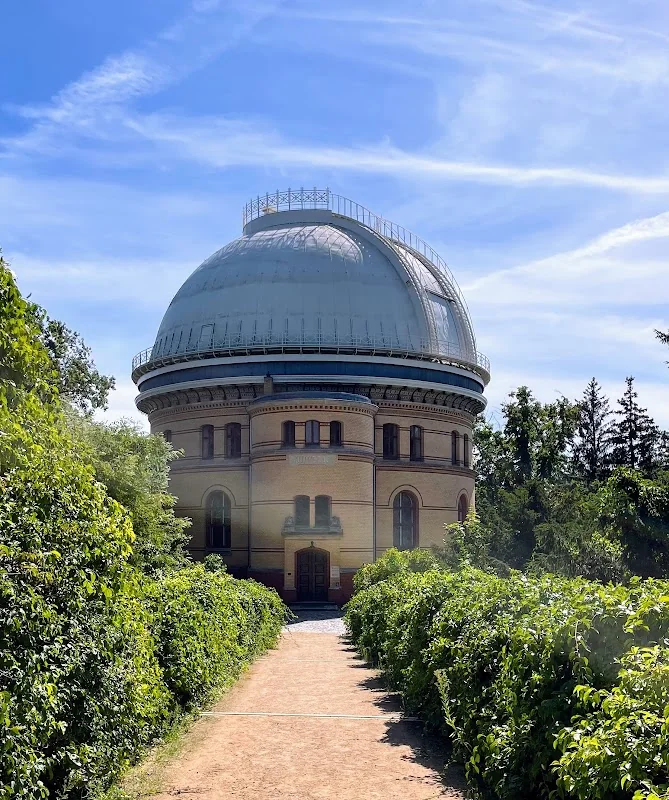
The search interest around Great Refractor Potsdam photos is very understandable, as the site has several image motifs that immediately stick in the memory. Particularly striking is the large, rotating dome with a diameter of 21 meters, which shapes the entire structure of the telescope. Additionally, there are the two telescopes of the double refractor, which are firmly connected, making it clear from the outside that it is not an ordinary museum object, but an astronomical high-precision instrument from the imperial era. The AIP shows both exterior views and interior shots of the dome and close-ups of the instrument on its pages; thus, those looking for reference images will find official impressions that capture the historical character very well. The combination of technical rigor and monumental form makes the refractor photogenic. The location on Telegrafenberg also contributes to this: The ensemble does not appear isolated but embedded in a science park with plenty of greenery, historical research tradition, and other well-known buildings like the Einstein Tower. ([aip.de](https://www.aip.de/de/institute/locations/great-refractor/?utm_source=openai))
The strongest images on site are usually created where one combines the historical architecture and the astronomical environment in the frame. Even the outer appearance of the building tells of the significance of the place: It is not a decorative theater but a functional building developed for a specific scientific purpose. This makes the photos interesting because they do not just show a beautiful facade but make visible the logic of an entire research era. Therefore, those visiting the site should not only pay attention to the large dome but also to details like the shape of the columns, the access to the site, and the perspective on Telegrafenberg. Even if one only photographs from the outside, the images immediately convey the feeling of being in a place that is a mix of a technical monument, observatory, and science campus. For social media, editorial contributions, or a local landing page, these motifs are ideal because they spark curiosity without appearing artificial. This is one of the reasons why the Great Refractor still counts among the most visually striking places in Potsdam today. ([aip.de](https://www.aip.de/de/institute/locations/great-refractor/?utm_source=openai))
Friends of the Great Refractor Potsdam e.V.: Preservation, Restoration, and Engagement
Without the Friends of the Great Refractor Potsdam e.V., the current experience of the telescope would hardly be conceivable. The association was founded in 1997 specifically to preserve the monument and support the restoration of the instrument. The official pages make it clear that the restoration took several years and was supported by generous donations, the commitment of the association, and other supporters. In 2006, the Great Refractor was finally inaugurated again in full working order. This period is important because it shows that it is not a static monument but an object that has been actively preserved through civic and scientific engagement. Even today, the Friends of the Great Refractor continue to advocate for the interests of the Great Refractor. Donations are explicitly welcome, and this support helps ensure that tours, events, and the preservation of the instrument remain possible in the long term. ([aip.de](https://www.aip.de/de/institute/locations/great-refractor/?utm_source=openai))
For visitors, the Friends of the Great Refractor is not just an organizational background but part of the quality of the experience. Tours for larger groups are possible through the association, and on special occasions such as the Day of Open Monuments or public observation evenings, the historical site is opened to a broader audience. This is relevant for SEO because the keyword Friends of the Great Refractor Potsdam e.V. does not merely refer to an association name but to the core of today's educational work. Those interested in local history, astronomical heritage, or volunteer engagement will find here a vivid example of how monument protection and science communication can work together. The Friends of the Great Refractor thus represent continuity: They connect the past of the instrument with its current use as a place of learning, monument, and place of wonder. This blend makes the Great Refractor an address that goes far beyond a mere excursion destination in Potsdam. ([aip.de](https://www.aip.de/de/pr/visit-the-telescopes/visiting-the-great-refractor/?utm_source=openai))
History of the Great Refractor: Imperial Era, Research, and Restoration
The history of the Great Refractor dates back to a phase when astronomy and physics came closer together, leading to the emergence of modern astrophysics. The refractor was inaugurated in 1899 in the presence of the emperor and was then a technological top product. The AIP still describes it as the fourth largest lens telescope in the world, and its historical significance lies not only in its size but also in the combination of mechanical precision and scientific ambition. A scientific highlight was the discovery of the diffuse interstellar medium by Johannes Hartmann in 1904 based on stationary calcium lines in spectroscopic double stars. This finding was a milestone in the development of the understanding of the space between the stars. At the same time, the history of the instrument also shows breaks: In 1945, it suffered damage due to the war, in 1953 it underwent modernization, and in 1968, operations were completely discontinued. Later, in 1983, the refractor was placed under monument protection, which further secured its cultural-historical significance. ([aip.de](https://www.aip.de/de/institute/locations/great-refractor/?utm_source=openai))
The recovery of the Great Refractor as a functional monument is at least as remarkable as its original scientific career. In 1997, the Friends of the Great Refractor Potsdam e.V. was founded, and in the following years, the telescope was extensively restored. The work was completed in 2006 with the renewed, fully functional inauguration. This is not only a technical success story but also an example of how careful monument preservation and science-related communication can intertwine. The refractor is thus not a frozen relic but a place where history remains visible and can be utilized. Today, anyone entering the building experiences not only a historical shell but an instrument that has survived its past and continues to resonate in the memory of early astrophysics. This is particularly significant for Potsdam, as the city has an exceptionally dense scientific history with its research sites, and the Great Refractor plays a central role in it. ([aip.de](https://www.aip.de/de/institute/locations/great-refractor/?utm_source=openai))
Technology and Architecture: Double Refractor, Dome, and Lens Telescope
Technically, the Great Refractor Potsdam is a double refractor, meaning it is a telescope with two firmly connected telescopes on a parallactic mount. The larger tube has an 80-centimeter objective and a focal length of 12.2 meters, while the smaller tube has a diameter of 50 centimeters and a focal length of 12.5 meters. These numbers already show why the facility occupies a special place in the history of astronomy. The refractor is not only large but also a testament to the precise fine mechanics of the late 19th century. The instrument combined the possibilities of its time with the astrophysical requirements that were just beginning to emerge, especially in the field of spectroscopy. The fact that the rotating dome has a diameter of 21 meters and weighs about 200 tons further underscores the monumental character of the building. When one looks at the construction, it becomes clear why the facility continues to attract so much attention: It is simultaneously scientific equipment, a monument, and an architectural staging of technical performance. ([aip.de](https://www.aip.de/de/institute/locations/great-refractor/?utm_source=openai))
The current perception of the Great Refractor is also strongly linked to this technical peculiarity. Lens telescopes of this size are rare, and that is precisely what makes the object so fascinating for professionals, school groups, and culture enthusiasts. The official AIP site emphasizes that the Great Refractor is still functional, which distinguishes it from many other historical large instruments. At the same time, the construction is closely linked to the development of astrophysics because it allowed spectroscopic observations in a previously new quality. Therefore, those searching for Great Refractor Potsdam photos today see not only a beautiful dome but an instrument whose form arises from its scientific purpose. This makes the facility strong in content: It is not just old but requires explanation, is precise, and is unique in its construction. This blend of technology, history, and visual presence is the reason why the Great Refractor continues to be one of the most exciting attractions on Telegrafenberg. ([aip.de](https://www.aip.de/de/institute/locations/great-refractor/?utm_source=openai))
Telegrafenberg and Albert Einstein Science Park: Location, Environment, and Significance
The Great Refractor is closely connected to Telegrafenberg, which itself has a special history. The mountain received its name in 1832 when an optical telegraph station was established here. Today, Telegrafenberg is a 96-meter-high elevation and part of the Albert Einstein Science Park, which houses several significant research institutions. These include the Leibniz Institute for Astrophysics Potsdam, the Helmholtz Center Potsdam German GeoResearch Center, the Potsdam Institute for Climate Impact Research, a branch of the Alfred Wegener Institute, and other scientific institutions. The state capital Potsdam describes the site as a traditional facility that houses two particularly outstanding buildings: the Einstein Tower and the Great Refractor. This creates a rare connection for visitors between nature, research, and architecture. One does not move through a classic museum quarter but through a historically grown scientific area whose character has remained visible to this day. ([aip.de](https://www.aip.de/en/institute/locations/?utm_source=openai))
For SEO logic, the topic of Telegrafenberg Potsdam is therefore indispensable because many users are not only searching for the individual telescope but also for the overall experience of the place. The Great Refractor is part of a historically scientific ensemble, which also includes the Einstein Tower. The AIP points out that the park is open during the day and visitors can view the buildings from the outside, while access is regulated through the park entrance. This organizational structure fits well with a place that is both publicly accessible and scientifically sensitive. The surroundings make the appeal of the refractor even greater because several epochs of research stand side by side: optical telegraphy, astrophysics, modern climate and geoscience. Thus, those visiting the Great Refractor are not just visiting an individual monument but an entire scientific landscape that makes Potsdam internationally unique. ([aip.de](https://www.aip.de/de/pr/visit-the-telescopes/visiting-the-great-refractor/?utm_source=openai))
Directions and Parking at the Great Refractor Potsdam
The approach to the Great Refractor is clearly regulated and important for visit planning. According to the AIP, those arriving by car should use the parking facilities on Albert-Einstein-Straße. Entry into the science park is not permitted; from the entrance, it is about a 10-minute walk or around 500 meters to the Great Refractor. This is particularly helpful for first-time visitors because the facility is not located directly on a typical city center street but on a scientifically shaped site with controlled access. Once one has walked the route, it quickly becomes clear why the path is part of the visit experience: One approaches the monument not abruptly but experiences Telegrafenberg as a kind of transition between city, landscape, and research campus. This short distance is also relevant from an SEO perspective because many search queries regarding directions, parking, and visits are made simultaneously. ([aip.de](https://www.aip.de/beobachtungsabende?utm_source=openai))
For visitors who prefer to use public transport or walk, clear orientation regarding the park entrance is especially important. The AIP emphasizes that guests must register there before entering the science park. Although the page primarily addresses visitors with guided tours or event appointments, it shows that the site is structured and well-organized for accessibility. Those wishing to take photos or plan a quiet walk should also pay attention to good weather and enough time, as Telegrafenberg is not just a single destination but an ensemble best experienced without haste. Especially during events with observation evenings or tours, it is worthwhile to plan for the walk and possible waiting times. Thus, the visit to the Great Refractor Potsdam is not a short stop but a rounded visit to one of the most remarkable scientific places in the city. ([aip.de](https://www.aip.de/de/pr/visit-the-telescopes/visiting-the-great-refractor/?utm_source=openai))
Photos, Impressions, and Special Highlights on Site
Those searching for Great Refractor Potsdam photos are usually interested not only in documentary shots but also in the special atmosphere of the place. This is precisely where the strength of the refractor lies: It offers clear, recognizable motifs that stand out significantly from typical city views. The large rotating dome, the two telescope tubes, the historic building structure, and the location on Telegrafenberg together create a visual language that immediately suggests a history of science. On the official AIP pages, there is an image archive with interior and exterior views of the instrument, and the location pages also show the domes of the Einstein Tower and the Great Refractor in their characteristic neighborhood. This way, one gets a good impression of how the monument appears even before the visit. For content, social media, or editorial contributions, this is important because the visual potential of the place is an essential part of its SEO value. ([aip.de](https://www.aip.de/image_archive/Institute.Grosser_Refraktor.html?utm_source=openai))
The best impressions are created on site where technology and landscape come together. The facility is not located in a noisy city center but on a historic research hill shaped by scientific tradition. This makes the refractor photogenic but also rich in narrative: Every image refers to the history of astrophysics, the restoration by the Friends of the Great Refractor, and the current use in the context of tours and observation evenings. Therefore, those visiting the site should not only photograph the well-known dome but also consider details such as the dimensions of the building, the pathways on Telegrafenberg, and the view of the surroundings. This way, images are created that not only look beautiful but also accurately reflect the character of the place. The Great Refractor is thus an ideal motif for visitors seeking authentic, scientifically historical, and aesthetically pleasing photos from Potsdam. ([aip.de](https://www.aip.de/de/institute/locations/great-refractor/?utm_source=openai))
Sources:
Mehr anzeigenWeniger anzeigen
Great Refractor Potsdam | Visit & Photos
The Great Refractor Potsdam on Telegrafenberg is one of the most distinctive technical monuments in the city and a rare testimony to astrophysics around 1900. The historic double refractor telescope was inaugurated in 1899, is now located in the Albert Einstein Science Park, and can be experienced through guided tours or observation evenings. The combination of scientific history, restored historical architecture, and the tranquil location on Telegrafenberg makes it a special destination for visitors who want to discover Potsdam beyond the usual attractions. The site combines monument protection, research history, and an extraordinary sense of space that one does not find during a typical city stroll. Those searching for Great Refractor Potsdam photos, a visit to the Great Refractor Potsdam, or the Friends of the Great Refractor Potsdam e.V. will find here not only a telescope but a vibrant piece of science and city history. ([aip.de](https://www.aip.de/de/institute/locations/great-refractor/?utm_source=openai))
Visiting the Great Refractor: Tours, Dates, and Access
The most important information for anyone wishing to visit the Great Refractor Potsdam is also the most practical: The building is located in the Albert Einstein Science Park on Telegrafenberg, is accessible from the outside during the day, and can be viewed without an appointment from the exterior. However, those who want to see the telescope from the inside need a guided tour or a public event. Guests of the science park must register at the park entrance, which clearly structures the visit and protects the historical site at the same time. For groups of 15 or more, tours are also possible through the Friends of the Great Refractor e.V., and in the winter months, there are additional observation evenings where, weather permitting, one can even look through the historic instrument. The AIP also points out that dates and times are announced on the website and through local media. Thus, the visit is not a spontaneous museum visit like in a city center, but rather a consciously planned appointment that feels particularly intense for that reason. ([aip.de](https://www.aip.de/de/pr/visit-the-telescopes/visiting-the-great-refractor/?utm_source=openai))
The process for visitors is also well explained: Participation in the observation evenings is only possible with prior registration, and the events are usually quickly booked out. The event lasts about an hour or, with good weather, a bit longer, so that all guests have the chance to look through the telescope. If the weather is bad, such as rain, snow, or fog, one can still see the telescope and visit the exhibition in the dome. It is also important to have a realistic view of the conditions on site: The dome has outside temperatures, which means it can be very cold there even on cooler days. The Great Refractor is also not barrier-free, as the dome is only accessible via stairs. This combination of historical substance, organizational clarity, and immediate proximity to the instrument makes the charm of the visit. Those who inform themselves in advance experience not only a monument but a functioning access to the history of astronomy. ([aip.de](https://www.aip.de/beobachtungsabende?utm_source=openai))
Photos of the Great Refractor: The Most Impressive Motifs on Site
The search interest around Great Refractor Potsdam photos is very understandable, as the site has several image motifs that immediately stick in the memory. Particularly striking is the large, rotating dome with a diameter of 21 meters, which shapes the entire structure of the telescope. Additionally, there are the two telescopes of the double refractor, which are firmly connected, making it clear from the outside that it is not an ordinary museum object, but an astronomical high-precision instrument from the imperial era. The AIP shows both exterior views and interior shots of the dome and close-ups of the instrument on its pages; thus, those looking for reference images will find official impressions that capture the historical character very well. The combination of technical rigor and monumental form makes the refractor photogenic. The location on Telegrafenberg also contributes to this: The ensemble does not appear isolated but embedded in a science park with plenty of greenery, historical research tradition, and other well-known buildings like the Einstein Tower. ([aip.de](https://www.aip.de/de/institute/locations/great-refractor/?utm_source=openai))
The strongest images on site are usually created where one combines the historical architecture and the astronomical environment in the frame. Even the outer appearance of the building tells of the significance of the place: It is not a decorative theater but a functional building developed for a specific scientific purpose. This makes the photos interesting because they do not just show a beautiful facade but make visible the logic of an entire research era. Therefore, those visiting the site should not only pay attention to the large dome but also to details like the shape of the columns, the access to the site, and the perspective on Telegrafenberg. Even if one only photographs from the outside, the images immediately convey the feeling of being in a place that is a mix of a technical monument, observatory, and science campus. For social media, editorial contributions, or a local landing page, these motifs are ideal because they spark curiosity without appearing artificial. This is one of the reasons why the Great Refractor still counts among the most visually striking places in Potsdam today. ([aip.de](https://www.aip.de/de/institute/locations/great-refractor/?utm_source=openai))
Friends of the Great Refractor Potsdam e.V.: Preservation, Restoration, and Engagement
Without the Friends of the Great Refractor Potsdam e.V., the current experience of the telescope would hardly be conceivable. The association was founded in 1997 specifically to preserve the monument and support the restoration of the instrument. The official pages make it clear that the restoration took several years and was supported by generous donations, the commitment of the association, and other supporters. In 2006, the Great Refractor was finally inaugurated again in full working order. This period is important because it shows that it is not a static monument but an object that has been actively preserved through civic and scientific engagement. Even today, the Friends of the Great Refractor continue to advocate for the interests of the Great Refractor. Donations are explicitly welcome, and this support helps ensure that tours, events, and the preservation of the instrument remain possible in the long term. ([aip.de](https://www.aip.de/de/institute/locations/great-refractor/?utm_source=openai))
For visitors, the Friends of the Great Refractor is not just an organizational background but part of the quality of the experience. Tours for larger groups are possible through the association, and on special occasions such as the Day of Open Monuments or public observation evenings, the historical site is opened to a broader audience. This is relevant for SEO because the keyword Friends of the Great Refractor Potsdam e.V. does not merely refer to an association name but to the core of today's educational work. Those interested in local history, astronomical heritage, or volunteer engagement will find here a vivid example of how monument protection and science communication can work together. The Friends of the Great Refractor thus represent continuity: They connect the past of the instrument with its current use as a place of learning, monument, and place of wonder. This blend makes the Great Refractor an address that goes far beyond a mere excursion destination in Potsdam. ([aip.de](https://www.aip.de/de/pr/visit-the-telescopes/visiting-the-great-refractor/?utm_source=openai))
History of the Great Refractor: Imperial Era, Research, and Restoration
The history of the Great Refractor dates back to a phase when astronomy and physics came closer together, leading to the emergence of modern astrophysics. The refractor was inaugurated in 1899 in the presence of the emperor and was then a technological top product. The AIP still describes it as the fourth largest lens telescope in the world, and its historical significance lies not only in its size but also in the combination of mechanical precision and scientific ambition. A scientific highlight was the discovery of the diffuse interstellar medium by Johannes Hartmann in 1904 based on stationary calcium lines in spectroscopic double stars. This finding was a milestone in the development of the understanding of the space between the stars. At the same time, the history of the instrument also shows breaks: In 1945, it suffered damage due to the war, in 1953 it underwent modernization, and in 1968, operations were completely discontinued. Later, in 1983, the refractor was placed under monument protection, which further secured its cultural-historical significance. ([aip.de](https://www.aip.de/de/institute/locations/great-refractor/?utm_source=openai))
The recovery of the Great Refractor as a functional monument is at least as remarkable as its original scientific career. In 1997, the Friends of the Great Refractor Potsdam e.V. was founded, and in the following years, the telescope was extensively restored. The work was completed in 2006 with the renewed, fully functional inauguration. This is not only a technical success story but also an example of how careful monument preservation and science-related communication can intertwine. The refractor is thus not a frozen relic but a place where history remains visible and can be utilized. Today, anyone entering the building experiences not only a historical shell but an instrument that has survived its past and continues to resonate in the memory of early astrophysics. This is particularly significant for Potsdam, as the city has an exceptionally dense scientific history with its research sites, and the Great Refractor plays a central role in it. ([aip.de](https://www.aip.de/de/institute/locations/great-refractor/?utm_source=openai))
Technology and Architecture: Double Refractor, Dome, and Lens Telescope
Technically, the Great Refractor Potsdam is a double refractor, meaning it is a telescope with two firmly connected telescopes on a parallactic mount. The larger tube has an 80-centimeter objective and a focal length of 12.2 meters, while the smaller tube has a diameter of 50 centimeters and a focal length of 12.5 meters. These numbers already show why the facility occupies a special place in the history of astronomy. The refractor is not only large but also a testament to the precise fine mechanics of the late 19th century. The instrument combined the possibilities of its time with the astrophysical requirements that were just beginning to emerge, especially in the field of spectroscopy. The fact that the rotating dome has a diameter of 21 meters and weighs about 200 tons further underscores the monumental character of the building. When one looks at the construction, it becomes clear why the facility continues to attract so much attention: It is simultaneously scientific equipment, a monument, and an architectural staging of technical performance. ([aip.de](https://www.aip.de/de/institute/locations/great-refractor/?utm_source=openai))
The current perception of the Great Refractor is also strongly linked to this technical peculiarity. Lens telescopes of this size are rare, and that is precisely what makes the object so fascinating for professionals, school groups, and culture enthusiasts. The official AIP site emphasizes that the Great Refractor is still functional, which distinguishes it from many other historical large instruments. At the same time, the construction is closely linked to the development of astrophysics because it allowed spectroscopic observations in a previously new quality. Therefore, those searching for Great Refractor Potsdam photos today see not only a beautiful dome but an instrument whose form arises from its scientific purpose. This makes the facility strong in content: It is not just old but requires explanation, is precise, and is unique in its construction. This blend of technology, history, and visual presence is the reason why the Great Refractor continues to be one of the most exciting attractions on Telegrafenberg. ([aip.de](https://www.aip.de/de/institute/locations/great-refractor/?utm_source=openai))
Telegrafenberg and Albert Einstein Science Park: Location, Environment, and Significance
The Great Refractor is closely connected to Telegrafenberg, which itself has a special history. The mountain received its name in 1832 when an optical telegraph station was established here. Today, Telegrafenberg is a 96-meter-high elevation and part of the Albert Einstein Science Park, which houses several significant research institutions. These include the Leibniz Institute for Astrophysics Potsdam, the Helmholtz Center Potsdam German GeoResearch Center, the Potsdam Institute for Climate Impact Research, a branch of the Alfred Wegener Institute, and other scientific institutions. The state capital Potsdam describes the site as a traditional facility that houses two particularly outstanding buildings: the Einstein Tower and the Great Refractor. This creates a rare connection for visitors between nature, research, and architecture. One does not move through a classic museum quarter but through a historically grown scientific area whose character has remained visible to this day. ([aip.de](https://www.aip.de/en/institute/locations/?utm_source=openai))
For SEO logic, the topic of Telegrafenberg Potsdam is therefore indispensable because many users are not only searching for the individual telescope but also for the overall experience of the place. The Great Refractor is part of a historically scientific ensemble, which also includes the Einstein Tower. The AIP points out that the park is open during the day and visitors can view the buildings from the outside, while access is regulated through the park entrance. This organizational structure fits well with a place that is both publicly accessible and scientifically sensitive. The surroundings make the appeal of the refractor even greater because several epochs of research stand side by side: optical telegraphy, astrophysics, modern climate and geoscience. Thus, those visiting the Great Refractor are not just visiting an individual monument but an entire scientific landscape that makes Potsdam internationally unique. ([aip.de](https://www.aip.de/de/pr/visit-the-telescopes/visiting-the-great-refractor/?utm_source=openai))
Directions and Parking at the Great Refractor Potsdam
The approach to the Great Refractor is clearly regulated and important for visit planning. According to the AIP, those arriving by car should use the parking facilities on Albert-Einstein-Straße. Entry into the science park is not permitted; from the entrance, it is about a 10-minute walk or around 500 meters to the Great Refractor. This is particularly helpful for first-time visitors because the facility is not located directly on a typical city center street but on a scientifically shaped site with controlled access. Once one has walked the route, it quickly becomes clear why the path is part of the visit experience: One approaches the monument not abruptly but experiences Telegrafenberg as a kind of transition between city, landscape, and research campus. This short distance is also relevant from an SEO perspective because many search queries regarding directions, parking, and visits are made simultaneously. ([aip.de](https://www.aip.de/beobachtungsabende?utm_source=openai))
For visitors who prefer to use public transport or walk, clear orientation regarding the park entrance is especially important. The AIP emphasizes that guests must register there before entering the science park. Although the page primarily addresses visitors with guided tours or event appointments, it shows that the site is structured and well-organized for accessibility. Those wishing to take photos or plan a quiet walk should also pay attention to good weather and enough time, as Telegrafenberg is not just a single destination but an ensemble best experienced without haste. Especially during events with observation evenings or tours, it is worthwhile to plan for the walk and possible waiting times. Thus, the visit to the Great Refractor Potsdam is not a short stop but a rounded visit to one of the most remarkable scientific places in the city. ([aip.de](https://www.aip.de/de/pr/visit-the-telescopes/visiting-the-great-refractor/?utm_source=openai))
Photos, Impressions, and Special Highlights on Site
Those searching for Great Refractor Potsdam photos are usually interested not only in documentary shots but also in the special atmosphere of the place. This is precisely where the strength of the refractor lies: It offers clear, recognizable motifs that stand out significantly from typical city views. The large rotating dome, the two telescope tubes, the historic building structure, and the location on Telegrafenberg together create a visual language that immediately suggests a history of science. On the official AIP pages, there is an image archive with interior and exterior views of the instrument, and the location pages also show the domes of the Einstein Tower and the Great Refractor in their characteristic neighborhood. This way, one gets a good impression of how the monument appears even before the visit. For content, social media, or editorial contributions, this is important because the visual potential of the place is an essential part of its SEO value. ([aip.de](https://www.aip.de/image_archive/Institute.Grosser_Refraktor.html?utm_source=openai))
The best impressions are created on site where technology and landscape come together. The facility is not located in a noisy city center but on a historic research hill shaped by scientific tradition. This makes the refractor photogenic but also rich in narrative: Every image refers to the history of astrophysics, the restoration by the Friends of the Great Refractor, and the current use in the context of tours and observation evenings. Therefore, those visiting the site should not only photograph the well-known dome but also consider details such as the dimensions of the building, the pathways on Telegrafenberg, and the view of the surroundings. This way, images are created that not only look beautiful but also accurately reflect the character of the place. The Great Refractor is thus an ideal motif for visitors seeking authentic, scientifically historical, and aesthetically pleasing photos from Potsdam. ([aip.de](https://www.aip.de/de/institute/locations/great-refractor/?utm_source=openai))
Sources:
Great Refractor Potsdam | Visit & Photos
The Great Refractor Potsdam on Telegrafenberg is one of the most distinctive technical monuments in the city and a rare testimony to astrophysics around 1900. The historic double refractor telescope was inaugurated in 1899, is now located in the Albert Einstein Science Park, and can be experienced through guided tours or observation evenings. The combination of scientific history, restored historical architecture, and the tranquil location on Telegrafenberg makes it a special destination for visitors who want to discover Potsdam beyond the usual attractions. The site combines monument protection, research history, and an extraordinary sense of space that one does not find during a typical city stroll. Those searching for Great Refractor Potsdam photos, a visit to the Great Refractor Potsdam, or the Friends of the Great Refractor Potsdam e.V. will find here not only a telescope but a vibrant piece of science and city history. ([aip.de](https://www.aip.de/de/institute/locations/great-refractor/?utm_source=openai))
Visiting the Great Refractor: Tours, Dates, and Access
The most important information for anyone wishing to visit the Great Refractor Potsdam is also the most practical: The building is located in the Albert Einstein Science Park on Telegrafenberg, is accessible from the outside during the day, and can be viewed without an appointment from the exterior. However, those who want to see the telescope from the inside need a guided tour or a public event. Guests of the science park must register at the park entrance, which clearly structures the visit and protects the historical site at the same time. For groups of 15 or more, tours are also possible through the Friends of the Great Refractor e.V., and in the winter months, there are additional observation evenings where, weather permitting, one can even look through the historic instrument. The AIP also points out that dates and times are announced on the website and through local media. Thus, the visit is not a spontaneous museum visit like in a city center, but rather a consciously planned appointment that feels particularly intense for that reason. ([aip.de](https://www.aip.de/de/pr/visit-the-telescopes/visiting-the-great-refractor/?utm_source=openai))
The process for visitors is also well explained: Participation in the observation evenings is only possible with prior registration, and the events are usually quickly booked out. The event lasts about an hour or, with good weather, a bit longer, so that all guests have the chance to look through the telescope. If the weather is bad, such as rain, snow, or fog, one can still see the telescope and visit the exhibition in the dome. It is also important to have a realistic view of the conditions on site: The dome has outside temperatures, which means it can be very cold there even on cooler days. The Great Refractor is also not barrier-free, as the dome is only accessible via stairs. This combination of historical substance, organizational clarity, and immediate proximity to the instrument makes the charm of the visit. Those who inform themselves in advance experience not only a monument but a functioning access to the history of astronomy. ([aip.de](https://www.aip.de/beobachtungsabende?utm_source=openai))
Photos of the Great Refractor: The Most Impressive Motifs on Site
The search interest around Great Refractor Potsdam photos is very understandable, as the site has several image motifs that immediately stick in the memory. Particularly striking is the large, rotating dome with a diameter of 21 meters, which shapes the entire structure of the telescope. Additionally, there are the two telescopes of the double refractor, which are firmly connected, making it clear from the outside that it is not an ordinary museum object, but an astronomical high-precision instrument from the imperial era. The AIP shows both exterior views and interior shots of the dome and close-ups of the instrument on its pages; thus, those looking for reference images will find official impressions that capture the historical character very well. The combination of technical rigor and monumental form makes the refractor photogenic. The location on Telegrafenberg also contributes to this: The ensemble does not appear isolated but embedded in a science park with plenty of greenery, historical research tradition, and other well-known buildings like the Einstein Tower. ([aip.de](https://www.aip.de/de/institute/locations/great-refractor/?utm_source=openai))
The strongest images on site are usually created where one combines the historical architecture and the astronomical environment in the frame. Even the outer appearance of the building tells of the significance of the place: It is not a decorative theater but a functional building developed for a specific scientific purpose. This makes the photos interesting because they do not just show a beautiful facade but make visible the logic of an entire research era. Therefore, those visiting the site should not only pay attention to the large dome but also to details like the shape of the columns, the access to the site, and the perspective on Telegrafenberg. Even if one only photographs from the outside, the images immediately convey the feeling of being in a place that is a mix of a technical monument, observatory, and science campus. For social media, editorial contributions, or a local landing page, these motifs are ideal because they spark curiosity without appearing artificial. This is one of the reasons why the Great Refractor still counts among the most visually striking places in Potsdam today. ([aip.de](https://www.aip.de/de/institute/locations/great-refractor/?utm_source=openai))
Friends of the Great Refractor Potsdam e.V.: Preservation, Restoration, and Engagement
Without the Friends of the Great Refractor Potsdam e.V., the current experience of the telescope would hardly be conceivable. The association was founded in 1997 specifically to preserve the monument and support the restoration of the instrument. The official pages make it clear that the restoration took several years and was supported by generous donations, the commitment of the association, and other supporters. In 2006, the Great Refractor was finally inaugurated again in full working order. This period is important because it shows that it is not a static monument but an object that has been actively preserved through civic and scientific engagement. Even today, the Friends of the Great Refractor continue to advocate for the interests of the Great Refractor. Donations are explicitly welcome, and this support helps ensure that tours, events, and the preservation of the instrument remain possible in the long term. ([aip.de](https://www.aip.de/de/institute/locations/great-refractor/?utm_source=openai))
For visitors, the Friends of the Great Refractor is not just an organizational background but part of the quality of the experience. Tours for larger groups are possible through the association, and on special occasions such as the Day of Open Monuments or public observation evenings, the historical site is opened to a broader audience. This is relevant for SEO because the keyword Friends of the Great Refractor Potsdam e.V. does not merely refer to an association name but to the core of today's educational work. Those interested in local history, astronomical heritage, or volunteer engagement will find here a vivid example of how monument protection and science communication can work together. The Friends of the Great Refractor thus represent continuity: They connect the past of the instrument with its current use as a place of learning, monument, and place of wonder. This blend makes the Great Refractor an address that goes far beyond a mere excursion destination in Potsdam. ([aip.de](https://www.aip.de/de/pr/visit-the-telescopes/visiting-the-great-refractor/?utm_source=openai))
History of the Great Refractor: Imperial Era, Research, and Restoration
The history of the Great Refractor dates back to a phase when astronomy and physics came closer together, leading to the emergence of modern astrophysics. The refractor was inaugurated in 1899 in the presence of the emperor and was then a technological top product. The AIP still describes it as the fourth largest lens telescope in the world, and its historical significance lies not only in its size but also in the combination of mechanical precision and scientific ambition. A scientific highlight was the discovery of the diffuse interstellar medium by Johannes Hartmann in 1904 based on stationary calcium lines in spectroscopic double stars. This finding was a milestone in the development of the understanding of the space between the stars. At the same time, the history of the instrument also shows breaks: In 1945, it suffered damage due to the war, in 1953 it underwent modernization, and in 1968, operations were completely discontinued. Later, in 1983, the refractor was placed under monument protection, which further secured its cultural-historical significance. ([aip.de](https://www.aip.de/de/institute/locations/great-refractor/?utm_source=openai))
The recovery of the Great Refractor as a functional monument is at least as remarkable as its original scientific career. In 1997, the Friends of the Great Refractor Potsdam e.V. was founded, and in the following years, the telescope was extensively restored. The work was completed in 2006 with the renewed, fully functional inauguration. This is not only a technical success story but also an example of how careful monument preservation and science-related communication can intertwine. The refractor is thus not a frozen relic but a place where history remains visible and can be utilized. Today, anyone entering the building experiences not only a historical shell but an instrument that has survived its past and continues to resonate in the memory of early astrophysics. This is particularly significant for Potsdam, as the city has an exceptionally dense scientific history with its research sites, and the Great Refractor plays a central role in it. ([aip.de](https://www.aip.de/de/institute/locations/great-refractor/?utm_source=openai))
Technology and Architecture: Double Refractor, Dome, and Lens Telescope
Technically, the Great Refractor Potsdam is a double refractor, meaning it is a telescope with two firmly connected telescopes on a parallactic mount. The larger tube has an 80-centimeter objective and a focal length of 12.2 meters, while the smaller tube has a diameter of 50 centimeters and a focal length of 12.5 meters. These numbers already show why the facility occupies a special place in the history of astronomy. The refractor is not only large but also a testament to the precise fine mechanics of the late 19th century. The instrument combined the possibilities of its time with the astrophysical requirements that were just beginning to emerge, especially in the field of spectroscopy. The fact that the rotating dome has a diameter of 21 meters and weighs about 200 tons further underscores the monumental character of the building. When one looks at the construction, it becomes clear why the facility continues to attract so much attention: It is simultaneously scientific equipment, a monument, and an architectural staging of technical performance. ([aip.de](https://www.aip.de/de/institute/locations/great-refractor/?utm_source=openai))
The current perception of the Great Refractor is also strongly linked to this technical peculiarity. Lens telescopes of this size are rare, and that is precisely what makes the object so fascinating for professionals, school groups, and culture enthusiasts. The official AIP site emphasizes that the Great Refractor is still functional, which distinguishes it from many other historical large instruments. At the same time, the construction is closely linked to the development of astrophysics because it allowed spectroscopic observations in a previously new quality. Therefore, those searching for Great Refractor Potsdam photos today see not only a beautiful dome but an instrument whose form arises from its scientific purpose. This makes the facility strong in content: It is not just old but requires explanation, is precise, and is unique in its construction. This blend of technology, history, and visual presence is the reason why the Great Refractor continues to be one of the most exciting attractions on Telegrafenberg. ([aip.de](https://www.aip.de/de/institute/locations/great-refractor/?utm_source=openai))
Telegrafenberg and Albert Einstein Science Park: Location, Environment, and Significance
The Great Refractor is closely connected to Telegrafenberg, which itself has a special history. The mountain received its name in 1832 when an optical telegraph station was established here. Today, Telegrafenberg is a 96-meter-high elevation and part of the Albert Einstein Science Park, which houses several significant research institutions. These include the Leibniz Institute for Astrophysics Potsdam, the Helmholtz Center Potsdam German GeoResearch Center, the Potsdam Institute for Climate Impact Research, a branch of the Alfred Wegener Institute, and other scientific institutions. The state capital Potsdam describes the site as a traditional facility that houses two particularly outstanding buildings: the Einstein Tower and the Great Refractor. This creates a rare connection for visitors between nature, research, and architecture. One does not move through a classic museum quarter but through a historically grown scientific area whose character has remained visible to this day. ([aip.de](https://www.aip.de/en/institute/locations/?utm_source=openai))
For SEO logic, the topic of Telegrafenberg Potsdam is therefore indispensable because many users are not only searching for the individual telescope but also for the overall experience of the place. The Great Refractor is part of a historically scientific ensemble, which also includes the Einstein Tower. The AIP points out that the park is open during the day and visitors can view the buildings from the outside, while access is regulated through the park entrance. This organizational structure fits well with a place that is both publicly accessible and scientifically sensitive. The surroundings make the appeal of the refractor even greater because several epochs of research stand side by side: optical telegraphy, astrophysics, modern climate and geoscience. Thus, those visiting the Great Refractor are not just visiting an individual monument but an entire scientific landscape that makes Potsdam internationally unique. ([aip.de](https://www.aip.de/de/pr/visit-the-telescopes/visiting-the-great-refractor/?utm_source=openai))
Directions and Parking at the Great Refractor Potsdam
The approach to the Great Refractor is clearly regulated and important for visit planning. According to the AIP, those arriving by car should use the parking facilities on Albert-Einstein-Straße. Entry into the science park is not permitted; from the entrance, it is about a 10-minute walk or around 500 meters to the Great Refractor. This is particularly helpful for first-time visitors because the facility is not located directly on a typical city center street but on a scientifically shaped site with controlled access. Once one has walked the route, it quickly becomes clear why the path is part of the visit experience: One approaches the monument not abruptly but experiences Telegrafenberg as a kind of transition between city, landscape, and research campus. This short distance is also relevant from an SEO perspective because many search queries regarding directions, parking, and visits are made simultaneously. ([aip.de](https://www.aip.de/beobachtungsabende?utm_source=openai))
For visitors who prefer to use public transport or walk, clear orientation regarding the park entrance is especially important. The AIP emphasizes that guests must register there before entering the science park. Although the page primarily addresses visitors with guided tours or event appointments, it shows that the site is structured and well-organized for accessibility. Those wishing to take photos or plan a quiet walk should also pay attention to good weather and enough time, as Telegrafenberg is not just a single destination but an ensemble best experienced without haste. Especially during events with observation evenings or tours, it is worthwhile to plan for the walk and possible waiting times. Thus, the visit to the Great Refractor Potsdam is not a short stop but a rounded visit to one of the most remarkable scientific places in the city. ([aip.de](https://www.aip.de/de/pr/visit-the-telescopes/visiting-the-great-refractor/?utm_source=openai))
Photos, Impressions, and Special Highlights on Site
Those searching for Great Refractor Potsdam photos are usually interested not only in documentary shots but also in the special atmosphere of the place. This is precisely where the strength of the refractor lies: It offers clear, recognizable motifs that stand out significantly from typical city views. The large rotating dome, the two telescope tubes, the historic building structure, and the location on Telegrafenberg together create a visual language that immediately suggests a history of science. On the official AIP pages, there is an image archive with interior and exterior views of the instrument, and the location pages also show the domes of the Einstein Tower and the Great Refractor in their characteristic neighborhood. This way, one gets a good impression of how the monument appears even before the visit. For content, social media, or editorial contributions, this is important because the visual potential of the place is an essential part of its SEO value. ([aip.de](https://www.aip.de/image_archive/Institute.Grosser_Refraktor.html?utm_source=openai))
The best impressions are created on site where technology and landscape come together. The facility is not located in a noisy city center but on a historic research hill shaped by scientific tradition. This makes the refractor photogenic but also rich in narrative: Every image refers to the history of astrophysics, the restoration by the Friends of the Great Refractor, and the current use in the context of tours and observation evenings. Therefore, those visiting the site should not only photograph the well-known dome but also consider details such as the dimensions of the building, the pathways on Telegrafenberg, and the view of the surroundings. This way, images are created that not only look beautiful but also accurately reflect the character of the place. The Great Refractor is thus an ideal motif for visitors seeking authentic, scientifically historical, and aesthetically pleasing photos from Potsdam. ([aip.de](https://www.aip.de/de/institute/locations/great-refractor/?utm_source=openai))
Sources:
Upcoming Events
No events found
Frequently Asked Questions
Reviews
Katharina Vogt
18. December 2025
A walk through the observatory building and looking through the Großer Refraktor was an almost magical experience. The guide showed us historical drawings and photographs of stars, which enriched the visit even further. I didn’t expect to enjoy it this much.
Tom Beck
13. January 2018
Visually interesting, even if it wasn’t open to visitors.
Philipp Löschl
16. August 2019
Probably the most beautiful large historic telescope out there.
Iwan Setiawan
5. December 2021
Great office located on top of the hill.
Dmitry Dreyer
21. August 2019
Nice place to visit!