
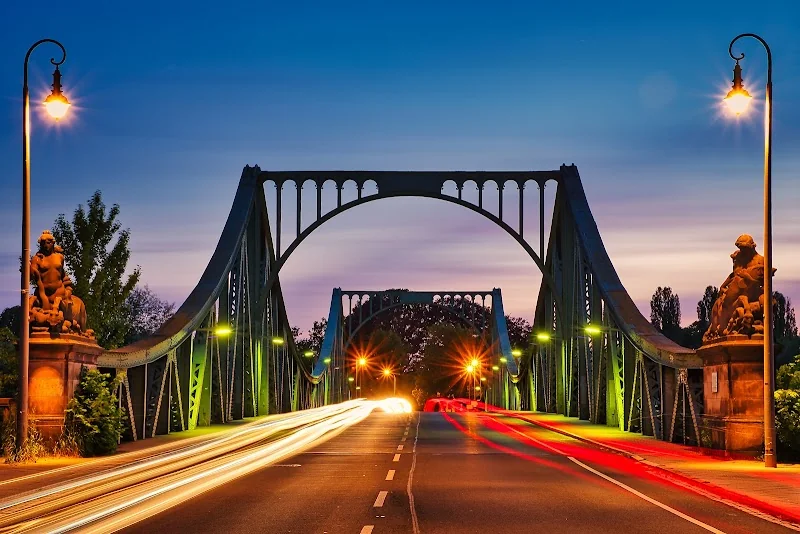
Berlin
Königstraße 36, 14109 Berlin, Deutschland
Glienicker Bridge | History & Agent Exchange
The Glienicker Bridge is much more than a connection over the Havel. It connects Berlin-Wannsee with Potsdam, precisely marks the border between Berlin and Brandenburg, and is one of the most famous historical sites in the southwest of the capital region. The current steel truss structure dates back to 1907, after several predecessor bridges had already stood at the same location. Today, the bridge is part of Federal Highway 1, shapes the cityscape with its location between Jungfernsee and Glienicker Lake, and remains a place where traffic, landscape, and world history meet directly. Those who visit experience not just a transition, but a stage where Prussian architecture, the Cold War, and a recreational destination overlap in unusual density. ([potsdam.de](https://www.potsdam.de/en/glienicker-bruecke))
History of the Glienicker Bridge
The history of the Glienicker Bridge goes back a long way. According to official Berlin monument and Potsdam city history, a wooden bridge spanned the Havel at this location as early as the 17th century; around 1777, it was replaced by a wooden drawbridge. Between 1831 and 1834, a stone bridge with eleven arches was built with the participation of Karl Friedrich Schinkel, which permanently shaped the transition between Berlin and Potsdam. This development shows that the location did not become important by chance, but was part of a transportation and connection route used for centuries. Even the Prussian rulers recognized the landscape and urban planning value of the site where water, gardens, and residential landscapes meet. ([denkmaldatenbank.berlin.de](https://denkmaldatenbank.berlin.de/daobj.php?obj_dok_nr=09075538))
The current bridge was built between 1905 and 1907 on behalf of the Prussian Water Management Authority as a steel truss bridge. The architectural design of the piers, bridge heads, and bank reinforcements was the responsibility of the building department of the Prussian Ministry of Public Works; the designs were by Chief Building Officer Eduard Fürstenau. The structure is designed as a three-span steel truss bridge with a lower roadway, featuring strong pylons, portal arches, and massive bridge heads made of ashlar masonry. It is this contrast between delicate steel and stone monumentality that makes the bridge architecturally remarkable. On the Potsdam side, colonnades accompany the approach, while on the Berlin side, two of the originally four sandstone sculptures have been preserved. ([denkmaldatenbank.berlin.de](https://denkmaldatenbank.berlin.de/daobj.php?obj_dok_nr=09075538))
The bridge was blown up by the Wehrmacht in April 1945 during the Battle of Berlin and was subsequently restored largely to its original state between 1947 and 1949. This reconstruction was important because the structure was not only a technical object but also a historical transition. After 1949, the bridge initially remained a border crossing, was then closed to private traffic in 1952, and became impassable after the construction of the Wall. Since November 1989, it has been open again and once again fulfills its traffic and connection function. Thus, the Glienicker Bridge stands like hardly any other place for continuity and rupture at the same time: for centuries-long connection, for destruction in war, and for reopening after division. ([denkmaldatenbank.berlin.de](https://denkmaldatenbank.berlin.de/daobj.php?obj_dok_nr=09075538))
Agent Exchange, GDR, and Cold War
The Glienicker Bridge owes its worldwide fame primarily to the Cold War. After 1949, it served as a border crossing from Potsdam to West Berlin but was already closed to civilian traffic in 1952. With the construction of the Berlin Wall, the crossing became completely impassable. Precisely because the bridge was easy to monitor, the USA and the Soviet Union used it multiple times as a location for the exchange of spies and prisoners. VisitBerlin and the Berlin Monument Database therefore describe it as a legendary stage of division and as a place where the border bridge became an agent bridge. This makes its reputation so strong to this day: Here, the history of division condenses into a single, very real place. ([visitberlin.de](https://www.visitberlin.de/de/die-glienicker-bruecke))
Especially famous was the exchange of Francis Gary Powers for Rudolf Abel in 1962, which visitBerlin explicitly associates with the Glienicker Bridge. The site thus stands for one of the most well-known episodes of German-German and American-Soviet history of the 20th century. The bridge was not only a symbolic transition but also a precisely controllable stage for political power games. That it later appeared in public consciousness as an agent bridge, bridge of unity, and historical memorial is due to this extraordinary function during the Cold War. Current texts from Potsdam and Berlin also repeatedly emphasize that at this location, East and West could literally meet. ([visitberlin.de](https://www.visitberlin.de/de/die-glienicker-bruecke))
The GDR history also includes the strictly monitored border situation of the surrounding areas, such as the Potsdam district of Klein-Glienicke, which was perceived as a special zone during the division. After reunification, the bridge became a strong symbol for open borders and overcoming division. Potsdam additionally remembers the fall of the Wall and the return of connection with the sculpture Nike 89. For the historical classification, it is therefore important: The Glienicker Bridge is not simply a stage of the Cold War but one of the few places in Germany where the logic of border regimes, intelligence politics, and later reopening can be read so clearly. ([potsdam.de](https://www.potsdam.de/de/gedenken-am-61-jahrestag-des-mauerbaus?utm_source=openai))
Directions, Map, and Route to the Glienicker Bridge
Those looking for the Glienicker Bridge on the map will find it at a very clear address: Königstraße 36 in 14109 Berlin, directly at the crossing to Potsdam. The Berlin tourism site names the nearest transport points as the stops Wannseebrücke, Am Kleinen Wannsee, and S Wannsee Bhf. Among others, bus lines N16, 114, 118, 218, 316, 318, and 620 as well as S7 and RE7 stop there. Additionally, on the Berlin side, there is also a ferry connection via S Wannsee Bhf [Ferry] with line F10. This information shows: The bridge is easily accessible by public transport for a visit, and the official visitor information emphasizes the public transport connection. ([berlin.de](https://www.berlin.de/sehenswuerdigkeiten/3560243-3558930-glienicker-bruecke.html))
On the Potsdam side, the bridge is also well connected. Official Potsdam transport and location information mentions the stop Potsdam, Glienicker Brücke with tram 93 and bus 316; furthermore, Potsdam describes the route via B1 directly from Berlin-Wannsee to Potsdam. This makes it clear that the Glienicker Bridge is not just a monument in everyday life but continues to be a functioning part of the regional transport network. Those arriving by car should therefore orient themselves to Federal Highway 1 and the signage for Berlin-Wannsee or Potsdam-Berliner Vorstadt. The official presentation focuses more on the traffic connection itself than on a separate visitor parking situation. ([potsdam.de](https://www.potsdam.de/de/content/standortplan-0?utm_source=openai))
For a meaningful route, it is also important that the border runs exactly in the middle of the bridge. This makes the Glienicker Bridge a place where two administrative areas and two city sides meet directly. Those coming from Berlin experience Königstraße as a very straight axis to the crossing; those coming from Potsdam approach via the Berlin suburb and the waterfront paths. For this reason, the bridge is very popular for walks, city tours, and routes between Wannsee and Potsdam. The Berlin and Potsdam tourist sites consistently link it with city tours, boat tours, and waterfront paths because it functions as a natural focal point in the urban structure. ([denkmaldatenbank.berlin.de](https://denkmaldatenbank.berlin.de/daobj.php?obj_dok_nr=09075538))
Photos, Views, and UNESCO Surroundings
Those looking for photos of the Glienicker Bridge will find one thing above all: impressive views. The official sites describe the view from the bridge as extraordinarily beautiful and name specific sightlines to Babelsberg Palace and Park, the Heilandskirche in Sacrow, Glienicke Palace, and the garden landscapes of Lenné. It is this variety that makes the motif so strong: The bridge connects not only two cities but also opens up a panorama of water, parks, villa landscapes, and Prussian architecture. Therefore, it is particularly photogenic in sunlight, clear visibility, and the golden evening hours. ([potsdam.de](https://www.potsdam.de/en/glienicker-bruecke))
Especially important for the surroundings is the proximity to the UNESCO World Heritage. VisitBerlin points out that Glienicke Palace in the same-named landscape park has been part of the UNESCO World Heritage since 1990. Potsdam also emphasizes Babelsberg Park as an outstanding garden artwork with spectacular views of the famous Glienicker Bridge. This explains why the bridge is so often mentioned together with palace and park landscapes: It is part of a larger cultural landscape where art, gardening, and transport routes are closely intertwined. Therefore, when photographing the bridge, one is always also capturing a piece of the Berlin and Potsdam World Heritage topography. ([visitberlin.de](https://www.visitberlin.de/de/die-glienicker-bruecke))
The immediate surroundings also provide strong motifs. South of the bridge, the waterfront path continues around the Glienicker Horn and offers views of Babelsberg Palace as well as Klein-Glienicke with park and hunting lodge. Potsdam also describes Schwanenallee as a connection to the New Garden and as a renovated pedestrian promenade with views to the waterfront. Thus, the Glienicker Bridge is not just a single photographic motif but a starting point for several different perspectives: water view, architectural view, park view, and historical view. It is precisely this layering that makes the place so attractive for photographers, walkers, and day-trippers. ([potsdam.de](https://www.potsdam.de/de/content/schwanenallee-und-glienicker-horn?utm_source=openai))
GDR, Closure, Film, and Walking Paths around the Havel
The GDR history of the Glienicker Bridge is closely linked to closure and reopening. The bridge was closed to private traffic after 1952 and became completely impassable after the construction of the Wall. After the fall of the Berlin Wall, it was reopened for traffic in November 1989. Berlin district and Potsdam texts highlight this moment as a visible symbol of the peaceful revolution. Therefore, the bridge stands not only for division but also for the return of open paths between Berlin and Potsdam. ([potsdam.de](https://www.potsdam.de/en/glienicker-bruecke))
The bridge is also a real filming location. The Potsdam film history names the Glienicker Bridge as the filming location for Under the Bridges from 1946; VisitBerlin additionally points out that Bridge of Spies - The Negotiator by Steven Spielberg was filmed at the original location in 2015. This fits with its historical impact: The site not only provides real history but also the strong imagery that films need. Additionally, organized walks and tours address the former border course, Klein-Glienicke, and the New Garden. Therefore, those who visit the bridge are moving in a lively historical location that remains present in city tours and cultural programs to this day. ([potsdam.de](https://www.potsdam.de/de/content/filmschauplatz-des-monats-september-0))
For a successful visit, a relaxed look at the entire surroundings is worthwhile. The official presentation of the bridge portrays it as a destination, viewpoint, and connection point, not as an isolated attraction. Those who stay longer can use the path along Schwanenallee, the waterfront path at Glienicker Horn, or the connection towards Babelsberg Park to experience the historical context between the bridge, gardens, and lake landscape. Even though the bridge itself is not a classic event location, it offers exactly that mix of history, panoramic location, and urban accessibility that makes it so attractive for day trips. ([potsdam.de](https://www.potsdam.de/en/glienicker-bruecke))
Sources:
- Berlin.de - Glienicker Bridge: Attraction, Address, and Directions
- State Capital Potsdam - Glienicker Bridge
- visitBerlin - The Glienicker Bridge
- Berlin Monument Database - Glienicker Bridge
- State Capital Potsdam - Film Location of the Month September
- State Capital Potsdam - Location Plan and Transport Connection
Show moreShow less
Glienicker Bridge | History & Agent Exchange
The Glienicker Bridge is much more than a connection over the Havel. It connects Berlin-Wannsee with Potsdam, precisely marks the border between Berlin and Brandenburg, and is one of the most famous historical sites in the southwest of the capital region. The current steel truss structure dates back to 1907, after several predecessor bridges had already stood at the same location. Today, the bridge is part of Federal Highway 1, shapes the cityscape with its location between Jungfernsee and Glienicker Lake, and remains a place where traffic, landscape, and world history meet directly. Those who visit experience not just a transition, but a stage where Prussian architecture, the Cold War, and a recreational destination overlap in unusual density. ([potsdam.de](https://www.potsdam.de/en/glienicker-bruecke))
History of the Glienicker Bridge
The history of the Glienicker Bridge goes back a long way. According to official Berlin monument and Potsdam city history, a wooden bridge spanned the Havel at this location as early as the 17th century; around 1777, it was replaced by a wooden drawbridge. Between 1831 and 1834, a stone bridge with eleven arches was built with the participation of Karl Friedrich Schinkel, which permanently shaped the transition between Berlin and Potsdam. This development shows that the location did not become important by chance, but was part of a transportation and connection route used for centuries. Even the Prussian rulers recognized the landscape and urban planning value of the site where water, gardens, and residential landscapes meet. ([denkmaldatenbank.berlin.de](https://denkmaldatenbank.berlin.de/daobj.php?obj_dok_nr=09075538))
The current bridge was built between 1905 and 1907 on behalf of the Prussian Water Management Authority as a steel truss bridge. The architectural design of the piers, bridge heads, and bank reinforcements was the responsibility of the building department of the Prussian Ministry of Public Works; the designs were by Chief Building Officer Eduard Fürstenau. The structure is designed as a three-span steel truss bridge with a lower roadway, featuring strong pylons, portal arches, and massive bridge heads made of ashlar masonry. It is this contrast between delicate steel and stone monumentality that makes the bridge architecturally remarkable. On the Potsdam side, colonnades accompany the approach, while on the Berlin side, two of the originally four sandstone sculptures have been preserved. ([denkmaldatenbank.berlin.de](https://denkmaldatenbank.berlin.de/daobj.php?obj_dok_nr=09075538))
The bridge was blown up by the Wehrmacht in April 1945 during the Battle of Berlin and was subsequently restored largely to its original state between 1947 and 1949. This reconstruction was important because the structure was not only a technical object but also a historical transition. After 1949, the bridge initially remained a border crossing, was then closed to private traffic in 1952, and became impassable after the construction of the Wall. Since November 1989, it has been open again and once again fulfills its traffic and connection function. Thus, the Glienicker Bridge stands like hardly any other place for continuity and rupture at the same time: for centuries-long connection, for destruction in war, and for reopening after division. ([denkmaldatenbank.berlin.de](https://denkmaldatenbank.berlin.de/daobj.php?obj_dok_nr=09075538))
Agent Exchange, GDR, and Cold War
The Glienicker Bridge owes its worldwide fame primarily to the Cold War. After 1949, it served as a border crossing from Potsdam to West Berlin but was already closed to civilian traffic in 1952. With the construction of the Berlin Wall, the crossing became completely impassable. Precisely because the bridge was easy to monitor, the USA and the Soviet Union used it multiple times as a location for the exchange of spies and prisoners. VisitBerlin and the Berlin Monument Database therefore describe it as a legendary stage of division and as a place where the border bridge became an agent bridge. This makes its reputation so strong to this day: Here, the history of division condenses into a single, very real place. ([visitberlin.de](https://www.visitberlin.de/de/die-glienicker-bruecke))
Especially famous was the exchange of Francis Gary Powers for Rudolf Abel in 1962, which visitBerlin explicitly associates with the Glienicker Bridge. The site thus stands for one of the most well-known episodes of German-German and American-Soviet history of the 20th century. The bridge was not only a symbolic transition but also a precisely controllable stage for political power games. That it later appeared in public consciousness as an agent bridge, bridge of unity, and historical memorial is due to this extraordinary function during the Cold War. Current texts from Potsdam and Berlin also repeatedly emphasize that at this location, East and West could literally meet. ([visitberlin.de](https://www.visitberlin.de/de/die-glienicker-bruecke))
The GDR history also includes the strictly monitored border situation of the surrounding areas, such as the Potsdam district of Klein-Glienicke, which was perceived as a special zone during the division. After reunification, the bridge became a strong symbol for open borders and overcoming division. Potsdam additionally remembers the fall of the Wall and the return of connection with the sculpture Nike 89. For the historical classification, it is therefore important: The Glienicker Bridge is not simply a stage of the Cold War but one of the few places in Germany where the logic of border regimes, intelligence politics, and later reopening can be read so clearly. ([potsdam.de](https://www.potsdam.de/de/gedenken-am-61-jahrestag-des-mauerbaus?utm_source=openai))
Directions, Map, and Route to the Glienicker Bridge
Those looking for the Glienicker Bridge on the map will find it at a very clear address: Königstraße 36 in 14109 Berlin, directly at the crossing to Potsdam. The Berlin tourism site names the nearest transport points as the stops Wannseebrücke, Am Kleinen Wannsee, and S Wannsee Bhf. Among others, bus lines N16, 114, 118, 218, 316, 318, and 620 as well as S7 and RE7 stop there. Additionally, on the Berlin side, there is also a ferry connection via S Wannsee Bhf [Ferry] with line F10. This information shows: The bridge is easily accessible by public transport for a visit, and the official visitor information emphasizes the public transport connection. ([berlin.de](https://www.berlin.de/sehenswuerdigkeiten/3560243-3558930-glienicker-bruecke.html))
On the Potsdam side, the bridge is also well connected. Official Potsdam transport and location information mentions the stop Potsdam, Glienicker Brücke with tram 93 and bus 316; furthermore, Potsdam describes the route via B1 directly from Berlin-Wannsee to Potsdam. This makes it clear that the Glienicker Bridge is not just a monument in everyday life but continues to be a functioning part of the regional transport network. Those arriving by car should therefore orient themselves to Federal Highway 1 and the signage for Berlin-Wannsee or Potsdam-Berliner Vorstadt. The official presentation focuses more on the traffic connection itself than on a separate visitor parking situation. ([potsdam.de](https://www.potsdam.de/de/content/standortplan-0?utm_source=openai))
For a meaningful route, it is also important that the border runs exactly in the middle of the bridge. This makes the Glienicker Bridge a place where two administrative areas and two city sides meet directly. Those coming from Berlin experience Königstraße as a very straight axis to the crossing; those coming from Potsdam approach via the Berlin suburb and the waterfront paths. For this reason, the bridge is very popular for walks, city tours, and routes between Wannsee and Potsdam. The Berlin and Potsdam tourist sites consistently link it with city tours, boat tours, and waterfront paths because it functions as a natural focal point in the urban structure. ([denkmaldatenbank.berlin.de](https://denkmaldatenbank.berlin.de/daobj.php?obj_dok_nr=09075538))
Photos, Views, and UNESCO Surroundings
Those looking for photos of the Glienicker Bridge will find one thing above all: impressive views. The official sites describe the view from the bridge as extraordinarily beautiful and name specific sightlines to Babelsberg Palace and Park, the Heilandskirche in Sacrow, Glienicke Palace, and the garden landscapes of Lenné. It is this variety that makes the motif so strong: The bridge connects not only two cities but also opens up a panorama of water, parks, villa landscapes, and Prussian architecture. Therefore, it is particularly photogenic in sunlight, clear visibility, and the golden evening hours. ([potsdam.de](https://www.potsdam.de/en/glienicker-bruecke))
Especially important for the surroundings is the proximity to the UNESCO World Heritage. VisitBerlin points out that Glienicke Palace in the same-named landscape park has been part of the UNESCO World Heritage since 1990. Potsdam also emphasizes Babelsberg Park as an outstanding garden artwork with spectacular views of the famous Glienicker Bridge. This explains why the bridge is so often mentioned together with palace and park landscapes: It is part of a larger cultural landscape where art, gardening, and transport routes are closely intertwined. Therefore, when photographing the bridge, one is always also capturing a piece of the Berlin and Potsdam World Heritage topography. ([visitberlin.de](https://www.visitberlin.de/de/die-glienicker-bruecke))
The immediate surroundings also provide strong motifs. South of the bridge, the waterfront path continues around the Glienicker Horn and offers views of Babelsberg Palace as well as Klein-Glienicke with park and hunting lodge. Potsdam also describes Schwanenallee as a connection to the New Garden and as a renovated pedestrian promenade with views to the waterfront. Thus, the Glienicker Bridge is not just a single photographic motif but a starting point for several different perspectives: water view, architectural view, park view, and historical view. It is precisely this layering that makes the place so attractive for photographers, walkers, and day-trippers. ([potsdam.de](https://www.potsdam.de/de/content/schwanenallee-und-glienicker-horn?utm_source=openai))
GDR, Closure, Film, and Walking Paths around the Havel
The GDR history of the Glienicker Bridge is closely linked to closure and reopening. The bridge was closed to private traffic after 1952 and became completely impassable after the construction of the Wall. After the fall of the Berlin Wall, it was reopened for traffic in November 1989. Berlin district and Potsdam texts highlight this moment as a visible symbol of the peaceful revolution. Therefore, the bridge stands not only for division but also for the return of open paths between Berlin and Potsdam. ([potsdam.de](https://www.potsdam.de/en/glienicker-bruecke))
The bridge is also a real filming location. The Potsdam film history names the Glienicker Bridge as the filming location for Under the Bridges from 1946; VisitBerlin additionally points out that Bridge of Spies - The Negotiator by Steven Spielberg was filmed at the original location in 2015. This fits with its historical impact: The site not only provides real history but also the strong imagery that films need. Additionally, organized walks and tours address the former border course, Klein-Glienicke, and the New Garden. Therefore, those who visit the bridge are moving in a lively historical location that remains present in city tours and cultural programs to this day. ([potsdam.de](https://www.potsdam.de/de/content/filmschauplatz-des-monats-september-0))
For a successful visit, a relaxed look at the entire surroundings is worthwhile. The official presentation of the bridge portrays it as a destination, viewpoint, and connection point, not as an isolated attraction. Those who stay longer can use the path along Schwanenallee, the waterfront path at Glienicker Horn, or the connection towards Babelsberg Park to experience the historical context between the bridge, gardens, and lake landscape. Even though the bridge itself is not a classic event location, it offers exactly that mix of history, panoramic location, and urban accessibility that makes it so attractive for day trips. ([potsdam.de](https://www.potsdam.de/en/glienicker-bruecke))
Sources:
- Berlin.de - Glienicker Bridge: Attraction, Address, and Directions
- State Capital Potsdam - Glienicker Bridge
- visitBerlin - The Glienicker Bridge
- Berlin Monument Database - Glienicker Bridge
- State Capital Potsdam - Film Location of the Month September
- State Capital Potsdam - Location Plan and Transport Connection
Glienicker Bridge | History & Agent Exchange
The Glienicker Bridge is much more than a connection over the Havel. It connects Berlin-Wannsee with Potsdam, precisely marks the border between Berlin and Brandenburg, and is one of the most famous historical sites in the southwest of the capital region. The current steel truss structure dates back to 1907, after several predecessor bridges had already stood at the same location. Today, the bridge is part of Federal Highway 1, shapes the cityscape with its location between Jungfernsee and Glienicker Lake, and remains a place where traffic, landscape, and world history meet directly. Those who visit experience not just a transition, but a stage where Prussian architecture, the Cold War, and a recreational destination overlap in unusual density. ([potsdam.de](https://www.potsdam.de/en/glienicker-bruecke))
History of the Glienicker Bridge
The history of the Glienicker Bridge goes back a long way. According to official Berlin monument and Potsdam city history, a wooden bridge spanned the Havel at this location as early as the 17th century; around 1777, it was replaced by a wooden drawbridge. Between 1831 and 1834, a stone bridge with eleven arches was built with the participation of Karl Friedrich Schinkel, which permanently shaped the transition between Berlin and Potsdam. This development shows that the location did not become important by chance, but was part of a transportation and connection route used for centuries. Even the Prussian rulers recognized the landscape and urban planning value of the site where water, gardens, and residential landscapes meet. ([denkmaldatenbank.berlin.de](https://denkmaldatenbank.berlin.de/daobj.php?obj_dok_nr=09075538))
The current bridge was built between 1905 and 1907 on behalf of the Prussian Water Management Authority as a steel truss bridge. The architectural design of the piers, bridge heads, and bank reinforcements was the responsibility of the building department of the Prussian Ministry of Public Works; the designs were by Chief Building Officer Eduard Fürstenau. The structure is designed as a three-span steel truss bridge with a lower roadway, featuring strong pylons, portal arches, and massive bridge heads made of ashlar masonry. It is this contrast between delicate steel and stone monumentality that makes the bridge architecturally remarkable. On the Potsdam side, colonnades accompany the approach, while on the Berlin side, two of the originally four sandstone sculptures have been preserved. ([denkmaldatenbank.berlin.de](https://denkmaldatenbank.berlin.de/daobj.php?obj_dok_nr=09075538))
The bridge was blown up by the Wehrmacht in April 1945 during the Battle of Berlin and was subsequently restored largely to its original state between 1947 and 1949. This reconstruction was important because the structure was not only a technical object but also a historical transition. After 1949, the bridge initially remained a border crossing, was then closed to private traffic in 1952, and became impassable after the construction of the Wall. Since November 1989, it has been open again and once again fulfills its traffic and connection function. Thus, the Glienicker Bridge stands like hardly any other place for continuity and rupture at the same time: for centuries-long connection, for destruction in war, and for reopening after division. ([denkmaldatenbank.berlin.de](https://denkmaldatenbank.berlin.de/daobj.php?obj_dok_nr=09075538))
Agent Exchange, GDR, and Cold War
The Glienicker Bridge owes its worldwide fame primarily to the Cold War. After 1949, it served as a border crossing from Potsdam to West Berlin but was already closed to civilian traffic in 1952. With the construction of the Berlin Wall, the crossing became completely impassable. Precisely because the bridge was easy to monitor, the USA and the Soviet Union used it multiple times as a location for the exchange of spies and prisoners. VisitBerlin and the Berlin Monument Database therefore describe it as a legendary stage of division and as a place where the border bridge became an agent bridge. This makes its reputation so strong to this day: Here, the history of division condenses into a single, very real place. ([visitberlin.de](https://www.visitberlin.de/de/die-glienicker-bruecke))
Especially famous was the exchange of Francis Gary Powers for Rudolf Abel in 1962, which visitBerlin explicitly associates with the Glienicker Bridge. The site thus stands for one of the most well-known episodes of German-German and American-Soviet history of the 20th century. The bridge was not only a symbolic transition but also a precisely controllable stage for political power games. That it later appeared in public consciousness as an agent bridge, bridge of unity, and historical memorial is due to this extraordinary function during the Cold War. Current texts from Potsdam and Berlin also repeatedly emphasize that at this location, East and West could literally meet. ([visitberlin.de](https://www.visitberlin.de/de/die-glienicker-bruecke))
The GDR history also includes the strictly monitored border situation of the surrounding areas, such as the Potsdam district of Klein-Glienicke, which was perceived as a special zone during the division. After reunification, the bridge became a strong symbol for open borders and overcoming division. Potsdam additionally remembers the fall of the Wall and the return of connection with the sculpture Nike 89. For the historical classification, it is therefore important: The Glienicker Bridge is not simply a stage of the Cold War but one of the few places in Germany where the logic of border regimes, intelligence politics, and later reopening can be read so clearly. ([potsdam.de](https://www.potsdam.de/de/gedenken-am-61-jahrestag-des-mauerbaus?utm_source=openai))
Directions, Map, and Route to the Glienicker Bridge
Those looking for the Glienicker Bridge on the map will find it at a very clear address: Königstraße 36 in 14109 Berlin, directly at the crossing to Potsdam. The Berlin tourism site names the nearest transport points as the stops Wannseebrücke, Am Kleinen Wannsee, and S Wannsee Bhf. Among others, bus lines N16, 114, 118, 218, 316, 318, and 620 as well as S7 and RE7 stop there. Additionally, on the Berlin side, there is also a ferry connection via S Wannsee Bhf [Ferry] with line F10. This information shows: The bridge is easily accessible by public transport for a visit, and the official visitor information emphasizes the public transport connection. ([berlin.de](https://www.berlin.de/sehenswuerdigkeiten/3560243-3558930-glienicker-bruecke.html))
On the Potsdam side, the bridge is also well connected. Official Potsdam transport and location information mentions the stop Potsdam, Glienicker Brücke with tram 93 and bus 316; furthermore, Potsdam describes the route via B1 directly from Berlin-Wannsee to Potsdam. This makes it clear that the Glienicker Bridge is not just a monument in everyday life but continues to be a functioning part of the regional transport network. Those arriving by car should therefore orient themselves to Federal Highway 1 and the signage for Berlin-Wannsee or Potsdam-Berliner Vorstadt. The official presentation focuses more on the traffic connection itself than on a separate visitor parking situation. ([potsdam.de](https://www.potsdam.de/de/content/standortplan-0?utm_source=openai))
For a meaningful route, it is also important that the border runs exactly in the middle of the bridge. This makes the Glienicker Bridge a place where two administrative areas and two city sides meet directly. Those coming from Berlin experience Königstraße as a very straight axis to the crossing; those coming from Potsdam approach via the Berlin suburb and the waterfront paths. For this reason, the bridge is very popular for walks, city tours, and routes between Wannsee and Potsdam. The Berlin and Potsdam tourist sites consistently link it with city tours, boat tours, and waterfront paths because it functions as a natural focal point in the urban structure. ([denkmaldatenbank.berlin.de](https://denkmaldatenbank.berlin.de/daobj.php?obj_dok_nr=09075538))
Photos, Views, and UNESCO Surroundings
Those looking for photos of the Glienicker Bridge will find one thing above all: impressive views. The official sites describe the view from the bridge as extraordinarily beautiful and name specific sightlines to Babelsberg Palace and Park, the Heilandskirche in Sacrow, Glienicke Palace, and the garden landscapes of Lenné. It is this variety that makes the motif so strong: The bridge connects not only two cities but also opens up a panorama of water, parks, villa landscapes, and Prussian architecture. Therefore, it is particularly photogenic in sunlight, clear visibility, and the golden evening hours. ([potsdam.de](https://www.potsdam.de/en/glienicker-bruecke))
Especially important for the surroundings is the proximity to the UNESCO World Heritage. VisitBerlin points out that Glienicke Palace in the same-named landscape park has been part of the UNESCO World Heritage since 1990. Potsdam also emphasizes Babelsberg Park as an outstanding garden artwork with spectacular views of the famous Glienicker Bridge. This explains why the bridge is so often mentioned together with palace and park landscapes: It is part of a larger cultural landscape where art, gardening, and transport routes are closely intertwined. Therefore, when photographing the bridge, one is always also capturing a piece of the Berlin and Potsdam World Heritage topography. ([visitberlin.de](https://www.visitberlin.de/de/die-glienicker-bruecke))
The immediate surroundings also provide strong motifs. South of the bridge, the waterfront path continues around the Glienicker Horn and offers views of Babelsberg Palace as well as Klein-Glienicke with park and hunting lodge. Potsdam also describes Schwanenallee as a connection to the New Garden and as a renovated pedestrian promenade with views to the waterfront. Thus, the Glienicker Bridge is not just a single photographic motif but a starting point for several different perspectives: water view, architectural view, park view, and historical view. It is precisely this layering that makes the place so attractive for photographers, walkers, and day-trippers. ([potsdam.de](https://www.potsdam.de/de/content/schwanenallee-und-glienicker-horn?utm_source=openai))
GDR, Closure, Film, and Walking Paths around the Havel
The GDR history of the Glienicker Bridge is closely linked to closure and reopening. The bridge was closed to private traffic after 1952 and became completely impassable after the construction of the Wall. After the fall of the Berlin Wall, it was reopened for traffic in November 1989. Berlin district and Potsdam texts highlight this moment as a visible symbol of the peaceful revolution. Therefore, the bridge stands not only for division but also for the return of open paths between Berlin and Potsdam. ([potsdam.de](https://www.potsdam.de/en/glienicker-bruecke))
The bridge is also a real filming location. The Potsdam film history names the Glienicker Bridge as the filming location for Under the Bridges from 1946; VisitBerlin additionally points out that Bridge of Spies - The Negotiator by Steven Spielberg was filmed at the original location in 2015. This fits with its historical impact: The site not only provides real history but also the strong imagery that films need. Additionally, organized walks and tours address the former border course, Klein-Glienicke, and the New Garden. Therefore, those who visit the bridge are moving in a lively historical location that remains present in city tours and cultural programs to this day. ([potsdam.de](https://www.potsdam.de/de/content/filmschauplatz-des-monats-september-0))
For a successful visit, a relaxed look at the entire surroundings is worthwhile. The official presentation of the bridge portrays it as a destination, viewpoint, and connection point, not as an isolated attraction. Those who stay longer can use the path along Schwanenallee, the waterfront path at Glienicker Horn, or the connection towards Babelsberg Park to experience the historical context between the bridge, gardens, and lake landscape. Even though the bridge itself is not a classic event location, it offers exactly that mix of history, panoramic location, and urban accessibility that makes it so attractive for day trips. ([potsdam.de](https://www.potsdam.de/en/glienicker-bruecke))
Sources:
- Berlin.de - Glienicker Bridge: Attraction, Address, and Directions
- State Capital Potsdam - Glienicker Bridge
- visitBerlin - The Glienicker Bridge
- Berlin Monument Database - Glienicker Bridge
- State Capital Potsdam - Film Location of the Month September
- State Capital Potsdam - Location Plan and Transport Connection
Upcoming Events
Art Ship SALON WALTER — Stage #11 in Potsdam
Join the art ship SALON WALTER on its Potsdam stage with workshops and culture for everyone.
Attention, Restricted Area! Along the Potsdam Border Strip
Experience the history of the Cold War on our exciting tour along the former Potsdam border.
Frequently Asked Questions
Reviews
Sebastiaan Kramer
26. December 2025
This historic waypoint was infamous for its prisoner exchange between the Americans and the Soviets during the Cold War. If you want to experience the realities around the prisoner exchanges, go and watch the movie "Bridge of Spies".
Steven Cheng
13. December 2024
As famous as it can be! This bridge was the place where West and East Berlin exchanged their captured spies. We saw it on the movie screen before but now it is in front of us! We visited here as part of Viking’s transfer from Berlin to Wittenberg to board our river cruise ship! Our bus parked on the East end of the bridge then we walked across this historical bridge! It’s fun to be able to experience part of history after so many years!
Dave Stubbs
30. July 2024
Location stacked full of Cold War history. Easy to find and walk around, and a thought-provoking experience of what happened during the Cold War between East and West Germany before reunification in 1989. I'd recommend visiting here, and also watch the film Bridge of Spies too 😁🇬🇧 🇩🇪
Gerardo Fernandez
15. October 2025
For many bikers, this is a huge point for a short stop on the tour from Wannsee or around the Grunewald track. Just surrounded by historic buildings and places.
Michael Mack
10. April 2024
Best known as “The Bridge of Spies” from the movie. This bridge served as a separation of East (Soviets) and West (Allies) after WWII and into the Cold War. Worth seeing. Historical. We took the bus from Wannsee Train station and it lets you off right at the bridge. Short trip. Enjoyed the visit.