
Potsdam
Leistikowstraße 1, 14469 Potsdam, Deutschland
Memorial and Meeting Place Leistikowstraße | Directions & Tours
The Memorial and Meeting Place Leistikowstraße Potsdam is a place where city history, history of violence, and culture of remembrance come together in a special way. The area is located at Leistikowstraße 1 in the Nauener Vorstadt and is now part of the Brandenburg Memorials Foundation. The site is primarily known as a former Soviet investigative prison and as part of the Soviet intelligence city Military Town No. 7. At the same time, the address also tells of its earlier use as the seat of the Protestant Women's Aid. This multi-layered history makes the place so impressive: a building that has been used as a church institution, then as a detention site, and today as a memorial and educational site throughout the 20th century. Those searching for Memorial Potsdam, Leistikowstraße Potsdam, or Memorial and Meeting Place Leistikowstraße will find here not a classic event venue, but a historical space of remembrance with high authenticity and great documentary value. ([leistikowstrasse-sbg.de](https://www.leistikowstrasse-sbg.de/))
It is particularly noteworthy that the memorial not only displays its history but also methodically explores it: with a permanent exhibition, historical photographs, biographies, media stations, guided tours, audio guides, and a historical path in the vicinity of the former restricted area. This transforms a single building into a larger learning and remembrance space that makes the history of the Soviet occupation and the Cold War in Potsdam comprehensible. Those interested in photos, reviews, or practical visitor information often search for the same questions: How do I get there, how long does the visit take, are there parking spaces, and what exactly can I see on-site? These points are crucial for planning, as the memorial combines an emotionally charged historical site with very concrete service information for today's visitors. ([leistikowstrasse-sbg.de](https://www.leistikowstrasse-sbg.de/service/oeffnungszeiten-und-anfahrt/))
Directions, Opening Hours, and Parking
The journey to the Memorial and Meeting Place Leistikowstraße Potsdam is easily possible by public transport and clearly described on the official website. From Potsdam Central Station, tram 92 towards Kirschallee and tram 96 towards Campus Jungfernsee go to the stop Puschkinallee/Alexandrowka; from there, the walk to Leistikowstraße 1 takes about ten minutes. Another option is to take tram 96, bus 638, or bus 609 to Reiterweg/Alleestraße and then switch to bus 603 to Glumestraße; from there, it is about a three-minute walk. For guests arriving by bus and tram, the route is relatively easy to plan. The official address is Leistikowstraße 1, 14469 Potsdam. ([leistikowstrasse-sbg.de](https://www.leistikowstrasse-sbg.de/service/oeffnungszeiten-und-anfahrt/))
Those arriving by car should note that there are no parking spaces available at the memorial itself. The nearest parking lot is located at Schloss Cecilienhof and is about an eight-minute walk away. This is important for visitors specifically looking for parking Leistikowstraße or parking Memorial Potsdam. The opening hours are seasonal: from April to October, the memorial is open from Tuesday to Sunday between 2:00 PM and 6:00 PM, and from November to March from Tuesday to Sunday between 1:00 PM and 5:00 PM. The facility is closed on Mondays. This structure makes sense for a memorial, as it creates a reliable framework for individual visits, guided tours, and educational offerings. The visit can be well combined with a walk through the Nauener Vorstadt or a detour to the surroundings of Cecilienhof. ([leistikowstrasse-sbg.de](https://www.leistikowstrasse-sbg.de/service/oeffnungszeiten-und-anfahrt/))
Free Admission, Visit Duration, and Practical Information
A central advantage for all those searching for free admission Memorial Potsdam or free admission Leistikowstraße is the free use for individual visitors. The memorial explicitly states that admission is free; those who wish can leave a donation at the visitor center to support the work. For planning, it is also helpful that the official FAQ recommends at least one hour for visiting the permanent exhibition. This time frame is realistic because the exhibition consists not only of individual object information but also brings together many levels: historical rooms, texts, photos, biographies, and media stations. Those who wish to move without time pressure should plan for a bit longer, especially since the outdoor area and the historical path offer additional impressions. ([leistikowstrasse-sbg.de](https://www.leistikowstrasse-sbg.de/en/service/faq/))
Practical information also includes rules that are intended to protect the character of the place. Bags and backpacks must be deposited in lockers at the visitor center before entering the exhibition; a 1-euro coin is required for this, which is returned after opening. The building is minimally heated in the cold season, so appropriate clothing is recommended. Photography and filming are allowed for private purposes; for professional or commercial purposes, prior permission is required. Those visiting with children should know that the cellar cells are not recommended for children under twelve years due to their oppressive atmosphere. These notes are not formal hurdles but expressions of respect for a historical detention site where many people have suffered. ([leistikowstrasse-sbg.de](https://www.leistikowstrasse-sbg.de/en/service/faq/))
Permanent Exhibition in the Former Investigative Prison
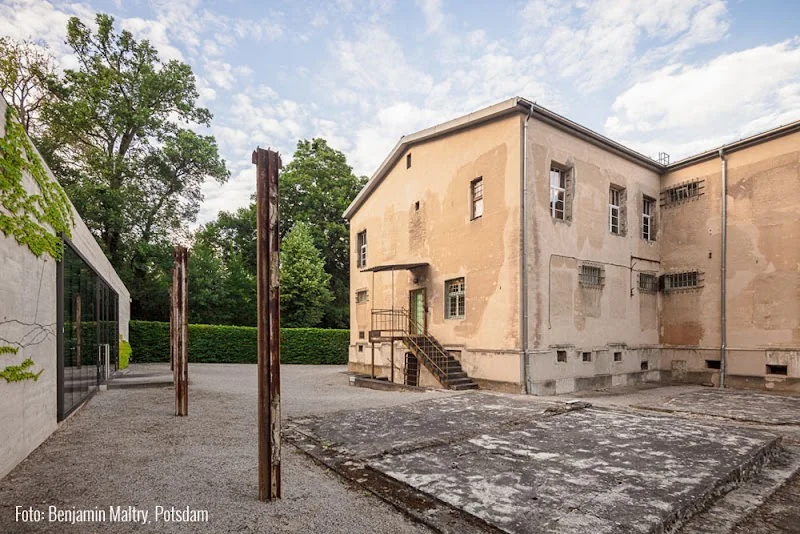
The permanent exhibition of the memorial is the centerpiece of the visit. It extends over all three floors of the former investigative prison of the Soviet counterintelligence and makes the eventful history of the place tangible at its authentic location. The building itself is the most important exhibit: it has been largely preserved and thus shows not only information about the past but also the spatial conditions of detention, control, and isolation. Particularly striking are the cellar cells with their sparse wooden bunks, which refer to the deprivations of the 1940s and 1950s, while the upper floors more visibly reflect the prison use of the 1970s. Inscriptions preserved in the cell walls enhance the impression of confinement, despair, and disenfranchisement. For this reason, the permanent exhibition is often described as one of the most authentic historical detention sites in Brandenburg. ([leistikowstrasse-sbg.de](https://www.leistikowstrasse-sbg.de/ausstellungen/dauerausstellungen/))
In terms of content, the exhibition focuses not only on architecture or administrative history but primarily on people. Historical photos, original objects, eyewitness interviews, and 50 biographies provide insight into the groups of prisoners and their fates. These include German and Soviet prisoners who were incarcerated for very different reasons: due to alleged or actual espionage, desertion, other service offenses, or due to false suspicions and unrelated life circumstances. The military counterintelligence used the site as a tool to secure its troops and to control political and military loyalty. For visitors, this connection between personal fate and political function is central, as it elevates the historical site beyond a mere building narrative. Additionally, there is a virtual 360° tour and an audio guide through the exhibition, which further facilitates access. ([leistikowstrasse-sbg.de](https://www.leistikowstrasse-sbg.de/ausstellungen/dauerausstellungen/))
History of the Site from 1916 to 2008
The history of Leistikowstraße begins long before its time as a detention site. In 1916, the Protestant Church Aid Association built a representative parsonage at the current address Leistikowstraße 1. Until the end of World War II, the villa served as the seat of the Protestant Women's Aid. The building also housed editorial offices, living quarters for the managing pastor and the female vicar, as well as rooms for the organizational work of the association. This early phase of use is important because it shows that the site was not originally created for repression but comes from a church-social context. The later repurposing by the Soviet occupying power fundamentally changed the character of the house and transformed a religious-social building into a place of interrogation, isolation, and detention. ([leistikowstrasse-sbg.de](https://www.leistikowstrasse-sbg.de/geschichte/1916-1945-sitz-der-evangelischen-frauenhilfe/))
From 1945, the actual history of the Soviet investigative prison began. The former parsonage was converted into the central investigative and transit prison of the Soviet military counterintelligence and remained so until 1991. The official narrative describes that people from very different backgrounds were held here, including Nazi perpetrators, spies, deserters, and completely uninvolved individuals. Concurrently, the intelligence city Military Town No. 7 developed around the prison, a highly secured area with administrative buildings, barracks, medical care, its own supply structures, and heavily shielded pathways. After the withdrawal of the last military units in 1994, civic engagement began for the preservation of the building. On December 5, 2008, the Memorial and Meeting Place was finally established; since June 30, 2023, it has been fully integrated into the Brandenburg Memorials Foundation. This development from a church house through the prison to an educational memorial site explains why the address today possesses such historical depth. ([leistikowstrasse-sbg.de](https://www.leistikowstrasse-sbg.de/geschichte/1945-1994-geheimdienststadt-militaerstaedtchen-nr-7/))
Guided Tours, Audio Guide, and 360° Tour
Those who wish to experience the memorial not only independently but also accompanied will find a wide range of guided tours. The classic tours address both the Soviet investigative prison and the intelligence city Military Town No. 7. According to the official description, the tours typically last 60 minutes and are recommended for visitors aged 15 and older. The history of the site, the spatial structure, and the biographies of former prisoners are interconnected. The dialogical approach is particularly important: questions and discussions are explicitly encouraged. This makes the tours a suitable format for school classes, groups, associations, and anyone who wants to delve deeper into history. Those searching for tours Leistikowstraße Potsdam will thus find not a standardized tourism product but a didactically strong educational offering with a clear reference to the historical site. ([leistikowstrasse-sbg.de](https://www.leistikowstrasse-sbg.de/bildung/fuehrungen/))
The guided tours are complemented by digital offerings. The permanent exhibition features a free audio guide that lasts about 60 minutes and guides visitors through the history of the site at 22 stations. For the audio guide, visitors use their own smartphone or tablet; headphones can be borrowed at the visitor center, and free Wi-Fi is available on-site. Additionally, there is an audio walk tracing the traces of the Soviet intelligence city, which complements the 13 information steles of the historical path and provides background knowledge, photos, and eyewitness reports. For those who prefer to explore virtually, there is also a 360° online tour available. For groups, a digital model of the former prison building is available, which also provides access to areas that are not entered during classic tours. The memorial thus combines analog authenticity with modern mediation in a remarkably consistent way. ([leistikowstrasse-sbg.de](https://www.leistikowstrasse-sbg.de/service/audioguides/?utm_source=openai))
Military Town No. 7 and the Historical Path
A special search topic around Leistikowstraße is Military Town No. 7. This term refers to the Soviet intelligence city in the Nauener Vorstadt, whose center developed around the prison and the neighboring buildings. According to the official narrative, the area was one of the most important intelligence outposts of the Soviet Union at the juncture with Western Europe. As early as 1945, the first buildings were confiscated, and after the Potsdam Conference, the area expanded to 16 hectares with around 100 buildings. The infrastructure included not only administration and detention but also living quarters, canteens, medical stations, shops, storage facilities, sports and recreational facilities, as well as its own communication structures. This explains why the site is described as an almost self-sufficient, heavily shielded complex. ([leistikowstrasse-sbg.de](https://www.leistikowstrasse-sbg.de/geschichte/1945-1994-geheimdienststadt-militaerstaedtchen-nr-7/))
Today, this history can be traced along a 2.5-kilometer historical path. It includes 13 information steles with historical photos and texts in German and English and leads past the former administrative center, the residence of the intelligence chiefs, the barracks area of the guard battalion, and other architectural relics. A scale model of the neighborhood in the courtyard of the memorial helps to better understand the historical space and makes the proximity to significant places such as Schloss Cecilienhof or the Berlin Wall visible. For visitors, this is very helpful, as it transforms the abstract history into a walkable space. The historical path connects memory, urban space, and topography and explains why the site must be understood not only as a single memorial but as part of a larger historical network. ([leistikowstrasse-sbg.de](https://www.leistikowstrasse-sbg.de/ausstellungen/dauerausstellungen/))
Accessibility, Children, and Visitor Regulations
The memorial strives to provide practical support to visitors, but the architectural conditions of a historical prison set clear limits. The visitor information center, including an event room and library, is accessible; there is also a disabled toilet. However, the historic prison building, which houses the permanent exhibition, is not accessible due to monument protection reasons. Access to the former prison area is only limited for wheelchair users. At the same time, there are positive aspects: the bronze or tactile model in the courtyard can be touched and contains Braille labels, which is helpful for visually impaired and blind visitors. Those needing assistance can contact the staff at the visitor center. This mix of accessibility and architectural limits should be realistically planned before the visit. ([leistikowstrasse-sbg.de](https://www.leistikowstrasse-sbg.de/service/barrierefreiheit/?utm_source=openai))
The visitor regulations also show that this place requires special consideration. Dogs, except for assistance dogs, are not allowed on the former prison grounds. Eating, drinking, and smoking are not permitted on the premises, as it is a place of remembrance. There are also guidelines regarding bags, children, and clothing that serve to protect the building and ensure a respectful visit. Families should especially know that the cellar cells are not recommended for children under twelve years due to their oppressive atmosphere. These notes are not expressions of exclusion but part of a sensitive approach to a historical detention site that remembers violence, isolation, and state repression. Those who adhere to these rules will experience the memorial not as a mere museum but as a reflective place of pause and understanding. ([leistikowstrasse-sbg.de](https://www.leistikowstrasse-sbg.de/en/service/faq/))
Sources:
- Memorial and Meeting Place Leistikowstraße Potsdam - Homepage
- Memorial and Meeting Place Leistikowstraße Potsdam - Opening Hours and Directions
- Memorial and Meeting Place Leistikowstraße Potsdam - Permanent Exhibitions
- Memorial and Meeting Place Leistikowstraße Potsdam - Guided Tours
- Memorial and Meeting Place Leistikowstraße Potsdam - Frequently Asked Questions
- Memorial and Meeting Place Leistikowstraße Potsdam - Accessibility
Show moreShow less
Memorial and Meeting Place Leistikowstraße | Directions & Tours
The Memorial and Meeting Place Leistikowstraße Potsdam is a place where city history, history of violence, and culture of remembrance come together in a special way. The area is located at Leistikowstraße 1 in the Nauener Vorstadt and is now part of the Brandenburg Memorials Foundation. The site is primarily known as a former Soviet investigative prison and as part of the Soviet intelligence city Military Town No. 7. At the same time, the address also tells of its earlier use as the seat of the Protestant Women's Aid. This multi-layered history makes the place so impressive: a building that has been used as a church institution, then as a detention site, and today as a memorial and educational site throughout the 20th century. Those searching for Memorial Potsdam, Leistikowstraße Potsdam, or Memorial and Meeting Place Leistikowstraße will find here not a classic event venue, but a historical space of remembrance with high authenticity and great documentary value. ([leistikowstrasse-sbg.de](https://www.leistikowstrasse-sbg.de/))
It is particularly noteworthy that the memorial not only displays its history but also methodically explores it: with a permanent exhibition, historical photographs, biographies, media stations, guided tours, audio guides, and a historical path in the vicinity of the former restricted area. This transforms a single building into a larger learning and remembrance space that makes the history of the Soviet occupation and the Cold War in Potsdam comprehensible. Those interested in photos, reviews, or practical visitor information often search for the same questions: How do I get there, how long does the visit take, are there parking spaces, and what exactly can I see on-site? These points are crucial for planning, as the memorial combines an emotionally charged historical site with very concrete service information for today's visitors. ([leistikowstrasse-sbg.de](https://www.leistikowstrasse-sbg.de/service/oeffnungszeiten-und-anfahrt/))
Directions, Opening Hours, and Parking
The journey to the Memorial and Meeting Place Leistikowstraße Potsdam is easily possible by public transport and clearly described on the official website. From Potsdam Central Station, tram 92 towards Kirschallee and tram 96 towards Campus Jungfernsee go to the stop Puschkinallee/Alexandrowka; from there, the walk to Leistikowstraße 1 takes about ten minutes. Another option is to take tram 96, bus 638, or bus 609 to Reiterweg/Alleestraße and then switch to bus 603 to Glumestraße; from there, it is about a three-minute walk. For guests arriving by bus and tram, the route is relatively easy to plan. The official address is Leistikowstraße 1, 14469 Potsdam. ([leistikowstrasse-sbg.de](https://www.leistikowstrasse-sbg.de/service/oeffnungszeiten-und-anfahrt/))
Those arriving by car should note that there are no parking spaces available at the memorial itself. The nearest parking lot is located at Schloss Cecilienhof and is about an eight-minute walk away. This is important for visitors specifically looking for parking Leistikowstraße or parking Memorial Potsdam. The opening hours are seasonal: from April to October, the memorial is open from Tuesday to Sunday between 2:00 PM and 6:00 PM, and from November to March from Tuesday to Sunday between 1:00 PM and 5:00 PM. The facility is closed on Mondays. This structure makes sense for a memorial, as it creates a reliable framework for individual visits, guided tours, and educational offerings. The visit can be well combined with a walk through the Nauener Vorstadt or a detour to the surroundings of Cecilienhof. ([leistikowstrasse-sbg.de](https://www.leistikowstrasse-sbg.de/service/oeffnungszeiten-und-anfahrt/))
Free Admission, Visit Duration, and Practical Information
A central advantage for all those searching for free admission Memorial Potsdam or free admission Leistikowstraße is the free use for individual visitors. The memorial explicitly states that admission is free; those who wish can leave a donation at the visitor center to support the work. For planning, it is also helpful that the official FAQ recommends at least one hour for visiting the permanent exhibition. This time frame is realistic because the exhibition consists not only of individual object information but also brings together many levels: historical rooms, texts, photos, biographies, and media stations. Those who wish to move without time pressure should plan for a bit longer, especially since the outdoor area and the historical path offer additional impressions. ([leistikowstrasse-sbg.de](https://www.leistikowstrasse-sbg.de/en/service/faq/))
Practical information also includes rules that are intended to protect the character of the place. Bags and backpacks must be deposited in lockers at the visitor center before entering the exhibition; a 1-euro coin is required for this, which is returned after opening. The building is minimally heated in the cold season, so appropriate clothing is recommended. Photography and filming are allowed for private purposes; for professional or commercial purposes, prior permission is required. Those visiting with children should know that the cellar cells are not recommended for children under twelve years due to their oppressive atmosphere. These notes are not formal hurdles but expressions of respect for a historical detention site where many people have suffered. ([leistikowstrasse-sbg.de](https://www.leistikowstrasse-sbg.de/en/service/faq/))
Permanent Exhibition in the Former Investigative Prison
The permanent exhibition of the memorial is the centerpiece of the visit. It extends over all three floors of the former investigative prison of the Soviet counterintelligence and makes the eventful history of the place tangible at its authentic location. The building itself is the most important exhibit: it has been largely preserved and thus shows not only information about the past but also the spatial conditions of detention, control, and isolation. Particularly striking are the cellar cells with their sparse wooden bunks, which refer to the deprivations of the 1940s and 1950s, while the upper floors more visibly reflect the prison use of the 1970s. Inscriptions preserved in the cell walls enhance the impression of confinement, despair, and disenfranchisement. For this reason, the permanent exhibition is often described as one of the most authentic historical detention sites in Brandenburg. ([leistikowstrasse-sbg.de](https://www.leistikowstrasse-sbg.de/ausstellungen/dauerausstellungen/))
In terms of content, the exhibition focuses not only on architecture or administrative history but primarily on people. Historical photos, original objects, eyewitness interviews, and 50 biographies provide insight into the groups of prisoners and their fates. These include German and Soviet prisoners who were incarcerated for very different reasons: due to alleged or actual espionage, desertion, other service offenses, or due to false suspicions and unrelated life circumstances. The military counterintelligence used the site as a tool to secure its troops and to control political and military loyalty. For visitors, this connection between personal fate and political function is central, as it elevates the historical site beyond a mere building narrative. Additionally, there is a virtual 360° tour and an audio guide through the exhibition, which further facilitates access. ([leistikowstrasse-sbg.de](https://www.leistikowstrasse-sbg.de/ausstellungen/dauerausstellungen/))
History of the Site from 1916 to 2008
The history of Leistikowstraße begins long before its time as a detention site. In 1916, the Protestant Church Aid Association built a representative parsonage at the current address Leistikowstraße 1. Until the end of World War II, the villa served as the seat of the Protestant Women's Aid. The building also housed editorial offices, living quarters for the managing pastor and the female vicar, as well as rooms for the organizational work of the association. This early phase of use is important because it shows that the site was not originally created for repression but comes from a church-social context. The later repurposing by the Soviet occupying power fundamentally changed the character of the house and transformed a religious-social building into a place of interrogation, isolation, and detention. ([leistikowstrasse-sbg.de](https://www.leistikowstrasse-sbg.de/geschichte/1916-1945-sitz-der-evangelischen-frauenhilfe/))
From 1945, the actual history of the Soviet investigative prison began. The former parsonage was converted into the central investigative and transit prison of the Soviet military counterintelligence and remained so until 1991. The official narrative describes that people from very different backgrounds were held here, including Nazi perpetrators, spies, deserters, and completely uninvolved individuals. Concurrently, the intelligence city Military Town No. 7 developed around the prison, a highly secured area with administrative buildings, barracks, medical care, its own supply structures, and heavily shielded pathways. After the withdrawal of the last military units in 1994, civic engagement began for the preservation of the building. On December 5, 2008, the Memorial and Meeting Place was finally established; since June 30, 2023, it has been fully integrated into the Brandenburg Memorials Foundation. This development from a church house through the prison to an educational memorial site explains why the address today possesses such historical depth. ([leistikowstrasse-sbg.de](https://www.leistikowstrasse-sbg.de/geschichte/1945-1994-geheimdienststadt-militaerstaedtchen-nr-7/))
Guided Tours, Audio Guide, and 360° Tour
Those who wish to experience the memorial not only independently but also accompanied will find a wide range of guided tours. The classic tours address both the Soviet investigative prison and the intelligence city Military Town No. 7. According to the official description, the tours typically last 60 minutes and are recommended for visitors aged 15 and older. The history of the site, the spatial structure, and the biographies of former prisoners are interconnected. The dialogical approach is particularly important: questions and discussions are explicitly encouraged. This makes the tours a suitable format for school classes, groups, associations, and anyone who wants to delve deeper into history. Those searching for tours Leistikowstraße Potsdam will thus find not a standardized tourism product but a didactically strong educational offering with a clear reference to the historical site. ([leistikowstrasse-sbg.de](https://www.leistikowstrasse-sbg.de/bildung/fuehrungen/))
The guided tours are complemented by digital offerings. The permanent exhibition features a free audio guide that lasts about 60 minutes and guides visitors through the history of the site at 22 stations. For the audio guide, visitors use their own smartphone or tablet; headphones can be borrowed at the visitor center, and free Wi-Fi is available on-site. Additionally, there is an audio walk tracing the traces of the Soviet intelligence city, which complements the 13 information steles of the historical path and provides background knowledge, photos, and eyewitness reports. For those who prefer to explore virtually, there is also a 360° online tour available. For groups, a digital model of the former prison building is available, which also provides access to areas that are not entered during classic tours. The memorial thus combines analog authenticity with modern mediation in a remarkably consistent way. ([leistikowstrasse-sbg.de](https://www.leistikowstrasse-sbg.de/service/audioguides/?utm_source=openai))
Military Town No. 7 and the Historical Path
A special search topic around Leistikowstraße is Military Town No. 7. This term refers to the Soviet intelligence city in the Nauener Vorstadt, whose center developed around the prison and the neighboring buildings. According to the official narrative, the area was one of the most important intelligence outposts of the Soviet Union at the juncture with Western Europe. As early as 1945, the first buildings were confiscated, and after the Potsdam Conference, the area expanded to 16 hectares with around 100 buildings. The infrastructure included not only administration and detention but also living quarters, canteens, medical stations, shops, storage facilities, sports and recreational facilities, as well as its own communication structures. This explains why the site is described as an almost self-sufficient, heavily shielded complex. ([leistikowstrasse-sbg.de](https://www.leistikowstrasse-sbg.de/geschichte/1945-1994-geheimdienststadt-militaerstaedtchen-nr-7/))
Today, this history can be traced along a 2.5-kilometer historical path. It includes 13 information steles with historical photos and texts in German and English and leads past the former administrative center, the residence of the intelligence chiefs, the barracks area of the guard battalion, and other architectural relics. A scale model of the neighborhood in the courtyard of the memorial helps to better understand the historical space and makes the proximity to significant places such as Schloss Cecilienhof or the Berlin Wall visible. For visitors, this is very helpful, as it transforms the abstract history into a walkable space. The historical path connects memory, urban space, and topography and explains why the site must be understood not only as a single memorial but as part of a larger historical network. ([leistikowstrasse-sbg.de](https://www.leistikowstrasse-sbg.de/ausstellungen/dauerausstellungen/))
Accessibility, Children, and Visitor Regulations
The memorial strives to provide practical support to visitors, but the architectural conditions of a historical prison set clear limits. The visitor information center, including an event room and library, is accessible; there is also a disabled toilet. However, the historic prison building, which houses the permanent exhibition, is not accessible due to monument protection reasons. Access to the former prison area is only limited for wheelchair users. At the same time, there are positive aspects: the bronze or tactile model in the courtyard can be touched and contains Braille labels, which is helpful for visually impaired and blind visitors. Those needing assistance can contact the staff at the visitor center. This mix of accessibility and architectural limits should be realistically planned before the visit. ([leistikowstrasse-sbg.de](https://www.leistikowstrasse-sbg.de/service/barrierefreiheit/?utm_source=openai))
The visitor regulations also show that this place requires special consideration. Dogs, except for assistance dogs, are not allowed on the former prison grounds. Eating, drinking, and smoking are not permitted on the premises, as it is a place of remembrance. There are also guidelines regarding bags, children, and clothing that serve to protect the building and ensure a respectful visit. Families should especially know that the cellar cells are not recommended for children under twelve years due to their oppressive atmosphere. These notes are not expressions of exclusion but part of a sensitive approach to a historical detention site that remembers violence, isolation, and state repression. Those who adhere to these rules will experience the memorial not as a mere museum but as a reflective place of pause and understanding. ([leistikowstrasse-sbg.de](https://www.leistikowstrasse-sbg.de/en/service/faq/))
Sources:
- Memorial and Meeting Place Leistikowstraße Potsdam - Homepage
- Memorial and Meeting Place Leistikowstraße Potsdam - Opening Hours and Directions
- Memorial and Meeting Place Leistikowstraße Potsdam - Permanent Exhibitions
- Memorial and Meeting Place Leistikowstraße Potsdam - Guided Tours
- Memorial and Meeting Place Leistikowstraße Potsdam - Frequently Asked Questions
- Memorial and Meeting Place Leistikowstraße Potsdam - Accessibility
Memorial and Meeting Place Leistikowstraße | Directions & Tours
The Memorial and Meeting Place Leistikowstraße Potsdam is a place where city history, history of violence, and culture of remembrance come together in a special way. The area is located at Leistikowstraße 1 in the Nauener Vorstadt and is now part of the Brandenburg Memorials Foundation. The site is primarily known as a former Soviet investigative prison and as part of the Soviet intelligence city Military Town No. 7. At the same time, the address also tells of its earlier use as the seat of the Protestant Women's Aid. This multi-layered history makes the place so impressive: a building that has been used as a church institution, then as a detention site, and today as a memorial and educational site throughout the 20th century. Those searching for Memorial Potsdam, Leistikowstraße Potsdam, or Memorial and Meeting Place Leistikowstraße will find here not a classic event venue, but a historical space of remembrance with high authenticity and great documentary value. ([leistikowstrasse-sbg.de](https://www.leistikowstrasse-sbg.de/))
It is particularly noteworthy that the memorial not only displays its history but also methodically explores it: with a permanent exhibition, historical photographs, biographies, media stations, guided tours, audio guides, and a historical path in the vicinity of the former restricted area. This transforms a single building into a larger learning and remembrance space that makes the history of the Soviet occupation and the Cold War in Potsdam comprehensible. Those interested in photos, reviews, or practical visitor information often search for the same questions: How do I get there, how long does the visit take, are there parking spaces, and what exactly can I see on-site? These points are crucial for planning, as the memorial combines an emotionally charged historical site with very concrete service information for today's visitors. ([leistikowstrasse-sbg.de](https://www.leistikowstrasse-sbg.de/service/oeffnungszeiten-und-anfahrt/))
Directions, Opening Hours, and Parking
The journey to the Memorial and Meeting Place Leistikowstraße Potsdam is easily possible by public transport and clearly described on the official website. From Potsdam Central Station, tram 92 towards Kirschallee and tram 96 towards Campus Jungfernsee go to the stop Puschkinallee/Alexandrowka; from there, the walk to Leistikowstraße 1 takes about ten minutes. Another option is to take tram 96, bus 638, or bus 609 to Reiterweg/Alleestraße and then switch to bus 603 to Glumestraße; from there, it is about a three-minute walk. For guests arriving by bus and tram, the route is relatively easy to plan. The official address is Leistikowstraße 1, 14469 Potsdam. ([leistikowstrasse-sbg.de](https://www.leistikowstrasse-sbg.de/service/oeffnungszeiten-und-anfahrt/))
Those arriving by car should note that there are no parking spaces available at the memorial itself. The nearest parking lot is located at Schloss Cecilienhof and is about an eight-minute walk away. This is important for visitors specifically looking for parking Leistikowstraße or parking Memorial Potsdam. The opening hours are seasonal: from April to October, the memorial is open from Tuesday to Sunday between 2:00 PM and 6:00 PM, and from November to March from Tuesday to Sunday between 1:00 PM and 5:00 PM. The facility is closed on Mondays. This structure makes sense for a memorial, as it creates a reliable framework for individual visits, guided tours, and educational offerings. The visit can be well combined with a walk through the Nauener Vorstadt or a detour to the surroundings of Cecilienhof. ([leistikowstrasse-sbg.de](https://www.leistikowstrasse-sbg.de/service/oeffnungszeiten-und-anfahrt/))
Free Admission, Visit Duration, and Practical Information
A central advantage for all those searching for free admission Memorial Potsdam or free admission Leistikowstraße is the free use for individual visitors. The memorial explicitly states that admission is free; those who wish can leave a donation at the visitor center to support the work. For planning, it is also helpful that the official FAQ recommends at least one hour for visiting the permanent exhibition. This time frame is realistic because the exhibition consists not only of individual object information but also brings together many levels: historical rooms, texts, photos, biographies, and media stations. Those who wish to move without time pressure should plan for a bit longer, especially since the outdoor area and the historical path offer additional impressions. ([leistikowstrasse-sbg.de](https://www.leistikowstrasse-sbg.de/en/service/faq/))
Practical information also includes rules that are intended to protect the character of the place. Bags and backpacks must be deposited in lockers at the visitor center before entering the exhibition; a 1-euro coin is required for this, which is returned after opening. The building is minimally heated in the cold season, so appropriate clothing is recommended. Photography and filming are allowed for private purposes; for professional or commercial purposes, prior permission is required. Those visiting with children should know that the cellar cells are not recommended for children under twelve years due to their oppressive atmosphere. These notes are not formal hurdles but expressions of respect for a historical detention site where many people have suffered. ([leistikowstrasse-sbg.de](https://www.leistikowstrasse-sbg.de/en/service/faq/))
Permanent Exhibition in the Former Investigative Prison
The permanent exhibition of the memorial is the centerpiece of the visit. It extends over all three floors of the former investigative prison of the Soviet counterintelligence and makes the eventful history of the place tangible at its authentic location. The building itself is the most important exhibit: it has been largely preserved and thus shows not only information about the past but also the spatial conditions of detention, control, and isolation. Particularly striking are the cellar cells with their sparse wooden bunks, which refer to the deprivations of the 1940s and 1950s, while the upper floors more visibly reflect the prison use of the 1970s. Inscriptions preserved in the cell walls enhance the impression of confinement, despair, and disenfranchisement. For this reason, the permanent exhibition is often described as one of the most authentic historical detention sites in Brandenburg. ([leistikowstrasse-sbg.de](https://www.leistikowstrasse-sbg.de/ausstellungen/dauerausstellungen/))
In terms of content, the exhibition focuses not only on architecture or administrative history but primarily on people. Historical photos, original objects, eyewitness interviews, and 50 biographies provide insight into the groups of prisoners and their fates. These include German and Soviet prisoners who were incarcerated for very different reasons: due to alleged or actual espionage, desertion, other service offenses, or due to false suspicions and unrelated life circumstances. The military counterintelligence used the site as a tool to secure its troops and to control political and military loyalty. For visitors, this connection between personal fate and political function is central, as it elevates the historical site beyond a mere building narrative. Additionally, there is a virtual 360° tour and an audio guide through the exhibition, which further facilitates access. ([leistikowstrasse-sbg.de](https://www.leistikowstrasse-sbg.de/ausstellungen/dauerausstellungen/))
History of the Site from 1916 to 2008
The history of Leistikowstraße begins long before its time as a detention site. In 1916, the Protestant Church Aid Association built a representative parsonage at the current address Leistikowstraße 1. Until the end of World War II, the villa served as the seat of the Protestant Women's Aid. The building also housed editorial offices, living quarters for the managing pastor and the female vicar, as well as rooms for the organizational work of the association. This early phase of use is important because it shows that the site was not originally created for repression but comes from a church-social context. The later repurposing by the Soviet occupying power fundamentally changed the character of the house and transformed a religious-social building into a place of interrogation, isolation, and detention. ([leistikowstrasse-sbg.de](https://www.leistikowstrasse-sbg.de/geschichte/1916-1945-sitz-der-evangelischen-frauenhilfe/))
From 1945, the actual history of the Soviet investigative prison began. The former parsonage was converted into the central investigative and transit prison of the Soviet military counterintelligence and remained so until 1991. The official narrative describes that people from very different backgrounds were held here, including Nazi perpetrators, spies, deserters, and completely uninvolved individuals. Concurrently, the intelligence city Military Town No. 7 developed around the prison, a highly secured area with administrative buildings, barracks, medical care, its own supply structures, and heavily shielded pathways. After the withdrawal of the last military units in 1994, civic engagement began for the preservation of the building. On December 5, 2008, the Memorial and Meeting Place was finally established; since June 30, 2023, it has been fully integrated into the Brandenburg Memorials Foundation. This development from a church house through the prison to an educational memorial site explains why the address today possesses such historical depth. ([leistikowstrasse-sbg.de](https://www.leistikowstrasse-sbg.de/geschichte/1945-1994-geheimdienststadt-militaerstaedtchen-nr-7/))
Guided Tours, Audio Guide, and 360° Tour
Those who wish to experience the memorial not only independently but also accompanied will find a wide range of guided tours. The classic tours address both the Soviet investigative prison and the intelligence city Military Town No. 7. According to the official description, the tours typically last 60 minutes and are recommended for visitors aged 15 and older. The history of the site, the spatial structure, and the biographies of former prisoners are interconnected. The dialogical approach is particularly important: questions and discussions are explicitly encouraged. This makes the tours a suitable format for school classes, groups, associations, and anyone who wants to delve deeper into history. Those searching for tours Leistikowstraße Potsdam will thus find not a standardized tourism product but a didactically strong educational offering with a clear reference to the historical site. ([leistikowstrasse-sbg.de](https://www.leistikowstrasse-sbg.de/bildung/fuehrungen/))
The guided tours are complemented by digital offerings. The permanent exhibition features a free audio guide that lasts about 60 minutes and guides visitors through the history of the site at 22 stations. For the audio guide, visitors use their own smartphone or tablet; headphones can be borrowed at the visitor center, and free Wi-Fi is available on-site. Additionally, there is an audio walk tracing the traces of the Soviet intelligence city, which complements the 13 information steles of the historical path and provides background knowledge, photos, and eyewitness reports. For those who prefer to explore virtually, there is also a 360° online tour available. For groups, a digital model of the former prison building is available, which also provides access to areas that are not entered during classic tours. The memorial thus combines analog authenticity with modern mediation in a remarkably consistent way. ([leistikowstrasse-sbg.de](https://www.leistikowstrasse-sbg.de/service/audioguides/?utm_source=openai))
Military Town No. 7 and the Historical Path
A special search topic around Leistikowstraße is Military Town No. 7. This term refers to the Soviet intelligence city in the Nauener Vorstadt, whose center developed around the prison and the neighboring buildings. According to the official narrative, the area was one of the most important intelligence outposts of the Soviet Union at the juncture with Western Europe. As early as 1945, the first buildings were confiscated, and after the Potsdam Conference, the area expanded to 16 hectares with around 100 buildings. The infrastructure included not only administration and detention but also living quarters, canteens, medical stations, shops, storage facilities, sports and recreational facilities, as well as its own communication structures. This explains why the site is described as an almost self-sufficient, heavily shielded complex. ([leistikowstrasse-sbg.de](https://www.leistikowstrasse-sbg.de/geschichte/1945-1994-geheimdienststadt-militaerstaedtchen-nr-7/))
Today, this history can be traced along a 2.5-kilometer historical path. It includes 13 information steles with historical photos and texts in German and English and leads past the former administrative center, the residence of the intelligence chiefs, the barracks area of the guard battalion, and other architectural relics. A scale model of the neighborhood in the courtyard of the memorial helps to better understand the historical space and makes the proximity to significant places such as Schloss Cecilienhof or the Berlin Wall visible. For visitors, this is very helpful, as it transforms the abstract history into a walkable space. The historical path connects memory, urban space, and topography and explains why the site must be understood not only as a single memorial but as part of a larger historical network. ([leistikowstrasse-sbg.de](https://www.leistikowstrasse-sbg.de/ausstellungen/dauerausstellungen/))
Accessibility, Children, and Visitor Regulations
The memorial strives to provide practical support to visitors, but the architectural conditions of a historical prison set clear limits. The visitor information center, including an event room and library, is accessible; there is also a disabled toilet. However, the historic prison building, which houses the permanent exhibition, is not accessible due to monument protection reasons. Access to the former prison area is only limited for wheelchair users. At the same time, there are positive aspects: the bronze or tactile model in the courtyard can be touched and contains Braille labels, which is helpful for visually impaired and blind visitors. Those needing assistance can contact the staff at the visitor center. This mix of accessibility and architectural limits should be realistically planned before the visit. ([leistikowstrasse-sbg.de](https://www.leistikowstrasse-sbg.de/service/barrierefreiheit/?utm_source=openai))
The visitor regulations also show that this place requires special consideration. Dogs, except for assistance dogs, are not allowed on the former prison grounds. Eating, drinking, and smoking are not permitted on the premises, as it is a place of remembrance. There are also guidelines regarding bags, children, and clothing that serve to protect the building and ensure a respectful visit. Families should especially know that the cellar cells are not recommended for children under twelve years due to their oppressive atmosphere. These notes are not expressions of exclusion but part of a sensitive approach to a historical detention site that remembers violence, isolation, and state repression. Those who adhere to these rules will experience the memorial not as a mere museum but as a reflective place of pause and understanding. ([leistikowstrasse-sbg.de](https://www.leistikowstrasse-sbg.de/en/service/faq/))
Sources:
- Memorial and Meeting Place Leistikowstraße Potsdam - Homepage
- Memorial and Meeting Place Leistikowstraße Potsdam - Opening Hours and Directions
- Memorial and Meeting Place Leistikowstraße Potsdam - Permanent Exhibitions
- Memorial and Meeting Place Leistikowstraße Potsdam - Guided Tours
- Memorial and Meeting Place Leistikowstraße Potsdam - Frequently Asked Questions
- Memorial and Meeting Place Leistikowstraße Potsdam - Accessibility
Upcoming Events
No events found
Frequently Asked Questions
Reviews
Chris Quinn
25. April 2025
An amazing museum - with tragic but often inspiring personal stories woven together with the larger historical narrative surrounding Soviet occupation; all in the context of where it happened. At least one hour recommended but better if you can spare two. The museum only opens at 2pm and is closed Mondays. Be aware that the prison is part of a larger story - that of Military Camp No 7 - which is also significant and worth exploring.
Virginia L
14. May 2024
Highly recommended this free soviet prison visit! The place has been kept original and the staff is very nice! They also offer audio guide, bathrooms and locker for free. The visit is very eye opening! Highly recommended!
Foodie Explorers
24. August 2025
Excellent place. Reception lady very friendly and helpful. Sad place, however lots of info available.
S F
19. May 2018
Nicely done up museum and it is free! Spent around 1 hour here. It showcases and explains the suffering of some German Civilians whom were falsely accused of being spies and were persecuted and harshly interrogated. Definitely worth a visit!
Michiel Buitelaar
18. July 2018
Quietly overwhelming. Scary and threatening. Very good, very desirable archiving of quite recent bad things. Also illustrates that the Russian machine became redundant, with the STASI becoming professional and self-sufficient: this building became less vital.