
Am Grünen Gitter 3, Potsdam
Am Grünen Gitter 3, 14469 Potsdam, Germany
Friedenskirche Potsdam | History & Opening Hours
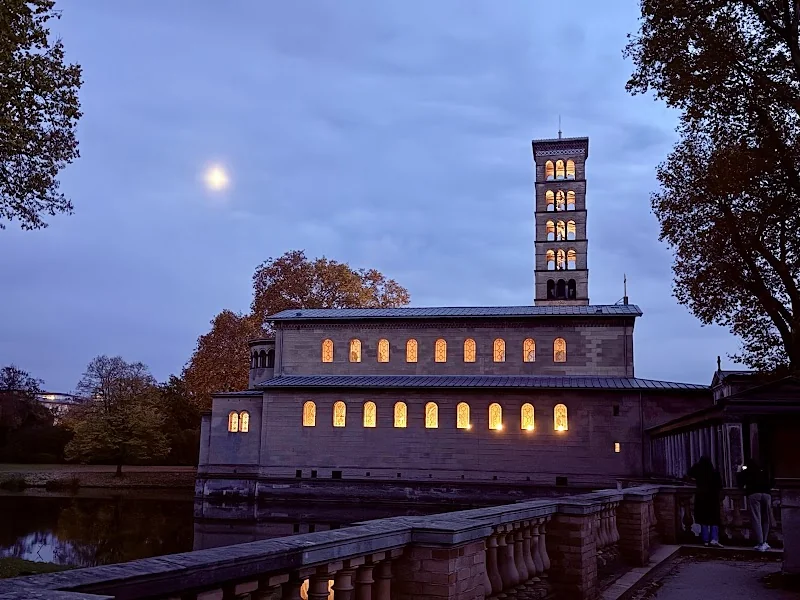
The Friedenskirche in Potsdam is much more than a quiet place in the greenery. It connects Prussian history, romantic architecture, spiritual life, and cultural use in a way that continues to shape the Sanssouci Park to this day. Those searching for the Friedenskirche Potsdam are referring not only to a building but to an ensemble of church, cloister, column courtyard, garden layout, pond, and the adjacent buildings of the historic area. The SPSG describes the Friedenskirche as one of the most significant architectural and garden artistic creations of German Romanticism, and it is precisely this dual character that makes it appealing: it is a monument, a house of God, a destination for excursions, and occasionally also a stage for music and spiritual formats. Its location at the Grünen Gitter in the Sanssouci Park, near Marlygarten and the Historical Mill, anchors it in the midst of one of Germany's most famous cultural landscapes. Those planning a visit will find clear information on opening hours, arrival, and parking, while also experiencing an atmosphere that invites more to tranquility than haste. This blend of representative history and quiet presence ensures that the Friedenskirche remains a special destination for visitors from Potsdam, Berlin, and far beyond. ([spsg.de](https://www.spsg.de/schloesser-gaerten/objekt/friedenskirche/))
History and Significance of the Friedenskirche in the Sanssouci Park
The history of the Friedenskirche is inextricably linked to Friedrich Wilhelm IV. Exactly 100 years after the laying of the foundation stone of Sanssouci, the king began the construction of a court church at the foot of the vineyard terraces in 1845. With this project, he aimed to give a religious foundation to the dynastic heritage, and the church was meant to make visible the idea of a monarchical order under God's grace. The consecration took place in 1848, during a politically charged moment: the revolution in Berlin had shaken the monarchical claim to power, and the Friedenskirche was understood by contemporaries as a programmatic response to this development. Thus, it is not only a religious place but also an architectural statement that reflects the political tensions of its time. At the same time, its location in the Sanssouci Park remains a symbol of the connection between rule, landscape, and sacred representation. Therefore, those visiting the Friedenskirche Potsdam today encounter a building that is deeply rooted in Prussian history and simultaneously exudes great tranquility. The official representation of the SPSG particularly emphasizes this blend of spiritual aspiration, historical dimension, and park artistic embedding. ([spsg.de](https://www.spsg.de/schloesser-gaerten/objekt/friedenskirche/))
The construction idea itself is also remarkable. The Friedenskirche is oriented towards the oldest church buildings in Italy, particularly San Clemente in Rome. Friedrich Wilhelm IV. associated this with the idea of using supposedly early Christian forms and the spirit of early Christianity for a renewal of church and society. Based on his sketches, Ludwig Persius and August Stüler developed the designs and construction plans. This collaboration makes the building a typical testimony of Prussian Romanticism, where architecture, politics, religion, and art were not thought of separately. The Friedenskirche was not planned in isolation but as an ensemble with outbuildings, outdoor spaces, and garden artistic references. This is precisely why it still appears so cohesive today: not only the facade but also the pathways, pond, cloister, and the adjacent Marlygarten to the west are part of the overall concept. The result is a place that translates the idea of a quiet court church into landscape while simultaneously making the ruler's claim to spiritual and historical continuity visible. ([spsg.de](https://www.spsg.de/schloesser-gaerten/objekt/friedenskirche/))
Architecture, Interior, and Artworks of the Friedenskirche
The first impression from the outside is deliberately restrained, almost plain. It is precisely this contrast between the rather sober exterior and the rich interior decoration that makes the Friedenskirche so fascinating. Inside, colorful marble and a carefully composed spatial effect dominate the image. Particularly significant is the apse, which is adorned with an original mosaic from the first half of the 13th century from the church of San Cipriano in Murano near Venice. This historical mosaic not only gives the space art-historical weight but also connects Potsdam directly with European sacred art of the Middle Ages. The church is also oriented towards medieval sacred buildings and features a cloister, a column courtyard, and a covered column walkway. This creates a circuit that makes religious architecture experienceable not as a closed block but as a sequence of spaces and transitions. The free-standing bell tower, the campanile, is also a striking element of the ensemble and continues to shape the silhouette of the place today. In sum, a space is created that does not need to be loud to leave an impression: material, proportions, and historical references speak for themselves. ([spsg.de](https://www.spsg.de/schloesser-gaerten/objekt/friedenskirche/))
Among the most impressive individual works is the statue of the Blessing Christ, a replica after Bertel Thorvaldsen. It symbolically represents the connection between classical visual art and Christian symbolism, which is repeatedly visible in the Friedenskirche. Beneath the church nave are also the graves of Friedrich Wilhelm IV. and his wife Elisabeth, making the place also a dynastic memorial site. This adds an additional historical depth to the visit, as the church is not only a house of God but also a burial church and memorial site. In the outdoor area, a white-blue glass column complements the design; it recalls the queen's Bavarian homeland and shows how carefully the ensemble has been charged with personal and political meanings. The view of the complex makes it clear that nothing stands here by chance: architecture, sculpture, mosaic, burial, and garden are interrelated. Those exploring the Friedenskirche Potsdam photographically or culturally should therefore not only consider the facade but also the interior, the axes, and the artworks in detail. ([spsg.de](https://www.spsg.de/schloesser-gaerten/objekt/friedenskirche/))
Arrival, Opening Hours, and Parking at the Friedenskirche Potsdam
For practical planning, the SPSG provides clear visitor information. The address is Am Grünen Gitter 3 in 14469 Potsdam. The Friedenskirche is accessible by public transport via the stop Potsdam, Luisenplatz-Nord/Park Sanssouci. Those arriving by car or bus will find paid parking spaces in the P1 parking lot at the Historical Mill. Additionally, the SPSG offers a free shuttle service between the Grünen Gitter and the Neues Palais on the Ökonomieweg from April to October daily from 11:00 AM to 5:30 PM, which, however, depends on volunteer drivers and may not always be available. This information is particularly helpful for visitors who want to experience the Sanssouci Park on foot, as the Friedenskirche can be easily integrated into a longer walk. Its location between the park, city, and other attractions makes arrival relatively uncomplicated. However, those specifically wanting to visit the Friedenskirche should still check the opening hours and any potential restrictions in advance, as the church is opened by volunteers and may vary on a daily basis. ([spsg.de](https://www.spsg.de/schloesser-gaerten/objekt/friedenskirche/))
The opening hours are regulated seasonally. From March 15 to October 15, the Friedenskirche is open Monday to Saturday from 11:00 AM to 5:00 PM and Sunday from 12:00 PM to 5:00 PM. From October 16 to March 14, shortened winter hours apply: Monday to Friday the church remains closed, Saturday it opens from 11:30 AM to 4:00 PM, and Sunday from 12:00 PM to 4:00 PM. Additionally, the Friedenskirche is closed during events. Admission is by donation, which makes the visit low-threshold while still supporting the preservation of the site. In practice, this means: those who want to experience the church without crowds should ideally visit outside of larger event dates and plan enough time for the tour through the ensemble. Since access is based on volunteer opening, small changes in the daily schedule are possible. This should be taken into account when planning the trip, as the charm of the place also lies in the fact that it does not function like an arbitrary museum building but as a living church and cultural space. ([spsg.de](https://www.spsg.de/schloesser-gaerten/objekt/friedenskirche/))
Concerts, Evensong, and Events in the Friedenskirche
The Friedenskirche is not only a monument but also a place for music and spiritual formats. Official SPSG events show that the church is regularly used for Evensongs, that is, musical Sunday evening services on Friday evenings at 7:00 PM. The model for this form comes from the Anglican Church; at the same time, the series combines choral music with chamber music and a spiritual impulse. After the Evensong, lingering in the atrium with drinks and light snacks is explicitly intended, creating a quiet, communal setting. Organ evenings like Organ 30, where half an hour of organ music is followed by an organ tour, are also documented. In addition, there are other classical concerts that utilize the special acoustics and atmosphere of the church. The Friedenskirche Potsdam is thus an example of how historical heritage and contemporary use can intertwine without losing the character of the place. Those looking for tickets should check the specific event format, as some dates are free with a collection, while others have fixed admission prices or their own pre-sale. ([spsg.de](https://www.spsg.de/aktuelles/veranstaltung/evensong?utm_source=openai))
This cultural use becomes particularly visible at the Potsdam Winter Opera, which has been hosted multiple times at the Friedenskirche. The SPSG points out that the series was continued in the Friedenskirche and that oratorios and music theater productions were presented there. The event Zanaida in 2026 also names the Friedenskirche as a venue and refers to tickets, introductions, and other practical details. Thus, the church is a significant alternative and performance venue for demanding productions that benefit from the historical surroundings in their combination of space, music, and staging. In the past, Handel oratorios such as Jephtha, Israel in Egypt, and Theodora have already been staged there. This shows that the Friedenskirche is not limited to a single role: it is a community church, a monument, and a cultural space at the same time. This multifunctionality also explains why it is relevant for different inquiries, from opening hours to concert programs to tickets and arrival. For visitors, this means a wide range of content in a compact space. ([spsg.de](https://www.spsg.de/aktuelles/veranstaltung/potsdamer-winteroper/event/tid/13470?utm_source=openai))
Marlygarten, Friedensteich, and Kaiser-Friedrich-Mausoleum
A significant part of the Friedenskirche's impact arises from its embedding in the garden landscape. To the east, an artificially created pond adjoins, which plays around the church building on this side with water. This creates a calm spatial edge and simultaneously ensures the characteristic dialogue between architecture and landscape. To the west, the Marlygarten adjoins, the former kitchen garden of Friedrich Wilhelm I, which Peter Joseph Lenné transformed into a miniature landscape garden. This redesign is typical of Prussian garden art of the 19th century: a functional kitchen garden is transformed into an aesthetic, romantically shaped landscape space. The SPSG also describes that the plants and a white-blue glass column remind of the queen's Bavarian origin. Those who observe the ensemble closely will recognize that not only the church itself but also its surroundings should be told deliberately. The park area is part of the statement, not just a backdrop. For this reason, the Friedenskirche Potsdam is always also content-wise part of the Sanssouci Park and not just the church's history. ([spsg.de](https://www.spsg.de/schloesser-gaerten/objekt/friedenskirche/))
The complex also includes the Kaiser-Friedrich-Mausoleum, which is located in close proximity to the Friedenskirche and further enhances the historical character of the site. The SPSG also presents the Friedenskirche and the mausoleum together in its imagery, thus referring to the ensemble as a cohesive memorial and landscape formation. Additionally, the use of the site by various actors remains: the Friedenskirche community uses the church, parsonage, and schoolhouse, while the remaining buildings are partially used by the SPSG as office space. This keeps the area lively and well-maintained, rather than freezing as an isolated monument. Those visiting the Friedenskirche should therefore take the time to consciously walk around the pond, cloister, and surrounding buildings. The interplay of water, architecture, mausoleum, and garden paths is a central part of the visitor experience. It also explains why many guests describe the place as quiet and yet impressive, as the complex creates a calm, almost contemplative atmosphere that arises from its clear spatial composition. ([spsg.de](https://www.spsg.de/unterstuetzen-foerdern/spenden/projekte/friedenskirche))
Visitor Tips, Accessibility, and Surroundings of the Friedenskirche
For the visit, it is advisable to combine the Friedenskirche with a larger walk through Sanssouci. The SPSG refers in its surrounding list to Sanssouci Palace, the Historical Mill, Charlottenhof Palace, the Orangery Palace, the New Palace, and other destinations. Thus, the Friedenskirche is located in a cluster of attractions that can be easily combined on foot. Those coming from the direction of Potsdam city center will already experience the special transition zone between city and park on the way to the Grünen Gitter. This location makes the site attractive for day visitors who are looking for not just a single church but a whole cultural experience. The free shuttle service between the Grünen Gitter and the Neues Palais is also particularly valuable, as it allows for convenient transfer through the park, provided it is available. Those who want to explore the church in peace should ideally come on a day that is not too busy and pay attention to event notices. The mix of walk, monument, and garden art makes the visit a varied but unhurried experience. ([spsg.de](https://www.spsg.de/schloesser-gaerten/objekt/friedenskirche/))
When it comes to accessibility, careful planning is advisable. For individual events, the SPSG indicates the Friedenskirche as conditionally wheelchair accessible; other dates are even marked as not wheelchair accessible. This means: the suitability depends heavily on the respective format and the specific purpose of use, so one should check the detailed information for the date before visiting. This also emphasizes that the Friedenskirche is not a standardized event space but a historical site with different requirements. Those looking for tickets for concerts, winter opera, or special tours should pay attention to the information for the event date. For regular church visits, access by donation remains attractive and uncomplicated. As a practical point of contact, the SPSG also mentions the Friedenskirche community in Potsdam with phone number and email address. This is particularly helpful when it comes to short-term openings, volunteer support, or current questions. Overall, it becomes clear: the Friedenskirche Potsdam is a destination for people who want to combine history, architecture, music, and garden culture in a single visit. This very complexity contributes to its SEO value as well as its real experiential value on site. ([spsg.de](https://www.spsg.de/aktuelles/veranstaltung/evensong?utm_source=openai))
Sources:
- Foundation Prussian Palaces and Gardens Berlin-Brandenburg – Friedenskirche ([spsg.de](https://www.spsg.de/schloesser-gaerten/objekt/friedenskirche/))
- Foundation Prussian Palaces and Gardens Berlin-Brandenburg – Friedenskirche Project Page ([spsg.de](https://www.spsg.de/unterstuetzen-foerdern/spenden/projekte/friedenskirche))
- Foundation Prussian Palaces and Gardens Berlin-Brandenburg – Evensong in the Friedenskirche ([spsg.de](https://www.spsg.de/aktuelles/veranstaltung/evensong?utm_source=openai))
- Foundation Prussian Palaces and Gardens Berlin-Brandenburg – Potsdam Winter Opera in the Friedenskirche ([spsg.de](https://www.spsg.de/aktuelles/veranstaltung/potsdamer-winteroper/event/tid/13470?utm_source=openai))
- Foundation Prussian Palaces and Gardens Berlin-Brandenburg – Park Sanssouci in Simple Language ([spsg.de](https://www.spsg.de/leichte-sprache/leichte-sprache-park-sanssouci?utm_source=openai))
Show moreShow less
Friedenskirche Potsdam | History & Opening Hours
The Friedenskirche in Potsdam is much more than a quiet place in the greenery. It connects Prussian history, romantic architecture, spiritual life, and cultural use in a way that continues to shape the Sanssouci Park to this day. Those searching for the Friedenskirche Potsdam are referring not only to a building but to an ensemble of church, cloister, column courtyard, garden layout, pond, and the adjacent buildings of the historic area. The SPSG describes the Friedenskirche as one of the most significant architectural and garden artistic creations of German Romanticism, and it is precisely this dual character that makes it appealing: it is a monument, a house of God, a destination for excursions, and occasionally also a stage for music and spiritual formats. Its location at the Grünen Gitter in the Sanssouci Park, near Marlygarten and the Historical Mill, anchors it in the midst of one of Germany's most famous cultural landscapes. Those planning a visit will find clear information on opening hours, arrival, and parking, while also experiencing an atmosphere that invites more to tranquility than haste. This blend of representative history and quiet presence ensures that the Friedenskirche remains a special destination for visitors from Potsdam, Berlin, and far beyond. ([spsg.de](https://www.spsg.de/schloesser-gaerten/objekt/friedenskirche/))
History and Significance of the Friedenskirche in the Sanssouci Park
The history of the Friedenskirche is inextricably linked to Friedrich Wilhelm IV. Exactly 100 years after the laying of the foundation stone of Sanssouci, the king began the construction of a court church at the foot of the vineyard terraces in 1845. With this project, he aimed to give a religious foundation to the dynastic heritage, and the church was meant to make visible the idea of a monarchical order under God's grace. The consecration took place in 1848, during a politically charged moment: the revolution in Berlin had shaken the monarchical claim to power, and the Friedenskirche was understood by contemporaries as a programmatic response to this development. Thus, it is not only a religious place but also an architectural statement that reflects the political tensions of its time. At the same time, its location in the Sanssouci Park remains a symbol of the connection between rule, landscape, and sacred representation. Therefore, those visiting the Friedenskirche Potsdam today encounter a building that is deeply rooted in Prussian history and simultaneously exudes great tranquility. The official representation of the SPSG particularly emphasizes this blend of spiritual aspiration, historical dimension, and park artistic embedding. ([spsg.de](https://www.spsg.de/schloesser-gaerten/objekt/friedenskirche/))
The construction idea itself is also remarkable. The Friedenskirche is oriented towards the oldest church buildings in Italy, particularly San Clemente in Rome. Friedrich Wilhelm IV. associated this with the idea of using supposedly early Christian forms and the spirit of early Christianity for a renewal of church and society. Based on his sketches, Ludwig Persius and August Stüler developed the designs and construction plans. This collaboration makes the building a typical testimony of Prussian Romanticism, where architecture, politics, religion, and art were not thought of separately. The Friedenskirche was not planned in isolation but as an ensemble with outbuildings, outdoor spaces, and garden artistic references. This is precisely why it still appears so cohesive today: not only the facade but also the pathways, pond, cloister, and the adjacent Marlygarten to the west are part of the overall concept. The result is a place that translates the idea of a quiet court church into landscape while simultaneously making the ruler's claim to spiritual and historical continuity visible. ([spsg.de](https://www.spsg.de/schloesser-gaerten/objekt/friedenskirche/))
Architecture, Interior, and Artworks of the Friedenskirche
The first impression from the outside is deliberately restrained, almost plain. It is precisely this contrast between the rather sober exterior and the rich interior decoration that makes the Friedenskirche so fascinating. Inside, colorful marble and a carefully composed spatial effect dominate the image. Particularly significant is the apse, which is adorned with an original mosaic from the first half of the 13th century from the church of San Cipriano in Murano near Venice. This historical mosaic not only gives the space art-historical weight but also connects Potsdam directly with European sacred art of the Middle Ages. The church is also oriented towards medieval sacred buildings and features a cloister, a column courtyard, and a covered column walkway. This creates a circuit that makes religious architecture experienceable not as a closed block but as a sequence of spaces and transitions. The free-standing bell tower, the campanile, is also a striking element of the ensemble and continues to shape the silhouette of the place today. In sum, a space is created that does not need to be loud to leave an impression: material, proportions, and historical references speak for themselves. ([spsg.de](https://www.spsg.de/schloesser-gaerten/objekt/friedenskirche/))
Among the most impressive individual works is the statue of the Blessing Christ, a replica after Bertel Thorvaldsen. It symbolically represents the connection between classical visual art and Christian symbolism, which is repeatedly visible in the Friedenskirche. Beneath the church nave are also the graves of Friedrich Wilhelm IV. and his wife Elisabeth, making the place also a dynastic memorial site. This adds an additional historical depth to the visit, as the church is not only a house of God but also a burial church and memorial site. In the outdoor area, a white-blue glass column complements the design; it recalls the queen's Bavarian homeland and shows how carefully the ensemble has been charged with personal and political meanings. The view of the complex makes it clear that nothing stands here by chance: architecture, sculpture, mosaic, burial, and garden are interrelated. Those exploring the Friedenskirche Potsdam photographically or culturally should therefore not only consider the facade but also the interior, the axes, and the artworks in detail. ([spsg.de](https://www.spsg.de/schloesser-gaerten/objekt/friedenskirche/))
Arrival, Opening Hours, and Parking at the Friedenskirche Potsdam
For practical planning, the SPSG provides clear visitor information. The address is Am Grünen Gitter 3 in 14469 Potsdam. The Friedenskirche is accessible by public transport via the stop Potsdam, Luisenplatz-Nord/Park Sanssouci. Those arriving by car or bus will find paid parking spaces in the P1 parking lot at the Historical Mill. Additionally, the SPSG offers a free shuttle service between the Grünen Gitter and the Neues Palais on the Ökonomieweg from April to October daily from 11:00 AM to 5:30 PM, which, however, depends on volunteer drivers and may not always be available. This information is particularly helpful for visitors who want to experience the Sanssouci Park on foot, as the Friedenskirche can be easily integrated into a longer walk. Its location between the park, city, and other attractions makes arrival relatively uncomplicated. However, those specifically wanting to visit the Friedenskirche should still check the opening hours and any potential restrictions in advance, as the church is opened by volunteers and may vary on a daily basis. ([spsg.de](https://www.spsg.de/schloesser-gaerten/objekt/friedenskirche/))
The opening hours are regulated seasonally. From March 15 to October 15, the Friedenskirche is open Monday to Saturday from 11:00 AM to 5:00 PM and Sunday from 12:00 PM to 5:00 PM. From October 16 to March 14, shortened winter hours apply: Monday to Friday the church remains closed, Saturday it opens from 11:30 AM to 4:00 PM, and Sunday from 12:00 PM to 4:00 PM. Additionally, the Friedenskirche is closed during events. Admission is by donation, which makes the visit low-threshold while still supporting the preservation of the site. In practice, this means: those who want to experience the church without crowds should ideally visit outside of larger event dates and plan enough time for the tour through the ensemble. Since access is based on volunteer opening, small changes in the daily schedule are possible. This should be taken into account when planning the trip, as the charm of the place also lies in the fact that it does not function like an arbitrary museum building but as a living church and cultural space. ([spsg.de](https://www.spsg.de/schloesser-gaerten/objekt/friedenskirche/))
Concerts, Evensong, and Events in the Friedenskirche
The Friedenskirche is not only a monument but also a place for music and spiritual formats. Official SPSG events show that the church is regularly used for Evensongs, that is, musical Sunday evening services on Friday evenings at 7:00 PM. The model for this form comes from the Anglican Church; at the same time, the series combines choral music with chamber music and a spiritual impulse. After the Evensong, lingering in the atrium with drinks and light snacks is explicitly intended, creating a quiet, communal setting. Organ evenings like Organ 30, where half an hour of organ music is followed by an organ tour, are also documented. In addition, there are other classical concerts that utilize the special acoustics and atmosphere of the church. The Friedenskirche Potsdam is thus an example of how historical heritage and contemporary use can intertwine without losing the character of the place. Those looking for tickets should check the specific event format, as some dates are free with a collection, while others have fixed admission prices or their own pre-sale. ([spsg.de](https://www.spsg.de/aktuelles/veranstaltung/evensong?utm_source=openai))
This cultural use becomes particularly visible at the Potsdam Winter Opera, which has been hosted multiple times at the Friedenskirche. The SPSG points out that the series was continued in the Friedenskirche and that oratorios and music theater productions were presented there. The event Zanaida in 2026 also names the Friedenskirche as a venue and refers to tickets, introductions, and other practical details. Thus, the church is a significant alternative and performance venue for demanding productions that benefit from the historical surroundings in their combination of space, music, and staging. In the past, Handel oratorios such as Jephtha, Israel in Egypt, and Theodora have already been staged there. This shows that the Friedenskirche is not limited to a single role: it is a community church, a monument, and a cultural space at the same time. This multifunctionality also explains why it is relevant for different inquiries, from opening hours to concert programs to tickets and arrival. For visitors, this means a wide range of content in a compact space. ([spsg.de](https://www.spsg.de/aktuelles/veranstaltung/potsdamer-winteroper/event/tid/13470?utm_source=openai))
Marlygarten, Friedensteich, and Kaiser-Friedrich-Mausoleum
A significant part of the Friedenskirche's impact arises from its embedding in the garden landscape. To the east, an artificially created pond adjoins, which plays around the church building on this side with water. This creates a calm spatial edge and simultaneously ensures the characteristic dialogue between architecture and landscape. To the west, the Marlygarten adjoins, the former kitchen garden of Friedrich Wilhelm I, which Peter Joseph Lenné transformed into a miniature landscape garden. This redesign is typical of Prussian garden art of the 19th century: a functional kitchen garden is transformed into an aesthetic, romantically shaped landscape space. The SPSG also describes that the plants and a white-blue glass column remind of the queen's Bavarian origin. Those who observe the ensemble closely will recognize that not only the church itself but also its surroundings should be told deliberately. The park area is part of the statement, not just a backdrop. For this reason, the Friedenskirche Potsdam is always also content-wise part of the Sanssouci Park and not just the church's history. ([spsg.de](https://www.spsg.de/schloesser-gaerten/objekt/friedenskirche/))
The complex also includes the Kaiser-Friedrich-Mausoleum, which is located in close proximity to the Friedenskirche and further enhances the historical character of the site. The SPSG also presents the Friedenskirche and the mausoleum together in its imagery, thus referring to the ensemble as a cohesive memorial and landscape formation. Additionally, the use of the site by various actors remains: the Friedenskirche community uses the church, parsonage, and schoolhouse, while the remaining buildings are partially used by the SPSG as office space. This keeps the area lively and well-maintained, rather than freezing as an isolated monument. Those visiting the Friedenskirche should therefore take the time to consciously walk around the pond, cloister, and surrounding buildings. The interplay of water, architecture, mausoleum, and garden paths is a central part of the visitor experience. It also explains why many guests describe the place as quiet and yet impressive, as the complex creates a calm, almost contemplative atmosphere that arises from its clear spatial composition. ([spsg.de](https://www.spsg.de/unterstuetzen-foerdern/spenden/projekte/friedenskirche))
Visitor Tips, Accessibility, and Surroundings of the Friedenskirche
For the visit, it is advisable to combine the Friedenskirche with a larger walk through Sanssouci. The SPSG refers in its surrounding list to Sanssouci Palace, the Historical Mill, Charlottenhof Palace, the Orangery Palace, the New Palace, and other destinations. Thus, the Friedenskirche is located in a cluster of attractions that can be easily combined on foot. Those coming from the direction of Potsdam city center will already experience the special transition zone between city and park on the way to the Grünen Gitter. This location makes the site attractive for day visitors who are looking for not just a single church but a whole cultural experience. The free shuttle service between the Grünen Gitter and the Neues Palais is also particularly valuable, as it allows for convenient transfer through the park, provided it is available. Those who want to explore the church in peace should ideally come on a day that is not too busy and pay attention to event notices. The mix of walk, monument, and garden art makes the visit a varied but unhurried experience. ([spsg.de](https://www.spsg.de/schloesser-gaerten/objekt/friedenskirche/))
When it comes to accessibility, careful planning is advisable. For individual events, the SPSG indicates the Friedenskirche as conditionally wheelchair accessible; other dates are even marked as not wheelchair accessible. This means: the suitability depends heavily on the respective format and the specific purpose of use, so one should check the detailed information for the date before visiting. This also emphasizes that the Friedenskirche is not a standardized event space but a historical site with different requirements. Those looking for tickets for concerts, winter opera, or special tours should pay attention to the information for the event date. For regular church visits, access by donation remains attractive and uncomplicated. As a practical point of contact, the SPSG also mentions the Friedenskirche community in Potsdam with phone number and email address. This is particularly helpful when it comes to short-term openings, volunteer support, or current questions. Overall, it becomes clear: the Friedenskirche Potsdam is a destination for people who want to combine history, architecture, music, and garden culture in a single visit. This very complexity contributes to its SEO value as well as its real experiential value on site. ([spsg.de](https://www.spsg.de/aktuelles/veranstaltung/evensong?utm_source=openai))
Sources:
- Foundation Prussian Palaces and Gardens Berlin-Brandenburg – Friedenskirche ([spsg.de](https://www.spsg.de/schloesser-gaerten/objekt/friedenskirche/))
- Foundation Prussian Palaces and Gardens Berlin-Brandenburg – Friedenskirche Project Page ([spsg.de](https://www.spsg.de/unterstuetzen-foerdern/spenden/projekte/friedenskirche))
- Foundation Prussian Palaces and Gardens Berlin-Brandenburg – Evensong in the Friedenskirche ([spsg.de](https://www.spsg.de/aktuelles/veranstaltung/evensong?utm_source=openai))
- Foundation Prussian Palaces and Gardens Berlin-Brandenburg – Potsdam Winter Opera in the Friedenskirche ([spsg.de](https://www.spsg.de/aktuelles/veranstaltung/potsdamer-winteroper/event/tid/13470?utm_source=openai))
- Foundation Prussian Palaces and Gardens Berlin-Brandenburg – Park Sanssouci in Simple Language ([spsg.de](https://www.spsg.de/leichte-sprache/leichte-sprache-park-sanssouci?utm_source=openai))
Friedenskirche Potsdam | History & Opening Hours
The Friedenskirche in Potsdam is much more than a quiet place in the greenery. It connects Prussian history, romantic architecture, spiritual life, and cultural use in a way that continues to shape the Sanssouci Park to this day. Those searching for the Friedenskirche Potsdam are referring not only to a building but to an ensemble of church, cloister, column courtyard, garden layout, pond, and the adjacent buildings of the historic area. The SPSG describes the Friedenskirche as one of the most significant architectural and garden artistic creations of German Romanticism, and it is precisely this dual character that makes it appealing: it is a monument, a house of God, a destination for excursions, and occasionally also a stage for music and spiritual formats. Its location at the Grünen Gitter in the Sanssouci Park, near Marlygarten and the Historical Mill, anchors it in the midst of one of Germany's most famous cultural landscapes. Those planning a visit will find clear information on opening hours, arrival, and parking, while also experiencing an atmosphere that invites more to tranquility than haste. This blend of representative history and quiet presence ensures that the Friedenskirche remains a special destination for visitors from Potsdam, Berlin, and far beyond. ([spsg.de](https://www.spsg.de/schloesser-gaerten/objekt/friedenskirche/))
History and Significance of the Friedenskirche in the Sanssouci Park
The history of the Friedenskirche is inextricably linked to Friedrich Wilhelm IV. Exactly 100 years after the laying of the foundation stone of Sanssouci, the king began the construction of a court church at the foot of the vineyard terraces in 1845. With this project, he aimed to give a religious foundation to the dynastic heritage, and the church was meant to make visible the idea of a monarchical order under God's grace. The consecration took place in 1848, during a politically charged moment: the revolution in Berlin had shaken the monarchical claim to power, and the Friedenskirche was understood by contemporaries as a programmatic response to this development. Thus, it is not only a religious place but also an architectural statement that reflects the political tensions of its time. At the same time, its location in the Sanssouci Park remains a symbol of the connection between rule, landscape, and sacred representation. Therefore, those visiting the Friedenskirche Potsdam today encounter a building that is deeply rooted in Prussian history and simultaneously exudes great tranquility. The official representation of the SPSG particularly emphasizes this blend of spiritual aspiration, historical dimension, and park artistic embedding. ([spsg.de](https://www.spsg.de/schloesser-gaerten/objekt/friedenskirche/))
The construction idea itself is also remarkable. The Friedenskirche is oriented towards the oldest church buildings in Italy, particularly San Clemente in Rome. Friedrich Wilhelm IV. associated this with the idea of using supposedly early Christian forms and the spirit of early Christianity for a renewal of church and society. Based on his sketches, Ludwig Persius and August Stüler developed the designs and construction plans. This collaboration makes the building a typical testimony of Prussian Romanticism, where architecture, politics, religion, and art were not thought of separately. The Friedenskirche was not planned in isolation but as an ensemble with outbuildings, outdoor spaces, and garden artistic references. This is precisely why it still appears so cohesive today: not only the facade but also the pathways, pond, cloister, and the adjacent Marlygarten to the west are part of the overall concept. The result is a place that translates the idea of a quiet court church into landscape while simultaneously making the ruler's claim to spiritual and historical continuity visible. ([spsg.de](https://www.spsg.de/schloesser-gaerten/objekt/friedenskirche/))
Architecture, Interior, and Artworks of the Friedenskirche
The first impression from the outside is deliberately restrained, almost plain. It is precisely this contrast between the rather sober exterior and the rich interior decoration that makes the Friedenskirche so fascinating. Inside, colorful marble and a carefully composed spatial effect dominate the image. Particularly significant is the apse, which is adorned with an original mosaic from the first half of the 13th century from the church of San Cipriano in Murano near Venice. This historical mosaic not only gives the space art-historical weight but also connects Potsdam directly with European sacred art of the Middle Ages. The church is also oriented towards medieval sacred buildings and features a cloister, a column courtyard, and a covered column walkway. This creates a circuit that makes religious architecture experienceable not as a closed block but as a sequence of spaces and transitions. The free-standing bell tower, the campanile, is also a striking element of the ensemble and continues to shape the silhouette of the place today. In sum, a space is created that does not need to be loud to leave an impression: material, proportions, and historical references speak for themselves. ([spsg.de](https://www.spsg.de/schloesser-gaerten/objekt/friedenskirche/))
Among the most impressive individual works is the statue of the Blessing Christ, a replica after Bertel Thorvaldsen. It symbolically represents the connection between classical visual art and Christian symbolism, which is repeatedly visible in the Friedenskirche. Beneath the church nave are also the graves of Friedrich Wilhelm IV. and his wife Elisabeth, making the place also a dynastic memorial site. This adds an additional historical depth to the visit, as the church is not only a house of God but also a burial church and memorial site. In the outdoor area, a white-blue glass column complements the design; it recalls the queen's Bavarian homeland and shows how carefully the ensemble has been charged with personal and political meanings. The view of the complex makes it clear that nothing stands here by chance: architecture, sculpture, mosaic, burial, and garden are interrelated. Those exploring the Friedenskirche Potsdam photographically or culturally should therefore not only consider the facade but also the interior, the axes, and the artworks in detail. ([spsg.de](https://www.spsg.de/schloesser-gaerten/objekt/friedenskirche/))
Arrival, Opening Hours, and Parking at the Friedenskirche Potsdam
For practical planning, the SPSG provides clear visitor information. The address is Am Grünen Gitter 3 in 14469 Potsdam. The Friedenskirche is accessible by public transport via the stop Potsdam, Luisenplatz-Nord/Park Sanssouci. Those arriving by car or bus will find paid parking spaces in the P1 parking lot at the Historical Mill. Additionally, the SPSG offers a free shuttle service between the Grünen Gitter and the Neues Palais on the Ökonomieweg from April to October daily from 11:00 AM to 5:30 PM, which, however, depends on volunteer drivers and may not always be available. This information is particularly helpful for visitors who want to experience the Sanssouci Park on foot, as the Friedenskirche can be easily integrated into a longer walk. Its location between the park, city, and other attractions makes arrival relatively uncomplicated. However, those specifically wanting to visit the Friedenskirche should still check the opening hours and any potential restrictions in advance, as the church is opened by volunteers and may vary on a daily basis. ([spsg.de](https://www.spsg.de/schloesser-gaerten/objekt/friedenskirche/))
The opening hours are regulated seasonally. From March 15 to October 15, the Friedenskirche is open Monday to Saturday from 11:00 AM to 5:00 PM and Sunday from 12:00 PM to 5:00 PM. From October 16 to March 14, shortened winter hours apply: Monday to Friday the church remains closed, Saturday it opens from 11:30 AM to 4:00 PM, and Sunday from 12:00 PM to 4:00 PM. Additionally, the Friedenskirche is closed during events. Admission is by donation, which makes the visit low-threshold while still supporting the preservation of the site. In practice, this means: those who want to experience the church without crowds should ideally visit outside of larger event dates and plan enough time for the tour through the ensemble. Since access is based on volunteer opening, small changes in the daily schedule are possible. This should be taken into account when planning the trip, as the charm of the place also lies in the fact that it does not function like an arbitrary museum building but as a living church and cultural space. ([spsg.de](https://www.spsg.de/schloesser-gaerten/objekt/friedenskirche/))
Concerts, Evensong, and Events in the Friedenskirche
The Friedenskirche is not only a monument but also a place for music and spiritual formats. Official SPSG events show that the church is regularly used for Evensongs, that is, musical Sunday evening services on Friday evenings at 7:00 PM. The model for this form comes from the Anglican Church; at the same time, the series combines choral music with chamber music and a spiritual impulse. After the Evensong, lingering in the atrium with drinks and light snacks is explicitly intended, creating a quiet, communal setting. Organ evenings like Organ 30, where half an hour of organ music is followed by an organ tour, are also documented. In addition, there are other classical concerts that utilize the special acoustics and atmosphere of the church. The Friedenskirche Potsdam is thus an example of how historical heritage and contemporary use can intertwine without losing the character of the place. Those looking for tickets should check the specific event format, as some dates are free with a collection, while others have fixed admission prices or their own pre-sale. ([spsg.de](https://www.spsg.de/aktuelles/veranstaltung/evensong?utm_source=openai))
This cultural use becomes particularly visible at the Potsdam Winter Opera, which has been hosted multiple times at the Friedenskirche. The SPSG points out that the series was continued in the Friedenskirche and that oratorios and music theater productions were presented there. The event Zanaida in 2026 also names the Friedenskirche as a venue and refers to tickets, introductions, and other practical details. Thus, the church is a significant alternative and performance venue for demanding productions that benefit from the historical surroundings in their combination of space, music, and staging. In the past, Handel oratorios such as Jephtha, Israel in Egypt, and Theodora have already been staged there. This shows that the Friedenskirche is not limited to a single role: it is a community church, a monument, and a cultural space at the same time. This multifunctionality also explains why it is relevant for different inquiries, from opening hours to concert programs to tickets and arrival. For visitors, this means a wide range of content in a compact space. ([spsg.de](https://www.spsg.de/aktuelles/veranstaltung/potsdamer-winteroper/event/tid/13470?utm_source=openai))
Marlygarten, Friedensteich, and Kaiser-Friedrich-Mausoleum
A significant part of the Friedenskirche's impact arises from its embedding in the garden landscape. To the east, an artificially created pond adjoins, which plays around the church building on this side with water. This creates a calm spatial edge and simultaneously ensures the characteristic dialogue between architecture and landscape. To the west, the Marlygarten adjoins, the former kitchen garden of Friedrich Wilhelm I, which Peter Joseph Lenné transformed into a miniature landscape garden. This redesign is typical of Prussian garden art of the 19th century: a functional kitchen garden is transformed into an aesthetic, romantically shaped landscape space. The SPSG also describes that the plants and a white-blue glass column remind of the queen's Bavarian origin. Those who observe the ensemble closely will recognize that not only the church itself but also its surroundings should be told deliberately. The park area is part of the statement, not just a backdrop. For this reason, the Friedenskirche Potsdam is always also content-wise part of the Sanssouci Park and not just the church's history. ([spsg.de](https://www.spsg.de/schloesser-gaerten/objekt/friedenskirche/))
The complex also includes the Kaiser-Friedrich-Mausoleum, which is located in close proximity to the Friedenskirche and further enhances the historical character of the site. The SPSG also presents the Friedenskirche and the mausoleum together in its imagery, thus referring to the ensemble as a cohesive memorial and landscape formation. Additionally, the use of the site by various actors remains: the Friedenskirche community uses the church, parsonage, and schoolhouse, while the remaining buildings are partially used by the SPSG as office space. This keeps the area lively and well-maintained, rather than freezing as an isolated monument. Those visiting the Friedenskirche should therefore take the time to consciously walk around the pond, cloister, and surrounding buildings. The interplay of water, architecture, mausoleum, and garden paths is a central part of the visitor experience. It also explains why many guests describe the place as quiet and yet impressive, as the complex creates a calm, almost contemplative atmosphere that arises from its clear spatial composition. ([spsg.de](https://www.spsg.de/unterstuetzen-foerdern/spenden/projekte/friedenskirche))
Visitor Tips, Accessibility, and Surroundings of the Friedenskirche
For the visit, it is advisable to combine the Friedenskirche with a larger walk through Sanssouci. The SPSG refers in its surrounding list to Sanssouci Palace, the Historical Mill, Charlottenhof Palace, the Orangery Palace, the New Palace, and other destinations. Thus, the Friedenskirche is located in a cluster of attractions that can be easily combined on foot. Those coming from the direction of Potsdam city center will already experience the special transition zone between city and park on the way to the Grünen Gitter. This location makes the site attractive for day visitors who are looking for not just a single church but a whole cultural experience. The free shuttle service between the Grünen Gitter and the Neues Palais is also particularly valuable, as it allows for convenient transfer through the park, provided it is available. Those who want to explore the church in peace should ideally come on a day that is not too busy and pay attention to event notices. The mix of walk, monument, and garden art makes the visit a varied but unhurried experience. ([spsg.de](https://www.spsg.de/schloesser-gaerten/objekt/friedenskirche/))
When it comes to accessibility, careful planning is advisable. For individual events, the SPSG indicates the Friedenskirche as conditionally wheelchair accessible; other dates are even marked as not wheelchair accessible. This means: the suitability depends heavily on the respective format and the specific purpose of use, so one should check the detailed information for the date before visiting. This also emphasizes that the Friedenskirche is not a standardized event space but a historical site with different requirements. Those looking for tickets for concerts, winter opera, or special tours should pay attention to the information for the event date. For regular church visits, access by donation remains attractive and uncomplicated. As a practical point of contact, the SPSG also mentions the Friedenskirche community in Potsdam with phone number and email address. This is particularly helpful when it comes to short-term openings, volunteer support, or current questions. Overall, it becomes clear: the Friedenskirche Potsdam is a destination for people who want to combine history, architecture, music, and garden culture in a single visit. This very complexity contributes to its SEO value as well as its real experiential value on site. ([spsg.de](https://www.spsg.de/aktuelles/veranstaltung/evensong?utm_source=openai))
Sources:
- Foundation Prussian Palaces and Gardens Berlin-Brandenburg – Friedenskirche ([spsg.de](https://www.spsg.de/schloesser-gaerten/objekt/friedenskirche/))
- Foundation Prussian Palaces and Gardens Berlin-Brandenburg – Friedenskirche Project Page ([spsg.de](https://www.spsg.de/unterstuetzen-foerdern/spenden/projekte/friedenskirche))
- Foundation Prussian Palaces and Gardens Berlin-Brandenburg – Evensong in the Friedenskirche ([spsg.de](https://www.spsg.de/aktuelles/veranstaltung/evensong?utm_source=openai))
- Foundation Prussian Palaces and Gardens Berlin-Brandenburg – Potsdam Winter Opera in the Friedenskirche ([spsg.de](https://www.spsg.de/aktuelles/veranstaltung/potsdamer-winteroper/event/tid/13470?utm_source=openai))
- Foundation Prussian Palaces and Gardens Berlin-Brandenburg – Park Sanssouci in Simple Language ([spsg.de](https://www.spsg.de/leichte-sprache/leichte-sprache-park-sanssouci?utm_source=openai))
Upcoming Events
No events found
Frequently Asked Questions
Reviews
Yusuf Elbir
3. October 2025
Friedenskirche is truly one of the most beautiful buildings I’ve seen. From the moment you arrive its graceful spire, harmonious proportions, and finely detailed masonry capture your attention. Up close you can admire the careful stonework and carved accents, and from a distance the whole structure holds a calm, dignified presence. What makes the visit unforgettable is the small lake beside the church. The water mirrors the facade beautifully, especially at golden hour, turning the scene into a painterly reflection. Ideal for a relaxed walk, quiet reflection, or photographing the architecture. Benches by the water invite you to linger and soak in the tranquility. Whether you love architecture, nature, or simply a tranquil escape, Friedenskirche is an absolute must-see. Five stars.
Patrick
11. December 2025
Located in a peaceful and serene corner of the park - worth checking out to walk around and reflect.
Tomasz Nguyen xuan
20. August 2025
Amazing Church located in the beautiful area of Sanssouci Park. When you enter to inside the main area, make sure to visit the tomb, with the entrance located on the left wall. Also post attention to the magnificent organs placed in the opposition of the altar, way above your head.
Renata Linker
22. December 2019
We briefly stopped by to walk around and enjoy the architecture on our way to the palace. It's a nice place to spend some quiet moments by the pond and luckily it wasn't too crowded the day we were there.
Marcus Hurley
2. September 2021
This is a very photogenic church, set next to a lake for maximum effect. I couldn't see any English information so I'm not sure of the history but it was lovely and peaceful to walk around although it was obviously a relatively modern (19th century?) building. Free to enter and set in lovely parkland.