
Uetzer Dorfstraße 21A, Potsdam-Nördliche Ortsteile
Uetzer Dorfstraße 21A, 14476 Potsdam, Germany
Village Church Uetz | History & Architecture
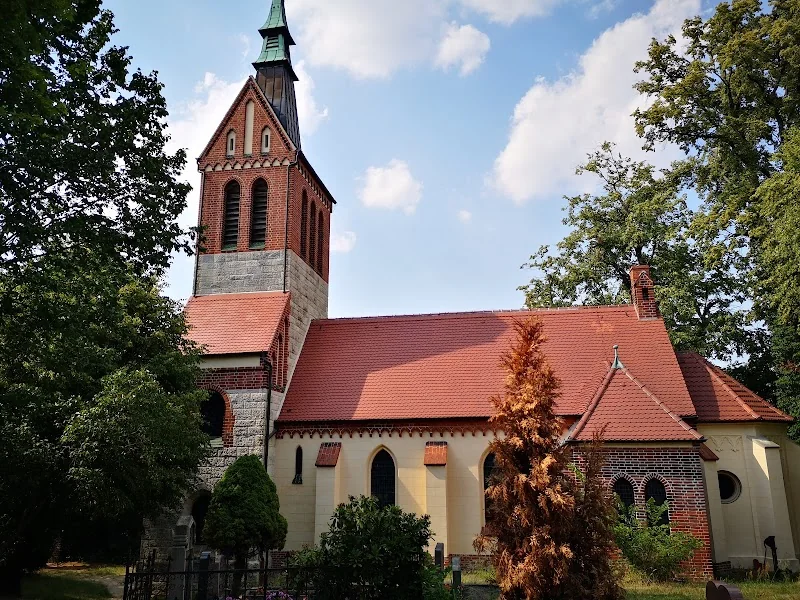
The Village Church Uetz is one of those places where village history, sacred architecture, and vibrant community practice in Potsdam come together very directly. In Uetz-Paaren, a northern district of the state capital, stands a neo-Gothic hall church, which was built around 1870 using medieval remnants, and whose bell tower was added around 1900. Visitors to the church experience not a museum-like void, but a building with clear historical depth, visible craftsmanship, and a location closely connected to the landscape between Potsdam and Paretz. Particularly characteristic are the uniform interior from the time of construction, the wooden barrel vault, the original Schuke organ, the patronage box, and an artistically crafted linden wood relief by Jakob Alberty. Thus, the church is suitable not only for those interested in village churches in Brandenburg but also for anyone seeking an authentic cultural venue in Potsdam away from the well-known palaces and large stages. By opening its doors for services and selected events, it remains part of church life and at the same time a significant monument in the village-shaped northern part of the city.
History of the Village Church Uetz: from medieval house of worship to neo-Gothic hall church
The history of the Village Church Uetz does not begin with the current 19th-century building, but much earlier. A place of worship is said to have existed at the site as early as the 14th century, reportedly built by a spiritual brotherhood. This is important for historical classification because the church is thus embedded in a very old settlement and religious landscape. The current building is therefore not an isolated monument but the result of a long succession of use, remodeling, renewal, and preservation. Another early testimony to the building history dates back to 1689; this document is referred to as the oldest record of the church's history and shows that the place already had local significance at that time. The present neo-Gothic church was finally built around 1870 using medieval remnants. Thus, it belongs to those Mark Brandenburg village churches that were newly constructed in the mid or late 19th century without losing their historical depth. The broad bell tower was added around 1900 and significantly changed the external appearance once again. This resulted in a building that unites medieval origins, the 19th century, and early 20th-century additions in a comparatively clear form.
For understanding the Village Church Uetz, the surrounding area of the place itself is also important. Uetz and Paaren formed a double community since 1961 and have belonged to the state capital Potsdam since October 2003. This administrative development explains why the church is now located in a village-shaped district and yet is part of the Potsdam monument and cultural landscape. Uetz has been a developed place for centuries, with roots that reach far back; the city describes Uetz-Paaren as a landscape area with ancient settlement, former fishermen, farmers, and a close relationship with the Wublitz. Such references make it understandable why the church is still perceived not only as a building monument but also as a point of identification for the place. Especially in an environment that presents itself as rural and quiet despite urban affiliation, church buildings often act as historical centers of an entire community part. The Village Church Uetz fulfills exactly this function. It bundles memory, religious practice, and cultural continuity. Therefore, anyone who engages with the history of the church also learns something about the history of Uetz-Paaren, about the development of Mark Brandenburg village culture, and about the role of small church spaces in a changing urban landscape.
Particularly interesting is also the location on a historical connection axis. The church is located on the King's Road to Paretz, that is, on the route that connected the residence of Potsdam with Queen Louise's summer residence. This links the Village Church Uetz with the Prussian cultural landscape far beyond the local framework. The place was not just a village on the edge but part of a landscape and political movement line between city, seat of power, and rural area. This connection also explains why the church is described in monument texts not merely as a village church but as a historically significant point. For today's visitors, this is a gain: one experiences a place that seems quiet but possesses many layers. One sees a house of worship that has grown over centuries, and at the same time, a point on a historical route where architecture, piety, and landscape combine to create a dense impression.
The recent history also shows that the church remains in the public consciousness to this day. During the Day of Open Monuments, it was presented with restoration work, music, discussions, and a lecture. Such events are not just marginal activities but expressions of ongoing engagement with the building. A monument that is restored, explained, and presented in current contexts remains part of a lively cultural conversation. The Village Church Uetz thus demonstrates how a historical sacred building can have an impact in the 21st century: as a place of memory, as a space for church use, and as a destination for people seeking genuine history on site.
Architecture, furnishings, and the special artwork in the interior
Architecturally, the Village Church Uetz is a clear representative of neo-Gothic sacred architecture in Brandenburg. The building was constructed around 1870 as a hall church and was built on the remnants of a much older predecessor building. This combination of historical substance and neo-Gothic form language shapes the character of the building to this day. Unlike many churches that have undergone profound renovations multiple times over the centuries, the church in Uetz appears comparatively closed. This is also emphasized in the official descriptions: the uniform interior comes from the time of construction. This finding makes the building so worth reading. It offers not only an exterior view and history but also an interior that has largely remained coherent in its design language. The church is thus not merely a shell for events but a closed art and history ensemble.
A central component of the exterior effect is the broad bell tower, which tapers upwards and was added around 1900. Its limestone cladding distinguishes it from the wall surface and gives the building a clear vertical marking. For village churches, such a tower is not only an architectural sign but also a point of orientation in the local landscape. In Uetz, it enhances the perception of the church as the center of the village. The tower complements the older neo-Gothic building without overshadowing it. This creates an image that fits well with the character of Mark Brandenburg village churches: simple enough to fit into the landscape and distinctive enough to assert itself as a special building in everyday life. Anyone observing the building from the outside quickly recognizes that this is a historical place that has been thoughtfully developed further.
Inside, the historical quality becomes even clearer. Notably mentioned are a wooden barrel vault with decorations, an original Schuke organ, and the patronage box. These elements indicate that the church was not only planned as a simple worship space but also had a representational and memorial value. The barrel vault gives the space a calm, almost floating structure. The decorations ensure that the construction does not appear austere but is crafted and designed. The patronage box refers to the historical social and church order, in which certain families or benefactors held a special position. Together with the organ, a space emerges that is acoustically and visually oriented towards liturgical and musical use. The mention of the original Schuke organ shows that the church is also of interest to music lovers. Such an organ is more than an instrument; it is part of the historical interior composition and significantly contributes to the identity of the church space.
Another remarkable detail is the linden wood relief of the burial of Jesus, created in 1838 by Jakob Alberty. This work distinguishes the Village Church Uetz from many other rural churches because it sets a clearly identifiable art-historical accent. The relief is not merely decoration but a testament to religious imagery and local art history. Especially in small village churches, such pieces often represent the connection between craftsmanship, piety, and individual artistic handwriting. The fact that a relief can be named with such a specific date of origin makes it particularly interesting for visitors. It is a piece of visible history that imbues the interior with a personal and artistic expression. Together with the later restored carpet painting in the apse, a space is created that preserves the old while being carefully maintained. The impression is not that of a spectacular monumental church but of a finely balanced, historically dense space.
When considering the furnishings, one should also keep the restoration context in mind. The church was explicitly presented in connection with ongoing or recently discussed restoration work during the Day of Open Monuments 2025. Discussion offers with restorers, references to the restored apse, and the emphasis on the preserved furnishings show that here not only the past is exhibited but substance is preserved. For a village church, this is an important signal. It means that the historical elements are not merely surviving as random remnants but are understood as protectable components of a cultural monument. Thus, anyone visiting Uetz encounters an interior that is both a work of art and a documented historical source.
Directions to the Village Church Uetz, location on the King's Road, and orientation in Potsdam
The Village Church Uetz is located in a place that is almost as important for its perception as the building itself. Its address is Uetzer Dorfstraße 21A in 14476 Potsdam, in the northern, rural part of the city. This location already says a lot about the character of the visit. One does not drive into a dense city center but into a district where village structure, nature, and historical paths are still strongly visible. The church thus stands in an environment that offers both tranquility and orientation. Especially for people who want to experience churches not just as buildings but as components of a landscape, the Village Church Uetz is a worthwhile destination. The public perception of the place is closely linked to the King's Road. This historic path connected the residence of Potsdam with Queen Louise's summer residence in Paretz and makes it clear that the church is not located at the edge of some path but on an axis of historical significance.
For travel, it is advisable to take the location in the Uetz-Paaren district as a starting point. The church is part of a district that has belonged to Potsdam since 2003 but has retained its rural character. Those traveling from the center experience a clear change in the environment: from the urban area to an open landscape with meadows, water references, and village buildings. This fits the historical function of the church as the center of a small place. In such locations, the journey itself becomes part of the visit experience. The path leads not only to a destination but into a different interpretation of the city. This is where the great appeal of the Village Church Uetz lies: it is Potsdam and yet not Potsdam, urban administrated and yet distinctly rural.
On the current monument page, the stop Church Uetz was mentioned for special dates; additionally, bus 614 from Potsdam Central Station was indicated. This is practical guidance for visitors as it makes travel by public transport easily planable. Especially for smaller churches in the surrounding area, it is helpful to have a clearly named stop. At the same time, this connection emphasizes that the church is not isolated but accessible. Those traveling by train and bus can easily incorporate the visit into an excursion through northern Potsdam. Additionally, it is interesting for cycling and hiking enthusiasts that the city describes Uetz as a station of the Fontane hiking trail and also assigns significance to the cycling route around Berlin along the Havel Canal. Thus, the Village Church Uetz is located at a crossroads of cultural paths, landscape routes, and regional mobility.
The immediate surroundings are also important for orientation. Uetz-Paaren lies on the Wublitz and is one of the northern districts of Potsdam, where nature and settlement space are closely intertwined. Visitors to the church can therefore plan the journey very well as part of a larger excursion: church, village structure, water landscape, and historical paths form a coherent backdrop. The relationship to the King's Road is particularly strong because it gives the church a clear historical framework. It is not just about finding an address but about seeking a place that once lay on a significant connection line. This adds depth to the visit and makes the church attractive for culturally and historically interested guests.
In practice, this means: The Village Church Uetz should not be approached like a big city attraction but like a quiet, locally rooted monument. Those who check the transport connection in advance, plan the Uetz-Paaren district as a destination, and allow enough time for the journey through the surroundings will experience the church with the necessary calm. This is often the best access to such buildings. The location, the journey, and the historical path network are inseparable from the significance of the building.
Services, opening hours, and Day of Open Monuments at the Church Uetz
The Village Church Uetz is not a monument that is only viewed from a distance. It remains part of the vibrant community life as a church space. The website of the Brandenburg travel region explicitly states that the church is open for services. This is important information because it shows that the building is not understood exclusively in a museum context. The church remains a space for devotion, spiritual practice, and gathering. For visitors, this means that the use of the church goes beyond mere monument status. It is a sacred building that has not lost its liturgical function. This is where a special value lies: historical buildings remain most convincing when they are not only documented but also used.
The church regularly receives special attention during the Day of Open Monuments. For 2025, an opening time of 2 PM to 7 PM was mentioned. Pastor Almut Gaedt was listed as the contact person in relation to the Evangelical Peter Church Community at Havel and Wublitz. The program vividly illustrated how a village church building can be culturally activated today: there were discussions with restorers about the work in the church, coffee and cake, jazz music with a Potsdam and Berlin band, and a lecture on the history and present of the Uetz church. Such programs make it clear that the Village Church Uetz is not only preserved but also conveyed. People come not just to see a facade but to learn about restoration, history, and artistic details. The interplay of monument, music, and conversation is very harmonious for such a place.
Another practical note from the same source concerns accessibility: the church is not barrier-free. This is also important as it sets realistic expectations and allows visitors to plan better. Especially in historical buildings, accessibility is often only limited, and clear communication helps avoid disappointments. Those arriving with special needs should consider this in advance. At the same time, the note shows that the church is perceived as an open event venue and its accessibility is treated transparently. This is part of serious monument communication, just like the description of restorations and open dates.
In connection with the events, the role of the church as a place of music should also be highlighted. The Day of Open Monuments 2025 combined restoration discussions with jazz and a lecture. Earlier monument notes also mentioned music on the organ. This reveals a significant aspect of the Village Church Uetz: it is a space where sound, history, and devotion come together. A historical church with a preserved organ and good acoustics is suitable for musical formats that do not overshadow the space but bring it to life. This fits very well with its character as a neo-Gothic hall church with a closed interior.
Therefore, those planning a visit should distinguish between three levels: regular worship use, special monument dates, and individual visits as part of an excursion. Each of these levels presents the church in a slightly different light. In the service, it is primarily a place for the community. During the Day of Open Monuments, it becomes a cultural monument with educational offerings. As a destination for architecture and history enthusiasts, it is ultimately a quiet, very concrete place for careful observation. This multifunctionality makes the Village Church Uetz so interesting. It is neither just a monument nor just a church space, but both in a convincing form.
Uetz-Paaren, Wublitz, and the church environment in northern Potsdam
Those who want to understand the Village Church Uetz should also consider the environment of Uetz-Paaren. The city of Potsdam describes the district as a rural area along the Wublitz, with a long settlement history, early original villages, and a clearly pronounced connection to nature. For Uetz, early mentions from 1313 are cited, and for Paaren from 1354. The oldest traces of settlement even date back to the Neolithic. This shows that the church does not stand in a random suburb but in a landscape area with enormous historical depth. Such backgrounds give the Village Church Uetz additional significance because it is embedded in a settlement landscape that existed long before the current city status.
The church environment is also interesting. Current information assigns the Village Church Uetz to the parish area of Alt Töplitz, and on the website of the Holy Spirit Church Community in Werder (Havel), the church is listed as part of the local church and community complex. For visitors, this means: the church is not isolated but integrated into church structures that connect several places and community parts. Such connections are typical for the rural area of Brandenburg. A single village church often carries not only its own history but is part of a network of churches, cemeteries, communities, and cultural offerings. This is precisely why Uetz is also interesting for people who are interested in community history and church regions.
Moreover, the surrounding area is scenically appealing. The city refers to the Wublitz, to meadows and pastures, to riding paths, and to a broad natural backdrop. Uetz is also a station of the Fontane hiking trail, and the European hiking trail E10 runs through Paaren, as well as the cycling route around Berlin along the Havel Canal. Thus, the church is located in an area that is excellent for combined cultural and nature tours. A visit to the Village Church Uetz can therefore be combined with walks, bike rides, or a look at other village attractions. Mentioned in the Potsdam local profiling are, among others, the Village Church Paaren, the ferry house, and the Schatullgut Uetz. Such neighborhoods make it clear that this is an exceptionally dense historical district.
The cultural identity of the district also plays a role. The city mentions activities for Uetz-Paaren such as fire brigade, Easter fire, spring cleaning, an apple and culture association, hunting societies, and a women's circle of the evangelical church community. These are indications of a lively local community that goes beyond mere residential function. Churches like the Village Church Uetz are often not just buildings in such structures but meeting points, places of remembrance, and anchor points of cohesion. This explains why their maintenance and opening are important to many people. A village church building thrives on the connection between monument preservation and community life. When both come together, the place does not remain static but retains significance.
For visitors, this results in a very coherent overall picture. The Village Church Uetz is not an isolated destination but part of a larger northern Potsdam landscape and cultural area. Those interested in small churches in Brandenburg, historical paths, the Wublitz, or rural districts with genuine history will find a convincing point of contact here. The appeal lies precisely in the combination of proximity and tranquility: the church is easily accessible, yet it remains a quiet, concentrated address. It connects the broad arc of Potsdam's history with the concrete experience of a village where a church building has remained the center for centuries.
In the end, there is therefore a clear impression: The Village Church Uetz is more than a church building. It is a monument with medieval roots, a neo-Gothic building with a carefully preserved interior, a place on the historic King's Road, and a vibrant part of church life in northern Potsdam. This mixture makes it so attractive for all who want to not only read history but experience it at a concrete place.
Sources:
Show moreShow less
Village Church Uetz | History & Architecture
The Village Church Uetz is one of those places where village history, sacred architecture, and vibrant community practice in Potsdam come together very directly. In Uetz-Paaren, a northern district of the state capital, stands a neo-Gothic hall church, which was built around 1870 using medieval remnants, and whose bell tower was added around 1900. Visitors to the church experience not a museum-like void, but a building with clear historical depth, visible craftsmanship, and a location closely connected to the landscape between Potsdam and Paretz. Particularly characteristic are the uniform interior from the time of construction, the wooden barrel vault, the original Schuke organ, the patronage box, and an artistically crafted linden wood relief by Jakob Alberty. Thus, the church is suitable not only for those interested in village churches in Brandenburg but also for anyone seeking an authentic cultural venue in Potsdam away from the well-known palaces and large stages. By opening its doors for services and selected events, it remains part of church life and at the same time a significant monument in the village-shaped northern part of the city.
History of the Village Church Uetz: from medieval house of worship to neo-Gothic hall church
The history of the Village Church Uetz does not begin with the current 19th-century building, but much earlier. A place of worship is said to have existed at the site as early as the 14th century, reportedly built by a spiritual brotherhood. This is important for historical classification because the church is thus embedded in a very old settlement and religious landscape. The current building is therefore not an isolated monument but the result of a long succession of use, remodeling, renewal, and preservation. Another early testimony to the building history dates back to 1689; this document is referred to as the oldest record of the church's history and shows that the place already had local significance at that time. The present neo-Gothic church was finally built around 1870 using medieval remnants. Thus, it belongs to those Mark Brandenburg village churches that were newly constructed in the mid or late 19th century without losing their historical depth. The broad bell tower was added around 1900 and significantly changed the external appearance once again. This resulted in a building that unites medieval origins, the 19th century, and early 20th-century additions in a comparatively clear form.
For understanding the Village Church Uetz, the surrounding area of the place itself is also important. Uetz and Paaren formed a double community since 1961 and have belonged to the state capital Potsdam since October 2003. This administrative development explains why the church is now located in a village-shaped district and yet is part of the Potsdam monument and cultural landscape. Uetz has been a developed place for centuries, with roots that reach far back; the city describes Uetz-Paaren as a landscape area with ancient settlement, former fishermen, farmers, and a close relationship with the Wublitz. Such references make it understandable why the church is still perceived not only as a building monument but also as a point of identification for the place. Especially in an environment that presents itself as rural and quiet despite urban affiliation, church buildings often act as historical centers of an entire community part. The Village Church Uetz fulfills exactly this function. It bundles memory, religious practice, and cultural continuity. Therefore, anyone who engages with the history of the church also learns something about the history of Uetz-Paaren, about the development of Mark Brandenburg village culture, and about the role of small church spaces in a changing urban landscape.
Particularly interesting is also the location on a historical connection axis. The church is located on the King's Road to Paretz, that is, on the route that connected the residence of Potsdam with Queen Louise's summer residence. This links the Village Church Uetz with the Prussian cultural landscape far beyond the local framework. The place was not just a village on the edge but part of a landscape and political movement line between city, seat of power, and rural area. This connection also explains why the church is described in monument texts not merely as a village church but as a historically significant point. For today's visitors, this is a gain: one experiences a place that seems quiet but possesses many layers. One sees a house of worship that has grown over centuries, and at the same time, a point on a historical route where architecture, piety, and landscape combine to create a dense impression.
The recent history also shows that the church remains in the public consciousness to this day. During the Day of Open Monuments, it was presented with restoration work, music, discussions, and a lecture. Such events are not just marginal activities but expressions of ongoing engagement with the building. A monument that is restored, explained, and presented in current contexts remains part of a lively cultural conversation. The Village Church Uetz thus demonstrates how a historical sacred building can have an impact in the 21st century: as a place of memory, as a space for church use, and as a destination for people seeking genuine history on site.
Architecture, furnishings, and the special artwork in the interior
Architecturally, the Village Church Uetz is a clear representative of neo-Gothic sacred architecture in Brandenburg. The building was constructed around 1870 as a hall church and was built on the remnants of a much older predecessor building. This combination of historical substance and neo-Gothic form language shapes the character of the building to this day. Unlike many churches that have undergone profound renovations multiple times over the centuries, the church in Uetz appears comparatively closed. This is also emphasized in the official descriptions: the uniform interior comes from the time of construction. This finding makes the building so worth reading. It offers not only an exterior view and history but also an interior that has largely remained coherent in its design language. The church is thus not merely a shell for events but a closed art and history ensemble.
A central component of the exterior effect is the broad bell tower, which tapers upwards and was added around 1900. Its limestone cladding distinguishes it from the wall surface and gives the building a clear vertical marking. For village churches, such a tower is not only an architectural sign but also a point of orientation in the local landscape. In Uetz, it enhances the perception of the church as the center of the village. The tower complements the older neo-Gothic building without overshadowing it. This creates an image that fits well with the character of Mark Brandenburg village churches: simple enough to fit into the landscape and distinctive enough to assert itself as a special building in everyday life. Anyone observing the building from the outside quickly recognizes that this is a historical place that has been thoughtfully developed further.
Inside, the historical quality becomes even clearer. Notably mentioned are a wooden barrel vault with decorations, an original Schuke organ, and the patronage box. These elements indicate that the church was not only planned as a simple worship space but also had a representational and memorial value. The barrel vault gives the space a calm, almost floating structure. The decorations ensure that the construction does not appear austere but is crafted and designed. The patronage box refers to the historical social and church order, in which certain families or benefactors held a special position. Together with the organ, a space emerges that is acoustically and visually oriented towards liturgical and musical use. The mention of the original Schuke organ shows that the church is also of interest to music lovers. Such an organ is more than an instrument; it is part of the historical interior composition and significantly contributes to the identity of the church space.
Another remarkable detail is the linden wood relief of the burial of Jesus, created in 1838 by Jakob Alberty. This work distinguishes the Village Church Uetz from many other rural churches because it sets a clearly identifiable art-historical accent. The relief is not merely decoration but a testament to religious imagery and local art history. Especially in small village churches, such pieces often represent the connection between craftsmanship, piety, and individual artistic handwriting. The fact that a relief can be named with such a specific date of origin makes it particularly interesting for visitors. It is a piece of visible history that imbues the interior with a personal and artistic expression. Together with the later restored carpet painting in the apse, a space is created that preserves the old while being carefully maintained. The impression is not that of a spectacular monumental church but of a finely balanced, historically dense space.
When considering the furnishings, one should also keep the restoration context in mind. The church was explicitly presented in connection with ongoing or recently discussed restoration work during the Day of Open Monuments 2025. Discussion offers with restorers, references to the restored apse, and the emphasis on the preserved furnishings show that here not only the past is exhibited but substance is preserved. For a village church, this is an important signal. It means that the historical elements are not merely surviving as random remnants but are understood as protectable components of a cultural monument. Thus, anyone visiting Uetz encounters an interior that is both a work of art and a documented historical source.
Directions to the Village Church Uetz, location on the King's Road, and orientation in Potsdam
The Village Church Uetz is located in a place that is almost as important for its perception as the building itself. Its address is Uetzer Dorfstraße 21A in 14476 Potsdam, in the northern, rural part of the city. This location already says a lot about the character of the visit. One does not drive into a dense city center but into a district where village structure, nature, and historical paths are still strongly visible. The church thus stands in an environment that offers both tranquility and orientation. Especially for people who want to experience churches not just as buildings but as components of a landscape, the Village Church Uetz is a worthwhile destination. The public perception of the place is closely linked to the King's Road. This historic path connected the residence of Potsdam with Queen Louise's summer residence in Paretz and makes it clear that the church is not located at the edge of some path but on an axis of historical significance.
For travel, it is advisable to take the location in the Uetz-Paaren district as a starting point. The church is part of a district that has belonged to Potsdam since 2003 but has retained its rural character. Those traveling from the center experience a clear change in the environment: from the urban area to an open landscape with meadows, water references, and village buildings. This fits the historical function of the church as the center of a small place. In such locations, the journey itself becomes part of the visit experience. The path leads not only to a destination but into a different interpretation of the city. This is where the great appeal of the Village Church Uetz lies: it is Potsdam and yet not Potsdam, urban administrated and yet distinctly rural.
On the current monument page, the stop Church Uetz was mentioned for special dates; additionally, bus 614 from Potsdam Central Station was indicated. This is practical guidance for visitors as it makes travel by public transport easily planable. Especially for smaller churches in the surrounding area, it is helpful to have a clearly named stop. At the same time, this connection emphasizes that the church is not isolated but accessible. Those traveling by train and bus can easily incorporate the visit into an excursion through northern Potsdam. Additionally, it is interesting for cycling and hiking enthusiasts that the city describes Uetz as a station of the Fontane hiking trail and also assigns significance to the cycling route around Berlin along the Havel Canal. Thus, the Village Church Uetz is located at a crossroads of cultural paths, landscape routes, and regional mobility.
The immediate surroundings are also important for orientation. Uetz-Paaren lies on the Wublitz and is one of the northern districts of Potsdam, where nature and settlement space are closely intertwined. Visitors to the church can therefore plan the journey very well as part of a larger excursion: church, village structure, water landscape, and historical paths form a coherent backdrop. The relationship to the King's Road is particularly strong because it gives the church a clear historical framework. It is not just about finding an address but about seeking a place that once lay on a significant connection line. This adds depth to the visit and makes the church attractive for culturally and historically interested guests.
In practice, this means: The Village Church Uetz should not be approached like a big city attraction but like a quiet, locally rooted monument. Those who check the transport connection in advance, plan the Uetz-Paaren district as a destination, and allow enough time for the journey through the surroundings will experience the church with the necessary calm. This is often the best access to such buildings. The location, the journey, and the historical path network are inseparable from the significance of the building.
Services, opening hours, and Day of Open Monuments at the Church Uetz
The Village Church Uetz is not a monument that is only viewed from a distance. It remains part of the vibrant community life as a church space. The website of the Brandenburg travel region explicitly states that the church is open for services. This is important information because it shows that the building is not understood exclusively in a museum context. The church remains a space for devotion, spiritual practice, and gathering. For visitors, this means that the use of the church goes beyond mere monument status. It is a sacred building that has not lost its liturgical function. This is where a special value lies: historical buildings remain most convincing when they are not only documented but also used.
The church regularly receives special attention during the Day of Open Monuments. For 2025, an opening time of 2 PM to 7 PM was mentioned. Pastor Almut Gaedt was listed as the contact person in relation to the Evangelical Peter Church Community at Havel and Wublitz. The program vividly illustrated how a village church building can be culturally activated today: there were discussions with restorers about the work in the church, coffee and cake, jazz music with a Potsdam and Berlin band, and a lecture on the history and present of the Uetz church. Such programs make it clear that the Village Church Uetz is not only preserved but also conveyed. People come not just to see a facade but to learn about restoration, history, and artistic details. The interplay of monument, music, and conversation is very harmonious for such a place.
Another practical note from the same source concerns accessibility: the church is not barrier-free. This is also important as it sets realistic expectations and allows visitors to plan better. Especially in historical buildings, accessibility is often only limited, and clear communication helps avoid disappointments. Those arriving with special needs should consider this in advance. At the same time, the note shows that the church is perceived as an open event venue and its accessibility is treated transparently. This is part of serious monument communication, just like the description of restorations and open dates.
In connection with the events, the role of the church as a place of music should also be highlighted. The Day of Open Monuments 2025 combined restoration discussions with jazz and a lecture. Earlier monument notes also mentioned music on the organ. This reveals a significant aspect of the Village Church Uetz: it is a space where sound, history, and devotion come together. A historical church with a preserved organ and good acoustics is suitable for musical formats that do not overshadow the space but bring it to life. This fits very well with its character as a neo-Gothic hall church with a closed interior.
Therefore, those planning a visit should distinguish between three levels: regular worship use, special monument dates, and individual visits as part of an excursion. Each of these levels presents the church in a slightly different light. In the service, it is primarily a place for the community. During the Day of Open Monuments, it becomes a cultural monument with educational offerings. As a destination for architecture and history enthusiasts, it is ultimately a quiet, very concrete place for careful observation. This multifunctionality makes the Village Church Uetz so interesting. It is neither just a monument nor just a church space, but both in a convincing form.
Uetz-Paaren, Wublitz, and the church environment in northern Potsdam
Those who want to understand the Village Church Uetz should also consider the environment of Uetz-Paaren. The city of Potsdam describes the district as a rural area along the Wublitz, with a long settlement history, early original villages, and a clearly pronounced connection to nature. For Uetz, early mentions from 1313 are cited, and for Paaren from 1354. The oldest traces of settlement even date back to the Neolithic. This shows that the church does not stand in a random suburb but in a landscape area with enormous historical depth. Such backgrounds give the Village Church Uetz additional significance because it is embedded in a settlement landscape that existed long before the current city status.
The church environment is also interesting. Current information assigns the Village Church Uetz to the parish area of Alt Töplitz, and on the website of the Holy Spirit Church Community in Werder (Havel), the church is listed as part of the local church and community complex. For visitors, this means: the church is not isolated but integrated into church structures that connect several places and community parts. Such connections are typical for the rural area of Brandenburg. A single village church often carries not only its own history but is part of a network of churches, cemeteries, communities, and cultural offerings. This is precisely why Uetz is also interesting for people who are interested in community history and church regions.
Moreover, the surrounding area is scenically appealing. The city refers to the Wublitz, to meadows and pastures, to riding paths, and to a broad natural backdrop. Uetz is also a station of the Fontane hiking trail, and the European hiking trail E10 runs through Paaren, as well as the cycling route around Berlin along the Havel Canal. Thus, the church is located in an area that is excellent for combined cultural and nature tours. A visit to the Village Church Uetz can therefore be combined with walks, bike rides, or a look at other village attractions. Mentioned in the Potsdam local profiling are, among others, the Village Church Paaren, the ferry house, and the Schatullgut Uetz. Such neighborhoods make it clear that this is an exceptionally dense historical district.
The cultural identity of the district also plays a role. The city mentions activities for Uetz-Paaren such as fire brigade, Easter fire, spring cleaning, an apple and culture association, hunting societies, and a women's circle of the evangelical church community. These are indications of a lively local community that goes beyond mere residential function. Churches like the Village Church Uetz are often not just buildings in such structures but meeting points, places of remembrance, and anchor points of cohesion. This explains why their maintenance and opening are important to many people. A village church building thrives on the connection between monument preservation and community life. When both come together, the place does not remain static but retains significance.
For visitors, this results in a very coherent overall picture. The Village Church Uetz is not an isolated destination but part of a larger northern Potsdam landscape and cultural area. Those interested in small churches in Brandenburg, historical paths, the Wublitz, or rural districts with genuine history will find a convincing point of contact here. The appeal lies precisely in the combination of proximity and tranquility: the church is easily accessible, yet it remains a quiet, concentrated address. It connects the broad arc of Potsdam's history with the concrete experience of a village where a church building has remained the center for centuries.
In the end, there is therefore a clear impression: The Village Church Uetz is more than a church building. It is a monument with medieval roots, a neo-Gothic building with a carefully preserved interior, a place on the historic King's Road, and a vibrant part of church life in northern Potsdam. This mixture makes it so attractive for all who want to not only read history but experience it at a concrete place.
Sources:
Village Church Uetz | History & Architecture
The Village Church Uetz is one of those places where village history, sacred architecture, and vibrant community practice in Potsdam come together very directly. In Uetz-Paaren, a northern district of the state capital, stands a neo-Gothic hall church, which was built around 1870 using medieval remnants, and whose bell tower was added around 1900. Visitors to the church experience not a museum-like void, but a building with clear historical depth, visible craftsmanship, and a location closely connected to the landscape between Potsdam and Paretz. Particularly characteristic are the uniform interior from the time of construction, the wooden barrel vault, the original Schuke organ, the patronage box, and an artistically crafted linden wood relief by Jakob Alberty. Thus, the church is suitable not only for those interested in village churches in Brandenburg but also for anyone seeking an authentic cultural venue in Potsdam away from the well-known palaces and large stages. By opening its doors for services and selected events, it remains part of church life and at the same time a significant monument in the village-shaped northern part of the city.
History of the Village Church Uetz: from medieval house of worship to neo-Gothic hall church
The history of the Village Church Uetz does not begin with the current 19th-century building, but much earlier. A place of worship is said to have existed at the site as early as the 14th century, reportedly built by a spiritual brotherhood. This is important for historical classification because the church is thus embedded in a very old settlement and religious landscape. The current building is therefore not an isolated monument but the result of a long succession of use, remodeling, renewal, and preservation. Another early testimony to the building history dates back to 1689; this document is referred to as the oldest record of the church's history and shows that the place already had local significance at that time. The present neo-Gothic church was finally built around 1870 using medieval remnants. Thus, it belongs to those Mark Brandenburg village churches that were newly constructed in the mid or late 19th century without losing their historical depth. The broad bell tower was added around 1900 and significantly changed the external appearance once again. This resulted in a building that unites medieval origins, the 19th century, and early 20th-century additions in a comparatively clear form.
For understanding the Village Church Uetz, the surrounding area of the place itself is also important. Uetz and Paaren formed a double community since 1961 and have belonged to the state capital Potsdam since October 2003. This administrative development explains why the church is now located in a village-shaped district and yet is part of the Potsdam monument and cultural landscape. Uetz has been a developed place for centuries, with roots that reach far back; the city describes Uetz-Paaren as a landscape area with ancient settlement, former fishermen, farmers, and a close relationship with the Wublitz. Such references make it understandable why the church is still perceived not only as a building monument but also as a point of identification for the place. Especially in an environment that presents itself as rural and quiet despite urban affiliation, church buildings often act as historical centers of an entire community part. The Village Church Uetz fulfills exactly this function. It bundles memory, religious practice, and cultural continuity. Therefore, anyone who engages with the history of the church also learns something about the history of Uetz-Paaren, about the development of Mark Brandenburg village culture, and about the role of small church spaces in a changing urban landscape.
Particularly interesting is also the location on a historical connection axis. The church is located on the King's Road to Paretz, that is, on the route that connected the residence of Potsdam with Queen Louise's summer residence. This links the Village Church Uetz with the Prussian cultural landscape far beyond the local framework. The place was not just a village on the edge but part of a landscape and political movement line between city, seat of power, and rural area. This connection also explains why the church is described in monument texts not merely as a village church but as a historically significant point. For today's visitors, this is a gain: one experiences a place that seems quiet but possesses many layers. One sees a house of worship that has grown over centuries, and at the same time, a point on a historical route where architecture, piety, and landscape combine to create a dense impression.
The recent history also shows that the church remains in the public consciousness to this day. During the Day of Open Monuments, it was presented with restoration work, music, discussions, and a lecture. Such events are not just marginal activities but expressions of ongoing engagement with the building. A monument that is restored, explained, and presented in current contexts remains part of a lively cultural conversation. The Village Church Uetz thus demonstrates how a historical sacred building can have an impact in the 21st century: as a place of memory, as a space for church use, and as a destination for people seeking genuine history on site.
Architecture, furnishings, and the special artwork in the interior
Architecturally, the Village Church Uetz is a clear representative of neo-Gothic sacred architecture in Brandenburg. The building was constructed around 1870 as a hall church and was built on the remnants of a much older predecessor building. This combination of historical substance and neo-Gothic form language shapes the character of the building to this day. Unlike many churches that have undergone profound renovations multiple times over the centuries, the church in Uetz appears comparatively closed. This is also emphasized in the official descriptions: the uniform interior comes from the time of construction. This finding makes the building so worth reading. It offers not only an exterior view and history but also an interior that has largely remained coherent in its design language. The church is thus not merely a shell for events but a closed art and history ensemble.
A central component of the exterior effect is the broad bell tower, which tapers upwards and was added around 1900. Its limestone cladding distinguishes it from the wall surface and gives the building a clear vertical marking. For village churches, such a tower is not only an architectural sign but also a point of orientation in the local landscape. In Uetz, it enhances the perception of the church as the center of the village. The tower complements the older neo-Gothic building without overshadowing it. This creates an image that fits well with the character of Mark Brandenburg village churches: simple enough to fit into the landscape and distinctive enough to assert itself as a special building in everyday life. Anyone observing the building from the outside quickly recognizes that this is a historical place that has been thoughtfully developed further.
Inside, the historical quality becomes even clearer. Notably mentioned are a wooden barrel vault with decorations, an original Schuke organ, and the patronage box. These elements indicate that the church was not only planned as a simple worship space but also had a representational and memorial value. The barrel vault gives the space a calm, almost floating structure. The decorations ensure that the construction does not appear austere but is crafted and designed. The patronage box refers to the historical social and church order, in which certain families or benefactors held a special position. Together with the organ, a space emerges that is acoustically and visually oriented towards liturgical and musical use. The mention of the original Schuke organ shows that the church is also of interest to music lovers. Such an organ is more than an instrument; it is part of the historical interior composition and significantly contributes to the identity of the church space.
Another remarkable detail is the linden wood relief of the burial of Jesus, created in 1838 by Jakob Alberty. This work distinguishes the Village Church Uetz from many other rural churches because it sets a clearly identifiable art-historical accent. The relief is not merely decoration but a testament to religious imagery and local art history. Especially in small village churches, such pieces often represent the connection between craftsmanship, piety, and individual artistic handwriting. The fact that a relief can be named with such a specific date of origin makes it particularly interesting for visitors. It is a piece of visible history that imbues the interior with a personal and artistic expression. Together with the later restored carpet painting in the apse, a space is created that preserves the old while being carefully maintained. The impression is not that of a spectacular monumental church but of a finely balanced, historically dense space.
When considering the furnishings, one should also keep the restoration context in mind. The church was explicitly presented in connection with ongoing or recently discussed restoration work during the Day of Open Monuments 2025. Discussion offers with restorers, references to the restored apse, and the emphasis on the preserved furnishings show that here not only the past is exhibited but substance is preserved. For a village church, this is an important signal. It means that the historical elements are not merely surviving as random remnants but are understood as protectable components of a cultural monument. Thus, anyone visiting Uetz encounters an interior that is both a work of art and a documented historical source.
Directions to the Village Church Uetz, location on the King's Road, and orientation in Potsdam
The Village Church Uetz is located in a place that is almost as important for its perception as the building itself. Its address is Uetzer Dorfstraße 21A in 14476 Potsdam, in the northern, rural part of the city. This location already says a lot about the character of the visit. One does not drive into a dense city center but into a district where village structure, nature, and historical paths are still strongly visible. The church thus stands in an environment that offers both tranquility and orientation. Especially for people who want to experience churches not just as buildings but as components of a landscape, the Village Church Uetz is a worthwhile destination. The public perception of the place is closely linked to the King's Road. This historic path connected the residence of Potsdam with Queen Louise's summer residence in Paretz and makes it clear that the church is not located at the edge of some path but on an axis of historical significance.
For travel, it is advisable to take the location in the Uetz-Paaren district as a starting point. The church is part of a district that has belonged to Potsdam since 2003 but has retained its rural character. Those traveling from the center experience a clear change in the environment: from the urban area to an open landscape with meadows, water references, and village buildings. This fits the historical function of the church as the center of a small place. In such locations, the journey itself becomes part of the visit experience. The path leads not only to a destination but into a different interpretation of the city. This is where the great appeal of the Village Church Uetz lies: it is Potsdam and yet not Potsdam, urban administrated and yet distinctly rural.
On the current monument page, the stop Church Uetz was mentioned for special dates; additionally, bus 614 from Potsdam Central Station was indicated. This is practical guidance for visitors as it makes travel by public transport easily planable. Especially for smaller churches in the surrounding area, it is helpful to have a clearly named stop. At the same time, this connection emphasizes that the church is not isolated but accessible. Those traveling by train and bus can easily incorporate the visit into an excursion through northern Potsdam. Additionally, it is interesting for cycling and hiking enthusiasts that the city describes Uetz as a station of the Fontane hiking trail and also assigns significance to the cycling route around Berlin along the Havel Canal. Thus, the Village Church Uetz is located at a crossroads of cultural paths, landscape routes, and regional mobility.
The immediate surroundings are also important for orientation. Uetz-Paaren lies on the Wublitz and is one of the northern districts of Potsdam, where nature and settlement space are closely intertwined. Visitors to the church can therefore plan the journey very well as part of a larger excursion: church, village structure, water landscape, and historical paths form a coherent backdrop. The relationship to the King's Road is particularly strong because it gives the church a clear historical framework. It is not just about finding an address but about seeking a place that once lay on a significant connection line. This adds depth to the visit and makes the church attractive for culturally and historically interested guests.
In practice, this means: The Village Church Uetz should not be approached like a big city attraction but like a quiet, locally rooted monument. Those who check the transport connection in advance, plan the Uetz-Paaren district as a destination, and allow enough time for the journey through the surroundings will experience the church with the necessary calm. This is often the best access to such buildings. The location, the journey, and the historical path network are inseparable from the significance of the building.
Services, opening hours, and Day of Open Monuments at the Church Uetz
The Village Church Uetz is not a monument that is only viewed from a distance. It remains part of the vibrant community life as a church space. The website of the Brandenburg travel region explicitly states that the church is open for services. This is important information because it shows that the building is not understood exclusively in a museum context. The church remains a space for devotion, spiritual practice, and gathering. For visitors, this means that the use of the church goes beyond mere monument status. It is a sacred building that has not lost its liturgical function. This is where a special value lies: historical buildings remain most convincing when they are not only documented but also used.
The church regularly receives special attention during the Day of Open Monuments. For 2025, an opening time of 2 PM to 7 PM was mentioned. Pastor Almut Gaedt was listed as the contact person in relation to the Evangelical Peter Church Community at Havel and Wublitz. The program vividly illustrated how a village church building can be culturally activated today: there were discussions with restorers about the work in the church, coffee and cake, jazz music with a Potsdam and Berlin band, and a lecture on the history and present of the Uetz church. Such programs make it clear that the Village Church Uetz is not only preserved but also conveyed. People come not just to see a facade but to learn about restoration, history, and artistic details. The interplay of monument, music, and conversation is very harmonious for such a place.
Another practical note from the same source concerns accessibility: the church is not barrier-free. This is also important as it sets realistic expectations and allows visitors to plan better. Especially in historical buildings, accessibility is often only limited, and clear communication helps avoid disappointments. Those arriving with special needs should consider this in advance. At the same time, the note shows that the church is perceived as an open event venue and its accessibility is treated transparently. This is part of serious monument communication, just like the description of restorations and open dates.
In connection with the events, the role of the church as a place of music should also be highlighted. The Day of Open Monuments 2025 combined restoration discussions with jazz and a lecture. Earlier monument notes also mentioned music on the organ. This reveals a significant aspect of the Village Church Uetz: it is a space where sound, history, and devotion come together. A historical church with a preserved organ and good acoustics is suitable for musical formats that do not overshadow the space but bring it to life. This fits very well with its character as a neo-Gothic hall church with a closed interior.
Therefore, those planning a visit should distinguish between three levels: regular worship use, special monument dates, and individual visits as part of an excursion. Each of these levels presents the church in a slightly different light. In the service, it is primarily a place for the community. During the Day of Open Monuments, it becomes a cultural monument with educational offerings. As a destination for architecture and history enthusiasts, it is ultimately a quiet, very concrete place for careful observation. This multifunctionality makes the Village Church Uetz so interesting. It is neither just a monument nor just a church space, but both in a convincing form.
Uetz-Paaren, Wublitz, and the church environment in northern Potsdam
Those who want to understand the Village Church Uetz should also consider the environment of Uetz-Paaren. The city of Potsdam describes the district as a rural area along the Wublitz, with a long settlement history, early original villages, and a clearly pronounced connection to nature. For Uetz, early mentions from 1313 are cited, and for Paaren from 1354. The oldest traces of settlement even date back to the Neolithic. This shows that the church does not stand in a random suburb but in a landscape area with enormous historical depth. Such backgrounds give the Village Church Uetz additional significance because it is embedded in a settlement landscape that existed long before the current city status.
The church environment is also interesting. Current information assigns the Village Church Uetz to the parish area of Alt Töplitz, and on the website of the Holy Spirit Church Community in Werder (Havel), the church is listed as part of the local church and community complex. For visitors, this means: the church is not isolated but integrated into church structures that connect several places and community parts. Such connections are typical for the rural area of Brandenburg. A single village church often carries not only its own history but is part of a network of churches, cemeteries, communities, and cultural offerings. This is precisely why Uetz is also interesting for people who are interested in community history and church regions.
Moreover, the surrounding area is scenically appealing. The city refers to the Wublitz, to meadows and pastures, to riding paths, and to a broad natural backdrop. Uetz is also a station of the Fontane hiking trail, and the European hiking trail E10 runs through Paaren, as well as the cycling route around Berlin along the Havel Canal. Thus, the church is located in an area that is excellent for combined cultural and nature tours. A visit to the Village Church Uetz can therefore be combined with walks, bike rides, or a look at other village attractions. Mentioned in the Potsdam local profiling are, among others, the Village Church Paaren, the ferry house, and the Schatullgut Uetz. Such neighborhoods make it clear that this is an exceptionally dense historical district.
The cultural identity of the district also plays a role. The city mentions activities for Uetz-Paaren such as fire brigade, Easter fire, spring cleaning, an apple and culture association, hunting societies, and a women's circle of the evangelical church community. These are indications of a lively local community that goes beyond mere residential function. Churches like the Village Church Uetz are often not just buildings in such structures but meeting points, places of remembrance, and anchor points of cohesion. This explains why their maintenance and opening are important to many people. A village church building thrives on the connection between monument preservation and community life. When both come together, the place does not remain static but retains significance.
For visitors, this results in a very coherent overall picture. The Village Church Uetz is not an isolated destination but part of a larger northern Potsdam landscape and cultural area. Those interested in small churches in Brandenburg, historical paths, the Wublitz, or rural districts with genuine history will find a convincing point of contact here. The appeal lies precisely in the combination of proximity and tranquility: the church is easily accessible, yet it remains a quiet, concentrated address. It connects the broad arc of Potsdam's history with the concrete experience of a village where a church building has remained the center for centuries.
In the end, there is therefore a clear impression: The Village Church Uetz is more than a church building. It is a monument with medieval roots, a neo-Gothic building with a carefully preserved interior, a place on the historic King's Road, and a vibrant part of church life in northern Potsdam. This mixture makes it so attractive for all who want to not only read history but experience it at a concrete place.
Sources:
Upcoming Events
No events found
Frequently Asked Questions
Reviews
Rina Chris
3. January 2019
😇😌😊😊😊
Rita Matthies
11. April 2025
Andre Scheffler
23. February 2020
Fahrländer
16. September 2019
Aga Ste
8. May 2019