
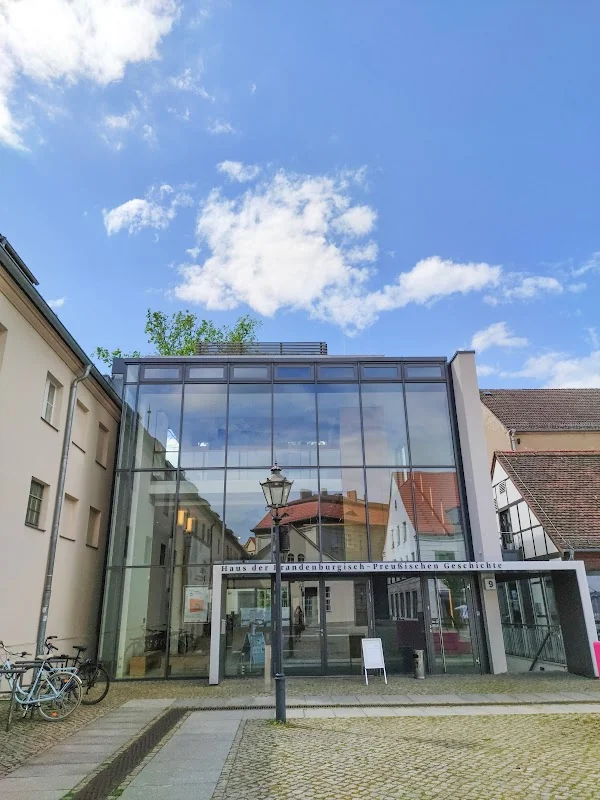
Potsdam
Am Neuen Markt 9, 14467 Potsdam, Deutschland
Brandenburg Museum Potsdam | History & Digital
The Brandenburg Museum for Future, Present, and History is a place in Potsdam where Brandenburg is not only explained but made experienceable from different perspectives. Upon entering the house at Neuen Markt, one finds not a rigid tour through a closed past, but a cultural place that poses questions, makes connections visible, and invites reflection. This is precisely the special strength of this museum: It connects history, present, and future in such a way that a visit sounds more like discovery than a mandatory program. From its central location in the historic coach house, the museum looks far beyond Potsdam and makes clear how closely local experiences, societal debates, and global developments are intertwined. The museum sees itself as an open place for exhibitions, events, discussions, and participation. It presents Brandenburg as a land with many voices, many ways of life, and a history that continues to influence the present. ([gesellschaft-kultur-geschichte.de](https://gesellschaft-kultur-geschichte.de/en/about-the-brandenburg-museum/))
Experience Brandenburg Museum digitally: Profile, Mission, and Formats
The Brandenburg Museum was founded in 2003 as the House of Brandenburg-Prussian History and was restructured architecturally, technically, and content-wise in a multi-year innovation process starting in 2018. Since spring 2022, the museum has fully reopened with a modular overview presentation, innovative digital offerings, artistic interventions, and participatory formats. This is important because the museum consciously distinguishes itself from a classic, purely object-oriented institution. Its own communication describes it as a place for discovering, exploring, and discussing cultures and identities in Brandenburg. The focus is not only on historical objects but especially on the people of the region, their ways of life, and the questions that shape Brandenburg yesterday, today, and tomorrow. ([gesellschaft-kultur-geschichte.de](https://gesellschaft-kultur-geschichte.de/en/about-the-brandenburg-museum/))
Especially formative is the claim to view Brandenburg from new perspectives. The official description emphasizes that while the state has only existed in its current form since 1990, it looks back on more than 1000 years of history. It is from this tension that the museum develops its content: Who held power here, who enforced rights, who resisted, how did people cope with drought or flooding, what happened when work was scarce, and who wanted to stay or leave? Such guiding questions connect the past and future in a very contemporary way. This makes it clear that the museum not only tells history but also engages with current debates and incorporates future questions into its programs. ([gesellschaft-kultur-geschichte.de](https://gesellschaft-kultur-geschichte.de/en/about-the-brandenburg-museum/))
The digital orientation also fits with the fact that the museum works with both analog and digital formats throughout the country. The official communication explicitly refers to augmented reality and virtual reality as well as collaborations with cultural institutions in Brandenburg. The museum sees itself not only as an exhibition site in the center of Potsdam but as a connected actor that influences regions, educational contexts, and cultural places. For SEO and visitor intentions, this is particularly interesting: Those searching for Brandenburg Museum digitally will find here a house that understands digital mediation not as an addition but as an integral part of its identity. ([gesellschaft-kultur-geschichte.de](https://gesellschaft-kultur-geschichte.de/en/about-the-brandenburg-museum/))
The current naming also follows this logic. Since June 11, 2024, the house officially presents itself as Brandenburg Museum for Future, Present, and History. The renaming aims to communicate more clearly that it is about Brandenburg as a whole, cultural diversity, exchange, and an open cultural place where one can visit exhibitions, experience events, discuss, participate, and co-create. This openness is not only a communicative signal but a substantive promise. Visitors to the museum encounter a place that does not present history as a closed narrative but as a living process. This is what makes the Brandenburg Museum particularly attractive for visitors, school classes, culture enthusiasts, and those curious about Brandenburg. ([gesellschaft-kultur-geschichte.de](https://gesellschaft-kultur-geschichte.de/brandenburg-museum/neuer-name-fuer-das-hbpg/))
History of the Coach House at Neuen Markt and the Development of the Museum
The current museum building carries its own multifaceted history. The coach house was built in 1671 as a princely riding horse stable. Between 1787 and 1790, a new building was constructed according to the plans of court architect Andreas Ludwig Krüger. Until 1918, the ensemble belonged to the court administration of the Potsdam City Palace. This is important for the classification of the place because the museum is not located in a neutral new building but in a historic structure that is directly connected to the residence and urban history of Potsdam. The early classicist architecture, the main portal with its arch-like form, and the quadriga with the coachman Pound still characterize the place today and give it a distinctive appearance. ([gesellschaft-kultur-geschichte.de](https://gesellschaft-kultur-geschichte.de/brandenburg-museum/der-kutschstall/?utm_source=openai))
Throughout the 20th century, the coach house experienced very different uses. Following its time as a horse stable, it housed police horses, workshops, garages, a tennis hall, a furniture warehouse, and later even a wholesale business for fruits, vegetables, and table potatoes. This varied use shows how strongly historical places can change without losing their identity entirely. This is precisely why the current museum location is so exciting: The coach house tells not only through exhibitions but also through its own biography of political upheavals, everyday history, and architectural adaptation. In the 1990s, an antiques shop also moved in before the state of Brandenburg took over the property from the federal government in 1997 to establish the House of Brandenburg-Prussian History there. ([gesellschaft-kultur-geschichte.de](https://gesellschaft-kultur-geschichte.de/brandenburg-museum/der-kutschstall/?utm_source=openai))
By 2001, the building had been extensively renovated, and the exhibition Marksteine marked the beginning of museum use at the site. From 2003 until the end of 2018, the house presented the permanent exhibition Land and People on the history of Brandenburg-Prussia. After that, a multi-year innovation process began, which repositioned the house technically and content-wise. Since April 2022, the Brandenburg Exhibition invites visitors to rediscover Brandenburg's culture and history as a new state history permanent presentation. This transformation is more than a relaunch. It shows how a historical place can be brought into the present through smart conception without losing its architectural and historical depth. ([gesellschaft-kultur-geschichte.de](https://gesellschaft-kultur-geschichte.de/brandenburg-museum/der-kutschstall/?utm_source=openai))
With the name change in June 2024, this transformation also became linguistically visible. The House of Brandenburg-Prussian History became the Brandenburg Museum for Future, Present, and History. The new name consolidates three perspectives: it names Brandenburg as a theme, opens the museum to current issues, and makes the future part of its mission. This fits very well with a place that is rooted in the historic coach house while also focusing on participatory, digital, and mobile formats. For visitors, this means: they enter not just a museum but an ensemble with a strong atmosphere, historical depth, and clear relevance to the present. ([gesellschaft-kultur-geschichte.de](https://gesellschaft-kultur-geschichte.de/brandenburg-museum/neuer-name-fuer-das-hbpg/))
Opening Hours, Tickets, and Visitor Information for the Museum Visit
Those planning a visit benefit from clear and easily understandable visitor information. The Brandenburg Museum is located at Neuen Markt 9 in 14467 Potsdam and is open according to the official website on Tuesdays, Wednesdays, and Fridays to Sundays from 11 AM to 6 PM. On Thursdays, the house is open from 11 AM to 8 PM, and it is closed on Mondays, except on holidays. The museum is closed on Christmas Eve and New Year's Day; on December 31, it is open from 11 AM to 4 PM. The last admission is 30 minutes before closing time. These times are particularly relevant for search queries regarding opening hours and assist in the concrete planning of a museum visit in Potsdam. ([gesellschaft-kultur-geschichte.de](https://gesellschaft-kultur-geschichte.de/brandenburg-museum/))
Upon entry, the museum adopts a deliberately low-threshold model. For the Brandenburg Exhibition, there is a voluntary admission fee between 0 and 10 euros. Tickets for exhibitions, guided tours, and events can be purchased directly at the museum ticket office in the foyer. This is pleasantly uncomplicated for many visitors, as it allows for flexible visit arrangements. At the same time, the offer makes it clear that the house values accessibility and cultural participation. Free admissions and discounts are also detailed on the FAQ page, for example, for children and young people under 18, job seekers, certain ticket holders, and other groups. So, those searching for admission to Brandenburg Museum will find a very transparent basis on the official website. ([gesellschaft-kultur-geschichte.de](https://gesellschaft-kultur-geschichte.de/brandenburg-museum/faq-museum/))
Practical preparation also includes looking at the service offerings in the house. The FAQ mentions a web-based multimedia offering for the Brandenburg Exhibition, free Wi-Fi throughout the building, lockers in the basement, and a museum shop in the entrance foyer. According to official visitor information, there is no café or restaurant, but there is a selection of literature on Brandenburg's history, current topics, children's books, and souvenirs. For private photo and film recordings in special exhibitions and in the Brandenburg Exhibition, there are specific rules; the website also mentions a hashtag and a social media tag for this purpose. Such details are particularly useful when visitors want to know in advance what to expect in the house and what conditions apply for the tour. ([gesellschaft-kultur-geschichte.de](https://gesellschaft-kultur-geschichte.de/brandenburg-museum/faq-museum/))
Accessibility is also well described. The museum can be reached by public transport via the regional express RE 1 to Potsdam Hauptbahnhof or by S-Bahn S7 from Berlin. In Potsdam itself, tram lines 91, 92, 93, 96, and 99 as well as bus lines 604, 614, and 650 go to the stop Potsdam, Alter Markt/Landtag. For visitors arriving by train, this is very convenient because the location is central and can be easily integrated into a city tour. ([gesellschaft-kultur-geschichte.de](https://gesellschaft-kultur-geschichte.de/brandenburg-museum/anfahrt/?utm_source=openai))
Directions and Parking at the Brandenburg Museum in Potsdam
The directions to the Brandenburg Museum are clearly described on the official website. The visitor entrance is through the gate at Neuen Markt, then to the left. This is especially helpful for first-time visitors, as historical buildings are often not self-explanatory at first glance. The address Am Neuen Markt 9 in 14467 Potsdam places the house right in the historic city center, making it easy to combine the visit with other destinations in the area. Those arriving by public transport can reach the museum via the stop Potsdam, Alter Markt/Landtag, from where the path is short and central. ([gesellschaft-kultur-geschichte.de](https://gesellschaft-kultur-geschichte.de/brandenburg-museum/faq-museum/))
When it comes to parking, the website lists several paid options in the immediate vicinity. These include Neuen Markt, Schloßstraße, Werner-Seelenbinder-Straße, and Yorckstraße. For tour buses, additional parking spaces are mentioned at Bassinplatz, Charlottenstraße, and Lustgarten. This information is particularly valuable for groups, school classes, or tour operators who plan a museum not just as an individual visit but as part of a Potsdam tour. Since parking options in central urban areas can be limited, prior coordination for groups is advisable. The official website provides the necessary information for this and thus supports uncomplicated arrival. ([gesellschaft-kultur-geschichte.de](https://gesellschaft-kultur-geschichte.de/brandenburg-museum/faq-museum/))
For SEO-relevant search queries regarding parking at Brandenburg Museum and directions to Brandenburg Museum, it is also important that the house consciously opts for a mix of urban location and good accessibility. The museum is not an isolated site on the outskirts but part of the historic center of Potsdam. This makes it attractive for day visitors, locals, and cultural travelers. Those who want to combine their visit with a walk around the Alter Markt, an appointment in the city center, or another exhibition in Potsdam benefit from this location. The central place also contributes to the character of the house: Here, Brandenburg is not negotiated away from the city but right in the middle of it. ([gesellschaft-kultur-geschichte.de](https://gesellschaft-kultur-geschichte.de/en/about-the-brandenburg-museum/))
For visitors with special needs, the website also offers clear information. The FAQ provides details about the barrier-free entrance, seating options, lockers, and the allowed or prohibited items in the house. Additionally, prior registration is required for groups, and there are separate contact options for guided tours. All of this makes the museum visit more planable and reliable, which is an important plus for families, school classes, and travel groups. ([gesellschaft-kultur-geschichte.de](https://gesellschaft-kultur-geschichte.de/brandenburg-museum/faq-museum/))
Accessibility, Service, and Spaces for Events
A strong feature of the Brandenburg Museum is the thoroughly documented accessibility. The website describes step-free access to the entrance foyer, the exhibition hall on the ground floor, and the vaulted hall. Another barrier-free entrance is located in the basement, and there is an elevator to the basement, intermediate floor, and upper floor. For people with visual impairments, there are safety markings on glass doors, tactile writing, and acoustic announcements in the elevators. The ticket area is equipped with an induction loop, and guide dogs are allowed. This shows that accessibility is not treated as a peripheral issue but as part of the house's concept. ([gesellschaft-kultur-geschichte.de](https://gesellschaft-kultur-geschichte.de/brandenburg-museum/barrierefreiheit-im-brandenburg-museum/?utm_source=openai))
Thought has also been given to the quality of stay. According to the FAQ, there are seating options in the foyer directly at the entrance and in the area of the museum shop. There are also seating options in the upper foyer, and in the Brandenburg Exhibition itself, there are benches and other resting points at the media stations as well as in the area of the 20th century. Additionally, folding stools can be borrowed free of charge. This is particularly important for longer visits, as an exhibition should be pleasant not only in content but also physically. For many people, such details increase the likelihood that a visit will be relaxed and unhurried. ([gesellschaft-kultur-geschichte.de](https://gesellschaft-kultur-geschichte.de/brandenburg-museum/faq-museum/))
For groups, associations, companies, or private events, the Brandenburg Museum also offers various rooms. According to the official website, conference room, historic vaulted hall, and seminar room can be rented. The vaulted hall is particularly striking: it encompasses 255 square meters with a counter, suitable for up to 200 people for a standing reception, 110 people for row seating, and 128 people for banquet seating. A ventilation system is available, but there is no air conditioning. This makes the vaulted hall a versatile place for receptions, presentations, gala dinners, weddings, or birthdays. So, those searching for Brandenburg Museum events or spaces for events will find a real, historically influenced offer here. ([gesellschaft-kultur-geschichte.de](https://gesellschaft-kultur-geschichte.de/brandenburg-museum/gewoelbehalle/))
The combination of exhibition site, event venue, and educational place is an essential part of the concept. The museum works not only with permanent and changing exhibitions but also with guided tours, workshops, digital offerings, and room uses. This creates a versatile cultural place that is suitable for both the classic museum visit and for exchange, learning, and celebration. Especially in the context of Potsdam, where historical places often fulfill multiple functions, this mix is particularly harmonious. It reflects the ambition to not merely represent Brandenburg but to understand it as a living space for the present and future. ([gesellschaft-kultur-geschichte.de](https://gesellschaft-kultur-geschichte.de/en/about-the-brandenburg-museum/))
The services of the house also include information on photo rules, group registrations, guided tour bookings, and contact options. The FAQ refers to clear phone numbers and email addresses for general inquiries, group visits, guided tours, and rentals. For search intentions related to Brandenburg Museum reviews, Brandenburg Museum digital, and Brandenburg Museum for Future, this is helpful in that visitors not only seek content but also want to know how practically and service-oriented a house operates. The official website provides a very concrete answer to this and emphasizes that service, mediation, and cultural participation belong together here. ([gesellschaft-kultur-geschichte.de](https://gesellschaft-kultur-geschichte.de/brandenburg-museum/faq-museum/))
Sources:
Show moreShow less
Brandenburg Museum Potsdam | History & Digital
The Brandenburg Museum for Future, Present, and History is a place in Potsdam where Brandenburg is not only explained but made experienceable from different perspectives. Upon entering the house at Neuen Markt, one finds not a rigid tour through a closed past, but a cultural place that poses questions, makes connections visible, and invites reflection. This is precisely the special strength of this museum: It connects history, present, and future in such a way that a visit sounds more like discovery than a mandatory program. From its central location in the historic coach house, the museum looks far beyond Potsdam and makes clear how closely local experiences, societal debates, and global developments are intertwined. The museum sees itself as an open place for exhibitions, events, discussions, and participation. It presents Brandenburg as a land with many voices, many ways of life, and a history that continues to influence the present. ([gesellschaft-kultur-geschichte.de](https://gesellschaft-kultur-geschichte.de/en/about-the-brandenburg-museum/))
Experience Brandenburg Museum digitally: Profile, Mission, and Formats
The Brandenburg Museum was founded in 2003 as the House of Brandenburg-Prussian History and was restructured architecturally, technically, and content-wise in a multi-year innovation process starting in 2018. Since spring 2022, the museum has fully reopened with a modular overview presentation, innovative digital offerings, artistic interventions, and participatory formats. This is important because the museum consciously distinguishes itself from a classic, purely object-oriented institution. Its own communication describes it as a place for discovering, exploring, and discussing cultures and identities in Brandenburg. The focus is not only on historical objects but especially on the people of the region, their ways of life, and the questions that shape Brandenburg yesterday, today, and tomorrow. ([gesellschaft-kultur-geschichte.de](https://gesellschaft-kultur-geschichte.de/en/about-the-brandenburg-museum/))
Especially formative is the claim to view Brandenburg from new perspectives. The official description emphasizes that while the state has only existed in its current form since 1990, it looks back on more than 1000 years of history. It is from this tension that the museum develops its content: Who held power here, who enforced rights, who resisted, how did people cope with drought or flooding, what happened when work was scarce, and who wanted to stay or leave? Such guiding questions connect the past and future in a very contemporary way. This makes it clear that the museum not only tells history but also engages with current debates and incorporates future questions into its programs. ([gesellschaft-kultur-geschichte.de](https://gesellschaft-kultur-geschichte.de/en/about-the-brandenburg-museum/))
The digital orientation also fits with the fact that the museum works with both analog and digital formats throughout the country. The official communication explicitly refers to augmented reality and virtual reality as well as collaborations with cultural institutions in Brandenburg. The museum sees itself not only as an exhibition site in the center of Potsdam but as a connected actor that influences regions, educational contexts, and cultural places. For SEO and visitor intentions, this is particularly interesting: Those searching for Brandenburg Museum digitally will find here a house that understands digital mediation not as an addition but as an integral part of its identity. ([gesellschaft-kultur-geschichte.de](https://gesellschaft-kultur-geschichte.de/en/about-the-brandenburg-museum/))
The current naming also follows this logic. Since June 11, 2024, the house officially presents itself as Brandenburg Museum for Future, Present, and History. The renaming aims to communicate more clearly that it is about Brandenburg as a whole, cultural diversity, exchange, and an open cultural place where one can visit exhibitions, experience events, discuss, participate, and co-create. This openness is not only a communicative signal but a substantive promise. Visitors to the museum encounter a place that does not present history as a closed narrative but as a living process. This is what makes the Brandenburg Museum particularly attractive for visitors, school classes, culture enthusiasts, and those curious about Brandenburg. ([gesellschaft-kultur-geschichte.de](https://gesellschaft-kultur-geschichte.de/brandenburg-museum/neuer-name-fuer-das-hbpg/))
History of the Coach House at Neuen Markt and the Development of the Museum
The current museum building carries its own multifaceted history. The coach house was built in 1671 as a princely riding horse stable. Between 1787 and 1790, a new building was constructed according to the plans of court architect Andreas Ludwig Krüger. Until 1918, the ensemble belonged to the court administration of the Potsdam City Palace. This is important for the classification of the place because the museum is not located in a neutral new building but in a historic structure that is directly connected to the residence and urban history of Potsdam. The early classicist architecture, the main portal with its arch-like form, and the quadriga with the coachman Pound still characterize the place today and give it a distinctive appearance. ([gesellschaft-kultur-geschichte.de](https://gesellschaft-kultur-geschichte.de/brandenburg-museum/der-kutschstall/?utm_source=openai))
Throughout the 20th century, the coach house experienced very different uses. Following its time as a horse stable, it housed police horses, workshops, garages, a tennis hall, a furniture warehouse, and later even a wholesale business for fruits, vegetables, and table potatoes. This varied use shows how strongly historical places can change without losing their identity entirely. This is precisely why the current museum location is so exciting: The coach house tells not only through exhibitions but also through its own biography of political upheavals, everyday history, and architectural adaptation. In the 1990s, an antiques shop also moved in before the state of Brandenburg took over the property from the federal government in 1997 to establish the House of Brandenburg-Prussian History there. ([gesellschaft-kultur-geschichte.de](https://gesellschaft-kultur-geschichte.de/brandenburg-museum/der-kutschstall/?utm_source=openai))
By 2001, the building had been extensively renovated, and the exhibition Marksteine marked the beginning of museum use at the site. From 2003 until the end of 2018, the house presented the permanent exhibition Land and People on the history of Brandenburg-Prussia. After that, a multi-year innovation process began, which repositioned the house technically and content-wise. Since April 2022, the Brandenburg Exhibition invites visitors to rediscover Brandenburg's culture and history as a new state history permanent presentation. This transformation is more than a relaunch. It shows how a historical place can be brought into the present through smart conception without losing its architectural and historical depth. ([gesellschaft-kultur-geschichte.de](https://gesellschaft-kultur-geschichte.de/brandenburg-museum/der-kutschstall/?utm_source=openai))
With the name change in June 2024, this transformation also became linguistically visible. The House of Brandenburg-Prussian History became the Brandenburg Museum for Future, Present, and History. The new name consolidates three perspectives: it names Brandenburg as a theme, opens the museum to current issues, and makes the future part of its mission. This fits very well with a place that is rooted in the historic coach house while also focusing on participatory, digital, and mobile formats. For visitors, this means: they enter not just a museum but an ensemble with a strong atmosphere, historical depth, and clear relevance to the present. ([gesellschaft-kultur-geschichte.de](https://gesellschaft-kultur-geschichte.de/brandenburg-museum/neuer-name-fuer-das-hbpg/))
Opening Hours, Tickets, and Visitor Information for the Museum Visit
Those planning a visit benefit from clear and easily understandable visitor information. The Brandenburg Museum is located at Neuen Markt 9 in 14467 Potsdam and is open according to the official website on Tuesdays, Wednesdays, and Fridays to Sundays from 11 AM to 6 PM. On Thursdays, the house is open from 11 AM to 8 PM, and it is closed on Mondays, except on holidays. The museum is closed on Christmas Eve and New Year's Day; on December 31, it is open from 11 AM to 4 PM. The last admission is 30 minutes before closing time. These times are particularly relevant for search queries regarding opening hours and assist in the concrete planning of a museum visit in Potsdam. ([gesellschaft-kultur-geschichte.de](https://gesellschaft-kultur-geschichte.de/brandenburg-museum/))
Upon entry, the museum adopts a deliberately low-threshold model. For the Brandenburg Exhibition, there is a voluntary admission fee between 0 and 10 euros. Tickets for exhibitions, guided tours, and events can be purchased directly at the museum ticket office in the foyer. This is pleasantly uncomplicated for many visitors, as it allows for flexible visit arrangements. At the same time, the offer makes it clear that the house values accessibility and cultural participation. Free admissions and discounts are also detailed on the FAQ page, for example, for children and young people under 18, job seekers, certain ticket holders, and other groups. So, those searching for admission to Brandenburg Museum will find a very transparent basis on the official website. ([gesellschaft-kultur-geschichte.de](https://gesellschaft-kultur-geschichte.de/brandenburg-museum/faq-museum/))
Practical preparation also includes looking at the service offerings in the house. The FAQ mentions a web-based multimedia offering for the Brandenburg Exhibition, free Wi-Fi throughout the building, lockers in the basement, and a museum shop in the entrance foyer. According to official visitor information, there is no café or restaurant, but there is a selection of literature on Brandenburg's history, current topics, children's books, and souvenirs. For private photo and film recordings in special exhibitions and in the Brandenburg Exhibition, there are specific rules; the website also mentions a hashtag and a social media tag for this purpose. Such details are particularly useful when visitors want to know in advance what to expect in the house and what conditions apply for the tour. ([gesellschaft-kultur-geschichte.de](https://gesellschaft-kultur-geschichte.de/brandenburg-museum/faq-museum/))
Accessibility is also well described. The museum can be reached by public transport via the regional express RE 1 to Potsdam Hauptbahnhof or by S-Bahn S7 from Berlin. In Potsdam itself, tram lines 91, 92, 93, 96, and 99 as well as bus lines 604, 614, and 650 go to the stop Potsdam, Alter Markt/Landtag. For visitors arriving by train, this is very convenient because the location is central and can be easily integrated into a city tour. ([gesellschaft-kultur-geschichte.de](https://gesellschaft-kultur-geschichte.de/brandenburg-museum/anfahrt/?utm_source=openai))
Directions and Parking at the Brandenburg Museum in Potsdam
The directions to the Brandenburg Museum are clearly described on the official website. The visitor entrance is through the gate at Neuen Markt, then to the left. This is especially helpful for first-time visitors, as historical buildings are often not self-explanatory at first glance. The address Am Neuen Markt 9 in 14467 Potsdam places the house right in the historic city center, making it easy to combine the visit with other destinations in the area. Those arriving by public transport can reach the museum via the stop Potsdam, Alter Markt/Landtag, from where the path is short and central. ([gesellschaft-kultur-geschichte.de](https://gesellschaft-kultur-geschichte.de/brandenburg-museum/faq-museum/))
When it comes to parking, the website lists several paid options in the immediate vicinity. These include Neuen Markt, Schloßstraße, Werner-Seelenbinder-Straße, and Yorckstraße. For tour buses, additional parking spaces are mentioned at Bassinplatz, Charlottenstraße, and Lustgarten. This information is particularly valuable for groups, school classes, or tour operators who plan a museum not just as an individual visit but as part of a Potsdam tour. Since parking options in central urban areas can be limited, prior coordination for groups is advisable. The official website provides the necessary information for this and thus supports uncomplicated arrival. ([gesellschaft-kultur-geschichte.de](https://gesellschaft-kultur-geschichte.de/brandenburg-museum/faq-museum/))
For SEO-relevant search queries regarding parking at Brandenburg Museum and directions to Brandenburg Museum, it is also important that the house consciously opts for a mix of urban location and good accessibility. The museum is not an isolated site on the outskirts but part of the historic center of Potsdam. This makes it attractive for day visitors, locals, and cultural travelers. Those who want to combine their visit with a walk around the Alter Markt, an appointment in the city center, or another exhibition in Potsdam benefit from this location. The central place also contributes to the character of the house: Here, Brandenburg is not negotiated away from the city but right in the middle of it. ([gesellschaft-kultur-geschichte.de](https://gesellschaft-kultur-geschichte.de/en/about-the-brandenburg-museum/))
For visitors with special needs, the website also offers clear information. The FAQ provides details about the barrier-free entrance, seating options, lockers, and the allowed or prohibited items in the house. Additionally, prior registration is required for groups, and there are separate contact options for guided tours. All of this makes the museum visit more planable and reliable, which is an important plus for families, school classes, and travel groups. ([gesellschaft-kultur-geschichte.de](https://gesellschaft-kultur-geschichte.de/brandenburg-museum/faq-museum/))
Accessibility, Service, and Spaces for Events
A strong feature of the Brandenburg Museum is the thoroughly documented accessibility. The website describes step-free access to the entrance foyer, the exhibition hall on the ground floor, and the vaulted hall. Another barrier-free entrance is located in the basement, and there is an elevator to the basement, intermediate floor, and upper floor. For people with visual impairments, there are safety markings on glass doors, tactile writing, and acoustic announcements in the elevators. The ticket area is equipped with an induction loop, and guide dogs are allowed. This shows that accessibility is not treated as a peripheral issue but as part of the house's concept. ([gesellschaft-kultur-geschichte.de](https://gesellschaft-kultur-geschichte.de/brandenburg-museum/barrierefreiheit-im-brandenburg-museum/?utm_source=openai))
Thought has also been given to the quality of stay. According to the FAQ, there are seating options in the foyer directly at the entrance and in the area of the museum shop. There are also seating options in the upper foyer, and in the Brandenburg Exhibition itself, there are benches and other resting points at the media stations as well as in the area of the 20th century. Additionally, folding stools can be borrowed free of charge. This is particularly important for longer visits, as an exhibition should be pleasant not only in content but also physically. For many people, such details increase the likelihood that a visit will be relaxed and unhurried. ([gesellschaft-kultur-geschichte.de](https://gesellschaft-kultur-geschichte.de/brandenburg-museum/faq-museum/))
For groups, associations, companies, or private events, the Brandenburg Museum also offers various rooms. According to the official website, conference room, historic vaulted hall, and seminar room can be rented. The vaulted hall is particularly striking: it encompasses 255 square meters with a counter, suitable for up to 200 people for a standing reception, 110 people for row seating, and 128 people for banquet seating. A ventilation system is available, but there is no air conditioning. This makes the vaulted hall a versatile place for receptions, presentations, gala dinners, weddings, or birthdays. So, those searching for Brandenburg Museum events or spaces for events will find a real, historically influenced offer here. ([gesellschaft-kultur-geschichte.de](https://gesellschaft-kultur-geschichte.de/brandenburg-museum/gewoelbehalle/))
The combination of exhibition site, event venue, and educational place is an essential part of the concept. The museum works not only with permanent and changing exhibitions but also with guided tours, workshops, digital offerings, and room uses. This creates a versatile cultural place that is suitable for both the classic museum visit and for exchange, learning, and celebration. Especially in the context of Potsdam, where historical places often fulfill multiple functions, this mix is particularly harmonious. It reflects the ambition to not merely represent Brandenburg but to understand it as a living space for the present and future. ([gesellschaft-kultur-geschichte.de](https://gesellschaft-kultur-geschichte.de/en/about-the-brandenburg-museum/))
The services of the house also include information on photo rules, group registrations, guided tour bookings, and contact options. The FAQ refers to clear phone numbers and email addresses for general inquiries, group visits, guided tours, and rentals. For search intentions related to Brandenburg Museum reviews, Brandenburg Museum digital, and Brandenburg Museum for Future, this is helpful in that visitors not only seek content but also want to know how practically and service-oriented a house operates. The official website provides a very concrete answer to this and emphasizes that service, mediation, and cultural participation belong together here. ([gesellschaft-kultur-geschichte.de](https://gesellschaft-kultur-geschichte.de/brandenburg-museum/faq-museum/))
Sources:
Brandenburg Museum Potsdam | History & Digital
The Brandenburg Museum for Future, Present, and History is a place in Potsdam where Brandenburg is not only explained but made experienceable from different perspectives. Upon entering the house at Neuen Markt, one finds not a rigid tour through a closed past, but a cultural place that poses questions, makes connections visible, and invites reflection. This is precisely the special strength of this museum: It connects history, present, and future in such a way that a visit sounds more like discovery than a mandatory program. From its central location in the historic coach house, the museum looks far beyond Potsdam and makes clear how closely local experiences, societal debates, and global developments are intertwined. The museum sees itself as an open place for exhibitions, events, discussions, and participation. It presents Brandenburg as a land with many voices, many ways of life, and a history that continues to influence the present. ([gesellschaft-kultur-geschichte.de](https://gesellschaft-kultur-geschichte.de/en/about-the-brandenburg-museum/))
Experience Brandenburg Museum digitally: Profile, Mission, and Formats
The Brandenburg Museum was founded in 2003 as the House of Brandenburg-Prussian History and was restructured architecturally, technically, and content-wise in a multi-year innovation process starting in 2018. Since spring 2022, the museum has fully reopened with a modular overview presentation, innovative digital offerings, artistic interventions, and participatory formats. This is important because the museum consciously distinguishes itself from a classic, purely object-oriented institution. Its own communication describes it as a place for discovering, exploring, and discussing cultures and identities in Brandenburg. The focus is not only on historical objects but especially on the people of the region, their ways of life, and the questions that shape Brandenburg yesterday, today, and tomorrow. ([gesellschaft-kultur-geschichte.de](https://gesellschaft-kultur-geschichte.de/en/about-the-brandenburg-museum/))
Especially formative is the claim to view Brandenburg from new perspectives. The official description emphasizes that while the state has only existed in its current form since 1990, it looks back on more than 1000 years of history. It is from this tension that the museum develops its content: Who held power here, who enforced rights, who resisted, how did people cope with drought or flooding, what happened when work was scarce, and who wanted to stay or leave? Such guiding questions connect the past and future in a very contemporary way. This makes it clear that the museum not only tells history but also engages with current debates and incorporates future questions into its programs. ([gesellschaft-kultur-geschichte.de](https://gesellschaft-kultur-geschichte.de/en/about-the-brandenburg-museum/))
The digital orientation also fits with the fact that the museum works with both analog and digital formats throughout the country. The official communication explicitly refers to augmented reality and virtual reality as well as collaborations with cultural institutions in Brandenburg. The museum sees itself not only as an exhibition site in the center of Potsdam but as a connected actor that influences regions, educational contexts, and cultural places. For SEO and visitor intentions, this is particularly interesting: Those searching for Brandenburg Museum digitally will find here a house that understands digital mediation not as an addition but as an integral part of its identity. ([gesellschaft-kultur-geschichte.de](https://gesellschaft-kultur-geschichte.de/en/about-the-brandenburg-museum/))
The current naming also follows this logic. Since June 11, 2024, the house officially presents itself as Brandenburg Museum for Future, Present, and History. The renaming aims to communicate more clearly that it is about Brandenburg as a whole, cultural diversity, exchange, and an open cultural place where one can visit exhibitions, experience events, discuss, participate, and co-create. This openness is not only a communicative signal but a substantive promise. Visitors to the museum encounter a place that does not present history as a closed narrative but as a living process. This is what makes the Brandenburg Museum particularly attractive for visitors, school classes, culture enthusiasts, and those curious about Brandenburg. ([gesellschaft-kultur-geschichte.de](https://gesellschaft-kultur-geschichte.de/brandenburg-museum/neuer-name-fuer-das-hbpg/))
History of the Coach House at Neuen Markt and the Development of the Museum
The current museum building carries its own multifaceted history. The coach house was built in 1671 as a princely riding horse stable. Between 1787 and 1790, a new building was constructed according to the plans of court architect Andreas Ludwig Krüger. Until 1918, the ensemble belonged to the court administration of the Potsdam City Palace. This is important for the classification of the place because the museum is not located in a neutral new building but in a historic structure that is directly connected to the residence and urban history of Potsdam. The early classicist architecture, the main portal with its arch-like form, and the quadriga with the coachman Pound still characterize the place today and give it a distinctive appearance. ([gesellschaft-kultur-geschichte.de](https://gesellschaft-kultur-geschichte.de/brandenburg-museum/der-kutschstall/?utm_source=openai))
Throughout the 20th century, the coach house experienced very different uses. Following its time as a horse stable, it housed police horses, workshops, garages, a tennis hall, a furniture warehouse, and later even a wholesale business for fruits, vegetables, and table potatoes. This varied use shows how strongly historical places can change without losing their identity entirely. This is precisely why the current museum location is so exciting: The coach house tells not only through exhibitions but also through its own biography of political upheavals, everyday history, and architectural adaptation. In the 1990s, an antiques shop also moved in before the state of Brandenburg took over the property from the federal government in 1997 to establish the House of Brandenburg-Prussian History there. ([gesellschaft-kultur-geschichte.de](https://gesellschaft-kultur-geschichte.de/brandenburg-museum/der-kutschstall/?utm_source=openai))
By 2001, the building had been extensively renovated, and the exhibition Marksteine marked the beginning of museum use at the site. From 2003 until the end of 2018, the house presented the permanent exhibition Land and People on the history of Brandenburg-Prussia. After that, a multi-year innovation process began, which repositioned the house technically and content-wise. Since April 2022, the Brandenburg Exhibition invites visitors to rediscover Brandenburg's culture and history as a new state history permanent presentation. This transformation is more than a relaunch. It shows how a historical place can be brought into the present through smart conception without losing its architectural and historical depth. ([gesellschaft-kultur-geschichte.de](https://gesellschaft-kultur-geschichte.de/brandenburg-museum/der-kutschstall/?utm_source=openai))
With the name change in June 2024, this transformation also became linguistically visible. The House of Brandenburg-Prussian History became the Brandenburg Museum for Future, Present, and History. The new name consolidates three perspectives: it names Brandenburg as a theme, opens the museum to current issues, and makes the future part of its mission. This fits very well with a place that is rooted in the historic coach house while also focusing on participatory, digital, and mobile formats. For visitors, this means: they enter not just a museum but an ensemble with a strong atmosphere, historical depth, and clear relevance to the present. ([gesellschaft-kultur-geschichte.de](https://gesellschaft-kultur-geschichte.de/brandenburg-museum/neuer-name-fuer-das-hbpg/))
Opening Hours, Tickets, and Visitor Information for the Museum Visit
Those planning a visit benefit from clear and easily understandable visitor information. The Brandenburg Museum is located at Neuen Markt 9 in 14467 Potsdam and is open according to the official website on Tuesdays, Wednesdays, and Fridays to Sundays from 11 AM to 6 PM. On Thursdays, the house is open from 11 AM to 8 PM, and it is closed on Mondays, except on holidays. The museum is closed on Christmas Eve and New Year's Day; on December 31, it is open from 11 AM to 4 PM. The last admission is 30 minutes before closing time. These times are particularly relevant for search queries regarding opening hours and assist in the concrete planning of a museum visit in Potsdam. ([gesellschaft-kultur-geschichte.de](https://gesellschaft-kultur-geschichte.de/brandenburg-museum/))
Upon entry, the museum adopts a deliberately low-threshold model. For the Brandenburg Exhibition, there is a voluntary admission fee between 0 and 10 euros. Tickets for exhibitions, guided tours, and events can be purchased directly at the museum ticket office in the foyer. This is pleasantly uncomplicated for many visitors, as it allows for flexible visit arrangements. At the same time, the offer makes it clear that the house values accessibility and cultural participation. Free admissions and discounts are also detailed on the FAQ page, for example, for children and young people under 18, job seekers, certain ticket holders, and other groups. So, those searching for admission to Brandenburg Museum will find a very transparent basis on the official website. ([gesellschaft-kultur-geschichte.de](https://gesellschaft-kultur-geschichte.de/brandenburg-museum/faq-museum/))
Practical preparation also includes looking at the service offerings in the house. The FAQ mentions a web-based multimedia offering for the Brandenburg Exhibition, free Wi-Fi throughout the building, lockers in the basement, and a museum shop in the entrance foyer. According to official visitor information, there is no café or restaurant, but there is a selection of literature on Brandenburg's history, current topics, children's books, and souvenirs. For private photo and film recordings in special exhibitions and in the Brandenburg Exhibition, there are specific rules; the website also mentions a hashtag and a social media tag for this purpose. Such details are particularly useful when visitors want to know in advance what to expect in the house and what conditions apply for the tour. ([gesellschaft-kultur-geschichte.de](https://gesellschaft-kultur-geschichte.de/brandenburg-museum/faq-museum/))
Accessibility is also well described. The museum can be reached by public transport via the regional express RE 1 to Potsdam Hauptbahnhof or by S-Bahn S7 from Berlin. In Potsdam itself, tram lines 91, 92, 93, 96, and 99 as well as bus lines 604, 614, and 650 go to the stop Potsdam, Alter Markt/Landtag. For visitors arriving by train, this is very convenient because the location is central and can be easily integrated into a city tour. ([gesellschaft-kultur-geschichte.de](https://gesellschaft-kultur-geschichte.de/brandenburg-museum/anfahrt/?utm_source=openai))
Directions and Parking at the Brandenburg Museum in Potsdam
The directions to the Brandenburg Museum are clearly described on the official website. The visitor entrance is through the gate at Neuen Markt, then to the left. This is especially helpful for first-time visitors, as historical buildings are often not self-explanatory at first glance. The address Am Neuen Markt 9 in 14467 Potsdam places the house right in the historic city center, making it easy to combine the visit with other destinations in the area. Those arriving by public transport can reach the museum via the stop Potsdam, Alter Markt/Landtag, from where the path is short and central. ([gesellschaft-kultur-geschichte.de](https://gesellschaft-kultur-geschichte.de/brandenburg-museum/faq-museum/))
When it comes to parking, the website lists several paid options in the immediate vicinity. These include Neuen Markt, Schloßstraße, Werner-Seelenbinder-Straße, and Yorckstraße. For tour buses, additional parking spaces are mentioned at Bassinplatz, Charlottenstraße, and Lustgarten. This information is particularly valuable for groups, school classes, or tour operators who plan a museum not just as an individual visit but as part of a Potsdam tour. Since parking options in central urban areas can be limited, prior coordination for groups is advisable. The official website provides the necessary information for this and thus supports uncomplicated arrival. ([gesellschaft-kultur-geschichte.de](https://gesellschaft-kultur-geschichte.de/brandenburg-museum/faq-museum/))
For SEO-relevant search queries regarding parking at Brandenburg Museum and directions to Brandenburg Museum, it is also important that the house consciously opts for a mix of urban location and good accessibility. The museum is not an isolated site on the outskirts but part of the historic center of Potsdam. This makes it attractive for day visitors, locals, and cultural travelers. Those who want to combine their visit with a walk around the Alter Markt, an appointment in the city center, or another exhibition in Potsdam benefit from this location. The central place also contributes to the character of the house: Here, Brandenburg is not negotiated away from the city but right in the middle of it. ([gesellschaft-kultur-geschichte.de](https://gesellschaft-kultur-geschichte.de/en/about-the-brandenburg-museum/))
For visitors with special needs, the website also offers clear information. The FAQ provides details about the barrier-free entrance, seating options, lockers, and the allowed or prohibited items in the house. Additionally, prior registration is required for groups, and there are separate contact options for guided tours. All of this makes the museum visit more planable and reliable, which is an important plus for families, school classes, and travel groups. ([gesellschaft-kultur-geschichte.de](https://gesellschaft-kultur-geschichte.de/brandenburg-museum/faq-museum/))
Accessibility, Service, and Spaces for Events
A strong feature of the Brandenburg Museum is the thoroughly documented accessibility. The website describes step-free access to the entrance foyer, the exhibition hall on the ground floor, and the vaulted hall. Another barrier-free entrance is located in the basement, and there is an elevator to the basement, intermediate floor, and upper floor. For people with visual impairments, there are safety markings on glass doors, tactile writing, and acoustic announcements in the elevators. The ticket area is equipped with an induction loop, and guide dogs are allowed. This shows that accessibility is not treated as a peripheral issue but as part of the house's concept. ([gesellschaft-kultur-geschichte.de](https://gesellschaft-kultur-geschichte.de/brandenburg-museum/barrierefreiheit-im-brandenburg-museum/?utm_source=openai))
Thought has also been given to the quality of stay. According to the FAQ, there are seating options in the foyer directly at the entrance and in the area of the museum shop. There are also seating options in the upper foyer, and in the Brandenburg Exhibition itself, there are benches and other resting points at the media stations as well as in the area of the 20th century. Additionally, folding stools can be borrowed free of charge. This is particularly important for longer visits, as an exhibition should be pleasant not only in content but also physically. For many people, such details increase the likelihood that a visit will be relaxed and unhurried. ([gesellschaft-kultur-geschichte.de](https://gesellschaft-kultur-geschichte.de/brandenburg-museum/faq-museum/))
For groups, associations, companies, or private events, the Brandenburg Museum also offers various rooms. According to the official website, conference room, historic vaulted hall, and seminar room can be rented. The vaulted hall is particularly striking: it encompasses 255 square meters with a counter, suitable for up to 200 people for a standing reception, 110 people for row seating, and 128 people for banquet seating. A ventilation system is available, but there is no air conditioning. This makes the vaulted hall a versatile place for receptions, presentations, gala dinners, weddings, or birthdays. So, those searching for Brandenburg Museum events or spaces for events will find a real, historically influenced offer here. ([gesellschaft-kultur-geschichte.de](https://gesellschaft-kultur-geschichte.de/brandenburg-museum/gewoelbehalle/))
The combination of exhibition site, event venue, and educational place is an essential part of the concept. The museum works not only with permanent and changing exhibitions but also with guided tours, workshops, digital offerings, and room uses. This creates a versatile cultural place that is suitable for both the classic museum visit and for exchange, learning, and celebration. Especially in the context of Potsdam, where historical places often fulfill multiple functions, this mix is particularly harmonious. It reflects the ambition to not merely represent Brandenburg but to understand it as a living space for the present and future. ([gesellschaft-kultur-geschichte.de](https://gesellschaft-kultur-geschichte.de/en/about-the-brandenburg-museum/))
The services of the house also include information on photo rules, group registrations, guided tour bookings, and contact options. The FAQ refers to clear phone numbers and email addresses for general inquiries, group visits, guided tours, and rentals. For search intentions related to Brandenburg Museum reviews, Brandenburg Museum digital, and Brandenburg Museum for Future, this is helpful in that visitors not only seek content but also want to know how practically and service-oriented a house operates. The official website provides a very concrete answer to this and emphasizes that service, mediation, and cultural participation belong together here. ([gesellschaft-kultur-geschichte.de](https://gesellschaft-kultur-geschichte.de/brandenburg-museum/faq-museum/))
Sources:
Frequently Asked Questions
Reviews
Jette Lewis
4. June 2025
The “Signale der Macht” exhibition here is a hidden gem that offers a powerful and eye-opening look at how early radio technology was used to control German colonies in Africa! Blending historical material with moving contemporary art! The museum itself is quiet and thoughtful, far from the crowds, making it a perfect spot to reflect and discover something new. It’s a unique and important exhibition that deserves more attention!
Katharina Vogt
17. December 2025
The museum is filled with detailed depictions of Prussian rulers and their political power, while interactive maps and weapon replicas further bring history to life. I especially enjoyed how the life stories of the Brandenburg family members are told through personal belongings – it feels like looking through a window into their world. Perfect for a family visit or solo exploration.
Leo Smith
8. March 2024
Very interesting building, super nice staff, evolving permanent collection and great temporary exhibition on the second floor (Christina Glanz at the time of my visit). It's one of the more dynamic and actively developing cultural institutes of Potsdam and 100% deserves your time and attention. Will surely return to visit whenever in town. Highly recommended.
Alina Studenova
18. April 2025
Awesome museum! I liked interactive activities, especially actors performing the roles of various people from the past.
Eh
24. February 2024
Very good. All in German, but good audio guide and info booklet. Don’t miss the eagle at the start like we did!