
Freundschaftsinsel, Potsdam
Freundschaftsinsel, 14467 Potsdam, Germany
Exhibition Pavilion Friendship Island | Art & Exhibitions
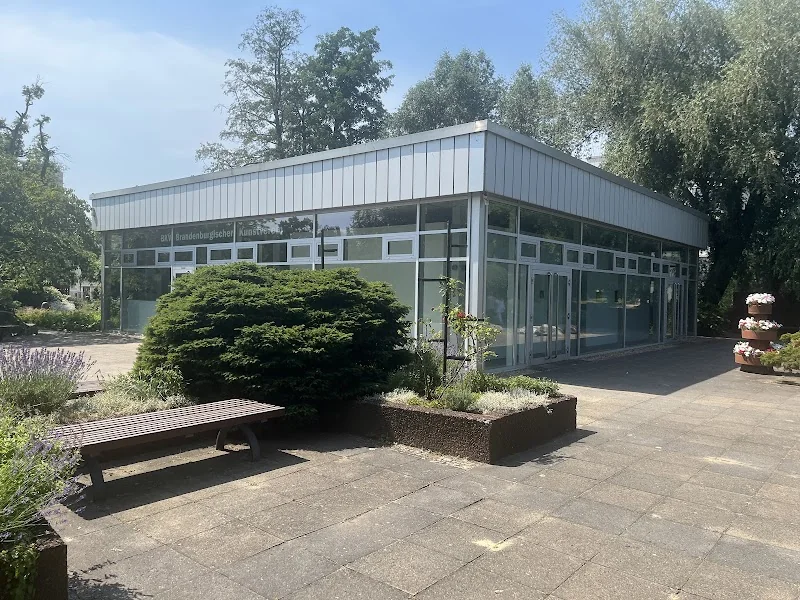
The exhibition pavilion of the Brandenburg Art Association Potsdam e. V. is a place where city, garden, and contemporary art meet in an unusually calm manner. Those who come here do not enter a classic trade fair or event building, but an open art space in the middle of Friendship Island, one of the most distinctive green spaces in the heart of Potsdam. Since April 2011, the BKV has been showcasing outstanding contemporary art here, utilizing a glass architecture that stands in direct dialogue with the garden, water, and urban space. This very mix is what makes it appealing: a walk across the island, then a glance into the pavilion, and then back into the landscape. Visitors do not experience a loud event atmosphere, but a concentrated, almost contemplative form of art mediation that remains accessible and open to a broad audience. Admission is free, the location is central, and the character of the place is clear: it is about contemporary art, exhibitions, conversations, and the interplay of place and work. ([potsdam.de](https://www.potsdam.de/de/content/brandenburgischer-kunstverein-potsdam-ev-3))
Events and Exhibitions in the Exhibition Pavilion
The most important search intention behind this place is not without reason events, as the Brandenburg Art Association Potsdam has seen itself as a laboratory and stage for young contemporary art since its founding. The official description emphasizes that the association does not want to provide comfortable answers, but rather makes artistic questions visible. This is also clearly evident at the pavilion on Friendship Island: Here, spectacular show effects are not at the forefront, but exhibitions that work with the architecture, that incorporate the garden, or that make the perception of the place itself the subject. In practice, this means: Visitors can expect changing presentations, often with installations, site-specific works, and projects that seek a clear relationship with Potsdam and its audience. The art association is aimed not only at connoisseurs but deliberately at a broader audience that should experience art in a low-threshold environment. This mix of ambition and accessibility is an important feature of the house and explains why the pavilion works so well as an art venue. It is neither an isolated white cube nor a pure event space, but a place of dialogue where art is exhibited and simultaneously read in relation to its surroundings. ([potsdam.de](https://www.potsdam.de/de/content/brandenburgischer-kunstverein-potsdam-ev-3))
Typical formats include not only the actual exhibitions but also openings, collector talks, public discussions with the audience, and project-related mediation offers. The official BKV website features examples of discussion formats with collectors, curators, and the audience, clearly showing that exchange is at least as important here as the quiet contemplation of the works. The exhibition is therefore not understood as a static display, but as a place where questions may arise and where art can also be experienced as a space for conversation. This openness is particularly relevant for the search for events: Those looking for a program in Potsdam will not find an endless list of events here, but curated contemporary art with a clear content-related stance. This makes the pavilion equally attractive for culture enthusiasts, art fans, and strollers. The location on Friendship Island also supports this character, as a visit can be easily combined with a short stay in the greenery, a walk by the water, or a detour into the city center. Thus, an exhibition quickly becomes a whole cultural walk that does not feel hectic but concentrated and relaxed at the same time. ([bkv-potsdam.de](https://bkv-potsdam.de/node/115?utm_source=openai))
Tickets, Free Admission, and the Uncomplicated Visit
Those looking for tickets will quickly find that visiting the exhibition pavilion is very uncomplicated. The official visitor information explicitly states free admission. This means for many guests: no long booking lead time, no reservation obligation for the regular exhibition visit, and no complicated ticket logic like in large arenas or theaters. Particularly at an art venue located in the public space, this is a decisive advantage. The pavilion thus appears open and inviting, and this corresponds to the programmatic approach of the Brandenburg Art Association, which understands art not as an elitist insider project but as an offer for conversation. For search queries like tickets, the most important answer is often the simplest: Generally, you do not need an admission ticket here, just time and interest. Because the exhibitions change, special dates or accompanying formats may of course have their own rules, but the principle remains: The regular exhibition visit is freely accessible. This openness is not only socially pleasant but also SEO-relevant, as it directly addresses a very common user problem. ([potsdam.de](https://www.potsdam.de/de/content/brandenburgischer-kunstverein-potsdam-ev-3))
The free admission also changes the way one plans the visit. Many visitors come spontaneously, combine the visit with a walk across the island, or decide on-site whether to enter the pavilion. This makes sense because Friendship Island itself is already an experience: nature, water, paths, sculptures, café, and playground make the place a lively city park where art is perceived not as an interruption but as a complement. So, for those who understand tickets not only as price but also as accessibility, there is a very pleasant solution here. The pavilion is low-threshold, central, and without barriers to visit. It is only important to check the respective exhibition times, as it is officially stated that it is only open during exhibitions. For seekers, this means: The place is excellent for a spontaneous cultural stop, for a quiet art visit after a city stroll, or for a targeted excursion with little organizational effort. This combination of free admission, good location, and clear programmatic approach makes the exhibition pavilion a place that is culturally visible in Potsdam without having to make a loud appearance. ([potsdam.de](https://www.potsdam.de/de/content/brandenburgischer-kunstverein-potsdam-ev-3))
Opening Hours and Program: When the Visit is Worthwhile
A close look at the opening hours is worthwhile, as the exhibition pavilion operates seasonally and exhibition-related. The official visitor information states for summer Wednesday to Sunday from 2 PM to 6 PM, for winter Wednesday to Sunday from 1 PM to 5 PM; it is closed on Mondays and Tuesdays. It is particularly important to note that these times only apply during exhibitions. This is practical for planning because the place does not operate daily in the same rhythm as a museum with standard operations. Therefore, those looking for opening hours should always check whether an exhibition is currently running and whether the time slots have changed in the specific case. This is not a weakness but part of the concept: The pavilion follows the exhibition rhythm and not a rigid permanent opening. This keeps the place focused, curatorially precise, and tailored to the respective artistic situation. ([potsdam.de](https://www.potsdam.de/de/content/brandenburgischer-kunstverein-potsdam-ev-3))
In practice, this means for visitors that a visit is best planned consciously. Especially because the pavilion combines well with a walk on Friendship Island, an afternoon visit is recommended when the garden, water, and light make the place appear particularly calm. Individual special exhibitions from other Potsdam institutions also show that longer daily opening hours can occasionally be utilized on the island, especially when a larger exhibition project is underway. However, one should always pay attention to the current announcement for the pavilion itself. For SEO searches, the combination of opening hours, program, and exhibition is particularly important: users want to know not only when it is open but also that the place is not just any event center but a clearly defined art venue with changing content. This makes planning simple. If you bring a little time, you will get a short but content-rich museum visit in an extraordinary environment, and those looking for the typical Friendship Island mix of nature and culture will likely find it here. ([potsdam.de](https://www.potsdam.de/de/veranstaltung/im-fluss-die-potsdamer-freundschaftsinsel?utm_source=openai))
Access by Tram, Walking, and Parking at the Main Train Station
The access is one of the strongest practical advantages of this location, as Friendship Island is very close to Potsdam Main Train Station and thus in direct transition between the station, city center, and Havel waterfront. The official visitor information of the BKV mentions three simple ways: on foot via the Long Bridge and Friedrich-Ebert-Straße from the main train station, by tram lines 91, 92, 93, 96, or 99, or from Burgstraße via the pedestrian bridge. This short distance makes the pavilion particularly attractive for spontaneous visits because one can easily reach the greenery and cultural offerings from the station without long walks. Those traveling by train or tram benefit from clear and uncomplicated navigation. This is pleasant for families, day visitors, and cultural travelers alike, as no complicated orientation is necessary. Additionally, the location is perfect for a visit to the city center, as one can quickly return to the main axes of Potsdam from the island. ([potsdam.de](https://www.potsdam.de/de/content/brandenburgischer-kunstverein-potsdam-ev-3))
When it comes to parking, one should plan realistically: free parking space around the main train station is scarce. The Bahnhofspassagen Potsdam explicitly points out that it is almost impossible to find a free parking space there and therefore recommends their two parking garages directly at the station. Both underground garages are open 24 hours a day; access is via Babelsberger Straße or Friedrich-Engels-Straße. For visitors to the exhibition pavilion, this is the most practical car option if one is not arriving by tram or on foot. Additionally, it is helpful to know that the parking garages are not only intended for shopping visits but also serve as starting points for walks into the city and to the sights. So, for those who want to park and then comfortably walk to Friendship Island, this is the right address. For search queries regarding parking, the place thus provides a clear, honest answer: better to aim for the station than the direct island edge and enjoy the last meters on foot. This keeps the visit relaxed and avoids unnecessary parking searches in a densely frequented city center area. ([bahnhofspassagen-potsdam.de](https://www.bahnhofspassagen-potsdam.de/branchen/parkhaus?utm_source=openai))
Friendship Island, Garden Art, and the Special Location on the Havel Waterfront
Friendship Island is much more than just the location of the pavilion. It is a freely accessible garden and park ensemble in the middle of Potsdam, located between the Old and New Channels of the Havel. The city describes it as a gem, a refuge for nature and art contemplation, walks, and relaxation. This multifaceted use is what makes the place so special: On the island, open-air stages, exhibition pavilions, island cafés, playgrounds, sculptures, and boat rentals come together. This creates an environment where art does not appear isolated but is embedded in a vibrant urban green space. For visitors, this means that a visit to the exhibition is never just an indoor experience but always also a stay outdoors, with views of water, paths, and plants. This is precisely what makes Friendship Island a place that plays a very unique role in Potsdam. It is neither a classic park nor a classic museum location, but a transitional space where culture and relaxation organically intertwine. ([potsdam.de](https://www.potsdam.de/de/freundschaftsinsel))
Historically, the island is also remarkable. It originated from a sandbank of the Havel and was established between 1938 and 1940 at the suggestion of Karl Foerster and according to designs by Hermann Mattern as a showcase and viewing garden; the facility was opened in 1941. Later, it experienced war destruction and underwent a redesign in the 1950s. Since 1977, it has had the status of a protected site, and since 1996, the architectural and gardening substance has been gradually reconstructed. The connection to perennials is particularly significant: The city mentions around 100,000 perennials, ferns, and grasses in various garden areas, which explains why the place has a strong visual impact in every season. For art visitors, this is important because the exhibition pavilion does not stand against a neutral backdrop but in front of a historically and horticulturally charged environment. This environment enhances the perception of the art and makes the visit simultaneously more atmospheric, calmer, and more impressive. ([potsdam.de](https://www.potsdam.de/de/freundschaftsinsel))
History of the BKV and the 1973 Glass Architecture
The Brandenburg Art Association Potsdam e. V. was founded in 1992 or 1993 and is considered one of the early art association foundations in the new federal states according to the official representation. Its history shows how much the association has had to adapt to new spaces and contexts repeatedly: first public space, then Persius storage, later cultural quarter and Luisenforum, and finally Friendship Island. This change of location is more than just an address; it also reflects the association's claim to think of art not as disconnected but always in the real urban space. The city of Potsdam describes the BKV as a laboratory and stage for young contemporary art, and the ADKV emphasizes the development from the early venue in public space to the later stations in the city. Since April 2011, the glass exhibition pavilion on Friendship Island has been the defining home. There, the work of the association meets a place that is not only centrally located but also architecturally and landscape-wise very clearly defined. ([potsdam.de](https://www.potsdam.de/de/content/brandenburgischer-kunstverein-potsdam-ev-3))
The architecture itself is part of the concept. The official city description speaks of a modernist glass architecture built in 1973 that stands in dialogue with the Foerster garden, designed as a total work of art. This interplay is what makes the place appealing: Artworks are not simply hung on a wall but enter into relationship with glass, light, garden, and pathway system. The BKV consciously utilizes this situation, with many exhibitions taking on unusual forms, playing with the architecture, or opening up to the garden. This creates a model project for direct dialogue with the audience that is neither elitist nor arbitrary. Thus, those visiting the pavilion experience not only changing art but also a very conscious local strategy: Contemporary art is shown in a space that carries its own history and is simultaneously open enough to make experimental positions visible. This is exactly where the strength of this location lies, and this is why it works both for visitors with specific event searches and for those who simply want to discover a special cultural place in Potsdam. ([potsdam.de](https://www.potsdam.de/de/content/brandenburgischer-kunstverein-potsdam-ev-3))
Sources:
Show moreShow less
Exhibition Pavilion Friendship Island | Art & Exhibitions
The exhibition pavilion of the Brandenburg Art Association Potsdam e. V. is a place where city, garden, and contemporary art meet in an unusually calm manner. Those who come here do not enter a classic trade fair or event building, but an open art space in the middle of Friendship Island, one of the most distinctive green spaces in the heart of Potsdam. Since April 2011, the BKV has been showcasing outstanding contemporary art here, utilizing a glass architecture that stands in direct dialogue with the garden, water, and urban space. This very mix is what makes it appealing: a walk across the island, then a glance into the pavilion, and then back into the landscape. Visitors do not experience a loud event atmosphere, but a concentrated, almost contemplative form of art mediation that remains accessible and open to a broad audience. Admission is free, the location is central, and the character of the place is clear: it is about contemporary art, exhibitions, conversations, and the interplay of place and work. ([potsdam.de](https://www.potsdam.de/de/content/brandenburgischer-kunstverein-potsdam-ev-3))
Events and Exhibitions in the Exhibition Pavilion
The most important search intention behind this place is not without reason events, as the Brandenburg Art Association Potsdam has seen itself as a laboratory and stage for young contemporary art since its founding. The official description emphasizes that the association does not want to provide comfortable answers, but rather makes artistic questions visible. This is also clearly evident at the pavilion on Friendship Island: Here, spectacular show effects are not at the forefront, but exhibitions that work with the architecture, that incorporate the garden, or that make the perception of the place itself the subject. In practice, this means: Visitors can expect changing presentations, often with installations, site-specific works, and projects that seek a clear relationship with Potsdam and its audience. The art association is aimed not only at connoisseurs but deliberately at a broader audience that should experience art in a low-threshold environment. This mix of ambition and accessibility is an important feature of the house and explains why the pavilion works so well as an art venue. It is neither an isolated white cube nor a pure event space, but a place of dialogue where art is exhibited and simultaneously read in relation to its surroundings. ([potsdam.de](https://www.potsdam.de/de/content/brandenburgischer-kunstverein-potsdam-ev-3))
Typical formats include not only the actual exhibitions but also openings, collector talks, public discussions with the audience, and project-related mediation offers. The official BKV website features examples of discussion formats with collectors, curators, and the audience, clearly showing that exchange is at least as important here as the quiet contemplation of the works. The exhibition is therefore not understood as a static display, but as a place where questions may arise and where art can also be experienced as a space for conversation. This openness is particularly relevant for the search for events: Those looking for a program in Potsdam will not find an endless list of events here, but curated contemporary art with a clear content-related stance. This makes the pavilion equally attractive for culture enthusiasts, art fans, and strollers. The location on Friendship Island also supports this character, as a visit can be easily combined with a short stay in the greenery, a walk by the water, or a detour into the city center. Thus, an exhibition quickly becomes a whole cultural walk that does not feel hectic but concentrated and relaxed at the same time. ([bkv-potsdam.de](https://bkv-potsdam.de/node/115?utm_source=openai))
Tickets, Free Admission, and the Uncomplicated Visit
Those looking for tickets will quickly find that visiting the exhibition pavilion is very uncomplicated. The official visitor information explicitly states free admission. This means for many guests: no long booking lead time, no reservation obligation for the regular exhibition visit, and no complicated ticket logic like in large arenas or theaters. Particularly at an art venue located in the public space, this is a decisive advantage. The pavilion thus appears open and inviting, and this corresponds to the programmatic approach of the Brandenburg Art Association, which understands art not as an elitist insider project but as an offer for conversation. For search queries like tickets, the most important answer is often the simplest: Generally, you do not need an admission ticket here, just time and interest. Because the exhibitions change, special dates or accompanying formats may of course have their own rules, but the principle remains: The regular exhibition visit is freely accessible. This openness is not only socially pleasant but also SEO-relevant, as it directly addresses a very common user problem. ([potsdam.de](https://www.potsdam.de/de/content/brandenburgischer-kunstverein-potsdam-ev-3))
The free admission also changes the way one plans the visit. Many visitors come spontaneously, combine the visit with a walk across the island, or decide on-site whether to enter the pavilion. This makes sense because Friendship Island itself is already an experience: nature, water, paths, sculptures, café, and playground make the place a lively city park where art is perceived not as an interruption but as a complement. So, for those who understand tickets not only as price but also as accessibility, there is a very pleasant solution here. The pavilion is low-threshold, central, and without barriers to visit. It is only important to check the respective exhibition times, as it is officially stated that it is only open during exhibitions. For seekers, this means: The place is excellent for a spontaneous cultural stop, for a quiet art visit after a city stroll, or for a targeted excursion with little organizational effort. This combination of free admission, good location, and clear programmatic approach makes the exhibition pavilion a place that is culturally visible in Potsdam without having to make a loud appearance. ([potsdam.de](https://www.potsdam.de/de/content/brandenburgischer-kunstverein-potsdam-ev-3))
Opening Hours and Program: When the Visit is Worthwhile
A close look at the opening hours is worthwhile, as the exhibition pavilion operates seasonally and exhibition-related. The official visitor information states for summer Wednesday to Sunday from 2 PM to 6 PM, for winter Wednesday to Sunday from 1 PM to 5 PM; it is closed on Mondays and Tuesdays. It is particularly important to note that these times only apply during exhibitions. This is practical for planning because the place does not operate daily in the same rhythm as a museum with standard operations. Therefore, those looking for opening hours should always check whether an exhibition is currently running and whether the time slots have changed in the specific case. This is not a weakness but part of the concept: The pavilion follows the exhibition rhythm and not a rigid permanent opening. This keeps the place focused, curatorially precise, and tailored to the respective artistic situation. ([potsdam.de](https://www.potsdam.de/de/content/brandenburgischer-kunstverein-potsdam-ev-3))
In practice, this means for visitors that a visit is best planned consciously. Especially because the pavilion combines well with a walk on Friendship Island, an afternoon visit is recommended when the garden, water, and light make the place appear particularly calm. Individual special exhibitions from other Potsdam institutions also show that longer daily opening hours can occasionally be utilized on the island, especially when a larger exhibition project is underway. However, one should always pay attention to the current announcement for the pavilion itself. For SEO searches, the combination of opening hours, program, and exhibition is particularly important: users want to know not only when it is open but also that the place is not just any event center but a clearly defined art venue with changing content. This makes planning simple. If you bring a little time, you will get a short but content-rich museum visit in an extraordinary environment, and those looking for the typical Friendship Island mix of nature and culture will likely find it here. ([potsdam.de](https://www.potsdam.de/de/veranstaltung/im-fluss-die-potsdamer-freundschaftsinsel?utm_source=openai))
Access by Tram, Walking, and Parking at the Main Train Station
The access is one of the strongest practical advantages of this location, as Friendship Island is very close to Potsdam Main Train Station and thus in direct transition between the station, city center, and Havel waterfront. The official visitor information of the BKV mentions three simple ways: on foot via the Long Bridge and Friedrich-Ebert-Straße from the main train station, by tram lines 91, 92, 93, 96, or 99, or from Burgstraße via the pedestrian bridge. This short distance makes the pavilion particularly attractive for spontaneous visits because one can easily reach the greenery and cultural offerings from the station without long walks. Those traveling by train or tram benefit from clear and uncomplicated navigation. This is pleasant for families, day visitors, and cultural travelers alike, as no complicated orientation is necessary. Additionally, the location is perfect for a visit to the city center, as one can quickly return to the main axes of Potsdam from the island. ([potsdam.de](https://www.potsdam.de/de/content/brandenburgischer-kunstverein-potsdam-ev-3))
When it comes to parking, one should plan realistically: free parking space around the main train station is scarce. The Bahnhofspassagen Potsdam explicitly points out that it is almost impossible to find a free parking space there and therefore recommends their two parking garages directly at the station. Both underground garages are open 24 hours a day; access is via Babelsberger Straße or Friedrich-Engels-Straße. For visitors to the exhibition pavilion, this is the most practical car option if one is not arriving by tram or on foot. Additionally, it is helpful to know that the parking garages are not only intended for shopping visits but also serve as starting points for walks into the city and to the sights. So, for those who want to park and then comfortably walk to Friendship Island, this is the right address. For search queries regarding parking, the place thus provides a clear, honest answer: better to aim for the station than the direct island edge and enjoy the last meters on foot. This keeps the visit relaxed and avoids unnecessary parking searches in a densely frequented city center area. ([bahnhofspassagen-potsdam.de](https://www.bahnhofspassagen-potsdam.de/branchen/parkhaus?utm_source=openai))
Friendship Island, Garden Art, and the Special Location on the Havel Waterfront
Friendship Island is much more than just the location of the pavilion. It is a freely accessible garden and park ensemble in the middle of Potsdam, located between the Old and New Channels of the Havel. The city describes it as a gem, a refuge for nature and art contemplation, walks, and relaxation. This multifaceted use is what makes the place so special: On the island, open-air stages, exhibition pavilions, island cafés, playgrounds, sculptures, and boat rentals come together. This creates an environment where art does not appear isolated but is embedded in a vibrant urban green space. For visitors, this means that a visit to the exhibition is never just an indoor experience but always also a stay outdoors, with views of water, paths, and plants. This is precisely what makes Friendship Island a place that plays a very unique role in Potsdam. It is neither a classic park nor a classic museum location, but a transitional space where culture and relaxation organically intertwine. ([potsdam.de](https://www.potsdam.de/de/freundschaftsinsel))
Historically, the island is also remarkable. It originated from a sandbank of the Havel and was established between 1938 and 1940 at the suggestion of Karl Foerster and according to designs by Hermann Mattern as a showcase and viewing garden; the facility was opened in 1941. Later, it experienced war destruction and underwent a redesign in the 1950s. Since 1977, it has had the status of a protected site, and since 1996, the architectural and gardening substance has been gradually reconstructed. The connection to perennials is particularly significant: The city mentions around 100,000 perennials, ferns, and grasses in various garden areas, which explains why the place has a strong visual impact in every season. For art visitors, this is important because the exhibition pavilion does not stand against a neutral backdrop but in front of a historically and horticulturally charged environment. This environment enhances the perception of the art and makes the visit simultaneously more atmospheric, calmer, and more impressive. ([potsdam.de](https://www.potsdam.de/de/freundschaftsinsel))
History of the BKV and the 1973 Glass Architecture
The Brandenburg Art Association Potsdam e. V. was founded in 1992 or 1993 and is considered one of the early art association foundations in the new federal states according to the official representation. Its history shows how much the association has had to adapt to new spaces and contexts repeatedly: first public space, then Persius storage, later cultural quarter and Luisenforum, and finally Friendship Island. This change of location is more than just an address; it also reflects the association's claim to think of art not as disconnected but always in the real urban space. The city of Potsdam describes the BKV as a laboratory and stage for young contemporary art, and the ADKV emphasizes the development from the early venue in public space to the later stations in the city. Since April 2011, the glass exhibition pavilion on Friendship Island has been the defining home. There, the work of the association meets a place that is not only centrally located but also architecturally and landscape-wise very clearly defined. ([potsdam.de](https://www.potsdam.de/de/content/brandenburgischer-kunstverein-potsdam-ev-3))
The architecture itself is part of the concept. The official city description speaks of a modernist glass architecture built in 1973 that stands in dialogue with the Foerster garden, designed as a total work of art. This interplay is what makes the place appealing: Artworks are not simply hung on a wall but enter into relationship with glass, light, garden, and pathway system. The BKV consciously utilizes this situation, with many exhibitions taking on unusual forms, playing with the architecture, or opening up to the garden. This creates a model project for direct dialogue with the audience that is neither elitist nor arbitrary. Thus, those visiting the pavilion experience not only changing art but also a very conscious local strategy: Contemporary art is shown in a space that carries its own history and is simultaneously open enough to make experimental positions visible. This is exactly where the strength of this location lies, and this is why it works both for visitors with specific event searches and for those who simply want to discover a special cultural place in Potsdam. ([potsdam.de](https://www.potsdam.de/de/content/brandenburgischer-kunstverein-potsdam-ev-3))
Sources:
Exhibition Pavilion Friendship Island | Art & Exhibitions
The exhibition pavilion of the Brandenburg Art Association Potsdam e. V. is a place where city, garden, and contemporary art meet in an unusually calm manner. Those who come here do not enter a classic trade fair or event building, but an open art space in the middle of Friendship Island, one of the most distinctive green spaces in the heart of Potsdam. Since April 2011, the BKV has been showcasing outstanding contemporary art here, utilizing a glass architecture that stands in direct dialogue with the garden, water, and urban space. This very mix is what makes it appealing: a walk across the island, then a glance into the pavilion, and then back into the landscape. Visitors do not experience a loud event atmosphere, but a concentrated, almost contemplative form of art mediation that remains accessible and open to a broad audience. Admission is free, the location is central, and the character of the place is clear: it is about contemporary art, exhibitions, conversations, and the interplay of place and work. ([potsdam.de](https://www.potsdam.de/de/content/brandenburgischer-kunstverein-potsdam-ev-3))
Events and Exhibitions in the Exhibition Pavilion
The most important search intention behind this place is not without reason events, as the Brandenburg Art Association Potsdam has seen itself as a laboratory and stage for young contemporary art since its founding. The official description emphasizes that the association does not want to provide comfortable answers, but rather makes artistic questions visible. This is also clearly evident at the pavilion on Friendship Island: Here, spectacular show effects are not at the forefront, but exhibitions that work with the architecture, that incorporate the garden, or that make the perception of the place itself the subject. In practice, this means: Visitors can expect changing presentations, often with installations, site-specific works, and projects that seek a clear relationship with Potsdam and its audience. The art association is aimed not only at connoisseurs but deliberately at a broader audience that should experience art in a low-threshold environment. This mix of ambition and accessibility is an important feature of the house and explains why the pavilion works so well as an art venue. It is neither an isolated white cube nor a pure event space, but a place of dialogue where art is exhibited and simultaneously read in relation to its surroundings. ([potsdam.de](https://www.potsdam.de/de/content/brandenburgischer-kunstverein-potsdam-ev-3))
Typical formats include not only the actual exhibitions but also openings, collector talks, public discussions with the audience, and project-related mediation offers. The official BKV website features examples of discussion formats with collectors, curators, and the audience, clearly showing that exchange is at least as important here as the quiet contemplation of the works. The exhibition is therefore not understood as a static display, but as a place where questions may arise and where art can also be experienced as a space for conversation. This openness is particularly relevant for the search for events: Those looking for a program in Potsdam will not find an endless list of events here, but curated contemporary art with a clear content-related stance. This makes the pavilion equally attractive for culture enthusiasts, art fans, and strollers. The location on Friendship Island also supports this character, as a visit can be easily combined with a short stay in the greenery, a walk by the water, or a detour into the city center. Thus, an exhibition quickly becomes a whole cultural walk that does not feel hectic but concentrated and relaxed at the same time. ([bkv-potsdam.de](https://bkv-potsdam.de/node/115?utm_source=openai))
Tickets, Free Admission, and the Uncomplicated Visit
Those looking for tickets will quickly find that visiting the exhibition pavilion is very uncomplicated. The official visitor information explicitly states free admission. This means for many guests: no long booking lead time, no reservation obligation for the regular exhibition visit, and no complicated ticket logic like in large arenas or theaters. Particularly at an art venue located in the public space, this is a decisive advantage. The pavilion thus appears open and inviting, and this corresponds to the programmatic approach of the Brandenburg Art Association, which understands art not as an elitist insider project but as an offer for conversation. For search queries like tickets, the most important answer is often the simplest: Generally, you do not need an admission ticket here, just time and interest. Because the exhibitions change, special dates or accompanying formats may of course have their own rules, but the principle remains: The regular exhibition visit is freely accessible. This openness is not only socially pleasant but also SEO-relevant, as it directly addresses a very common user problem. ([potsdam.de](https://www.potsdam.de/de/content/brandenburgischer-kunstverein-potsdam-ev-3))
The free admission also changes the way one plans the visit. Many visitors come spontaneously, combine the visit with a walk across the island, or decide on-site whether to enter the pavilion. This makes sense because Friendship Island itself is already an experience: nature, water, paths, sculptures, café, and playground make the place a lively city park where art is perceived not as an interruption but as a complement. So, for those who understand tickets not only as price but also as accessibility, there is a very pleasant solution here. The pavilion is low-threshold, central, and without barriers to visit. It is only important to check the respective exhibition times, as it is officially stated that it is only open during exhibitions. For seekers, this means: The place is excellent for a spontaneous cultural stop, for a quiet art visit after a city stroll, or for a targeted excursion with little organizational effort. This combination of free admission, good location, and clear programmatic approach makes the exhibition pavilion a place that is culturally visible in Potsdam without having to make a loud appearance. ([potsdam.de](https://www.potsdam.de/de/content/brandenburgischer-kunstverein-potsdam-ev-3))
Opening Hours and Program: When the Visit is Worthwhile
A close look at the opening hours is worthwhile, as the exhibition pavilion operates seasonally and exhibition-related. The official visitor information states for summer Wednesday to Sunday from 2 PM to 6 PM, for winter Wednesday to Sunday from 1 PM to 5 PM; it is closed on Mondays and Tuesdays. It is particularly important to note that these times only apply during exhibitions. This is practical for planning because the place does not operate daily in the same rhythm as a museum with standard operations. Therefore, those looking for opening hours should always check whether an exhibition is currently running and whether the time slots have changed in the specific case. This is not a weakness but part of the concept: The pavilion follows the exhibition rhythm and not a rigid permanent opening. This keeps the place focused, curatorially precise, and tailored to the respective artistic situation. ([potsdam.de](https://www.potsdam.de/de/content/brandenburgischer-kunstverein-potsdam-ev-3))
In practice, this means for visitors that a visit is best planned consciously. Especially because the pavilion combines well with a walk on Friendship Island, an afternoon visit is recommended when the garden, water, and light make the place appear particularly calm. Individual special exhibitions from other Potsdam institutions also show that longer daily opening hours can occasionally be utilized on the island, especially when a larger exhibition project is underway. However, one should always pay attention to the current announcement for the pavilion itself. For SEO searches, the combination of opening hours, program, and exhibition is particularly important: users want to know not only when it is open but also that the place is not just any event center but a clearly defined art venue with changing content. This makes planning simple. If you bring a little time, you will get a short but content-rich museum visit in an extraordinary environment, and those looking for the typical Friendship Island mix of nature and culture will likely find it here. ([potsdam.de](https://www.potsdam.de/de/veranstaltung/im-fluss-die-potsdamer-freundschaftsinsel?utm_source=openai))
Access by Tram, Walking, and Parking at the Main Train Station
The access is one of the strongest practical advantages of this location, as Friendship Island is very close to Potsdam Main Train Station and thus in direct transition between the station, city center, and Havel waterfront. The official visitor information of the BKV mentions three simple ways: on foot via the Long Bridge and Friedrich-Ebert-Straße from the main train station, by tram lines 91, 92, 93, 96, or 99, or from Burgstraße via the pedestrian bridge. This short distance makes the pavilion particularly attractive for spontaneous visits because one can easily reach the greenery and cultural offerings from the station without long walks. Those traveling by train or tram benefit from clear and uncomplicated navigation. This is pleasant for families, day visitors, and cultural travelers alike, as no complicated orientation is necessary. Additionally, the location is perfect for a visit to the city center, as one can quickly return to the main axes of Potsdam from the island. ([potsdam.de](https://www.potsdam.de/de/content/brandenburgischer-kunstverein-potsdam-ev-3))
When it comes to parking, one should plan realistically: free parking space around the main train station is scarce. The Bahnhofspassagen Potsdam explicitly points out that it is almost impossible to find a free parking space there and therefore recommends their two parking garages directly at the station. Both underground garages are open 24 hours a day; access is via Babelsberger Straße or Friedrich-Engels-Straße. For visitors to the exhibition pavilion, this is the most practical car option if one is not arriving by tram or on foot. Additionally, it is helpful to know that the parking garages are not only intended for shopping visits but also serve as starting points for walks into the city and to the sights. So, for those who want to park and then comfortably walk to Friendship Island, this is the right address. For search queries regarding parking, the place thus provides a clear, honest answer: better to aim for the station than the direct island edge and enjoy the last meters on foot. This keeps the visit relaxed and avoids unnecessary parking searches in a densely frequented city center area. ([bahnhofspassagen-potsdam.de](https://www.bahnhofspassagen-potsdam.de/branchen/parkhaus?utm_source=openai))
Friendship Island, Garden Art, and the Special Location on the Havel Waterfront
Friendship Island is much more than just the location of the pavilion. It is a freely accessible garden and park ensemble in the middle of Potsdam, located between the Old and New Channels of the Havel. The city describes it as a gem, a refuge for nature and art contemplation, walks, and relaxation. This multifaceted use is what makes the place so special: On the island, open-air stages, exhibition pavilions, island cafés, playgrounds, sculptures, and boat rentals come together. This creates an environment where art does not appear isolated but is embedded in a vibrant urban green space. For visitors, this means that a visit to the exhibition is never just an indoor experience but always also a stay outdoors, with views of water, paths, and plants. This is precisely what makes Friendship Island a place that plays a very unique role in Potsdam. It is neither a classic park nor a classic museum location, but a transitional space where culture and relaxation organically intertwine. ([potsdam.de](https://www.potsdam.de/de/freundschaftsinsel))
Historically, the island is also remarkable. It originated from a sandbank of the Havel and was established between 1938 and 1940 at the suggestion of Karl Foerster and according to designs by Hermann Mattern as a showcase and viewing garden; the facility was opened in 1941. Later, it experienced war destruction and underwent a redesign in the 1950s. Since 1977, it has had the status of a protected site, and since 1996, the architectural and gardening substance has been gradually reconstructed. The connection to perennials is particularly significant: The city mentions around 100,000 perennials, ferns, and grasses in various garden areas, which explains why the place has a strong visual impact in every season. For art visitors, this is important because the exhibition pavilion does not stand against a neutral backdrop but in front of a historically and horticulturally charged environment. This environment enhances the perception of the art and makes the visit simultaneously more atmospheric, calmer, and more impressive. ([potsdam.de](https://www.potsdam.de/de/freundschaftsinsel))
History of the BKV and the 1973 Glass Architecture
The Brandenburg Art Association Potsdam e. V. was founded in 1992 or 1993 and is considered one of the early art association foundations in the new federal states according to the official representation. Its history shows how much the association has had to adapt to new spaces and contexts repeatedly: first public space, then Persius storage, later cultural quarter and Luisenforum, and finally Friendship Island. This change of location is more than just an address; it also reflects the association's claim to think of art not as disconnected but always in the real urban space. The city of Potsdam describes the BKV as a laboratory and stage for young contemporary art, and the ADKV emphasizes the development from the early venue in public space to the later stations in the city. Since April 2011, the glass exhibition pavilion on Friendship Island has been the defining home. There, the work of the association meets a place that is not only centrally located but also architecturally and landscape-wise very clearly defined. ([potsdam.de](https://www.potsdam.de/de/content/brandenburgischer-kunstverein-potsdam-ev-3))
The architecture itself is part of the concept. The official city description speaks of a modernist glass architecture built in 1973 that stands in dialogue with the Foerster garden, designed as a total work of art. This interplay is what makes the place appealing: Artworks are not simply hung on a wall but enter into relationship with glass, light, garden, and pathway system. The BKV consciously utilizes this situation, with many exhibitions taking on unusual forms, playing with the architecture, or opening up to the garden. This creates a model project for direct dialogue with the audience that is neither elitist nor arbitrary. Thus, those visiting the pavilion experience not only changing art but also a very conscious local strategy: Contemporary art is shown in a space that carries its own history and is simultaneously open enough to make experimental positions visible. This is exactly where the strength of this location lies, and this is why it works both for visitors with specific event searches and for those who simply want to discover a special cultural place in Potsdam. ([potsdam.de](https://www.potsdam.de/de/content/brandenburgischer-kunstverein-potsdam-ev-3))
Sources:
Upcoming Events
No events found
Frequently Asked Questions
Reviews
*Chris*
21. September 2023
There are always very nice exhibitions there.
D_Moon Ukraine
4. February 2024
Richard Sorglos
5. June 2023