
Potsdam
Mangerstraße 42, 14467 Potsdam, Deutschland
At the Holy Lake | New Garden & Marble Palace
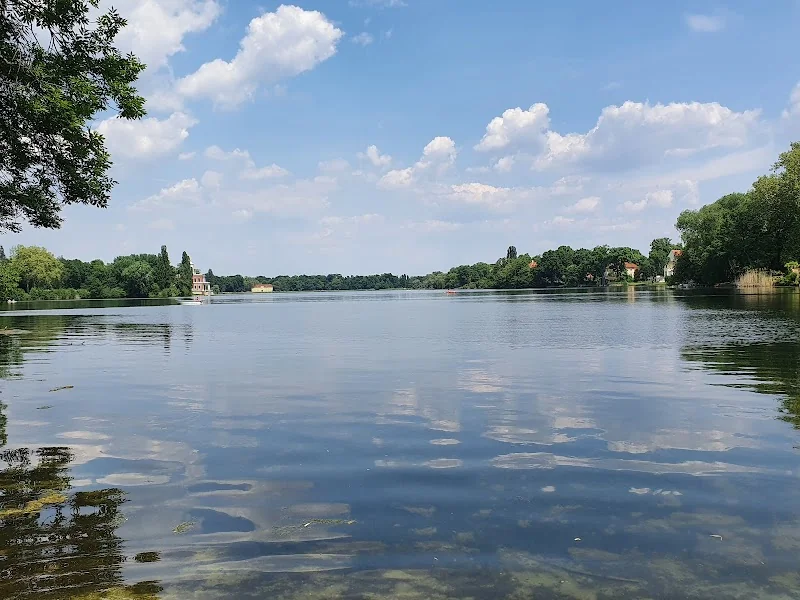
At the Holy Lake in Potsdam is not an ordinary point on the map, but a landscape of water, garden art, and Prussian history. The Holy Lake is, according to the city of Potsdam, a park water body that is artificially connected to the Jungfernsee via the Hasengraben. Its shores are largely undeveloped, with public access primarily in the areas of the New Garden. This mixture of water, old tree rows, historical buildings, and open sightlines makes the place so attractive for walks, quiet afternoons, and summer stays by the water. At the same time, the lake is heavily used for swimming due to its central location and relatively good water quality. Therefore, those looking for the Holy Lake find both: a nature-friendly place with much tranquility and an urban-integrated part of the Potsdam cultural landscape. ([potsdam.de](https://www.potsdam.de/de/content/heiliger-see))
Around the lake, Potsdam presents itself in its most representative form. The New Garden lies between the Holy Lake and Jungfernsee below the Pfingstberg and is dotted with the Marble Palace, Orangerie, Dutch establishments, Shingle House, Gothic Library, and Cecilienhof Palace. The Berlin suburb and the surrounding shore areas are also among the sought-after residential locations in the city, where representative villas and spacious gardens shape the image. It quickly becomes clear why the term At the Holy Lake not only refers to a lake but to an entire living and experiential space. ([potsdamtourismus.de](https://www.potsdamtourismus.de/poi/neuer-garten))
What makes the Holy Lake in Potsdam special
The Holy Lake connects nature experience, proximity to the city, and monument preservation in rare clarity. Unlike many urban waters, the shore here is not continuously developed but remains largely experienceable as a landscape space. The city of Potsdam describes the lake as a park water body with largely undeveloped shores, while the SPSG emphasizes the character of a garden monument of world significance for the New Garden. It is precisely from this constellation that the special charm arises: One stands by the water and simultaneously looks at a historically grown park landscape that does not appear loud but finely composed. The area invites not to grand displays but to quiet paths, changing perspectives, and long gazes over the water surface. Those who walk along the Holy Lake experience a place that changes with each season yet always retains the same fundamental mood: elegant, reserved, generous, and surprisingly quiet. ([potsdam.de](https://www.potsdam.de/de/content/heiliger-see))
Particularly striking is the balance between public access and protected character. The city of Potsdam points out that only the areas in the New Garden are publicly accessible, while on the eastern shore, private gardens extend right up to the water. At the same time, the lake is intensively used for swimming due to its central location and relatively good water quality. This makes it attractive for both locals and visitors, but it also requires consideration and conscious behavior. The Holy Lake is not a recreational pool but a historically embedded park water body that functions as a recreational area precisely because it has not been overly shaped. This mixture of use and protection also explains why the paths, accesses, and recreational areas around the lake are clearly defined, yet the scenery still appears open and inviting. The place is thus ideal for all those who want to not only see Potsdam but experience it atmospherically. ([potsdam.de](https://www.potsdam.de/de/content/heiliger-see))
New Garden and Marble Palace: the historical backdrop at the shore
The New Garden is the historical centerpiece at the Holy Lake. According to Potsdam Tourism, it lies between the Holy Lake and Jungfernsee and was created in 1787 on the orders of Friedrich Wilhelm II by Johann August Eyserbeck. Later, Peter Joseph Lenné revised the layout between 1816 and 1828 into a more open park landscape, the basic structure of which is still visible today. This history explains why the park does not appear like a strictly geometric palace garden but like a spacious, continually surprising ensemble of paths, meadows, sightlines, and buildings. The garden is not only a backdrop but itself a central cultural heritage of Potsdam. Its size, its location by the water, and its design openness give it a special lightness that is extraordinary in Prussian garden art. Those who stroll here move in a space that consciously opts for openness rather than closeness while remaining precisely composed. ([potsdamtourismus.de](https://www.potsdamtourismus.de/poi/neuer-garten))
The ensemble includes several buildings that make the visit varied. The SPSG mentions in the New Garden among others the Marble Palace, the Orangerie, the Gothic Library, and Cecilienhof Palace; Potsdam Tourism adds the Dutch establishments and the Shingle House. This mixture is precisely what makes the charm: The area is not only a park but also an open-air museum of historical architecture. The paths between the stations repeatedly open up new views, for example, of the lake, neighboring park facilities, or the Pfingstberg. Thus, the New Garden is a classic destination for quiet discoveries rather than hectic programs. It rewards all who take their time, and therefore fits excellently with queries related to New Garden Potsdam, Marble Palace at the Holy Lake, and walks by the water. The fact that the park is freely accessible and open daily from 8 a.m. until dusk further emphasizes its character as a public cultural and recreational space. ([potsdamtourismus.de](https://www.potsdamtourismus.de/poi/neuer-garten))
New Garden, UNESCO context, and the history of the garden landscape
Historically, the Holy Lake is closely linked to the development of the Potsdam garden landscape. The SPSG describes the New Garden as a world-famous garden ensemble and points out that the park facility has been part of the UNESCO World Heritage since 1990. The historical core dates back to the reign of Friedrich Wilhelm II, who had the New Garden created as a landscape counterpart to the stricter baroque forms of earlier facilities. It is precisely in this that the programmatic significance of this place lies: It marks a conscious step towards a more landscape-oriented, freer, and more emotional conception of gardens. The proximity of water, park, and architecture was meant not only to represent but also to surprise and enchant. This idea is still palpable today when one stands at the shore of the Holy Lake and perceives the buildings not as isolated objects but as parts of an overall staging. ([spsg.de](https://www.spsg.de/en/park-rules-for-the-new-garden-and-the-pfingstberg))
The historical charm of the area also lies in the fact that it has never been a purely museum landscape. The city of Potsdam emphasizes that the Holy Lake is artificially connected to the Jungfernsee via the Hasengraben and that its shore zones have been used differently for a long time. The eastern shore with private gardens still shows today that bourgeois and courtly history overlap here. At the same time, the New Garden is designed as a park facility in such a way that it not only provides monumental focal points but also intermediate spaces, sight relationships, and quiet passages. It is precisely these intermediate spaces that make the place photogenic and atmospherically dense. Those seeking history at the Holy Lake find it not only in the big names like Marble Palace or Cecilienhof but also in the paths, the tree and shore images, and the open park idea. This keeps the New Garden from being just a historical document but a vibrant urban space where the past naturally extends into everyday life. ([potsdam.de](https://www.potsdam.de/de/content/heiliger-see))
Access, parking, and opening hours at the Holy Lake
For visitors, orientation around the Holy Lake is pleasantly simple if one knows the main access points. The SPSG mentions for the New Garden the stop Potsdam, Schloss Cecilienhof as well as the stops Potsdam, Gothic Library, Potsdam, Birkenstr./Alleestr., and Potsdam, Glumestr. This makes the area well accessible by public transport. Those arriving by car will find paid parking spaces near Schloss Cecilienhof but must note that currently only parking spaces for cars are available due to construction work. Especially on sunny days, it is worth considering arriving by train, tram, or bus. This not only saves the search for parking but also better fits the character of the place, which invites more to a relaxed arrival than to a quick pass-through. For queries like access to the Holy Lake or parking at the Holy Lake, these access details are crucial. ([spsg.de](https://www.spsg.de/schloesser-gaerten/objekt/neuer-garten))
The opening hours of the New Garden are clearly regulated: The park is open daily from Monday to Sunday and is accessible from 8 a.m. until dusk. Admission is free. At the same time, there is a park regulation that protects the character of the monument: Vehicles are not allowed in the park without special permission, bicycles only on designated paths, and leaving the paths is also prohibited. These rules are not annoying but part of the protection of a sensitive ensemble. The Holy Lake and the New Garden are indeed not arbitrary green spaces but a historical garden artwork that demands tranquility and consideration. Those who adhere to this experience the place all the more intensely. For visitors, this means: come early, leave relaxed, use the sightlines, and understand the park as a quiet but not empty space. Precisely because access is free, personal responsibility is high. This mixture of openness and respect defines the quality of the visit. ([spsg.de](https://www.spsg.de/schloesser-gaerten/objekt/neuer-garten))
Walking, swimming, and rules in the park water
The Holy Lake is particularly attractive for walks because it connects water, paths, and historical architecture in a small space. Those who use the shore area or the adjacent park paths experience a landscape with changing views of the water, the Marble Palace, and the park trees of the New Garden. At the same time, the place is not an arbitrary recreational area but a sensitive protection area. The SPSG explicitly points out that swimming in the Holy Lake is only allowed in the designated areas. Additionally, in the park, among other things, driving and parking vehicles, leaving the paths, camping, barbecuing, and loud music are prohibited. This keeps the place quiet and is precisely why it is suitable for all those who want to consciously walk, photograph, or spend a few hours by the water. The lake thrives on this restraint: no loud recreational offerings but a clear, cultivated form of relaxation. ([spsg.de](https://www.spsg.de/en/park-rules-for-the-new-garden-and-the-pfingstberg))
Nature itself also plays an important role. The city of Potsdam describes the shores of the Holy Lake as largely undeveloped and points out that pronounced reed beds occur mainly on the northern shore. This gives the water a natural character in several places, even though it is located in the middle of an urban cultural landscape. For visitors, this means that they can find not only architecture but also quiet natural moments by the lake. Those who wish to swim should adhere to the designated zones and enjoy the historical surroundings with the necessary caution. The charm of the Holy Lake lies not in athletic activity but in the relaxed connection of water, greenery, and culture. Therefore, the place is ideal for slow movement, for quiet pauses on the paths, and for moments when the gaze simply drifts over the water surface. It is precisely this form of deceleration that makes At the Holy Lake so popular and timeless. ([potsdam.de](https://www.potsdam.de/de/content/heiliger-see))
Villas, Berlin suburb, and the special residential environment
Those looking for villas at the Holy Lake in Potsdam or villas at the Holy Lake quickly end up in the Berlin suburb. The city of Potsdam describes this area as attractively located, surrounded by Jungfernsee, Tiefem See, and Holy Lake, near the historical park facility of the New Garden and the city center. The suburb is one of the preferred residential areas of Potsdam and is characterized by representative villas amidst extensive gardens, complemented by single-family and two-family houses as well as elaborate apartment buildings from the early 20th century. This description explains why the lake is perceived not only as a destination for excursions but also as an attractive residential and living space. The architecture at the edge of the water appears generous, close to the city, and at the same time very private. This is precisely where the special charm of the environment comes from: It is an area where historical landscape and upscale residential culture overlap without losing their respective independence. ([potsdam.de](https://www.potsdam.de/de/content/nauener-vorstadt-jaegervorstadt-berliner-vorstadt))
The surrounding area is also well-equipped gastronomically and culturally. The SPSG mentions near the New Garden among others the Dairy in the New Garden directly at the shore of the Jungfernsee as well as Café Midi in the Treffpunkt Freizeit. This leads queries like restaurant at the Holy Lake or café at the Holy Lake to a real, nearby infrastructure without losing the character of the area. The Holy Lake remains primarily a place for walking, viewing, and lingering. Those planning a visit can combine the walk by the lake with a historical detour to the Marble Palace, a coffee nearby, or a longer stroll through the New Garden. This creates a day trip that does not consist of individual attractions but of a harmonious sequence of impressions. This is precisely what makes At the Holy Lake so valuable for Potsdam: It is not just a name but an ensemble of water, park, architecture, residential culture, and quiet elegance. ([spsg.de](https://www.spsg.de/schloesser-gaerten/objekt/neuer-garten))
The Marble Palace as a royal landmark by the water
No building shapes the Holy Lake as strongly as the Marble Palace. The SPSG describes it as romantically situated on a terrace directly at the shore in the New Garden. King Friedrich Wilhelm II had it built between 1787 and 1793 as a summer residence; Carl von Gontard designed it as the first and only Prussian royal palace in early classicism. The building embodies the architectural transition from courtly representation to a more sensitive, antiquity-oriented language of forms. In the vicinity of the lake, this attitude is still visible today: The palace is not isolated but integrated into the landscape and opens the view to the water and the Havel landscape. It is precisely this staging of closeness and distance that makes the Marble Palace a key place for all those who want to understand the relationship between Potsdam garden art and architecture. ([spsg.de](https://www.spsg.de/en/palaces-gardens/object/marble-house/))
Also inside, the palace is historically significant. The SPSG mentions among other things the interior designed by Carl Gotthard Langhans, the completely wood-paneled sleeping area of the king, the Oriental Cabinet, and the concert hall that resembles an ancient temple. Additionally, there are marble fireplaces, ancient sculptures, valuable furniture, paintings, and the second-largest Wedgwood ceramic collection in Germany. The Marble Palace is thus not only an eye-catcher from the outside but also dense in content and of high art historical significance. Those visiting the place do not simply see a castle by the water but a carefully composed total work of art made of architecture, furnishings, and landscape. This explains why the Marble Palace at the Holy Lake is often described as one of the most important landmarks of this Potsdam region and why it always plays a central role in queries about history, sights, and culture. ([spsg.de](https://www.spsg.de/presse-foto-film/pressematerial-schloesser-gaerten-stiftung/potsdam/presse-material-marmorpalais?utm_source=openai))
Visiting the Marble Palace: Opening hours, tickets, and practical tips
For a specific visit to the Holy Lake, the information about the Marble Palace is particularly useful. The SPSG provides the address Im Neuen Garten 10, 14469 Potsdam. The palace is open seasonally: In November and March only on weekends, in April also on weekends, and from May to October Tuesday to Sunday. The visit is conducted with a guided tour in German; for guests without German language skills, a multilingual tour is available in the free SANSSOUCI app. Also, the last admission is 30 minutes before closing time. This structure is important because it shows: The palace is a very well-maintained museum location with consciously managed visitor flow, not an open building for free wandering. Therefore, those looking for Marble Palace Potsdam or Marble Palace at the Holy Lake should plan for the guided tour situation. ([spsg.de](https://www.spsg.de/schloesser-gaerten/objekt/marmorpalais/))
Practically relevant are also the tips for arrival and accessibility. The nearest stop is Potsdam, Birkenstr./Alleestr., from there it is about 700 meters on foot. For drivers, paid parking spaces are available near Schloss Cecilienhof; here too, the note applies that due to construction work, currently only car parking spaces are available. The Marble Palace is also conditionally wheelchair accessible: The ground floor can be visited with a wheelchair, a lift leads to the entrance, and a wheelchair is available in the palace. For families, it is important that strollers may not be taken into the exhibition rooms for conservation reasons. This information shows how closely historical substance and modern visitor organization play together here. Those who plan the visit well experience one of the most elegant places in Potsdam without haste and with clear orientation. ([spsg.de](https://www.spsg.de/schloesser-gaerten/objekt/marmorpalais/))
Sources:
Show moreShow less
At the Holy Lake | New Garden & Marble Palace
At the Holy Lake in Potsdam is not an ordinary point on the map, but a landscape of water, garden art, and Prussian history. The Holy Lake is, according to the city of Potsdam, a park water body that is artificially connected to the Jungfernsee via the Hasengraben. Its shores are largely undeveloped, with public access primarily in the areas of the New Garden. This mixture of water, old tree rows, historical buildings, and open sightlines makes the place so attractive for walks, quiet afternoons, and summer stays by the water. At the same time, the lake is heavily used for swimming due to its central location and relatively good water quality. Therefore, those looking for the Holy Lake find both: a nature-friendly place with much tranquility and an urban-integrated part of the Potsdam cultural landscape. ([potsdam.de](https://www.potsdam.de/de/content/heiliger-see))
Around the lake, Potsdam presents itself in its most representative form. The New Garden lies between the Holy Lake and Jungfernsee below the Pfingstberg and is dotted with the Marble Palace, Orangerie, Dutch establishments, Shingle House, Gothic Library, and Cecilienhof Palace. The Berlin suburb and the surrounding shore areas are also among the sought-after residential locations in the city, where representative villas and spacious gardens shape the image. It quickly becomes clear why the term At the Holy Lake not only refers to a lake but to an entire living and experiential space. ([potsdamtourismus.de](https://www.potsdamtourismus.de/poi/neuer-garten))
What makes the Holy Lake in Potsdam special
The Holy Lake connects nature experience, proximity to the city, and monument preservation in rare clarity. Unlike many urban waters, the shore here is not continuously developed but remains largely experienceable as a landscape space. The city of Potsdam describes the lake as a park water body with largely undeveloped shores, while the SPSG emphasizes the character of a garden monument of world significance for the New Garden. It is precisely from this constellation that the special charm arises: One stands by the water and simultaneously looks at a historically grown park landscape that does not appear loud but finely composed. The area invites not to grand displays but to quiet paths, changing perspectives, and long gazes over the water surface. Those who walk along the Holy Lake experience a place that changes with each season yet always retains the same fundamental mood: elegant, reserved, generous, and surprisingly quiet. ([potsdam.de](https://www.potsdam.de/de/content/heiliger-see))
Particularly striking is the balance between public access and protected character. The city of Potsdam points out that only the areas in the New Garden are publicly accessible, while on the eastern shore, private gardens extend right up to the water. At the same time, the lake is intensively used for swimming due to its central location and relatively good water quality. This makes it attractive for both locals and visitors, but it also requires consideration and conscious behavior. The Holy Lake is not a recreational pool but a historically embedded park water body that functions as a recreational area precisely because it has not been overly shaped. This mixture of use and protection also explains why the paths, accesses, and recreational areas around the lake are clearly defined, yet the scenery still appears open and inviting. The place is thus ideal for all those who want to not only see Potsdam but experience it atmospherically. ([potsdam.de](https://www.potsdam.de/de/content/heiliger-see))
New Garden and Marble Palace: the historical backdrop at the shore
The New Garden is the historical centerpiece at the Holy Lake. According to Potsdam Tourism, it lies between the Holy Lake and Jungfernsee and was created in 1787 on the orders of Friedrich Wilhelm II by Johann August Eyserbeck. Later, Peter Joseph Lenné revised the layout between 1816 and 1828 into a more open park landscape, the basic structure of which is still visible today. This history explains why the park does not appear like a strictly geometric palace garden but like a spacious, continually surprising ensemble of paths, meadows, sightlines, and buildings. The garden is not only a backdrop but itself a central cultural heritage of Potsdam. Its size, its location by the water, and its design openness give it a special lightness that is extraordinary in Prussian garden art. Those who stroll here move in a space that consciously opts for openness rather than closeness while remaining precisely composed. ([potsdamtourismus.de](https://www.potsdamtourismus.de/poi/neuer-garten))
The ensemble includes several buildings that make the visit varied. The SPSG mentions in the New Garden among others the Marble Palace, the Orangerie, the Gothic Library, and Cecilienhof Palace; Potsdam Tourism adds the Dutch establishments and the Shingle House. This mixture is precisely what makes the charm: The area is not only a park but also an open-air museum of historical architecture. The paths between the stations repeatedly open up new views, for example, of the lake, neighboring park facilities, or the Pfingstberg. Thus, the New Garden is a classic destination for quiet discoveries rather than hectic programs. It rewards all who take their time, and therefore fits excellently with queries related to New Garden Potsdam, Marble Palace at the Holy Lake, and walks by the water. The fact that the park is freely accessible and open daily from 8 a.m. until dusk further emphasizes its character as a public cultural and recreational space. ([potsdamtourismus.de](https://www.potsdamtourismus.de/poi/neuer-garten))
New Garden, UNESCO context, and the history of the garden landscape
Historically, the Holy Lake is closely linked to the development of the Potsdam garden landscape. The SPSG describes the New Garden as a world-famous garden ensemble and points out that the park facility has been part of the UNESCO World Heritage since 1990. The historical core dates back to the reign of Friedrich Wilhelm II, who had the New Garden created as a landscape counterpart to the stricter baroque forms of earlier facilities. It is precisely in this that the programmatic significance of this place lies: It marks a conscious step towards a more landscape-oriented, freer, and more emotional conception of gardens. The proximity of water, park, and architecture was meant not only to represent but also to surprise and enchant. This idea is still palpable today when one stands at the shore of the Holy Lake and perceives the buildings not as isolated objects but as parts of an overall staging. ([spsg.de](https://www.spsg.de/en/park-rules-for-the-new-garden-and-the-pfingstberg))
The historical charm of the area also lies in the fact that it has never been a purely museum landscape. The city of Potsdam emphasizes that the Holy Lake is artificially connected to the Jungfernsee via the Hasengraben and that its shore zones have been used differently for a long time. The eastern shore with private gardens still shows today that bourgeois and courtly history overlap here. At the same time, the New Garden is designed as a park facility in such a way that it not only provides monumental focal points but also intermediate spaces, sight relationships, and quiet passages. It is precisely these intermediate spaces that make the place photogenic and atmospherically dense. Those seeking history at the Holy Lake find it not only in the big names like Marble Palace or Cecilienhof but also in the paths, the tree and shore images, and the open park idea. This keeps the New Garden from being just a historical document but a vibrant urban space where the past naturally extends into everyday life. ([potsdam.de](https://www.potsdam.de/de/content/heiliger-see))
Access, parking, and opening hours at the Holy Lake
For visitors, orientation around the Holy Lake is pleasantly simple if one knows the main access points. The SPSG mentions for the New Garden the stop Potsdam, Schloss Cecilienhof as well as the stops Potsdam, Gothic Library, Potsdam, Birkenstr./Alleestr., and Potsdam, Glumestr. This makes the area well accessible by public transport. Those arriving by car will find paid parking spaces near Schloss Cecilienhof but must note that currently only parking spaces for cars are available due to construction work. Especially on sunny days, it is worth considering arriving by train, tram, or bus. This not only saves the search for parking but also better fits the character of the place, which invites more to a relaxed arrival than to a quick pass-through. For queries like access to the Holy Lake or parking at the Holy Lake, these access details are crucial. ([spsg.de](https://www.spsg.de/schloesser-gaerten/objekt/neuer-garten))
The opening hours of the New Garden are clearly regulated: The park is open daily from Monday to Sunday and is accessible from 8 a.m. until dusk. Admission is free. At the same time, there is a park regulation that protects the character of the monument: Vehicles are not allowed in the park without special permission, bicycles only on designated paths, and leaving the paths is also prohibited. These rules are not annoying but part of the protection of a sensitive ensemble. The Holy Lake and the New Garden are indeed not arbitrary green spaces but a historical garden artwork that demands tranquility and consideration. Those who adhere to this experience the place all the more intensely. For visitors, this means: come early, leave relaxed, use the sightlines, and understand the park as a quiet but not empty space. Precisely because access is free, personal responsibility is high. This mixture of openness and respect defines the quality of the visit. ([spsg.de](https://www.spsg.de/schloesser-gaerten/objekt/neuer-garten))
Walking, swimming, and rules in the park water
The Holy Lake is particularly attractive for walks because it connects water, paths, and historical architecture in a small space. Those who use the shore area or the adjacent park paths experience a landscape with changing views of the water, the Marble Palace, and the park trees of the New Garden. At the same time, the place is not an arbitrary recreational area but a sensitive protection area. The SPSG explicitly points out that swimming in the Holy Lake is only allowed in the designated areas. Additionally, in the park, among other things, driving and parking vehicles, leaving the paths, camping, barbecuing, and loud music are prohibited. This keeps the place quiet and is precisely why it is suitable for all those who want to consciously walk, photograph, or spend a few hours by the water. The lake thrives on this restraint: no loud recreational offerings but a clear, cultivated form of relaxation. ([spsg.de](https://www.spsg.de/en/park-rules-for-the-new-garden-and-the-pfingstberg))
Nature itself also plays an important role. The city of Potsdam describes the shores of the Holy Lake as largely undeveloped and points out that pronounced reed beds occur mainly on the northern shore. This gives the water a natural character in several places, even though it is located in the middle of an urban cultural landscape. For visitors, this means that they can find not only architecture but also quiet natural moments by the lake. Those who wish to swim should adhere to the designated zones and enjoy the historical surroundings with the necessary caution. The charm of the Holy Lake lies not in athletic activity but in the relaxed connection of water, greenery, and culture. Therefore, the place is ideal for slow movement, for quiet pauses on the paths, and for moments when the gaze simply drifts over the water surface. It is precisely this form of deceleration that makes At the Holy Lake so popular and timeless. ([potsdam.de](https://www.potsdam.de/de/content/heiliger-see))
Villas, Berlin suburb, and the special residential environment
Those looking for villas at the Holy Lake in Potsdam or villas at the Holy Lake quickly end up in the Berlin suburb. The city of Potsdam describes this area as attractively located, surrounded by Jungfernsee, Tiefem See, and Holy Lake, near the historical park facility of the New Garden and the city center. The suburb is one of the preferred residential areas of Potsdam and is characterized by representative villas amidst extensive gardens, complemented by single-family and two-family houses as well as elaborate apartment buildings from the early 20th century. This description explains why the lake is perceived not only as a destination for excursions but also as an attractive residential and living space. The architecture at the edge of the water appears generous, close to the city, and at the same time very private. This is precisely where the special charm of the environment comes from: It is an area where historical landscape and upscale residential culture overlap without losing their respective independence. ([potsdam.de](https://www.potsdam.de/de/content/nauener-vorstadt-jaegervorstadt-berliner-vorstadt))
The surrounding area is also well-equipped gastronomically and culturally. The SPSG mentions near the New Garden among others the Dairy in the New Garden directly at the shore of the Jungfernsee as well as Café Midi in the Treffpunkt Freizeit. This leads queries like restaurant at the Holy Lake or café at the Holy Lake to a real, nearby infrastructure without losing the character of the area. The Holy Lake remains primarily a place for walking, viewing, and lingering. Those planning a visit can combine the walk by the lake with a historical detour to the Marble Palace, a coffee nearby, or a longer stroll through the New Garden. This creates a day trip that does not consist of individual attractions but of a harmonious sequence of impressions. This is precisely what makes At the Holy Lake so valuable for Potsdam: It is not just a name but an ensemble of water, park, architecture, residential culture, and quiet elegance. ([spsg.de](https://www.spsg.de/schloesser-gaerten/objekt/neuer-garten))
The Marble Palace as a royal landmark by the water
No building shapes the Holy Lake as strongly as the Marble Palace. The SPSG describes it as romantically situated on a terrace directly at the shore in the New Garden. King Friedrich Wilhelm II had it built between 1787 and 1793 as a summer residence; Carl von Gontard designed it as the first and only Prussian royal palace in early classicism. The building embodies the architectural transition from courtly representation to a more sensitive, antiquity-oriented language of forms. In the vicinity of the lake, this attitude is still visible today: The palace is not isolated but integrated into the landscape and opens the view to the water and the Havel landscape. It is precisely this staging of closeness and distance that makes the Marble Palace a key place for all those who want to understand the relationship between Potsdam garden art and architecture. ([spsg.de](https://www.spsg.de/en/palaces-gardens/object/marble-house/))
Also inside, the palace is historically significant. The SPSG mentions among other things the interior designed by Carl Gotthard Langhans, the completely wood-paneled sleeping area of the king, the Oriental Cabinet, and the concert hall that resembles an ancient temple. Additionally, there are marble fireplaces, ancient sculptures, valuable furniture, paintings, and the second-largest Wedgwood ceramic collection in Germany. The Marble Palace is thus not only an eye-catcher from the outside but also dense in content and of high art historical significance. Those visiting the place do not simply see a castle by the water but a carefully composed total work of art made of architecture, furnishings, and landscape. This explains why the Marble Palace at the Holy Lake is often described as one of the most important landmarks of this Potsdam region and why it always plays a central role in queries about history, sights, and culture. ([spsg.de](https://www.spsg.de/presse-foto-film/pressematerial-schloesser-gaerten-stiftung/potsdam/presse-material-marmorpalais?utm_source=openai))
Visiting the Marble Palace: Opening hours, tickets, and practical tips
For a specific visit to the Holy Lake, the information about the Marble Palace is particularly useful. The SPSG provides the address Im Neuen Garten 10, 14469 Potsdam. The palace is open seasonally: In November and March only on weekends, in April also on weekends, and from May to October Tuesday to Sunday. The visit is conducted with a guided tour in German; for guests without German language skills, a multilingual tour is available in the free SANSSOUCI app. Also, the last admission is 30 minutes before closing time. This structure is important because it shows: The palace is a very well-maintained museum location with consciously managed visitor flow, not an open building for free wandering. Therefore, those looking for Marble Palace Potsdam or Marble Palace at the Holy Lake should plan for the guided tour situation. ([spsg.de](https://www.spsg.de/schloesser-gaerten/objekt/marmorpalais/))
Practically relevant are also the tips for arrival and accessibility. The nearest stop is Potsdam, Birkenstr./Alleestr., from there it is about 700 meters on foot. For drivers, paid parking spaces are available near Schloss Cecilienhof; here too, the note applies that due to construction work, currently only car parking spaces are available. The Marble Palace is also conditionally wheelchair accessible: The ground floor can be visited with a wheelchair, a lift leads to the entrance, and a wheelchair is available in the palace. For families, it is important that strollers may not be taken into the exhibition rooms for conservation reasons. This information shows how closely historical substance and modern visitor organization play together here. Those who plan the visit well experience one of the most elegant places in Potsdam without haste and with clear orientation. ([spsg.de](https://www.spsg.de/schloesser-gaerten/objekt/marmorpalais/))
Sources:
At the Holy Lake | New Garden & Marble Palace
At the Holy Lake in Potsdam is not an ordinary point on the map, but a landscape of water, garden art, and Prussian history. The Holy Lake is, according to the city of Potsdam, a park water body that is artificially connected to the Jungfernsee via the Hasengraben. Its shores are largely undeveloped, with public access primarily in the areas of the New Garden. This mixture of water, old tree rows, historical buildings, and open sightlines makes the place so attractive for walks, quiet afternoons, and summer stays by the water. At the same time, the lake is heavily used for swimming due to its central location and relatively good water quality. Therefore, those looking for the Holy Lake find both: a nature-friendly place with much tranquility and an urban-integrated part of the Potsdam cultural landscape. ([potsdam.de](https://www.potsdam.de/de/content/heiliger-see))
Around the lake, Potsdam presents itself in its most representative form. The New Garden lies between the Holy Lake and Jungfernsee below the Pfingstberg and is dotted with the Marble Palace, Orangerie, Dutch establishments, Shingle House, Gothic Library, and Cecilienhof Palace. The Berlin suburb and the surrounding shore areas are also among the sought-after residential locations in the city, where representative villas and spacious gardens shape the image. It quickly becomes clear why the term At the Holy Lake not only refers to a lake but to an entire living and experiential space. ([potsdamtourismus.de](https://www.potsdamtourismus.de/poi/neuer-garten))
What makes the Holy Lake in Potsdam special
The Holy Lake connects nature experience, proximity to the city, and monument preservation in rare clarity. Unlike many urban waters, the shore here is not continuously developed but remains largely experienceable as a landscape space. The city of Potsdam describes the lake as a park water body with largely undeveloped shores, while the SPSG emphasizes the character of a garden monument of world significance for the New Garden. It is precisely from this constellation that the special charm arises: One stands by the water and simultaneously looks at a historically grown park landscape that does not appear loud but finely composed. The area invites not to grand displays but to quiet paths, changing perspectives, and long gazes over the water surface. Those who walk along the Holy Lake experience a place that changes with each season yet always retains the same fundamental mood: elegant, reserved, generous, and surprisingly quiet. ([potsdam.de](https://www.potsdam.de/de/content/heiliger-see))
Particularly striking is the balance between public access and protected character. The city of Potsdam points out that only the areas in the New Garden are publicly accessible, while on the eastern shore, private gardens extend right up to the water. At the same time, the lake is intensively used for swimming due to its central location and relatively good water quality. This makes it attractive for both locals and visitors, but it also requires consideration and conscious behavior. The Holy Lake is not a recreational pool but a historically embedded park water body that functions as a recreational area precisely because it has not been overly shaped. This mixture of use and protection also explains why the paths, accesses, and recreational areas around the lake are clearly defined, yet the scenery still appears open and inviting. The place is thus ideal for all those who want to not only see Potsdam but experience it atmospherically. ([potsdam.de](https://www.potsdam.de/de/content/heiliger-see))
New Garden and Marble Palace: the historical backdrop at the shore
The New Garden is the historical centerpiece at the Holy Lake. According to Potsdam Tourism, it lies between the Holy Lake and Jungfernsee and was created in 1787 on the orders of Friedrich Wilhelm II by Johann August Eyserbeck. Later, Peter Joseph Lenné revised the layout between 1816 and 1828 into a more open park landscape, the basic structure of which is still visible today. This history explains why the park does not appear like a strictly geometric palace garden but like a spacious, continually surprising ensemble of paths, meadows, sightlines, and buildings. The garden is not only a backdrop but itself a central cultural heritage of Potsdam. Its size, its location by the water, and its design openness give it a special lightness that is extraordinary in Prussian garden art. Those who stroll here move in a space that consciously opts for openness rather than closeness while remaining precisely composed. ([potsdamtourismus.de](https://www.potsdamtourismus.de/poi/neuer-garten))
The ensemble includes several buildings that make the visit varied. The SPSG mentions in the New Garden among others the Marble Palace, the Orangerie, the Gothic Library, and Cecilienhof Palace; Potsdam Tourism adds the Dutch establishments and the Shingle House. This mixture is precisely what makes the charm: The area is not only a park but also an open-air museum of historical architecture. The paths between the stations repeatedly open up new views, for example, of the lake, neighboring park facilities, or the Pfingstberg. Thus, the New Garden is a classic destination for quiet discoveries rather than hectic programs. It rewards all who take their time, and therefore fits excellently with queries related to New Garden Potsdam, Marble Palace at the Holy Lake, and walks by the water. The fact that the park is freely accessible and open daily from 8 a.m. until dusk further emphasizes its character as a public cultural and recreational space. ([potsdamtourismus.de](https://www.potsdamtourismus.de/poi/neuer-garten))
New Garden, UNESCO context, and the history of the garden landscape
Historically, the Holy Lake is closely linked to the development of the Potsdam garden landscape. The SPSG describes the New Garden as a world-famous garden ensemble and points out that the park facility has been part of the UNESCO World Heritage since 1990. The historical core dates back to the reign of Friedrich Wilhelm II, who had the New Garden created as a landscape counterpart to the stricter baroque forms of earlier facilities. It is precisely in this that the programmatic significance of this place lies: It marks a conscious step towards a more landscape-oriented, freer, and more emotional conception of gardens. The proximity of water, park, and architecture was meant not only to represent but also to surprise and enchant. This idea is still palpable today when one stands at the shore of the Holy Lake and perceives the buildings not as isolated objects but as parts of an overall staging. ([spsg.de](https://www.spsg.de/en/park-rules-for-the-new-garden-and-the-pfingstberg))
The historical charm of the area also lies in the fact that it has never been a purely museum landscape. The city of Potsdam emphasizes that the Holy Lake is artificially connected to the Jungfernsee via the Hasengraben and that its shore zones have been used differently for a long time. The eastern shore with private gardens still shows today that bourgeois and courtly history overlap here. At the same time, the New Garden is designed as a park facility in such a way that it not only provides monumental focal points but also intermediate spaces, sight relationships, and quiet passages. It is precisely these intermediate spaces that make the place photogenic and atmospherically dense. Those seeking history at the Holy Lake find it not only in the big names like Marble Palace or Cecilienhof but also in the paths, the tree and shore images, and the open park idea. This keeps the New Garden from being just a historical document but a vibrant urban space where the past naturally extends into everyday life. ([potsdam.de](https://www.potsdam.de/de/content/heiliger-see))
Access, parking, and opening hours at the Holy Lake
For visitors, orientation around the Holy Lake is pleasantly simple if one knows the main access points. The SPSG mentions for the New Garden the stop Potsdam, Schloss Cecilienhof as well as the stops Potsdam, Gothic Library, Potsdam, Birkenstr./Alleestr., and Potsdam, Glumestr. This makes the area well accessible by public transport. Those arriving by car will find paid parking spaces near Schloss Cecilienhof but must note that currently only parking spaces for cars are available due to construction work. Especially on sunny days, it is worth considering arriving by train, tram, or bus. This not only saves the search for parking but also better fits the character of the place, which invites more to a relaxed arrival than to a quick pass-through. For queries like access to the Holy Lake or parking at the Holy Lake, these access details are crucial. ([spsg.de](https://www.spsg.de/schloesser-gaerten/objekt/neuer-garten))
The opening hours of the New Garden are clearly regulated: The park is open daily from Monday to Sunday and is accessible from 8 a.m. until dusk. Admission is free. At the same time, there is a park regulation that protects the character of the monument: Vehicles are not allowed in the park without special permission, bicycles only on designated paths, and leaving the paths is also prohibited. These rules are not annoying but part of the protection of a sensitive ensemble. The Holy Lake and the New Garden are indeed not arbitrary green spaces but a historical garden artwork that demands tranquility and consideration. Those who adhere to this experience the place all the more intensely. For visitors, this means: come early, leave relaxed, use the sightlines, and understand the park as a quiet but not empty space. Precisely because access is free, personal responsibility is high. This mixture of openness and respect defines the quality of the visit. ([spsg.de](https://www.spsg.de/schloesser-gaerten/objekt/neuer-garten))
Walking, swimming, and rules in the park water
The Holy Lake is particularly attractive for walks because it connects water, paths, and historical architecture in a small space. Those who use the shore area or the adjacent park paths experience a landscape with changing views of the water, the Marble Palace, and the park trees of the New Garden. At the same time, the place is not an arbitrary recreational area but a sensitive protection area. The SPSG explicitly points out that swimming in the Holy Lake is only allowed in the designated areas. Additionally, in the park, among other things, driving and parking vehicles, leaving the paths, camping, barbecuing, and loud music are prohibited. This keeps the place quiet and is precisely why it is suitable for all those who want to consciously walk, photograph, or spend a few hours by the water. The lake thrives on this restraint: no loud recreational offerings but a clear, cultivated form of relaxation. ([spsg.de](https://www.spsg.de/en/park-rules-for-the-new-garden-and-the-pfingstberg))
Nature itself also plays an important role. The city of Potsdam describes the shores of the Holy Lake as largely undeveloped and points out that pronounced reed beds occur mainly on the northern shore. This gives the water a natural character in several places, even though it is located in the middle of an urban cultural landscape. For visitors, this means that they can find not only architecture but also quiet natural moments by the lake. Those who wish to swim should adhere to the designated zones and enjoy the historical surroundings with the necessary caution. The charm of the Holy Lake lies not in athletic activity but in the relaxed connection of water, greenery, and culture. Therefore, the place is ideal for slow movement, for quiet pauses on the paths, and for moments when the gaze simply drifts over the water surface. It is precisely this form of deceleration that makes At the Holy Lake so popular and timeless. ([potsdam.de](https://www.potsdam.de/de/content/heiliger-see))
Villas, Berlin suburb, and the special residential environment
Those looking for villas at the Holy Lake in Potsdam or villas at the Holy Lake quickly end up in the Berlin suburb. The city of Potsdam describes this area as attractively located, surrounded by Jungfernsee, Tiefem See, and Holy Lake, near the historical park facility of the New Garden and the city center. The suburb is one of the preferred residential areas of Potsdam and is characterized by representative villas amidst extensive gardens, complemented by single-family and two-family houses as well as elaborate apartment buildings from the early 20th century. This description explains why the lake is perceived not only as a destination for excursions but also as an attractive residential and living space. The architecture at the edge of the water appears generous, close to the city, and at the same time very private. This is precisely where the special charm of the environment comes from: It is an area where historical landscape and upscale residential culture overlap without losing their respective independence. ([potsdam.de](https://www.potsdam.de/de/content/nauener-vorstadt-jaegervorstadt-berliner-vorstadt))
The surrounding area is also well-equipped gastronomically and culturally. The SPSG mentions near the New Garden among others the Dairy in the New Garden directly at the shore of the Jungfernsee as well as Café Midi in the Treffpunkt Freizeit. This leads queries like restaurant at the Holy Lake or café at the Holy Lake to a real, nearby infrastructure without losing the character of the area. The Holy Lake remains primarily a place for walking, viewing, and lingering. Those planning a visit can combine the walk by the lake with a historical detour to the Marble Palace, a coffee nearby, or a longer stroll through the New Garden. This creates a day trip that does not consist of individual attractions but of a harmonious sequence of impressions. This is precisely what makes At the Holy Lake so valuable for Potsdam: It is not just a name but an ensemble of water, park, architecture, residential culture, and quiet elegance. ([spsg.de](https://www.spsg.de/schloesser-gaerten/objekt/neuer-garten))
The Marble Palace as a royal landmark by the water
No building shapes the Holy Lake as strongly as the Marble Palace. The SPSG describes it as romantically situated on a terrace directly at the shore in the New Garden. King Friedrich Wilhelm II had it built between 1787 and 1793 as a summer residence; Carl von Gontard designed it as the first and only Prussian royal palace in early classicism. The building embodies the architectural transition from courtly representation to a more sensitive, antiquity-oriented language of forms. In the vicinity of the lake, this attitude is still visible today: The palace is not isolated but integrated into the landscape and opens the view to the water and the Havel landscape. It is precisely this staging of closeness and distance that makes the Marble Palace a key place for all those who want to understand the relationship between Potsdam garden art and architecture. ([spsg.de](https://www.spsg.de/en/palaces-gardens/object/marble-house/))
Also inside, the palace is historically significant. The SPSG mentions among other things the interior designed by Carl Gotthard Langhans, the completely wood-paneled sleeping area of the king, the Oriental Cabinet, and the concert hall that resembles an ancient temple. Additionally, there are marble fireplaces, ancient sculptures, valuable furniture, paintings, and the second-largest Wedgwood ceramic collection in Germany. The Marble Palace is thus not only an eye-catcher from the outside but also dense in content and of high art historical significance. Those visiting the place do not simply see a castle by the water but a carefully composed total work of art made of architecture, furnishings, and landscape. This explains why the Marble Palace at the Holy Lake is often described as one of the most important landmarks of this Potsdam region and why it always plays a central role in queries about history, sights, and culture. ([spsg.de](https://www.spsg.de/presse-foto-film/pressematerial-schloesser-gaerten-stiftung/potsdam/presse-material-marmorpalais?utm_source=openai))
Visiting the Marble Palace: Opening hours, tickets, and practical tips
For a specific visit to the Holy Lake, the information about the Marble Palace is particularly useful. The SPSG provides the address Im Neuen Garten 10, 14469 Potsdam. The palace is open seasonally: In November and March only on weekends, in April also on weekends, and from May to October Tuesday to Sunday. The visit is conducted with a guided tour in German; for guests without German language skills, a multilingual tour is available in the free SANSSOUCI app. Also, the last admission is 30 minutes before closing time. This structure is important because it shows: The palace is a very well-maintained museum location with consciously managed visitor flow, not an open building for free wandering. Therefore, those looking for Marble Palace Potsdam or Marble Palace at the Holy Lake should plan for the guided tour situation. ([spsg.de](https://www.spsg.de/schloesser-gaerten/objekt/marmorpalais/))
Practically relevant are also the tips for arrival and accessibility. The nearest stop is Potsdam, Birkenstr./Alleestr., from there it is about 700 meters on foot. For drivers, paid parking spaces are available near Schloss Cecilienhof; here too, the note applies that due to construction work, currently only car parking spaces are available. The Marble Palace is also conditionally wheelchair accessible: The ground floor can be visited with a wheelchair, a lift leads to the entrance, and a wheelchair is available in the palace. For families, it is important that strollers may not be taken into the exhibition rooms for conservation reasons. This information shows how closely historical substance and modern visitor organization play together here. Those who plan the visit well experience one of the most elegant places in Potsdam without haste and with clear orientation. ([spsg.de](https://www.spsg.de/schloesser-gaerten/objekt/marmorpalais/))
Sources:
Upcoming Events
No events found
Frequently Asked Questions
Reviews
Tassilo Kubitz
19. March 2023
In the southern part of the New Garden, you find this shore. Swimming is prohibited, but the view over the Sacred Lake from here is enchanting.
Rüdiger Reuber
16. October 2024
Very beautiful lake, great for walking, relaxing, and enjoying. Gorgeous at sunset.
verbose
10. June 2023
Very nice spot with a view over the Sacred Lake and plenty of sunshine.
Nick
16. April 2025
In summer, it’s obviously quite crowded.
Lu Kre
8. August 2024
Very quiet and idyllic location.