
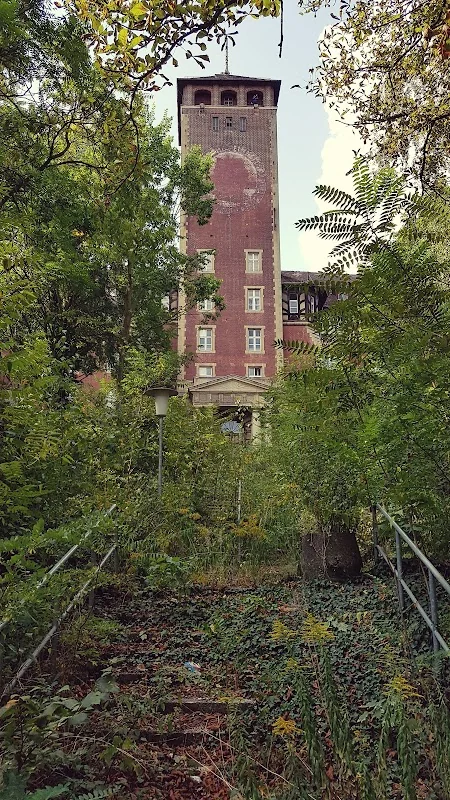
Potsdam
Am Havelblick 4, 14473 Potsdam, Deutschland
Old State Parliament Building Brandenburg | Photos & History
The old state parliament building on Brauhausberg is one of the places in Potsdam where the city's history can be read particularly closely. Its prominent location, the multiple changes in use, and the visible traces of upheaval make the complex one of the most exciting historical addresses in the city for many people. On the same site, there were successively a war school, later an archive, then the district and county leadership of the SED, and from 1991 the Brandenburg State Parliament. Since the opening of the new building at the Old Market in 2014, Brauhausberg is no longer the seat of parliament, but remains a significant place of remembrance. This was further highlighted by the fire in August 2023. Today, those wishing to visit the parliament go to Old Market 1, where the new building with exhibitions, foyer, and visitor offerings is accessible. ([landtag.brandenburg.de](https://www.landtag.brandenburg.de/de/geschichte_des_ehemaligen_landtagsgebaeudes_auf_dem_brauhausberg/7672))
The distinction is also important for orientation in Potsdam: Brauhausberg stands for the former, historically burdened, and today significantly changed building, while the current Brandenburg State Parliament at the Old Market is a modern parliamentary location. The new building was designed to visually align with the historical city palace, has approximately 19,000 square meters of usable space and 375 offices, and has been the seat of the parliament since 2014. It is precisely this overlay of the old place, the new parliament, and urban memory that explains why search queries often ask for photos, history, fire, and directions simultaneously. ([landtag.brandenburg.de](https://www.landtag.brandenburg.de/en/home/the_direct_link_to_the_landtag/26669))
Photos, History, and the Distinctive Silhouette of Brauhausberg
Photos of the old state parliament building Brandenburg primarily show an unusually strong silhouette: the building stands prominently on Brauhausberg and thus acts as an urban planning sign. The official history of the parliament describes the building as a complex whose external shape and function have changed multiple times over more than 100 years. This is precisely where its photographic fascination lies. Those who think of the former war school, the later archive, the SED use, or the parliament in a single motif do not get a static monument but a building with many lives. It is this change of power, rupture, and renewal that makes the house visually so memorable. ([landtag.brandenburg.de](https://www.landtag.brandenburg.de/de/geschichte_des_ehemaligen_landtagsgebaeudes_auf_dem_brauhausberg/7672))
The architectural basic idea was shaped at the beginning of the 20th century by Kaiser Wilhelm II, who selected Brauhausberg as a location and specified an execution in the style of English country houses with half-timbering and whitewashed fields. Renaissance motifs were intended to give the building an additional historicizing effect; the Porta Stupa in Verona served as a model for the main entrance. A monumental tower, originally 64 meters high, was also dominant. The architect was Franz Schwechten, who also built the Kaiser Wilhelm Memorial Church in Berlin. These details explain why the building appears so powerful in pictures: it combines military representation, historical quotes, and a very conscious distant impact. ([landtag.brandenburg.de](https://www.landtag.brandenburg.de/de/geschichte_des_ehemaligen_landtagsgebaeudes_auf_dem_brauhausberg/7672))
War School, Archive, and the Path to the “Kremlin”
The actual beginning of the construction history dates back to April 1, 1899, when the construction of a new war school on Brauhausberg began. The building was handed over to its purpose on August 2, 1902, and then served for the training of officer candidates from the entire army. During World War I, it was used as a battalion collection point. With the Treaty of Versailles, the function as a war school ended; in 1919, the building was repurposed as the Reichsarchiv. This began a new, also state-run, and very extensive phase in which civil and military records of the Reich were managed. The building thus never stood for stagnation but almost always for a form of power organization. ([landtag.brandenburg.de](https://www.landtag.brandenburg.de/de/geschichte_des_ehemaligen_landtagsgebaeudes_auf_dem_brauhausberg/7672))
In the 1930s, the inventory increased so significantly that an extension was occupied as a magazine in 1935. At the same time, the tower was reduced to 50 meters because it was considered too massive in the expanded complex. The air raid by the Royal Air Force on April 14, 1945, turned large parts of Brauhausberg into a rubble field; the magazine building was completely destroyed, and the tower and one wing of the main building were damaged. After the war, the heavily damaged house was initially used by the state of Brandenburg before the property passed into party ownership in 1949. From 1952, the SED district leaderships for Potsdam, Frankfurt (Oder), and Cottbus were located there, later also the Potsdam district leadership. The popular name “Kremlin,” which still clings to the building today, originates from this phase. ([landtag.brandenburg.de](https://www.landtag.brandenburg.de/de/geschichte_des_ehemaligen_landtagsgebaeudes_auf_dem_brauhausberg/7672))
The Brandenburg State Parliament on Brauhausberg from 1991 to 2013
With the re-establishment of the state of Brandenburg, the building received a democratic function once again. On January 16, 1991, the Brandenburg parliamentarians decided by majority to use the property on Brauhausberg as a parliamentary building because the premises at Heinrich-Mann-Allee 107 could not guarantee structural safety. Although experts advised against permanent use because the building was only partially functional for a parliament, after the necessary construction work, the deputies moved in. The first plenary session on Brauhausberg took place on September 25, 1991. Thus, a former military and party building became the political center of the state for just over two decades. ([landtag.brandenburg.de](https://www.landtag.brandenburg.de/de/geschichte_des_ehemaligen_landtagsgebaeudes_auf_dem_brauhausberg/7672))
It was precisely these provisional arrangements that shaped the perception of the house. Although the parliament was indeed present there, it was never housed in a fully ideal parliamentary building. For this reason, the parliament decided in 2005 to build a new parliamentary building in the outlines of the historical Potsdam city palace. A citizens' survey in Potsdam showed clear support for the new building at the Old Market, and the planning and construction work lasted a total of nine years. In 2014, the parliament finally moved into the new building. This development explains why Brauhausberg often appears in search queries together with the current parliament: those who want to understand the history of the old house almost automatically end up at the new location and the question of how political representation has been newly located in Potsdam. ([landtag.brandenburg.de](https://www.landtag.brandenburg.de/de/landtag_kennenlernen/gebaeude_und_verwaltung/ueber_das_landtagsgebaeude/25362))
Fire 2023, Vacancy, and the Current Significance of the Place
On August 5, 2023, the former state parliament building made headlines again when the fire department of Potsdam was alerted to a building fire in the Templiner suburb around 3:30 PM. The city reported that the fire in the side wing, where the former plenary hall was located, had been brought under control. Shortly thereafter, the roof structure of the south wing collapsed, and adjacent areas were also affected. About 120 emergency responders were on site, including professional firefighters, volunteer fire departments, police, regulatory office, and other supporters. This fire was so significant for public perception because it visibly damaged the already heavily burdened building complex even more. ([potsdam.de](https://www.potsdam.de/de/339-feuer-im-ehemaligen-landtag-auf-dem-brauhausberg-unter-kontrolle))
The city of Potsdam also historically classified the site: The building on Am Havelblick street was used as the state parliament of Brandenburg between 1990 and 2013. After that, the area served as an emergency shelter for refugees from 2015 to 2018; it has been vacant since the end of 2018. This is important for the present because it shows that Brauhausberg is not just an old backdrop but a place with changing social and political functions. This is precisely what gives it its current significance: it is less a closed monument than an open chapter of Potsdam's history, telling of statehood, repurposing, crises, and an uncertain future. Those searching for pictures or information are therefore often looking not just for a building but for the trace of a whole upheaval. ([potsdam.de](https://www.potsdam.de/de/339-feuer-im-ehemaligen-landtag-auf-dem-brauhausberg-unter-kontrolle))
Directions, Orientation, and Visitor Information for the Current Parliament
Those wishing to visit the Brandenburg State Parliament today must go to the Old Market, not to Brauhausberg. The official access is via the Fortunaportal from the Old Market. The courtyard of the parliament is open daily from 8:00 AM to 8:00 PM, and the Knobelsdorff staircase, exhibitions in the parliament, and the foyer with an interactive building model are accessible Monday to Friday from 8:00 AM to 6:00 PM. On plenary session days, access for visitors is contingent upon the submission of an official photo ID. For planning a visit, this is the most important practical information, as the current parliament functions as a publicly accessible parliamentary site and is no longer just an administrative building. ([landtag.brandenburg.de](https://www.landtag.brandenburg.de/de/landtag_kennenlernen/gebaeude_und_verwaltung/anfahrt_zugang_und_oeffnungszeiten/25863))
Also, regarding parking, the official situation is clear: There are no parking spaces available on the premises of the parliament; buses can stop for boarding and alighting in front of the Film Museum on Breiten Straße. Due to construction work in the vicinity of the parliament, the disabled parking spaces in front of the Potsdam Museum are currently not usable, which is why holders of the blue EU disabled parking permit can park at the Old Market. Access to the Old Market is via Am Alten Markt street, and the walking distance from Potsdam Central Station is about ten minutes or around 700 meters. Additionally, barrier-free access has been explicitly considered, including wheelchair spaces, induction loops, and orientation aids for the visually impaired. This makes it clear: those searching for directions or parking today sensibly end up at the visitor information of the new parliament at the Old Market. ([landtag.brandenburg.de](https://www.landtag.brandenburg.de/de/landtag_kennenlernen/gebaeude_und_verwaltung/anfahrt_zugang_und_oeffnungszeiten/25863))
Architecture, Panoramas, and Why the Place is So Visually Striking
The current parliament at the Old Market is itself a good example of how Potsdam reassembles historical images. According to the official description, the building has been the seat of the Brandenburg State Parliament since 2014, oriented externally to the early Baroque city palace and internally designed for modern parliamentary operations. New stairs, elevators, and generous light zones lead to the plenary hall, the foyer, and the presidium area. For visitors, there are changing exhibitions in the foyer and in the public areas of the south wing; additionally, a flyer provides information about the panorama from the roof terrace. The official building description explicitly speaks of a unique architectural ensemble of the state capital Potsdam. This is not just a marketing term but a precise description of the place where historical forms and political present have been consciously thought together. ([landtag.brandenburg.de](https://www.landtag.brandenburg.de/en/home/the_direct_link_to_the_landtag/26669))
For image searches of the old state parliament building, this context is crucial. The Brauhausberg building is present in photos primarily because of its tower, its elevation, and its eventful history; the current parliament at the Old Market complements this image as a modern counterpoint. Together, both places tell a single Potsdam narrative: first the representative military and archive building on the hill, then the provisional parliament, and finally the new building in the historical center. Thus, those searching for “images of the old state parliament building Brandenburg” are often not just looking for a single motif but the contrast between former power architecture, political use, and today's urban landscape. Precisely for this reason, Brauhausberg remains a strong motif for history, urban development, and photography alike. ([landtag.brandenburg.de](https://www.landtag.brandenburg.de/de/geschichte_des_ehemaligen_landtagsgebaeudes_auf_dem_brauhausberg/7672))
Sources:
- Brandenburg State Parliament – History of the Former State Parliament Building on Brauhausberg
- Brandenburg State Parliament – About the State Parliament Building
- Brandenburg State Parliament – Directions, Access, and Opening Hours
- Brandenburg State Parliament – The Direct Link to the Landtag
- State Capital Potsdam – Fire in the Former State Parliament on Brauhausberg Under Control
Show moreShow less
Old State Parliament Building Brandenburg | Photos & History
The old state parliament building on Brauhausberg is one of the places in Potsdam where the city's history can be read particularly closely. Its prominent location, the multiple changes in use, and the visible traces of upheaval make the complex one of the most exciting historical addresses in the city for many people. On the same site, there were successively a war school, later an archive, then the district and county leadership of the SED, and from 1991 the Brandenburg State Parliament. Since the opening of the new building at the Old Market in 2014, Brauhausberg is no longer the seat of parliament, but remains a significant place of remembrance. This was further highlighted by the fire in August 2023. Today, those wishing to visit the parliament go to Old Market 1, where the new building with exhibitions, foyer, and visitor offerings is accessible. ([landtag.brandenburg.de](https://www.landtag.brandenburg.de/de/geschichte_des_ehemaligen_landtagsgebaeudes_auf_dem_brauhausberg/7672))
The distinction is also important for orientation in Potsdam: Brauhausberg stands for the former, historically burdened, and today significantly changed building, while the current Brandenburg State Parliament at the Old Market is a modern parliamentary location. The new building was designed to visually align with the historical city palace, has approximately 19,000 square meters of usable space and 375 offices, and has been the seat of the parliament since 2014. It is precisely this overlay of the old place, the new parliament, and urban memory that explains why search queries often ask for photos, history, fire, and directions simultaneously. ([landtag.brandenburg.de](https://www.landtag.brandenburg.de/en/home/the_direct_link_to_the_landtag/26669))
Photos, History, and the Distinctive Silhouette of Brauhausberg
Photos of the old state parliament building Brandenburg primarily show an unusually strong silhouette: the building stands prominently on Brauhausberg and thus acts as an urban planning sign. The official history of the parliament describes the building as a complex whose external shape and function have changed multiple times over more than 100 years. This is precisely where its photographic fascination lies. Those who think of the former war school, the later archive, the SED use, or the parliament in a single motif do not get a static monument but a building with many lives. It is this change of power, rupture, and renewal that makes the house visually so memorable. ([landtag.brandenburg.de](https://www.landtag.brandenburg.de/de/geschichte_des_ehemaligen_landtagsgebaeudes_auf_dem_brauhausberg/7672))
The architectural basic idea was shaped at the beginning of the 20th century by Kaiser Wilhelm II, who selected Brauhausberg as a location and specified an execution in the style of English country houses with half-timbering and whitewashed fields. Renaissance motifs were intended to give the building an additional historicizing effect; the Porta Stupa in Verona served as a model for the main entrance. A monumental tower, originally 64 meters high, was also dominant. The architect was Franz Schwechten, who also built the Kaiser Wilhelm Memorial Church in Berlin. These details explain why the building appears so powerful in pictures: it combines military representation, historical quotes, and a very conscious distant impact. ([landtag.brandenburg.de](https://www.landtag.brandenburg.de/de/geschichte_des_ehemaligen_landtagsgebaeudes_auf_dem_brauhausberg/7672))
War School, Archive, and the Path to the “Kremlin”
The actual beginning of the construction history dates back to April 1, 1899, when the construction of a new war school on Brauhausberg began. The building was handed over to its purpose on August 2, 1902, and then served for the training of officer candidates from the entire army. During World War I, it was used as a battalion collection point. With the Treaty of Versailles, the function as a war school ended; in 1919, the building was repurposed as the Reichsarchiv. This began a new, also state-run, and very extensive phase in which civil and military records of the Reich were managed. The building thus never stood for stagnation but almost always for a form of power organization. ([landtag.brandenburg.de](https://www.landtag.brandenburg.de/de/geschichte_des_ehemaligen_landtagsgebaeudes_auf_dem_brauhausberg/7672))
In the 1930s, the inventory increased so significantly that an extension was occupied as a magazine in 1935. At the same time, the tower was reduced to 50 meters because it was considered too massive in the expanded complex. The air raid by the Royal Air Force on April 14, 1945, turned large parts of Brauhausberg into a rubble field; the magazine building was completely destroyed, and the tower and one wing of the main building were damaged. After the war, the heavily damaged house was initially used by the state of Brandenburg before the property passed into party ownership in 1949. From 1952, the SED district leaderships for Potsdam, Frankfurt (Oder), and Cottbus were located there, later also the Potsdam district leadership. The popular name “Kremlin,” which still clings to the building today, originates from this phase. ([landtag.brandenburg.de](https://www.landtag.brandenburg.de/de/geschichte_des_ehemaligen_landtagsgebaeudes_auf_dem_brauhausberg/7672))
The Brandenburg State Parliament on Brauhausberg from 1991 to 2013
With the re-establishment of the state of Brandenburg, the building received a democratic function once again. On January 16, 1991, the Brandenburg parliamentarians decided by majority to use the property on Brauhausberg as a parliamentary building because the premises at Heinrich-Mann-Allee 107 could not guarantee structural safety. Although experts advised against permanent use because the building was only partially functional for a parliament, after the necessary construction work, the deputies moved in. The first plenary session on Brauhausberg took place on September 25, 1991. Thus, a former military and party building became the political center of the state for just over two decades. ([landtag.brandenburg.de](https://www.landtag.brandenburg.de/de/geschichte_des_ehemaligen_landtagsgebaeudes_auf_dem_brauhausberg/7672))
It was precisely these provisional arrangements that shaped the perception of the house. Although the parliament was indeed present there, it was never housed in a fully ideal parliamentary building. For this reason, the parliament decided in 2005 to build a new parliamentary building in the outlines of the historical Potsdam city palace. A citizens' survey in Potsdam showed clear support for the new building at the Old Market, and the planning and construction work lasted a total of nine years. In 2014, the parliament finally moved into the new building. This development explains why Brauhausberg often appears in search queries together with the current parliament: those who want to understand the history of the old house almost automatically end up at the new location and the question of how political representation has been newly located in Potsdam. ([landtag.brandenburg.de](https://www.landtag.brandenburg.de/de/landtag_kennenlernen/gebaeude_und_verwaltung/ueber_das_landtagsgebaeude/25362))
Fire 2023, Vacancy, and the Current Significance of the Place
On August 5, 2023, the former state parliament building made headlines again when the fire department of Potsdam was alerted to a building fire in the Templiner suburb around 3:30 PM. The city reported that the fire in the side wing, where the former plenary hall was located, had been brought under control. Shortly thereafter, the roof structure of the south wing collapsed, and adjacent areas were also affected. About 120 emergency responders were on site, including professional firefighters, volunteer fire departments, police, regulatory office, and other supporters. This fire was so significant for public perception because it visibly damaged the already heavily burdened building complex even more. ([potsdam.de](https://www.potsdam.de/de/339-feuer-im-ehemaligen-landtag-auf-dem-brauhausberg-unter-kontrolle))
The city of Potsdam also historically classified the site: The building on Am Havelblick street was used as the state parliament of Brandenburg between 1990 and 2013. After that, the area served as an emergency shelter for refugees from 2015 to 2018; it has been vacant since the end of 2018. This is important for the present because it shows that Brauhausberg is not just an old backdrop but a place with changing social and political functions. This is precisely what gives it its current significance: it is less a closed monument than an open chapter of Potsdam's history, telling of statehood, repurposing, crises, and an uncertain future. Those searching for pictures or information are therefore often looking not just for a building but for the trace of a whole upheaval. ([potsdam.de](https://www.potsdam.de/de/339-feuer-im-ehemaligen-landtag-auf-dem-brauhausberg-unter-kontrolle))
Directions, Orientation, and Visitor Information for the Current Parliament
Those wishing to visit the Brandenburg State Parliament today must go to the Old Market, not to Brauhausberg. The official access is via the Fortunaportal from the Old Market. The courtyard of the parliament is open daily from 8:00 AM to 8:00 PM, and the Knobelsdorff staircase, exhibitions in the parliament, and the foyer with an interactive building model are accessible Monday to Friday from 8:00 AM to 6:00 PM. On plenary session days, access for visitors is contingent upon the submission of an official photo ID. For planning a visit, this is the most important practical information, as the current parliament functions as a publicly accessible parliamentary site and is no longer just an administrative building. ([landtag.brandenburg.de](https://www.landtag.brandenburg.de/de/landtag_kennenlernen/gebaeude_und_verwaltung/anfahrt_zugang_und_oeffnungszeiten/25863))
Also, regarding parking, the official situation is clear: There are no parking spaces available on the premises of the parliament; buses can stop for boarding and alighting in front of the Film Museum on Breiten Straße. Due to construction work in the vicinity of the parliament, the disabled parking spaces in front of the Potsdam Museum are currently not usable, which is why holders of the blue EU disabled parking permit can park at the Old Market. Access to the Old Market is via Am Alten Markt street, and the walking distance from Potsdam Central Station is about ten minutes or around 700 meters. Additionally, barrier-free access has been explicitly considered, including wheelchair spaces, induction loops, and orientation aids for the visually impaired. This makes it clear: those searching for directions or parking today sensibly end up at the visitor information of the new parliament at the Old Market. ([landtag.brandenburg.de](https://www.landtag.brandenburg.de/de/landtag_kennenlernen/gebaeude_und_verwaltung/anfahrt_zugang_und_oeffnungszeiten/25863))
Architecture, Panoramas, and Why the Place is So Visually Striking
The current parliament at the Old Market is itself a good example of how Potsdam reassembles historical images. According to the official description, the building has been the seat of the Brandenburg State Parliament since 2014, oriented externally to the early Baroque city palace and internally designed for modern parliamentary operations. New stairs, elevators, and generous light zones lead to the plenary hall, the foyer, and the presidium area. For visitors, there are changing exhibitions in the foyer and in the public areas of the south wing; additionally, a flyer provides information about the panorama from the roof terrace. The official building description explicitly speaks of a unique architectural ensemble of the state capital Potsdam. This is not just a marketing term but a precise description of the place where historical forms and political present have been consciously thought together. ([landtag.brandenburg.de](https://www.landtag.brandenburg.de/en/home/the_direct_link_to_the_landtag/26669))
For image searches of the old state parliament building, this context is crucial. The Brauhausberg building is present in photos primarily because of its tower, its elevation, and its eventful history; the current parliament at the Old Market complements this image as a modern counterpoint. Together, both places tell a single Potsdam narrative: first the representative military and archive building on the hill, then the provisional parliament, and finally the new building in the historical center. Thus, those searching for “images of the old state parliament building Brandenburg” are often not just looking for a single motif but the contrast between former power architecture, political use, and today's urban landscape. Precisely for this reason, Brauhausberg remains a strong motif for history, urban development, and photography alike. ([landtag.brandenburg.de](https://www.landtag.brandenburg.de/de/geschichte_des_ehemaligen_landtagsgebaeudes_auf_dem_brauhausberg/7672))
Sources:
- Brandenburg State Parliament – History of the Former State Parliament Building on Brauhausberg
- Brandenburg State Parliament – About the State Parliament Building
- Brandenburg State Parliament – Directions, Access, and Opening Hours
- Brandenburg State Parliament – The Direct Link to the Landtag
- State Capital Potsdam – Fire in the Former State Parliament on Brauhausberg Under Control
Old State Parliament Building Brandenburg | Photos & History
The old state parliament building on Brauhausberg is one of the places in Potsdam where the city's history can be read particularly closely. Its prominent location, the multiple changes in use, and the visible traces of upheaval make the complex one of the most exciting historical addresses in the city for many people. On the same site, there were successively a war school, later an archive, then the district and county leadership of the SED, and from 1991 the Brandenburg State Parliament. Since the opening of the new building at the Old Market in 2014, Brauhausberg is no longer the seat of parliament, but remains a significant place of remembrance. This was further highlighted by the fire in August 2023. Today, those wishing to visit the parliament go to Old Market 1, where the new building with exhibitions, foyer, and visitor offerings is accessible. ([landtag.brandenburg.de](https://www.landtag.brandenburg.de/de/geschichte_des_ehemaligen_landtagsgebaeudes_auf_dem_brauhausberg/7672))
The distinction is also important for orientation in Potsdam: Brauhausberg stands for the former, historically burdened, and today significantly changed building, while the current Brandenburg State Parliament at the Old Market is a modern parliamentary location. The new building was designed to visually align with the historical city palace, has approximately 19,000 square meters of usable space and 375 offices, and has been the seat of the parliament since 2014. It is precisely this overlay of the old place, the new parliament, and urban memory that explains why search queries often ask for photos, history, fire, and directions simultaneously. ([landtag.brandenburg.de](https://www.landtag.brandenburg.de/en/home/the_direct_link_to_the_landtag/26669))
Photos, History, and the Distinctive Silhouette of Brauhausberg
Photos of the old state parliament building Brandenburg primarily show an unusually strong silhouette: the building stands prominently on Brauhausberg and thus acts as an urban planning sign. The official history of the parliament describes the building as a complex whose external shape and function have changed multiple times over more than 100 years. This is precisely where its photographic fascination lies. Those who think of the former war school, the later archive, the SED use, or the parliament in a single motif do not get a static monument but a building with many lives. It is this change of power, rupture, and renewal that makes the house visually so memorable. ([landtag.brandenburg.de](https://www.landtag.brandenburg.de/de/geschichte_des_ehemaligen_landtagsgebaeudes_auf_dem_brauhausberg/7672))
The architectural basic idea was shaped at the beginning of the 20th century by Kaiser Wilhelm II, who selected Brauhausberg as a location and specified an execution in the style of English country houses with half-timbering and whitewashed fields. Renaissance motifs were intended to give the building an additional historicizing effect; the Porta Stupa in Verona served as a model for the main entrance. A monumental tower, originally 64 meters high, was also dominant. The architect was Franz Schwechten, who also built the Kaiser Wilhelm Memorial Church in Berlin. These details explain why the building appears so powerful in pictures: it combines military representation, historical quotes, and a very conscious distant impact. ([landtag.brandenburg.de](https://www.landtag.brandenburg.de/de/geschichte_des_ehemaligen_landtagsgebaeudes_auf_dem_brauhausberg/7672))
War School, Archive, and the Path to the “Kremlin”
The actual beginning of the construction history dates back to April 1, 1899, when the construction of a new war school on Brauhausberg began. The building was handed over to its purpose on August 2, 1902, and then served for the training of officer candidates from the entire army. During World War I, it was used as a battalion collection point. With the Treaty of Versailles, the function as a war school ended; in 1919, the building was repurposed as the Reichsarchiv. This began a new, also state-run, and very extensive phase in which civil and military records of the Reich were managed. The building thus never stood for stagnation but almost always for a form of power organization. ([landtag.brandenburg.de](https://www.landtag.brandenburg.de/de/geschichte_des_ehemaligen_landtagsgebaeudes_auf_dem_brauhausberg/7672))
In the 1930s, the inventory increased so significantly that an extension was occupied as a magazine in 1935. At the same time, the tower was reduced to 50 meters because it was considered too massive in the expanded complex. The air raid by the Royal Air Force on April 14, 1945, turned large parts of Brauhausberg into a rubble field; the magazine building was completely destroyed, and the tower and one wing of the main building were damaged. After the war, the heavily damaged house was initially used by the state of Brandenburg before the property passed into party ownership in 1949. From 1952, the SED district leaderships for Potsdam, Frankfurt (Oder), and Cottbus were located there, later also the Potsdam district leadership. The popular name “Kremlin,” which still clings to the building today, originates from this phase. ([landtag.brandenburg.de](https://www.landtag.brandenburg.de/de/geschichte_des_ehemaligen_landtagsgebaeudes_auf_dem_brauhausberg/7672))
The Brandenburg State Parliament on Brauhausberg from 1991 to 2013
With the re-establishment of the state of Brandenburg, the building received a democratic function once again. On January 16, 1991, the Brandenburg parliamentarians decided by majority to use the property on Brauhausberg as a parliamentary building because the premises at Heinrich-Mann-Allee 107 could not guarantee structural safety. Although experts advised against permanent use because the building was only partially functional for a parliament, after the necessary construction work, the deputies moved in. The first plenary session on Brauhausberg took place on September 25, 1991. Thus, a former military and party building became the political center of the state for just over two decades. ([landtag.brandenburg.de](https://www.landtag.brandenburg.de/de/geschichte_des_ehemaligen_landtagsgebaeudes_auf_dem_brauhausberg/7672))
It was precisely these provisional arrangements that shaped the perception of the house. Although the parliament was indeed present there, it was never housed in a fully ideal parliamentary building. For this reason, the parliament decided in 2005 to build a new parliamentary building in the outlines of the historical Potsdam city palace. A citizens' survey in Potsdam showed clear support for the new building at the Old Market, and the planning and construction work lasted a total of nine years. In 2014, the parliament finally moved into the new building. This development explains why Brauhausberg often appears in search queries together with the current parliament: those who want to understand the history of the old house almost automatically end up at the new location and the question of how political representation has been newly located in Potsdam. ([landtag.brandenburg.de](https://www.landtag.brandenburg.de/de/landtag_kennenlernen/gebaeude_und_verwaltung/ueber_das_landtagsgebaeude/25362))
Fire 2023, Vacancy, and the Current Significance of the Place
On August 5, 2023, the former state parliament building made headlines again when the fire department of Potsdam was alerted to a building fire in the Templiner suburb around 3:30 PM. The city reported that the fire in the side wing, where the former plenary hall was located, had been brought under control. Shortly thereafter, the roof structure of the south wing collapsed, and adjacent areas were also affected. About 120 emergency responders were on site, including professional firefighters, volunteer fire departments, police, regulatory office, and other supporters. This fire was so significant for public perception because it visibly damaged the already heavily burdened building complex even more. ([potsdam.de](https://www.potsdam.de/de/339-feuer-im-ehemaligen-landtag-auf-dem-brauhausberg-unter-kontrolle))
The city of Potsdam also historically classified the site: The building on Am Havelblick street was used as the state parliament of Brandenburg between 1990 and 2013. After that, the area served as an emergency shelter for refugees from 2015 to 2018; it has been vacant since the end of 2018. This is important for the present because it shows that Brauhausberg is not just an old backdrop but a place with changing social and political functions. This is precisely what gives it its current significance: it is less a closed monument than an open chapter of Potsdam's history, telling of statehood, repurposing, crises, and an uncertain future. Those searching for pictures or information are therefore often looking not just for a building but for the trace of a whole upheaval. ([potsdam.de](https://www.potsdam.de/de/339-feuer-im-ehemaligen-landtag-auf-dem-brauhausberg-unter-kontrolle))
Directions, Orientation, and Visitor Information for the Current Parliament
Those wishing to visit the Brandenburg State Parliament today must go to the Old Market, not to Brauhausberg. The official access is via the Fortunaportal from the Old Market. The courtyard of the parliament is open daily from 8:00 AM to 8:00 PM, and the Knobelsdorff staircase, exhibitions in the parliament, and the foyer with an interactive building model are accessible Monday to Friday from 8:00 AM to 6:00 PM. On plenary session days, access for visitors is contingent upon the submission of an official photo ID. For planning a visit, this is the most important practical information, as the current parliament functions as a publicly accessible parliamentary site and is no longer just an administrative building. ([landtag.brandenburg.de](https://www.landtag.brandenburg.de/de/landtag_kennenlernen/gebaeude_und_verwaltung/anfahrt_zugang_und_oeffnungszeiten/25863))
Also, regarding parking, the official situation is clear: There are no parking spaces available on the premises of the parliament; buses can stop for boarding and alighting in front of the Film Museum on Breiten Straße. Due to construction work in the vicinity of the parliament, the disabled parking spaces in front of the Potsdam Museum are currently not usable, which is why holders of the blue EU disabled parking permit can park at the Old Market. Access to the Old Market is via Am Alten Markt street, and the walking distance from Potsdam Central Station is about ten minutes or around 700 meters. Additionally, barrier-free access has been explicitly considered, including wheelchair spaces, induction loops, and orientation aids for the visually impaired. This makes it clear: those searching for directions or parking today sensibly end up at the visitor information of the new parliament at the Old Market. ([landtag.brandenburg.de](https://www.landtag.brandenburg.de/de/landtag_kennenlernen/gebaeude_und_verwaltung/anfahrt_zugang_und_oeffnungszeiten/25863))
Architecture, Panoramas, and Why the Place is So Visually Striking
The current parliament at the Old Market is itself a good example of how Potsdam reassembles historical images. According to the official description, the building has been the seat of the Brandenburg State Parliament since 2014, oriented externally to the early Baroque city palace and internally designed for modern parliamentary operations. New stairs, elevators, and generous light zones lead to the plenary hall, the foyer, and the presidium area. For visitors, there are changing exhibitions in the foyer and in the public areas of the south wing; additionally, a flyer provides information about the panorama from the roof terrace. The official building description explicitly speaks of a unique architectural ensemble of the state capital Potsdam. This is not just a marketing term but a precise description of the place where historical forms and political present have been consciously thought together. ([landtag.brandenburg.de](https://www.landtag.brandenburg.de/en/home/the_direct_link_to_the_landtag/26669))
For image searches of the old state parliament building, this context is crucial. The Brauhausberg building is present in photos primarily because of its tower, its elevation, and its eventful history; the current parliament at the Old Market complements this image as a modern counterpoint. Together, both places tell a single Potsdam narrative: first the representative military and archive building on the hill, then the provisional parliament, and finally the new building in the historical center. Thus, those searching for “images of the old state parliament building Brandenburg” are often not just looking for a single motif but the contrast between former power architecture, political use, and today's urban landscape. Precisely for this reason, Brauhausberg remains a strong motif for history, urban development, and photography alike. ([landtag.brandenburg.de](https://www.landtag.brandenburg.de/de/geschichte_des_ehemaligen_landtagsgebaeudes_auf_dem_brauhausberg/7672))
Sources:
- Brandenburg State Parliament – History of the Former State Parliament Building on Brauhausberg
- Brandenburg State Parliament – About the State Parliament Building
- Brandenburg State Parliament – Directions, Access, and Opening Hours
- Brandenburg State Parliament – The Direct Link to the Landtag
- State Capital Potsdam – Fire in the Former State Parliament on Brauhausberg Under Control
Frequently Asked Questions
Reviews
No reviews found