
Stanisław Lem
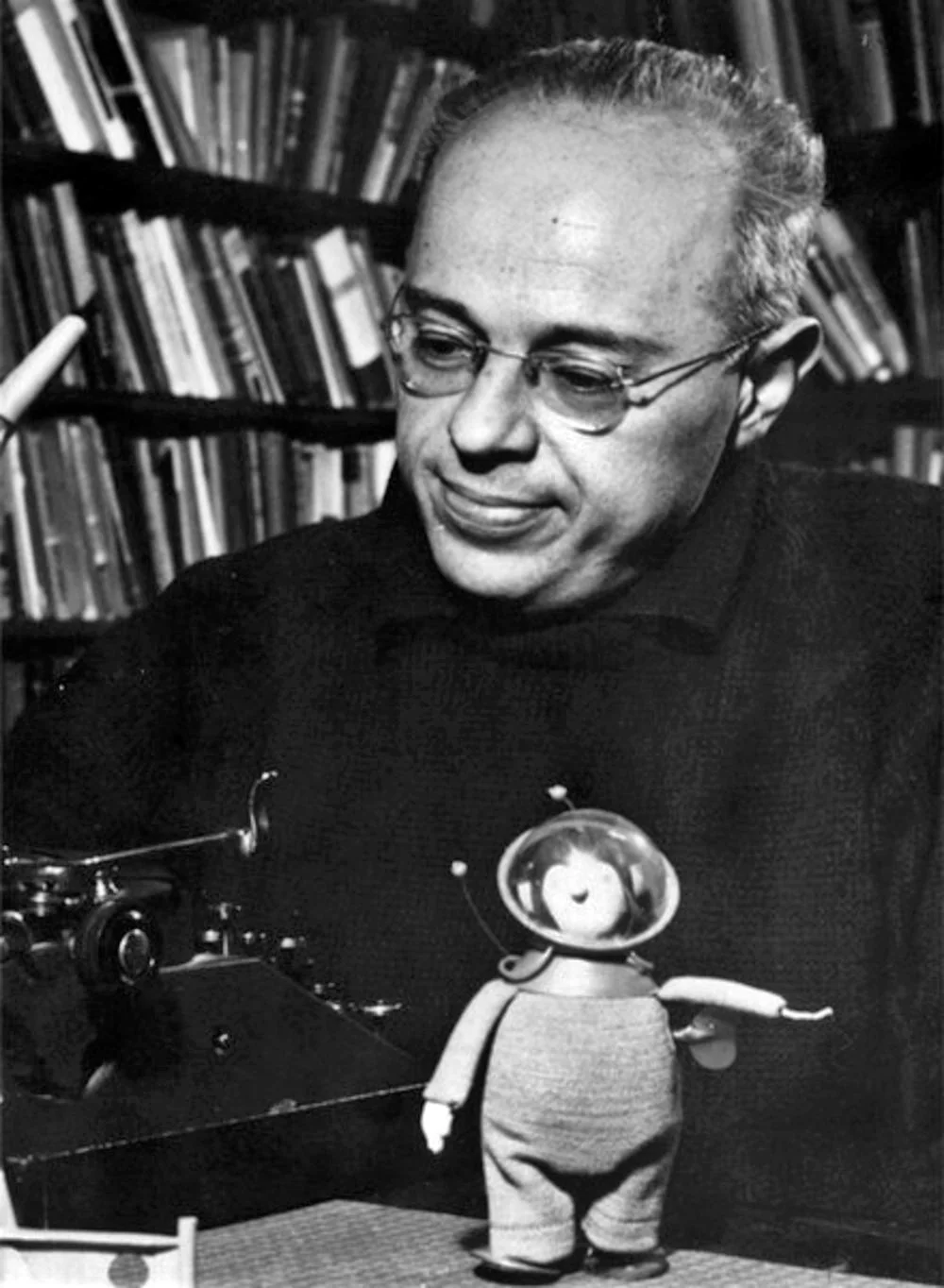
Image from Wikipedia
Image from Wikipedia
Stanisław Lem: The Great Visionary of Future Literature
A Thinker Who Not Only Told the Future but Contemplated It
Stanisław Lem was one of the most extraordinary writers of the 20th century: a Polish author, philosopher, and essayist whose work elevated science fiction far beyond genre boundaries. Born on September 12, 1921, in Lwów and passing away on March 27, 2006, in Kraków, he shaped a literature that combined technical visions, intellectual satire, and existential questions into a unique style. His books have been translated into dozens of languages and sold millions of copies, but Lem's true greatness lies in the intellectual weight of his ideas. (britannica.com)
Reading Lem means encountering not just a mere storyteller of the future, but an author who observed the mechanical illusions of progress as keenly as the weaknesses of humanity. His texts revolve around artificial intelligence, robotics, nanotechnology, virtual realities, and extraterrestrial communication, long before these topics became part of the cultural mainstream. At the same time, he masterfully wielded irony, philosophical sharpness, and literary estrangement at the highest level. (english.lem.pl)
Biography: From Lwów Intellectual to World Author
Lem's life journey began in a city that frequently changed its allegiance: Lwów, now Lviv in Ukraine. He grew up in an educated household and studied medicine, but had to interrupt his education due to World War II. The war years and the experience of political upheaval left deep marks on his thinking, focusing later on power, bureaucracy, control systems, and the limits of human understanding. (britannica.com)
After the war, Lem emerged in Poland as one of the leading literary voices of his time. His early breakthrough came with the novel Obłok Magellana in the 1950s, while his early science fiction texts quickly made him internationally renowned. The official Lem biography describes how a medical student, thrown off course by historical violence, formed into a globally resonant author. (de.wikipedia.org)
The Literary Breakthrough and the Birth of a Unique Worldview
From an early stage, it became evident that Lem did not write conventional science fiction. His books connected strict architectural ideas with a zest for linguistic invention, scientific curiosity, and a deep skepticism toward human self-delusion. This attitude established him as an author who not only designed worlds but tested models of thought: What remains of humanity when technology, logic, and power shake all certainties? (de.wikipedia.org)
The official website highlights that Lem was also a master of various genres and styles, from satire to philosophy. His literature encompasses novels, short stories, essays, literary critiques, fictitious reviews of non-existent books, and speculative treatises on Artificial Intelligence, cybernetics, and evolution. This diversity explains why he did not want to be reduced to the label of a science fiction author. (lem.pl)
Solaris, Cyberiad, Golem: Works with Lasting Impact
Solaris remains Lem's most famous novel and is still a milestone of modern literature. The work has been adapted into film several times, including by Andrei Tarkovsky and later by Steven Soderbergh, exemplifying Lem's interest in the impossibility of genuine communication between humans and alien intelligence. The story does not present a triumphant discovery but rather a failure to confront the radical Other. (britannica.com)
Similarly, The Cyberiad, Memoirs Found in a Bathtub, The Invincible, and Golem XIV mark highlights of his artistic development. The official works pages describe Golem XIV as an experiment in which Lem creates a supercomputer that surpasses the limits of human capabilities and ruthlessly dissects humanity’s hubris. Memoirs Found in a Bathtub, on the other hand, unfolds a satirical anti-utopia about bureaucracy, surveillance, and the loss of meaning. (german.lem.pl)
Style and Poetics: Intellect, Satire, and Technical Imagination
Lem's writing style combines analytical precision with imagination and comedic sharpness. His wordplay, neologisms, and satirical exaggerations make his texts famous and simultaneously challenging, as their immense creative wordplay poses a challenge to translation. This literary peculiarity explains why his books are considered difficult yet particularly rewarding. (de.wikipedia.org)
His themes range from nanotechnology to neural networks to virtual reality and artificial intelligence, reaching into fields that only decades later shaped the global discourse. The New Yorker and the official website particularly emphasize Lem's foresight: He articulated technical and philosophical scenarios that resonate remarkably well today. At the same time, he remained skeptical of the faith in progress and repeatedly exposed human self-delusion as hubris. (english.lem.pl)
Reception, Influence, and Cultural Authority
Few other Eastern European authors of the 20th century have been as widely received as Lem. His works have appeared in over 50 languages and, according to official sources, have surpassed 40 million copies sold; other biographical sources even cite 57 languages and over 45 million sales. This range underscores one thing above all: Lem was a global reference author whose influence extends far beyond Polish literature. (lem.pl)
His cultural resonance is immense as well. Film adaptations, scholarly debates, editorial reissues, and international essays demonstrate that Lem's work continues to be read anew. His critique of information overload and digital fragmentation is particularly impactful: even in the 2000s, he warned of a society of "information nomads" who jump from stimulus to stimulus and lose sight of the whole. (de.wikipedia.org)
Current Assessment: Why Lem Appears Even Greater Today
From today's perspective, Lem reads like a contemporary author. His scenarios about AI, communication failures, and technological dependence strike a nerve that has only intensified in the 21st century. This is precisely why his work does not remain in the museum of literary history but functions as a precise diagnostic tool for modern societies. (english.lem.pl)
His enduring relevance is also attributable to the internal tension of his texts: he believed in knowledge but not in simple answers. He loved technology as a space for thought, not as a promise of salvation. This mindset gives his artistic development a depth that has become rare and marks him as an author of lasting authority. (lem.pl)
Conclusion: A Literary Giant with Unbroken Radiance
Stanisław Lem remains intriguing because he never used the future merely as a backdrop, but as a laboratory for human questions. His books combine intellectual sharpness, formal boldness, and a rare emotional tension between hope and disillusionment. Reading his works does not provide light entertainment but an intellectual expedition with lasting effects. (lem.pl)
This is why it's worth discovering Lem again and again: as a great stylist, as a critical thinker, and as a visionary of modernity. His literature shows how exciting language can be when it unites philosophy, satire, and forward-thinking. Engaging with Lem offers an author who has expanded the boundaries of the imaginable. (lem.pl)
Official Channels of Stanisław Lem:
- Instagram: no official profile found
- Facebook: no official profile found
- YouTube: no official profile found
- Spotify: no official profile found
- TikTok: no official profile found
Sources:
- Stanislaw Lem: the official site - Artist Website
- Stanisław Lem - Home - Official Website
- Stanislaw Lem - Biography - Official Biography
- Wikipedia: Stanisław Lem - Image and Text Source
- Britannica - Stanisław Lem Biography
- The Official Lem Site - Essays and Reviews
- The New Yorker - Stanisław Lem’s Sci-Fi Critiques of Modern Life
- Official Works Page - Memoirs Found in a Bathtub
- Official Works Page - Golem XIV