
Gidon Kremer
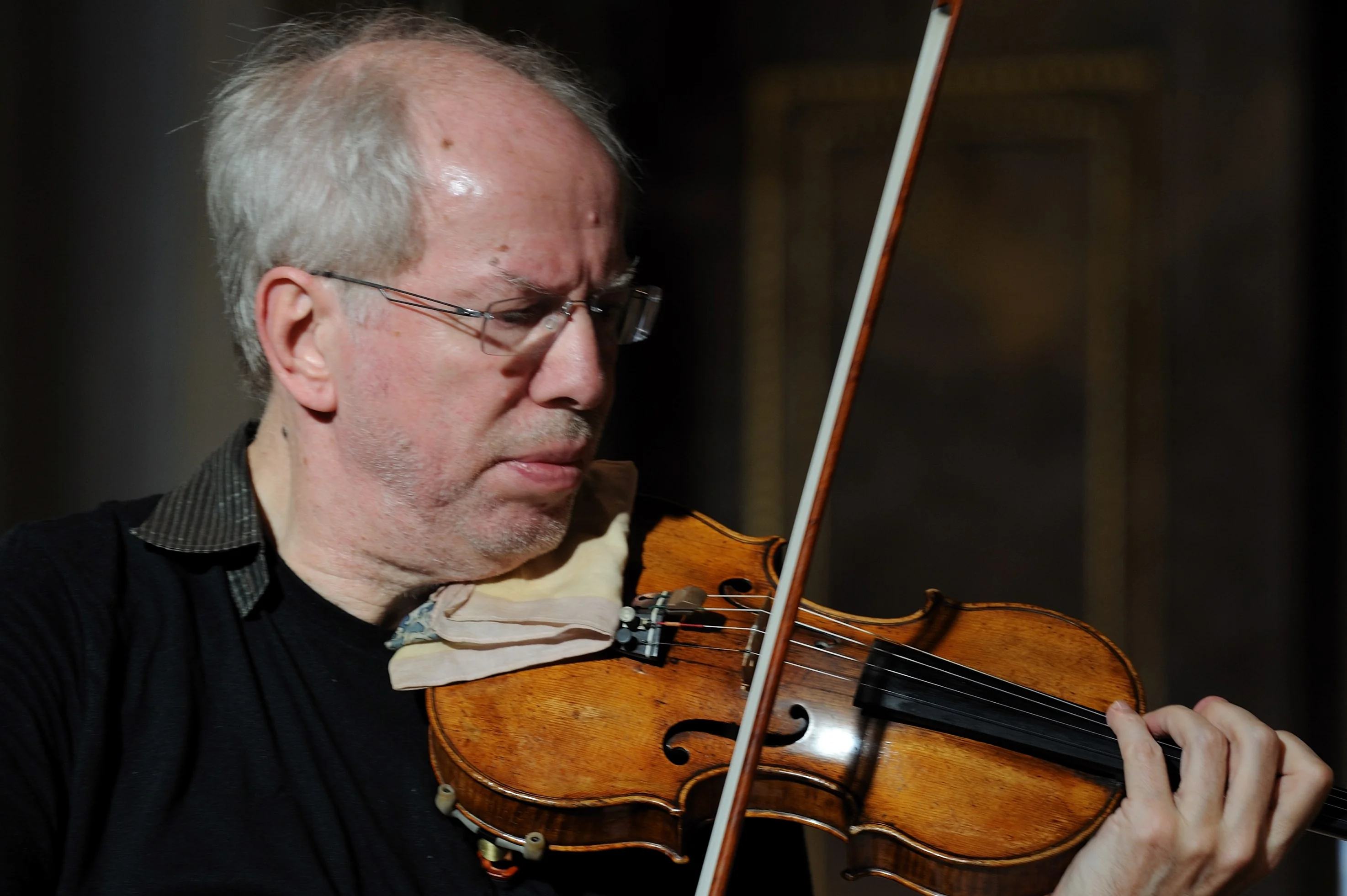
Image from Wikipedia
Image from Wikipedia
Gidon Kremer: The Uncomfortable Visionary of the Violin between World-Class, New Music, and Baltic Identity
A Boundary Crosser of Classical Music Who Turns Virtuosity into Attitude
Gidon Kremer is one of the most influential violinists in international music history. Born in 1947 in Riga, the Latvian-German violinist developed an extraordinary music career early on, one that did not rely on mere brilliance but rather on artistic independence, curiosity, and stylistic openness. His career connects the tradition of great Russian violin culture with an uncompromising commitment to contemporary music, Baltic identity, and intellectually precise interpretation. (gidonkremer.net)
Early Influences in Riga and the Rise to Exceptional Violinist
Kremer's musical journey began in a family environment: he received lessons from his father and grandfather, both of whom were string players, starting at the age of four. He entered the music school in Riga at seven, where he quickly climbed the ranks and won the First Prize of the Latvian Republic at sixteen. Just two years later, he moved to the Moscow Conservatoire to study with David Oistrach, one of the central figures of the Soviet violin school. This training shaped a technical sovereignty that later became his trademark. (gidonkremer.net)
Kremer solidified his international breakthrough through an impressive series of competition successes: in 1967 in Brussels, 1969 in Montreal, and with first prizes at the Paganini and Tchaikovsky competitions. These successes made him an artist of world stature at a young age, yet he never remained a pure virtuoso for the competition canon. More important to him was the question of how interpretation can be understood as a mental attitude. (gidonkremer.net)
The Breakthrough as an Artistic Personality Beyond the Mainstream
Kremer quickly became connected with the most renowned conductors of his time, including Leonard Bernstein, Riccardo Muti, Claudio Abbado, Lorin Maazel, Herbert von Karajan, and Seiji Ozawa. However, his artistic profile sharpened mainly where he challenged expectations: he preferred programs with substance, risky repertoire arcs, and an aesthetic that aimed not for effect but for message. The press repeatedly described him as an extraordinary figure among violinists. (radiofrance.fr)
A decisive step was his move to the West in 1980. Thereafter, he appeared even more independently as a musician with a clear position, increasingly engaging with Russian, Eastern European, and especially Baltic composers. His career thus tells not only of success but of a consciously chosen path away from a secure canon. This is precisely where his stage presence continues to draw its tension. (gidonkremer.net)
Lockenhaus and Kremerata Baltica: Institutions of an Idea
In 1981, Kremer founded the chamber music festival in Lockenhaus, which later continued under the name Kremerata Musica. In 1997, he followed this with the Kremerata Baltica, a chamber orchestra bringing together young musicians from Estonia, Latvia, and Lithuania. Both projects show that Kremer is not only a soloist but also a musical architect: he built institutions where repertoire, production, and ensemble culture are rethought. (larousse.fr)
The Kremerata Baltica became an artistic laboratory for programs spanning classical, modern, and rediscovery. The official repertoire and release area of his project features recordings of works by Mieczysław Weinberg, Giya Kancheli, Beethoven, Chopin, and other composers. This discography illustrates an artist who does not merely reproduce but curates, interprets, and makes cultural connections audible. (gidonkremer.net)
Discography: Over 200 Recordings and a Love for the Unheard
Kremer has recorded over 200 albums; his collaborations with labels such as Deutsche Grammophon, ECM, Sony, Nonesuch, Teldec, and Philips document one of the richest discographies of a violinist of his generation. Early on, he associated his career with the sound of idealized studio work, later with conceptually strong programs. These recordings range from standard works to world premieres and first recordings, often stemming from his own initiative. (gidonkremer.net)
His relationship with Mieczysław Weinberg is particularly significant. Kremer's website explicitly mentions his efforts to “discover” this composer, and ECM refers to his intense engagement with Weinberg’s chamber and vocal music. The album Songs of Fate, released in 2024 with Kremerata Baltica and Vida Miknevičiūtė, builds on this and gathers works by Raminta Šerkšnytė, Giedrius Kuprevičius, Jēkabs Jančevskis, and Weinberg, often in world premiere recordings. (gidonkremer.net)
Current Projects and Late Artistic Relevance
Even in his advanced age, Kremer remains productive and programmatically relevant. His official website highlights Songs of Fate as a central recent release; ECM documents the release from January 19, 2024, emphasizing the personal-existential character of the album. Furthermore, Kremer continues to be involved in projects with Kremerata Baltica, underscoring his role as an active creator rather than a museum-like elder statesman. (ecmrecords.com)
His official website also notes the ICMA Lifetime Achievement Award 2025 and the Beethoven Bonn Prize 2023. Thus, Kremer remains visible not only in concert halls but also in current music life. His artistic authority stems from continuity, relevance, and a discography that continues to bring together new works and unusual perspectives. (gidonkremer.net)
Playing Style, Approach, and Musical Signature
Kremer's style is characterized by analytical sharpness, expressive concentration, and a distinctive sound language. Deutsche Grammophon describes his approach as uncompromising and simultaneously marked by extraordinary originality; AllMusic emphasizes that he never seeks virtuosity for its own sake. This is precisely where the fascination of his interpretations lies: they combine technical mastery with mental restlessness and often an almost existential intensity. (gidonkremer.net)
His repertoire ranges from Bach, Mozart, Schubert, Brahms, and Schumann to Schnittke, Pärt, Gubaidulina, Silvestrov, Adams, Glass, and Piazzolla. This breadth is not arbitrariness but a reflection of an aesthetic conviction: music must speak in the present without denying tradition. Kremer's work with new music has decisively expanded the violin repertoire in the late 20th and early 21st centuries. (gidonkremer.net)
Cultural Influence and Legacy
Kremer represents a generation of artists that has productively shifted the boundaries between East and West, tradition and experiment, solo repertoire and ensemble work. His engagement with Jewish, Baltic, and Eastern European music gives his biography a historical depth that goes far beyond personal career successes. He has brought visibility to composers who have long been in the shadows, thereby permanently expanding the horizon of classical concert programs. (ecmrecords.com)
The press reception also underscores this standing. ECM describes Songs of Fate as widely celebrated, while other voices in music journalism highlight Kremer's role as a morally and aesthetically independent figure. His significance lies in his ability to combine technical excellence with attitude, thus creating a rare form of authority in the classical music scene. (ecmrecords.com)
Conclusion: Why Gidon Kremer Still Electrifies
Gidon Kremer is exciting because he does not view the violin as a shiny show instrument, but as a medium for ideas, memory, and cultural responsibility. His music career tells of courage, repertoire discovery, and a rarely consistent style consciousness. Those who listen to his recordings or experience him live encounter not just a mere virtuoso, but an artistic spirit who continually questions classical music anew. (gidonkremer.net)
Anyone seeking music with depth, attitude, and historical resonance should definitely experience Gidon Kremer live. It is particularly on stage that the blend of precision, risk, and expression unfolds, making his discography and career so extraordinary. He remains a violinist who does not only play but interprets, opens up, and contradicts. (gidonkremer.net)
Official Channels of Gidon Kremer:
- Instagram: no official profile found
- Facebook: no official profile found
- YouTube: no official profile found
- Spotify: no official profile found
- TikTok: no official profile found