Time Travel through Potsdam: Old Photos & Stories
Time Travel through Potsdam: Old Photos & Stories – Program Preview for the Coming Months
6 min readLaura Müller
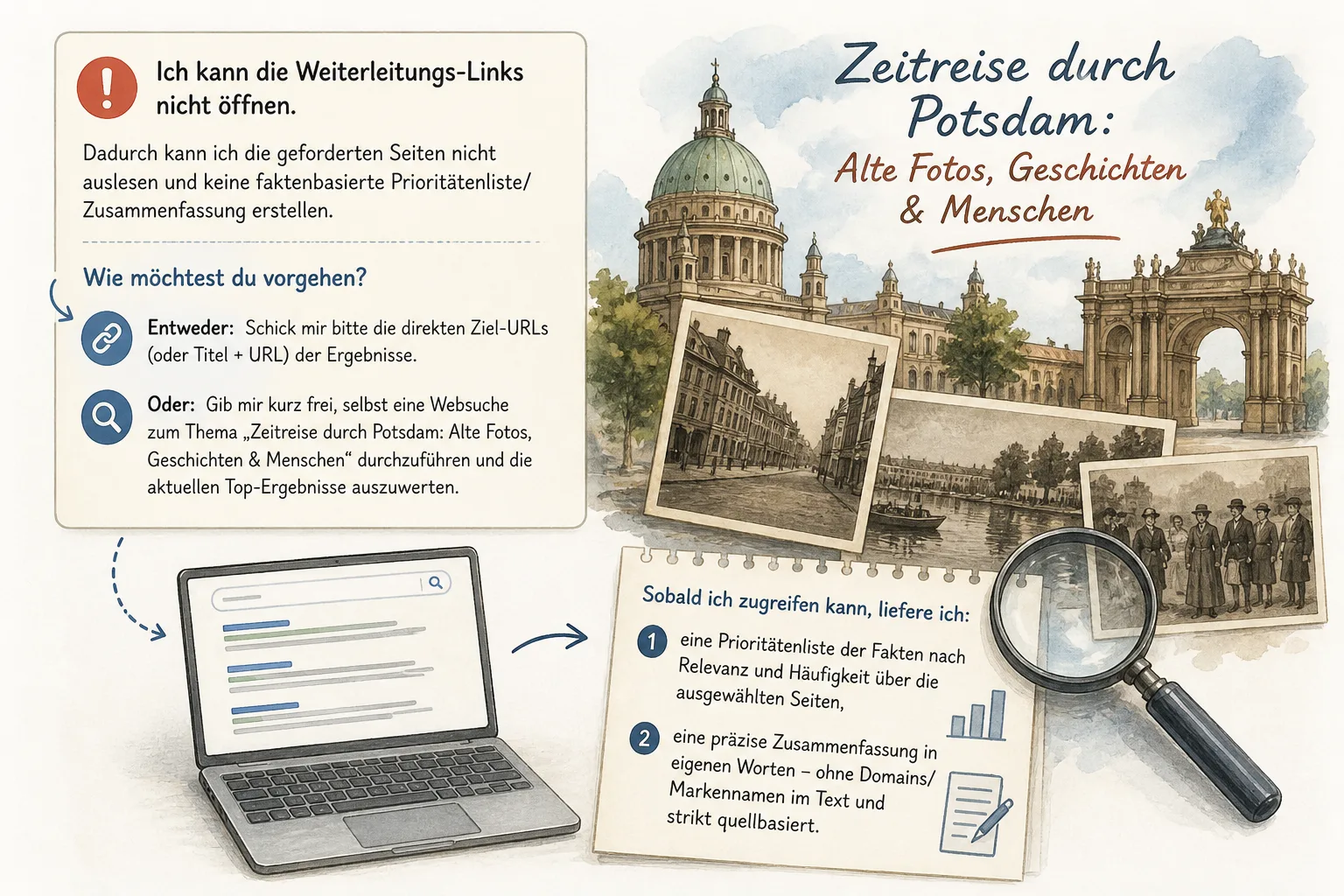
A preview of planned photo evenings, city walks, and participatory formats centered around historical Potsdam photographs – focusing on image reading, places in transition, and personal memories.
Status: Preview of future events and formats (no retrospective).
The Idea: Rediscovering Potsdam through Images in the Future
A "Time Travel through Potsdam" can be implemented in the coming months as a series of image and city formats: not as a nostalgic backdrop, but as a practical invitation to read today's cityscape more consciously with the help of historical photographs. The focus is on questions that can be clarified directly from the image: Where was the camera positioned? Which details are still present? Which changes can be clearly proven?
The approach is deliberately suitable for everyday life: In addition to well-known motifs (squares, axes, waterfronts), scenes from residential neighborhoods and side streets are to be brought into focus – places where change is particularly visible, even if you don't always notice it in passing.
Planned Formats: Photo Evening, Walks, Workshop
1) Public Photo Evening "Potsdam in Comparison"
A moderated evening is planned, where selected historical photographs are juxtaposed with current views (same location, similar focal length). The goal is to jointly identify features that are suitable for reliable location determination: rooflines, window axes, street layouts, bridge railings, tree populations, and sightlines.
- Focus: Image comparison, context, source references, classification without speculation
- Participation: Audience questions ("Where could this be?") and methodological approach to verification
2) Guided City Walks "Then/Now" (small groups)
Short tours are being prepared, working with printed comparison boards or a small handout. At several stops, a historical photo is shown, followed by a look at the present – with concrete hints on what to pay attention to during the comparison.
- Pace: relaxed, with photo stops
- Suitable for: Locals, visitors, families with older children
- Goal: Sharpen perception and strengthen image literacy
3) Workshop "Reading & Labeling Old Photos Correctly"
Additionally, a workshop format is planned that focuses on the "craft": How do you carefully date photos? How do you record sources? How do you write captions that remain verifiable? And how do you deal with uncertainties so that later users are not misled?
- Result: Participants create a small, properly labeled mini-series (with source references)
- Practice: Examples of captions, file names, metadata, and citation methods
Note: Specific dates, locations, and tickets will be published via the official channels of the organizing institution or initiative. This preview describes only planned content and possible procedures.
Possible Routes & Motifs: Squares, Bridges, Neighborhoods
For future walks and photo evenings, motifs that can be easily located and at the same time make typical city layers visible are suitable. The selection may vary depending on available image sources and permissions.
Places with High Recognizability
- Squares & Axes: Images where facade rhythm, sightlines, and square edges make comparison easier
- Bridges & Waterfronts: Railings, pier shapes, and waterfront lines are often suitable for precise location determination
- Neighborhoods with Clear Structure: Streets where window axes, eave heights, and courtyard situations are easy to read
"Hidden Corners" as a Deliberate Program
In addition to the expected motifs, side streets, courtyards, and transitional spaces should also be considered. Especially there, particularly good conversations can be held in the future: about uses (residential/commercial), about conversions, and about the question of which traces remain in the cityscape – and which are only passed down through photos.
Participate: Contribute Your Own Photos & Preserve Stories
For a lively "Time Travel," a participatory component is planned: Residents should in the future have the opportunity to submit private historical photographs (originals or scans) for a moderated review. The goal is not "collecting at any cost," but a comprehensible documentation with clear provenance.
- What is especially helpful: Notes on location, approximate time, occasion, depicted persons (only if consent or rights are clarified)
- What should be avoided: Unverified attributions ("must be 1932...") without indication of what the assumption is based on
- Planned addition: Short audio memories (voluntary) as context – separate from verifiable facts
In this way, images and stories can come together in the future without the creation of legends. The principle is: clearly separate observation, source, and interpretation.
Important in Advance: Image Rights, Sources, Correct Citation
To ensure that future photo formats remain reliable and fair, careful handling of rights and sources is essential. Historical photos are not automatically "free": Depending on the year of creation, author, and publication, protection periods or usage conditions still apply. Even with private images, clear agreements are needed for use (e.g., presentation, print, online gallery).
It is therefore planned to make visible at all events:
- Source: Archive/institution/private, signature or link (where possible)
- Rights: License or permission to use
- Editing: Whether an image has been cropped, edited, or colorized
Those who bring their own material benefit from this: Good source references significantly increase the value of the photos – for family, research, and city history.
How to Prepare for Your Personal "Time Travel"
If you would like to participate in a photo evening or walk in the future, these simple steps will help:
- Select a motif: Ideally, photos with clear landmarks (corners, bridges, distinctive rooflines).
- Formulate a question: "Where exactly was the camera positioned?" or "Which details are still recognizable today?"
- Prepare a comparison: Current photo from the presumed location (even with a smartphone) for juxtaposition.
- Bring notes: Origin of the image, approximate dating, everything that is certainly known.
- Respectful handling: For photos with recognizable people, be sensitive; only share private stories if it feels right for you.
This way, a single photo becomes a verifiable mini-research – and a walk becomes a discovery route.
Sources & Further Links
- Potsdam City Archive — Information on archive holdings and use (accessed 2026-11-18)
- Prussian Palaces and Gardens Foundation Berlin-Brandenburg (SPSG) — Background on sites and places as image motifs (accessed 2026-11-18)
- LeMO – Living Museum Online (DHM/HDG) — Classifications on German history as context for photo sources (accessed 2026-11-18)
- Europeana — European digital collections, including photographs and metadata practice (accessed 2026-11-18)