Gyms in Potsdam: Training, Courses, Yoga & More
Gyms & Sports Halls in Potsdam: Training & Course Starts, Action Days and Community Events from Summer 2026
You don't just want to train "sometime" in Potsdam, but set yourself fixed, motivating dates? From summer 2026 onwards, upcoming course starts, trial trainings, club trial trainings and seasonal fitness and health days are especially suitable for this. This guide helps you plan the next suitable opportunities – without having to rely on individual, possibly changing studio promotions.
Who is this for? For beginners, returnees, shift workers, students, families and everyone who prefers to train by appointment (instead of "sometime").
What's Next in Potsdam (from July 2026)
If you are now (summer 2026) looking for concrete, future training opportunities, these planning anchors work especially well in Potsdam:
- Monthly course starts (e.g. yoga, back fitness, functional, rehab-oriented formats) – often organized in blocks.
- Trial weeks & trial trainings – often as time-limited promotions, suitable for a stress-free start.
- Club trial trainings in sports halls – especially for children, teenagers and team sports enthusiasts.
- Seasonal challenges (summer/autumn/New Year challenges) – good if you are motivated by fixed goals.
- Health days & beginner workshops (technique check, equipment introduction, mobility) – ideal if you want to start safely.
Important for planning: Providers usually publish the specific dates on their websites, course schedules or social media channels. This article shows you how to find the right future events and what to look out for.
The Most Important Event Types: Course Start, Trial Training, Challenge, Action Day
1) Course Starts (Block Courses, Ongoing Courses, Beginner Series)
Course starts are the easiest way to build a rhythm from summer/autumn 2026. Especially beginner-friendly are:
- Beginner Yoga (basics, breathing, flexibility)
- Back & Core Formats (posture-oriented, often low-threshold)
- Functional Training Basics (focus on technique, simple progressions)
- Women's Courses (if you feel more comfortable in protected settings)
For event searches, terms like "course start", "beginner", "basics", "8-week program", "intro" or "workshop" will help you.
2) Trial Training & Taster Promotions
For your next trial training (from now and in the coming months), it's worth having a clear focus: answer one question per visit, instead of trying everything at once.
- If time is your bottleneck: Test at your realistic time (e.g. early morning or late evening).
- If motivation is your bottleneck: Test exactly the course format that really appeals to you.
- If safety is your bottleneck: Book an introduction/technique intro as an "event".
Plan your trial training as a future appointment with a fixed goal (e.g. "equipment intro + 20 minutes cardio") – this increases the likelihood that you will actually go.
3) Challenges (Summer/Autumn 2026, Turn of the Year 2026/2027)
Challenges are not mandatory, but a powerful tool: they make training measurable and social. Typical challenge formats you can expect in Potsdam in the coming seasons include:
- "12 trainings in 6 weeks" (consistency challenge)
- "Mobility Daily" (5–10 minutes per day, good for beginners)
- "Strength Basics" (technique, progression, repeatability)
For you, it counts: Choose a challenge that you can fulfill even on bad weeks. This is more effective in the long term than an overly ambitious plan.
4) Action Days (Health, Family, Clubs, Technique Checks)
Action days are ideal "starting points" for the coming months because they are low-threshold. For future action days, pay particular attention to:
- Technique and equipment introduction (reduces risk of injury, increases training effect)
- Family or children's activity days (if you want to integrate training into family life)
- Back & posture screenings (as orientation, not as a medical diagnosis)
Annual Calendar: How to Plan Realistically Until Spring 2027
So that you only work with future dates, you can divide the rest of 2026 and the start of 2027 into planning stages:
Summer 2026 (from now): Entry via short, clear formats
- Set yourself 1 trial training as a fixed date in the next 7–14 days.
- Book 1 beginner course or 1 technique intro as a second appointment.
- Choose a "mini-habit" (e.g. 2×/week 30 minutes) instead of maximum intensity.
Autumn 2026: Course blocks & fixed weekly routines
- Plan an 8–12 week block (course or training plan).
- If your everyday life fluctuates a lot: choose two possible training days per week (Plan A/Plan B).
- If you like to train in groups: prioritize courses or club offers in sports halls.
Winter 2026: Indoor Focus & Stabilize Motivation
- Rely on short sessions (20–40 minutes) and high planability.
- Use bad weather compatibility (close location, good accessibility, possibly flexible times).
- If wellness motivates: plan regeneration (e.g. sauna/relaxation) as a fixed part.
Start of 2027: Realignment with Measurable, Safe Goals
- Choose a maximum of one main goal (e.g. "pain-free back", "more strength", "endurance").
- Check every 4 weeks: sleep, stress, training frequency, progress.
- Rely on progression (small increases) instead of "all or nothing".
Places & Contact Points in Potsdam (for Future Dates)
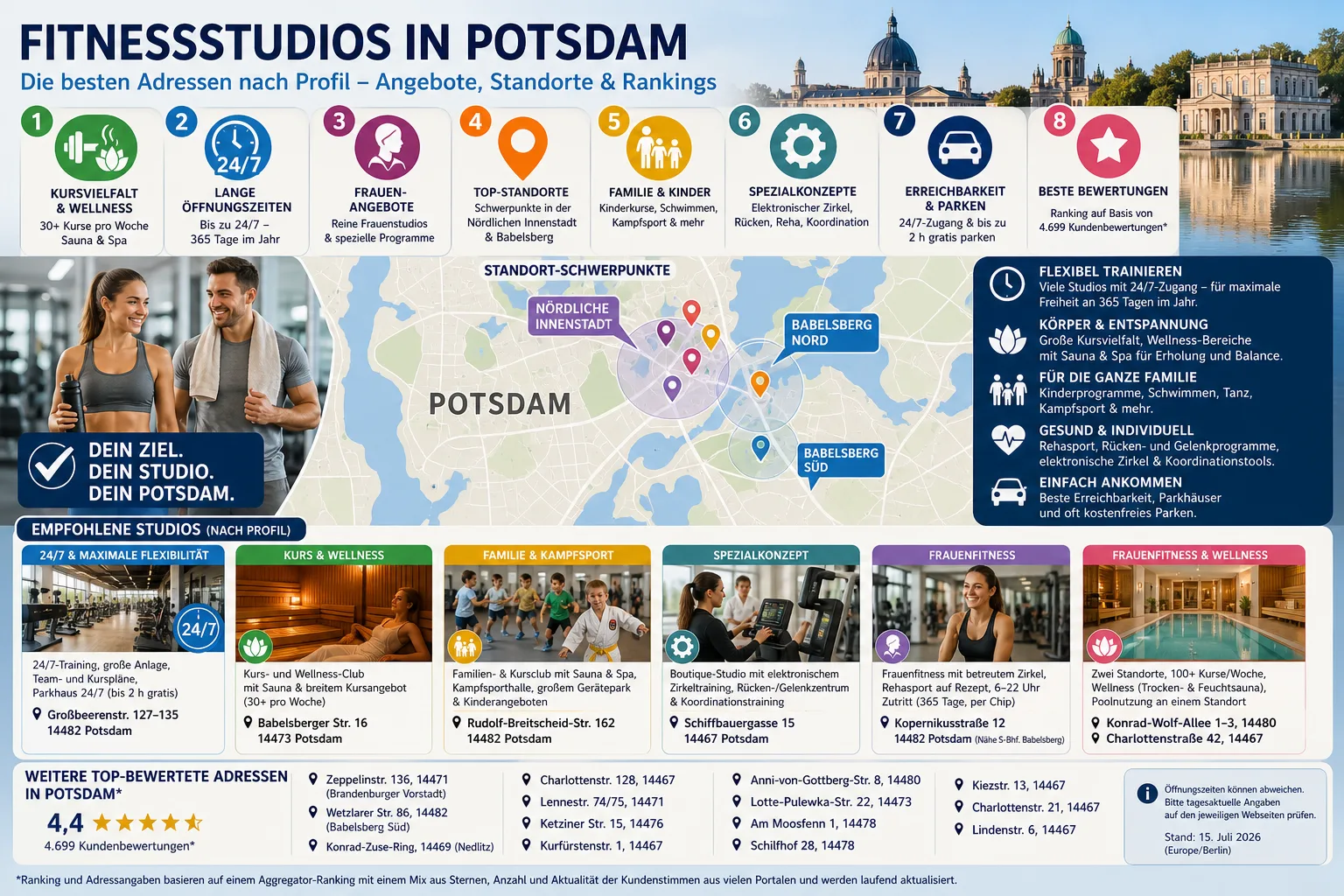
If you are looking for events such as trial trainings, course starts or club trial trainings from summer/autumn 2026, it helps to filter by easily accessible clusters. These address areas are suitable as starting points to find future course schedules, action days and beginner offers:
City Center/Northern City Center: Short Distances, Many Course Options
- Charlottenstraße (e.g. 42, 128)
- Kurfürstenstraße (e.g. 1)
- Lindenstraße (e.g. 6)
- Kiezstraße (e.g. 13)
Well suited for: course starts, after-work offers, short trial trainings between appointments.
Babelsberg (North/South): Commuter-Friendly, Often Long Training Hours
- Rudolf‑Breitscheid‑Straße (e.g. 162)
- Kopernikusstraße (e.g. 12)
- Wetzlarer Straße (e.g. 86)
- Großbeerenstraße (e.g. 127–135)
Well suited for: trial trainings at off-peak times, plannable weekly routines, family offers (depending on provider profile).
Southern Districts/Residential Quarters: Everyday Training
- Am Moosfenn (e.g. 1)
- Schilfhof (e.g. 28)
- Lotte‑Pulewka‑Straße (e.g. 22)
- Anni‑von‑Gottberg‑Straße (e.g. 8)
- Konrad‑Wolf‑Allee (e.g. 1–3)
Well suited for: family-friendly times, regular short sessions, courses close to home.
Brandenburger Suburb & Surroundings
- Zeppelinstraße (e.g. 136)
- Lennéstraße (e.g. 74/75)
- Ketziner Straße (e.g. 15)
Well suited for: routine weekly plans, combining everyday errands and training.
How to use the places correctly: Search the respective providers specifically for the categories "course schedule", "events", "workshops", "trial training", "taster", "club", "join in" or "holiday program" (for children/teenagers). This way you go directly to future dates instead of general advertising pages.
Registration & Checklist: How to Prepare for Your Next Event
- Set a clear goal: e.g. "test beginner course", "equipment introduction", "find back-friendly alternative".
- Choose a realistic time slot: plan travel + changing + 10 minutes buffer.
- Ask in advance about the conditions: course level, maximum number of participants, required equipment, cancellation rules.
- Bring the essentials: clean sports shoes (if indoor), towel, water, possibly a small lock for the locker.
- After the event, note 3 things: What did you like? What bothered you? Would you go again in 7 days?
If you quickly feel overwhelmed: Start with one event per week. Consistency beats intensity.
Safety & Health: Start Sensibly, Stick With It Long-Term
So that your upcoming training and course starts from summer 2026 do not end in overload, these principles make sense:
- Increase progression slowly: especially with strength training and high-intensity courses.
- Technique before weight/speed: a technique workshop or introduction is a valuable "event".
- Plan for regeneration: sleep, rest days and mobility are part of the plan.
- If you have pain, pre-existing conditions or after a long break: choose low-threshold beginner formats and clarify open questions medically.
Note (Health): This article does not replace medical advice. If you have acute complaints, cardiovascular diseases, neurological symptoms or persistent pain, please clarify starting training with your doctor or qualified therapists before future intensive programs.
Sources & Further Links
- World Health Organization (WHO): Physical activity (Fact sheet) — Recommendations and health relevance of exercise (accessed 2026-07-15)
- Robert Koch Institute (RKI): Physical Activity — Background on exercise and health in Germany (accessed 2026-07-15)
- ACSM: Physical Activity Guidelines Resources — Training basics and guidance on load management (accessed 2026-07-15)
- German Olympic Sports Confederation (DOSB) — Classification and structures of club sports (accessed 2026-07-15)