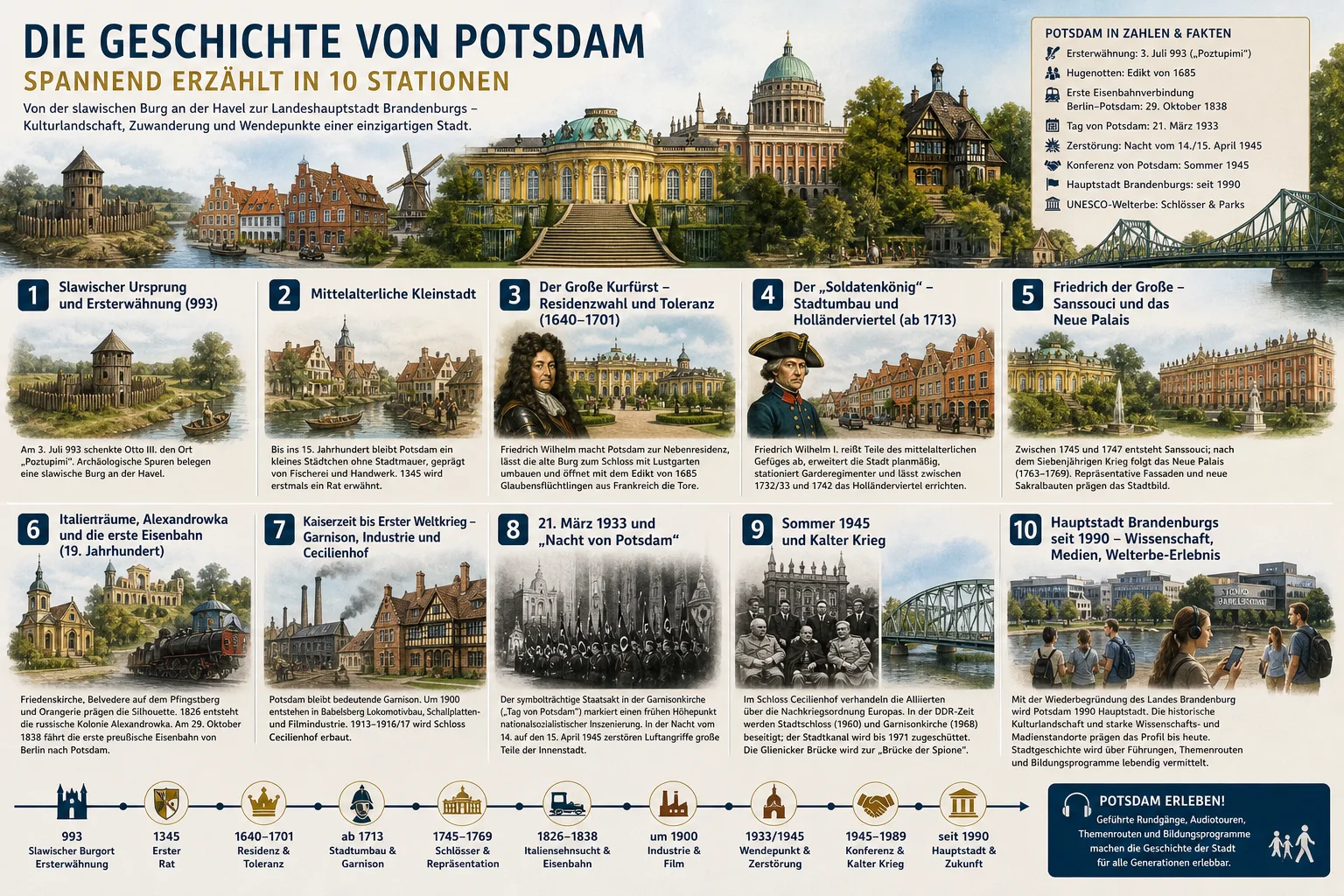
The History of Potsdam in 10 Stops
The History of Potsdam – Excitingly Told in 10 Stops (Time Travel as a Walking Tour Plan)
This article is designed as a route plan for a future city walking tour: You will walk through Potsdam at ten stops and at each one trace a historical layer of the city – from early settlement traces to today's landscape of culture and science. All stops are described so that you can experience them independently or with a guided tour in the coming days, weeks, or on your next visit.
1. Slavic Origins on the Havel – A Hidden Beginning
At the beginning, you will visit places where early settlement traces can be located on the Havel. In doing so, you will experience above all one thing: History is not always visible. Especially with the oldest layers of the city, you will learn how archaeology, topography, and river landscape together provide clues.
What you will pay attention to:
- Location by the water (crossings, islands, shorelines) and why they favor settlements
- How a place develops, even if hardly any structural traces of the first "core" remain today
- Which perspectives (view over the Havel, edges in the terrain) show you the "logic" of early settlements
2. Old Town Structure – Small Town Feel and Paths by the Water
Next, you will walk through areas that make the urban basic pattern tangible: route guidance, squares, proximity to water, and the role of market and craft locations. You will look less at "a monument" and more read a city organism.
This is what you will focus on along the way:
- You will pay attention to bottlenecks, open spaces, and short connections that make everyday routes easier.
- You will imagine how flows of goods and people could enliven the old town during future events, markets, or festivals.
- You will work out how a city without a dominant fortification effect appears more "open".
3. Residence & Immigration – How Diversity Shapes a City
At this stop, you will focus on the formation of a residence and immigration: You will recognize how political decisions can influence cityscapes, crafts, and neighborhoods in the future. Instead of just looking at splendor, you will think "behind the facades": Who lives here, who works here, and why is a new neighborhood emerging right here?
You will ask yourself specific questions:
- Which traces of crafts and building traditions will you find on facades, courtyards, and street sequences?
- How can neighborhoods in the future be told as places of memory and coexistence?
- How can the history of tolerance be made visible and communicable in the urban space in the future (e.g., through themed routes, exhibitions, guided tours)?
4. Garrison & Urban Planning – Straight Axes, Clear Order
Afterwards, you will experience how military and administrative logic can be expressed in street images, axes, and proportions. This stop will help you see Potsdam not only as a romantic backdrop, but as a planned urban space.
What you will pay attention to:
- Straight streets and sightlines that make orientation and control easier
- Neighborhoods that are deliberately designed as craft or functional spaces
- How "order" feels in the cityscape: rhythmic facades, uniform plots, clear edges
5. Sanssouci – Landscape, Architecture and Sightlines
In Sanssouci Park, you will be able to particularly well understand how nature, architecture, and route guidance become a total work of art. Here you will not just "visit" a palace, but read a landscape that deliberately creates moods with terraces, sightlines, and small buildings.
This is how you will experience the park:
- You will consciously stop and follow sightlines (what directs the view, what opens it?).
- You will perceive transitions: from open space into "chambers" of hedges, trees, or walls.
- You will set time windows for your future visit (e.g., quieter in the morning, livelier later) to experience the park in different "rhythms".
6. Romanticism & Cosmopolitanism – New Images of the City
On this stage, you will focus on building and garden ideas that appear particularly "European" in the future: inspirations from other regions, new forms of sacred and landscape architecture, and the play with panorama and long-distance effect. You will notice: Potsdam will present itself to you as a place that absorbs and develops cultural influences.
You will observe:
- How architecture creates moods (romanticism, vastness, "longing for Italy")
- How colonies/ensembles function as cultural narrative spaces that you can explore in more depth on future guided tours
- How mobility (e.g., by train) will facilitate future visiting and everyday relationships between cities
7. Film & Modernity – Experiencing Creative Industry
You will also be able to experience Potsdam as a media and creative location: At this stop, you will focus on places associated with film, production, and modern culture. The goal is for you to understand in the future how a city can combine its historical heritage with contemporary work and international networking.
For your future plan:
- You will look for clues to studio and production culture (notices, program boards, architecture of the facilities).
- You will (if open) plan to visit an exhibition or visitor information so that you don't just see the place from the outside.
- You will consciously set the contrast: park landscape in the morning, media location in the afternoon – this creates a "double image" of the city.
8. Places of Remembrance – Consciously Perceiving Difficult Chapters
You will approach this stop with particular attention: You will visit places where the instrumentalization of history, exclusion, violence, and loss can be addressed in the urban space. The focus is on how Potsdam can responsibly remember and communicate in the future – in public spaces, in exhibitions, and in educational offerings.
This is how you will orient yourself:
- You will consciously include information boards, memorial signs, and museum offerings.
- You will take time for context (audio guide, guided tour, or exhibition) instead of just "passing by".
- You will pay attention to language: What is named how, and which perspectives will be made visible in the future?
Note: If you plan the tour in the future with children or school groups, it is best to make this stop a moderated program point (museum/guided tour) so that there is space for classification and questions.
9. Border Area & World Politics – Bridges, Decisions, Symbolism
At this stop, you will learn how places in the cityscape can become symbols of international politics. Bridges, waterfront areas, and representative buildings will show you how a space can be both everyday and politically "charged" at the same time.
What you can do there in the future:
- You will consciously experience a bridge crossing as a "scene change" (urban space ↔ park space ↔ water space).
- You will take time on site for perspectives: How does the effect change depending on the viewing direction?
- You will (if open) add an interior stop to see how architecture can frame political communication.
10. Potsdam Today – Living Heritage, Science and Culture
At the end, you will experience Potsdam as a city of the present: Research, universities, culture, media, and tourism will continue to be visible side by side in the future – often in historic buildings or in direct proximity to parks and palaces. Here you will learn how "heritage" can not only be preserved, but used and retold.
This is how you will shape the conclusion:
- You will choose a quiet place by the water or in a park as the endpoint to reflect on the route.
- You will note two to three topics that you would like to explore in more depth on your next visit (e.g., garden art, urban planning, film culture).
- You will realize: The value of the route in the future lies not only in "ticking off" sights, but in comparing the layers of time.
Practical Tips for Your Future Walking Tour
Planning, Timing and Tickets
- Opening hours: You will check the current opening hours of the palaces/museums in advance, as they will vary depending on the season.
- Tickets: If you want to visit interiors, you will plan for time slots and book tickets as early as possible.
- Breaks: You will plan at least one longer break (e.g., between park and city center) so that the tour remains relaxed.
Barrier-free on the go
- You will take into account that cobblestones and park paths will be differently comfortable depending on the route.
- If you are traveling with a stroller, wheelchair, or walker, you will preferably choose wider paths and solid surfaces and check museum information for accessibility.
Respectful Visit to Memorial and Remembrance Sites
- You will behave quietly and respectfully at places of remembrance and observe photo rules.
- Whenever possible, you will use contextual offerings (exhibition texts, guided tours) to avoid oversimplification.